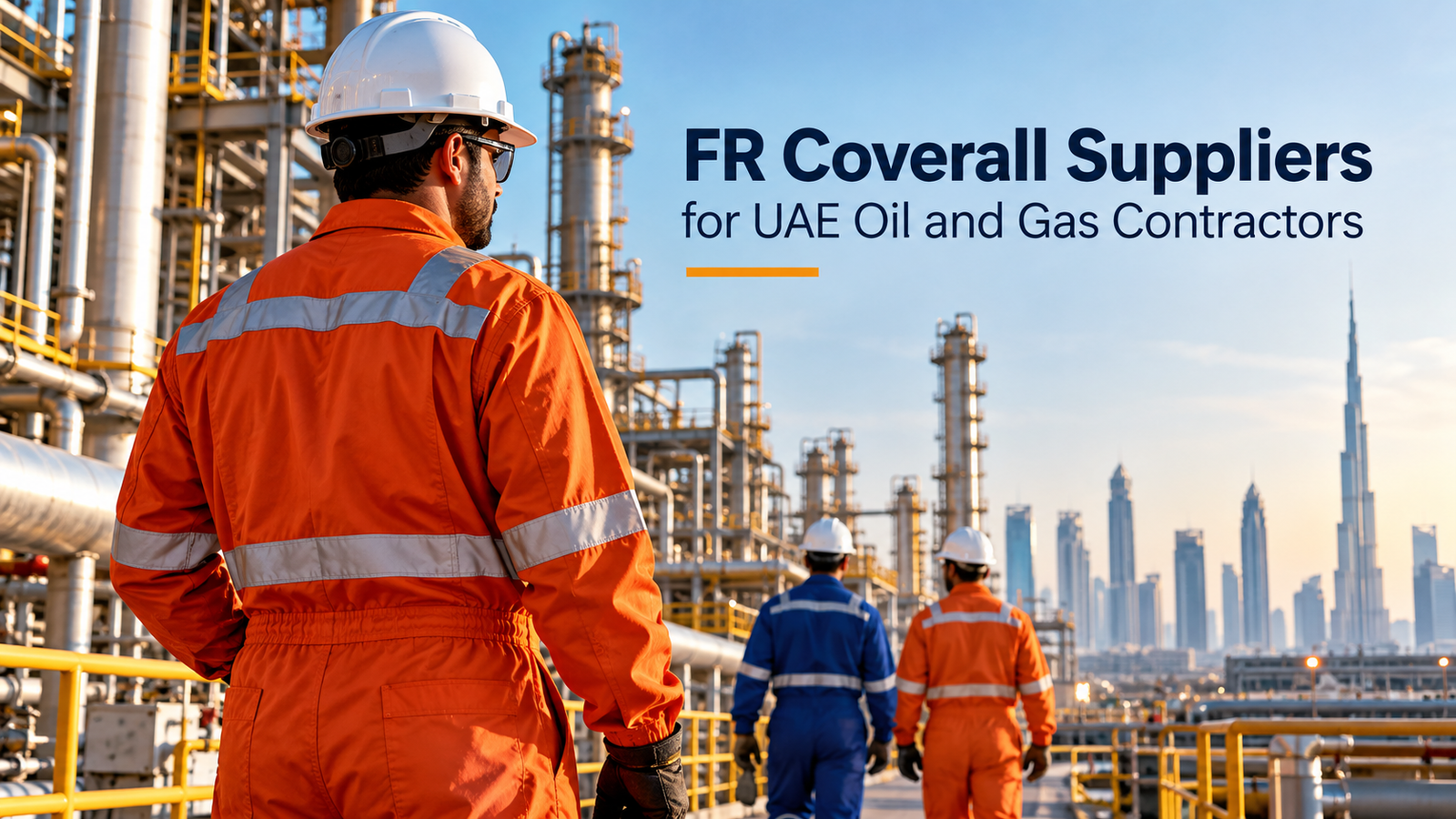
Picture a shutdown crew of 120 lining up at a gas plant gate in Abu Dhabi at six in the morning. The coveralls are the right color. The sizes are right. The cloth feels heavy enough to be safe. Then the inspector turns over a label and asks for the fabric report. The lot number on the paper does not match the lot number on the garment. The whole crew waits at the gate while someone makes phone calls.
That scene is avoidable. It starts with how you choose an FR coverall UAE supplier, well before the order goes out. This guide is for procurement managers, HSE teams, EPC contractors, and distributors who buy flame resistant coverall for oil and gas work. It covers fabric, weight, garment build, fit, samples and bulk ordering. The product sits at the center of every section.
Armstrong Products has been making industrial workwear since 2009. This FR coverall UAE guide is based on what we’ve learned as manufacturers.
Quick answer: When choosing an FR coverall UAE supplier, check that they specify the exact fabric and blend, provide a test report matching the fabric lot, and use flame-resistant components throughout the garment. A sealed sample should also be approved before bulk production begins. Fit and comfort in hot conditions matter just as much, as workers need to wear their coveralls throughout the shift.
What an FR Coverall UAE Buyer Is Really Buying
An FR coverall is a one-piece garment made from flame-resistant fabric. When a flame touches the cloth, it chars and stops burning once the flame is gone. A regular cotton coverall keeps burning. A polyester blend can melt onto the skin. That difference is why oil and gas sites ask for FR clothing.
Tenders use many names for the same garment. You will see FR coverall, fire retardant coverall, flame retardant coverall, boiler suit, and overall. FRC stands for flame resistant clothing. IFR means the flame resistance sits inside the fiber. Our post on fire retardant coverall vs regular coverall explains the basic gap in more detail.
An FR coverall UAE buyer pays for two things at once. One is a fabric with a test history. The other is a garment built to keep that protection intact. The fabric report covers the first. Thread, trims, seams, and fit cover the second. A good fabric can still sit inside a poor garment.
Where FR Coveralls Get Worn on UAE Oil and Gas Sites
Coveralls go through different conditions depending on where they’re used. At a wellsite, there’s constant exposure to sun and sand. Refinery shutdown crews work in high temperatures and need their coveralls washed frequently. Tank farm operators also have to consider static electricity around vapors. Use the table as a starting point when choosing FR coveralls in the UAE, but base your final specifications on the site hazard assessment.
| Work area | What the crew faces | Build to look at first |
| Wellsites and gathering lines | Hydrocarbon release, sun, sand | Lighter FR coverall with FR reflective tape |
| Refinery shutdowns | Hot work, long shifts, weekly washing | IFR blend, or heavier FR cotton if the hazard assessment allows |
| Gas processing plants | Flash fire risk, static | Antistatic FR coverall |
| Tank farms and terminals | Vapor, static, night shifts | Antistatic fiber grid with FR tape |
| Fabrication yards | Sparks, welding spatter | Heavier weave, with welding protection checked separately |
| Control rooms and walkways | Short exposure, comfort needs | Lightest approved FR build |
Welders need more than an FR label. Hot work throws sparks and spatter that ordinary FR workwear may not handle. Our guide to flame resistant clothing for welders shows what standard workwear misses.
Choosing Fabric: Treated Cotton or IFR
Fabric is the first choice on any FR coverall UAE spec sheet. Three builds appear in most UAE tenders.
| Build | How the protection is made | Wash behaviour | Heat comfort |
| FR treated cotton | A flame retardant finish bonded to cotton | Follow the maker’s wash rules to protect the finish | Soft and breathable |
| Modacrylic IFR blend | Flame resistance sits in the fiber | Protection stays through washing | Moderate, varies with the blend |
| Aramid IFR blend | Flame resistance sits in the fiber | Protection stays through washing | Light and strong |
Crews are comfortable with treated cotton because they’re used to wearing it. The finish needs proper care during washing. IFR blends have protection built into the fibers, making them a good choice for workwear washed in industrial laundries every week. Comfort can differ between modacrylic blends, so it’s worth trying them out before placing a bulk order.
No build wins on every FR coverall UAE job. The hazard, the wash plan and the heat decide. Two Armstrong posts go deeper: IFR vs FR clothing and modacrylic vs aramid IFR coverall. If aramid is on the table for a gas plant, read Nomex coverall vs standard FR cotton as well.
Ask every FR coverall supplier to name the fabric, the blend ratio, and the finish. Then ask for wash durability data on that exact fabric.
How to Choose GSM for an FR Coverall UAE Order
GSM means grams per square meter. It tells you how heavy the cloth is. Heavy cloth feels tough and holds more heat. Light cloth breathes better and wears cooler. Neither is safer by default. An FR coverall for hot weather leans lighter.
| Weight band | Feel in UAE heat | Suits | Check |
| 180 to 220 GSM | Lighter, easier on long summer shifts | Walkdowns, wellsite support, lighter hazard areas | The report covers this exact weight |
| 240 to 280 GSM | Heavier, holds more heat | Hot work and rough tasks | Heat stress plan for peak summer |
Use the weight bands as a reference, but go by what the hazard assessment requires.
During UAE summers, workers often unzip their coveralls or roll up their sleeves to cope with the heat. Both leave parts of the body exposed. A lighter coverall worn properly may offer better protection than a heavier one left open or tied around the waist.
Choose the lightest fabric weight allowed by the hazard assessment, and check with the supplier that the test report applies to that specific weight. Even an FR coverall for hot weather needs to be worn correctly to provide the intended protection.
Garment Build: What to Check on the Coverall Itself
Turn the FR coverall UAE sample inside out. The build tells you more than the brochure.
- Thread. Every seam needs FR thread. Ordinary polyester thread melts, and the seam opens before the cloth does.
- Zips and snaps. Look for FR zip tape and hardware made for flame-resistant garments. Plastic parts that melt can burn the skin.
- Pocket bags. The outer cloth may be FR while the pocket lining is not. Check both.
- Reflective tape. The tape should be FR and rated for industrial washing. Check how the stitching holds it down.
- Labels and logos. Care labels, name tags, and embroidery all count. Ask for FR thread and FR patches.
- Stress points. Bar-tacks at pocket corners, the crotch, and the zip base slow down seam failure. An action back gives room to bend and climb.
- Cuffs and collar. Adjustable cuffs and a collar that closes at the neck cut skin exposure.
Standards test the whole garment as well as the cloth. NFPA 2112, the flash fire standard many operators name, sets requirements for thread and hardware next to the fabric. Read your tender to see which standards apply to your site. Protection has to run through every part of the garment.
Hi-Vis and Antistatic Options
Hi-vis FR coverall
Crews on pipe racks, near vehicles, or on night shifts need to be seen. A hi-vis FR coverall with FR reflective tape does that in one layer. Hi-vis is a common line on an FR coverall UAE spec for night work. A plain polyester vest worn over an FR coverall adds a layer that can melt. Armstrong’s High Visibility Wear category covers visibility garments. The same tape rules apply to any FR build: FR-rated tape, secured with FR thread.
Antistatic FR coverall
Static can ignite vapor. Many FR fabrics weave antistatic fiber into the cloth in a grid. An antistatic FR coverall should show the fiber content and a test result for the static property. A label that only says antistatic proves nothing. Ask for the report.
Fit and Sizing for Crews
Crews come in every size, and fit is part of every FR coverall UAE spec. A coverall that is too loose snags on valve handles. One that is too tight pulls across the body and limits movement. FR fabric can shrink a little after washing, and workers wear base layers underneath. Both points matter when you set sizes.
Build the size run from real headcount. Add spare pieces in the larger and taller bands. Our FR workwear size chart guide for GCC workers shows how to measure a crew. Check fit again after the first few washes. If crews roll sleeves or open collars, check the weight before you blame the size.
Samples, Lot Numbers and Test Reports
Ask for a one-page specification sheet for the FR coverall UAE order before you ask for a quote. It should name the fabric, blend, GSM, finish, thread, zip, tape, and labels. That page becomes the reference for every later check.
- Match the fabric lot on the test report to the lot used for the sample.
- Approve one sealed sample, signed by both sides.
- Record the fabric lot for the bulk run.
- Compare bulk pieces with the sealed sample before dispatch.
Our guide to the sample approval process before a bulk FR order covers each step. If the job sits under an ADNOC contract, read ADNOC coverall approval: what suppliers must show for vendor registration and paperwork. For testing evidence, see in-house FR testing vs third-party lab certification.
Bulk Orders, Branding and OEM
A bulk FR coverall order needs more planning than a single sample. Size mix, lot control, and packing all affect the day your crew starts work. Ask for cartons packed by size and labeled with the lot number on every FR coverall UAE shipment. Site stores can then issue by size and trace any problem to a lot.
Company logos must not break the protection. Embroidery on an FR coverall needs FR thread. Patches and tape need FR-rated material. Ask which branding methods the supplier uses on FR fabric. Armstrong offers customization and branding, and private label and OEM manufacturing for contractors and distributors who want their own OEM FR coverall line.
Lead time on an FR coverall UAE order from an FR coverall manufacturer in India is production time plus freight. Plan the schedule backward from your site mobilization date, and book the sample stage early.
UAE Stockist or Direct Manufacturer
Both routes work for an FR coverall UAE program. Many contractors use a UAE stockist for urgent top-ups and a manufacturer for planned programs.
| Factor | UAE stockist | Direct manufacturer |
| Order size | Small, urgent lots | Bulk and repeat programs |
| Custom fabric and branding | Limited to the stock range | Made to your spec, including OEM FR coverall lines |
| Lead time | Short if the item is in stock | Production time plus freight |
| Documents | Depends on the brand carried | Reports and lot records can follow your spec |
| Best for | Top-ups and emergencies | Shutdowns and annual supply |
FR Coverall UAE Buying Checklist
- Read the tender or HSE plan and note the hazard, standards, and color.
- Ask for the fabric name, blend ratio, GSM, and finish in writing.
- Ask for the test report for that exact fabric.
- Match the fabric lot to the report.
- Check thread, zips, tape, pocket bags and labels for FR parts.
- Check antistatic fiber content if vapor is present.
- Check the hi-vis tape type and where it sits on the garment.
- Build the size run from real headcount.
- Approve a sealed sample.
- Before dispatch, compare pieces from the bulk FR coverall order with the sample.
Common Mistakes
- Taking “flame resistant” on a label as proof. Ask for the report.
- Using a report for a similar fabric instead of the exact one.
- Picking the heaviest GSM for an FR coverall for hot weather.
- Checking the cloth and ignoring thread and zips.
- Skipping the sealed sample to save time.
- Ordering one size run for every crew.
Care and Maintenance
Always check the manufacturer’s care label before washing. Avoid bleach and fabric softener unless the manufacturer says they’re safe to use. They can leave residue that affects certain FR finishes. Before starting a shift, check the coverall for burns, tears, thinning fabric, loose seams, oil stains that have soaked through, or damaged reflective tape. If it’s damaged, take it out of use. Small tears should only be fixed with FR thread and patches. Keep a record of each crew’s washes so any issues can be checked later.
How Armstrong Supports UAE Contractors
Armstrong Products is an industrial workwear manufacturer founded in 2009. The factory is in Boisar, Maharashtra. The corporate office is in Powai, Mumbai. The company holds ISO 9001:2015 for quality management and ISO 13688:2013 for protective clothing general requirements. Both certificates appear on the website. Our UAE workwear manufacturer page lists the range for distributors and contractors, and the Work Wear category shows the coverall lines.
For an FR coverall UAE inquiry, send your hazard assessment or tender clause. Our product team can match fabric options, garment build, samples, and lead time to it. Every flame-resistant coverall for oil and gas order starts from that document.
Summary: FR Coverall UAE Decision Table
| If your crew… | Look at | Ask for |
| Washes garments every week | IFR blend | Wash durability data on the exact fabric |
| Works in peak summer heat | Lighter GSM within the hazard limit | A report that covers that weight |
| Works near vapour | Antistatic FR coverall | Fibre content and a static test result |
| Works nights or near vehicles | Hi-vis FR coverall | FR-rated reflective tape details |
| Needs a branded uniform | FR thread and FR patches | Branding methods used on FR fabric |
| Plans a shutdown | Direct manufacturer | Sealed sample and lot records |
Conclusion
Choosing an FR coverall UAE supplier comes down to proof and build. Ask for the exact fabric, the matching report, and the whole-garment details. Pick a weight your crews will wear in summer. Set sizes from real headcount. Approve a sealed sample and compare it with the bulk lot. Do those things and your crew walks through the gate on day one.
Planning an FR coverall UAE order? Request the Armstrong catalog, or send your specification to our product team. For bulk, OEM, private label or export orders, Contact Us.
FAQs
What is an FR coverall?
An FR coverall is a one-piece garment made from flame resistant fabric. It chars and stops burning when the flame source goes away, instead of melting or feeding the fire. Oil and gas crews wear it where hydrocarbon vapor or hot work can ignite. The protection comes from the fabric and from the FR thread, zips, tape, and labels in the build. Every part needs to be flame resistant for the garment to protect as designed.
How do I pick a fabric for an FR coverall UAE crews can wear in summer?
Check the site hazards and washing requirements first. Treated FR cotton feels soft and allows air to pass through, while IFR blends retain their protective properties even after repeated industrial washes. Before placing a large order, have the crew try the fabric in actual site conditions. Check the test report for that specific fabric too. The coverall needs to be comfortable enough to wear throughout the shift. If workers unzip or take it off because of the heat, they lose the protection it provides.
What GSM should an FR coverall UAE order use?
It depends on the work being done. Fabrics weighing 180–220 GSM are suitable for walkdowns and areas with lower hazards. For hot work or rougher jobs, 240–280 GSM may be more suitable, although these fabrics trap more heat. Go with the lowest GSM that meets the site’s hazard requirements, and check that the test report applies to the same fabric weight.
Do FR coveralls need to be antistatic for oil and gas work?
Antistatic fiber is important at sites where flammable vapors may build up, including tank farms and gas plants. Many FR fabrics have these fibers woven into the fabric in a grid pattern. Check what your tender or site HSE plan requires and ask the supplier for details of the fiber content and static test results. Don’t rely on the label alone.
Can a regular hi-vis vest go over an FR coverall?
A vest made from ordinary polyester can melt or burn over an FR coverall and add a hazard of its own. Use a hi-vis FR coverall with FR reflective tape, or a vest made from FR fabric. Check that the tape and the stitching holding it are flame resistant as well.
How do I check an FR coverall supplier’s test report?
Look at the fabric name and blend mentioned in the test report. Both need to match what’s printed on the coverall label. The testing standard must be the one asked for in your tender. You’ll also need the test date, lab reference, and lot number. Check that the lot number belongs to the fabric being used for your order. If the supplier sends a report for a similar fabric, ask for the one covering your actual material. Any missing information should be sorted out before you approve the order.
Should I buy from a UAE stockist or an Indian manufacturer?
It depends on what you need and how soon. UAE stockists are useful for small, urgent orders, provided the items are in stock. For planned shutdowns, regular orders, custom coveralls or branding, buying directly from an Indian manufacturer can make sense. You’ll need to allow time for production and shipping. Many contractors buy from both. If you’re placing a large FR coverall order for the UAE, confirm the specifications and approve a sample before production begins.
Can FR coveralls carry company logos?
Logos work when the branding method keeps the garment flame resistant. Embroidery needs FR thread. Patches and tape need FR-rated material. Printing on FR fabric depends on the ink and method, so ask the supplier what they use. Armstrong offers customization and branding along with private label and OEM manufacturing.
How should crews wash FR coveralls?
Before putting the coveralls in the wash, check the care label for the right temperature and detergent. Leave out bleach and fabric softener unless the manufacturer permits them. Any residue left behind could affect certain FR finishes. Let the garments dry, check them for damage, and note the wash count for each crew. Taking care of them during washing helps the finish last and reduces wear over time.
When should an FR coverall be retired?
Retire a coverall that shows burns, tears, thin or worn patches, open seams, heavy oil soak, or reflective tape that has peeled or faded. A fixed calendar date is a weak test, since wash count and site conditions vary from crew to crew. Inspect each garment before every shift. Repair small tears only with FR thread and FR patches.