
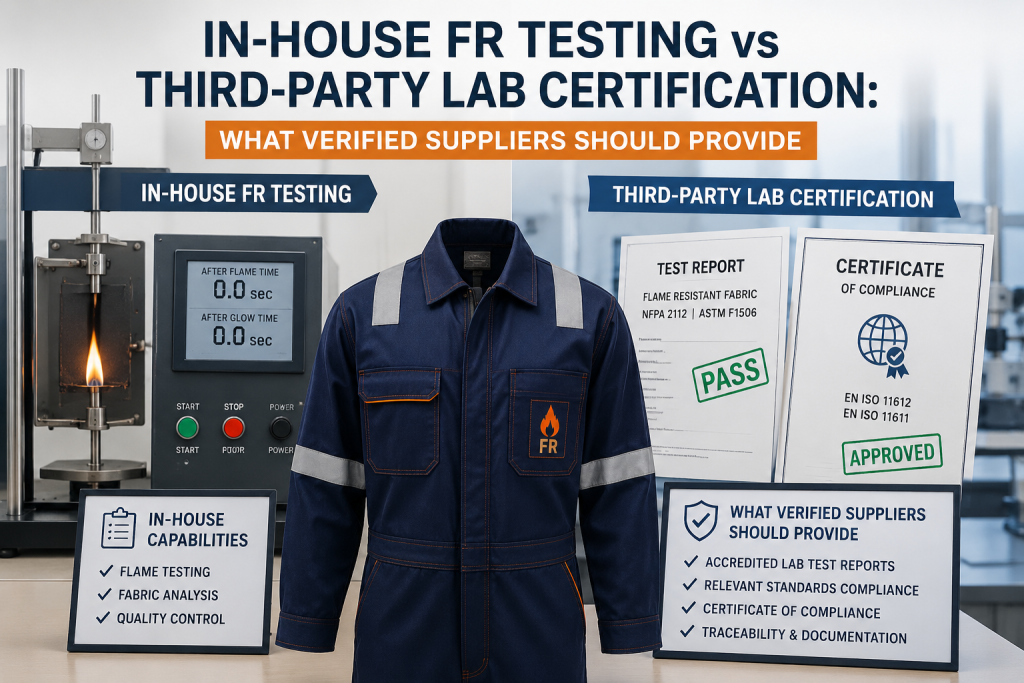
- NFPA 2112: US standard for flash fire protective clothing, requiring third-party lab certification and garment-level testing
- EN ISO 11612: international standard for heat and flame protection, with Category III requiring notified body sign-off at higher performance levels
- ISO 14116: limited flame spread standard, often used as a baseline before higher-hazard classification
- ASTM D6413: vertical flame test measuring afterflame time, afterglow, and char length on fabric
- ASTM F1930: instrumented manikin test predicting burn injury from a flash fire exposure
- ISO/IEC 17025: the accreditation standard the testing lab itself must hold, separate from the garment standard
- Can you show a test report with the lab’s name, accreditation number, and the exact standard tested against?
- Is the report for the finished garment or only the fabric?
- Which production lot or batch does this report cover, and how often do you retest?
- Can we request a sample coverall for our own independent verification before a bulk order ships?
- Do you keep batch traceability records that link a shipped order back to its test report?
None of these are things a buyer needs to memorize in full. What matters is knowing which ones apply to your destination market and asking the supplier to name the accredited lab and report number against each claim.
Reading a supplier’s in-house testing credibility for FR coveralls
Not every supplier that talks about in-house testing is overstating it. The honest ones are usually easy to spot, because they describe their in-house process as a filter rather than a certificate, and they don’t hesitate to name the outside lab they work with for compliance testing.
A few questions worth asking directly:
If a supplier answers these without hesitation, their in-house testing credibility is probably genuine. If the answers get vague or shift toward assurances instead of documents, treat that as a signal to dig further before committing to volume.
What a verified FR coverall supplier should hand over before you sign a purchase order:
| Document or record | Why it matters |
| Third-party test report with lab name and accreditation number | Confirms the standard claim is independently verified |
| Batch or lot number linked to the shipped order | Lets you trace a specific shipment back to its test data |
| Fabric composition and GSM specification sheet | Confirms the material matches what was tested |
| In-house QC checkpoints for the production run | Shows consistency controls beyond the one-time certificate |
| Factory audit report or access for buyer-side audit | Verifies manufacturing conditions match the claims on paper |
| Sample garments for buyer-side testing | Gives you an independent check before committing to bulk |
Armstrong Products, founded in 2009 and manufacturing out of its facility in Boisar, Maharashtra, builds its coverall production around this same logic: fabric and finished garments go through in-house QC checkpoints during production, and batch documentation is kept so a shipped order can be traced back to its testing record. The company holds ISO 9001:2015 certification for its quality management system and ISO 13688:2013 certification for general protective clothing requirements and works with accredited outside labs for markets where NFPA 2112 or EN ISO 11612 sign-off is required by the buyer or the destination country.
Procurement best practices for evaluating an FR supplier
Treat FR coverall sourcing the same way you’d treat any critical safety purchase. That means building verification into the process rather than trusting a product page.
Request the documents above before the first sample order, not after. Ask for a factory audit, either in person or through a third-party inspection agency, especially for a first-time supplier relationship. Keep a file of test reports against each purchase order so you have a paper trail if a client or regulator asks. And retest periodically, particularly if you’re buying from the same supplier over multiple years. Fabric formulations and thread sourcing can change quietly on the supplier’s side even when the product name on the invoice stays the same.
Conclusion
The in-house FR testing vs. third-party certification workwear decision isn’t really a choice between the two. A serious supplier runs both in-house checks to catch problems early and keep batches consistent and third-party accredited testing to prove the finished coverall meets the standard your buyer or your regulator actually requires. Verified suppliers don’t ask you to pick one. They produce the paperwork for both without hesitation, and that combination of tested fabric, tested garment, and traceable batch is what separates a long-term supplier relationship from one that only sounds compliant on a product page.
Working on an FR coverall order and want to see Armstrong’s test documentation and sample process first? Get in touch through the contact page to request documentation and start a supplier evaluation.
FAQ’s
Is in-house FR testing enough to prove a coverall meets NFPA 2112?
In-house testing alone does not satisfy NFPA 2112. The standard specifically requires certification through a third-party lab accredited to ISO 17025, so an internal pass confirms production consistency but carries no legal weight for the standard itself.
What’s the difference between fabric-level and garment-level FR testing?
Fabric-level testing checks the base cloth alone, while garment-level testing checks the finished coverall, including thread, zippers, buttons, and trims. A fabric can pass on its own and still fail as a finished garment if the thread or hardware isn’t FR-rated too.
How long does third-party FR certification usually take?
Turnaround varies by lab and test method, but most accredited labs need two to four weeks for a full garment certification, compared with same-day or same-week results from an in-house check.
Which accreditation should I look for on a supplier’s test report?
Look for ISO/IEC 17025 accreditation on the testing lab itself, plus confirmation that the specific standard you need, such as NFPA 2112 or EN ISO 11612, is within that lab’s accredited scope.
Do EN ISO 11612 coveralls always need notified body approval?
Approval from a notified body is required for the higher performance classes under EN ISO 11612, which fall under PPE Regulation Category III. Lower classes have lighter certification requirements, so it’s worth confirming which class applies to your use case.
Can a supplier’s in-house lab issue an official compliance certificate?
An in-house lab can issue an internal test report, but not an official compliance certificate for standards like NFPA 2112 or EN ISO 11612. Those certificates must come from an accredited third-party body.
What should I ask for before approving a bulk FR coverall order?
Ask for the third-party test report with the lab’s name and accreditation number, the batch or lot number tied to your shipment, the fabric specification sheet, and, where possible, sample garments for your own verification.
Why do coveralls need retesting even after the fabric is certified?
Fabric sourcing, thread suppliers, and trims can change over time even when the product name stays the same. Periodic retesting confirms the coverall you’re receiving today still matches the original test report.
Does a higher price always mean a supplier has better testing in place?
Not necessarily. Price reflects many factors beyond testing, including fabric type, order volume, and finishing. The only reliable way to confirm testing quality is to review the actual documentation rather than assume it from cost.
What’s the risk of buying FR coveralls without checking either type of testing?
Without either check, you’re relying entirely on the supplier’s word. If the garment fails to perform during an actual flash fire event, the gap in documentation becomes a liability question for your organization, not just a quality issue.