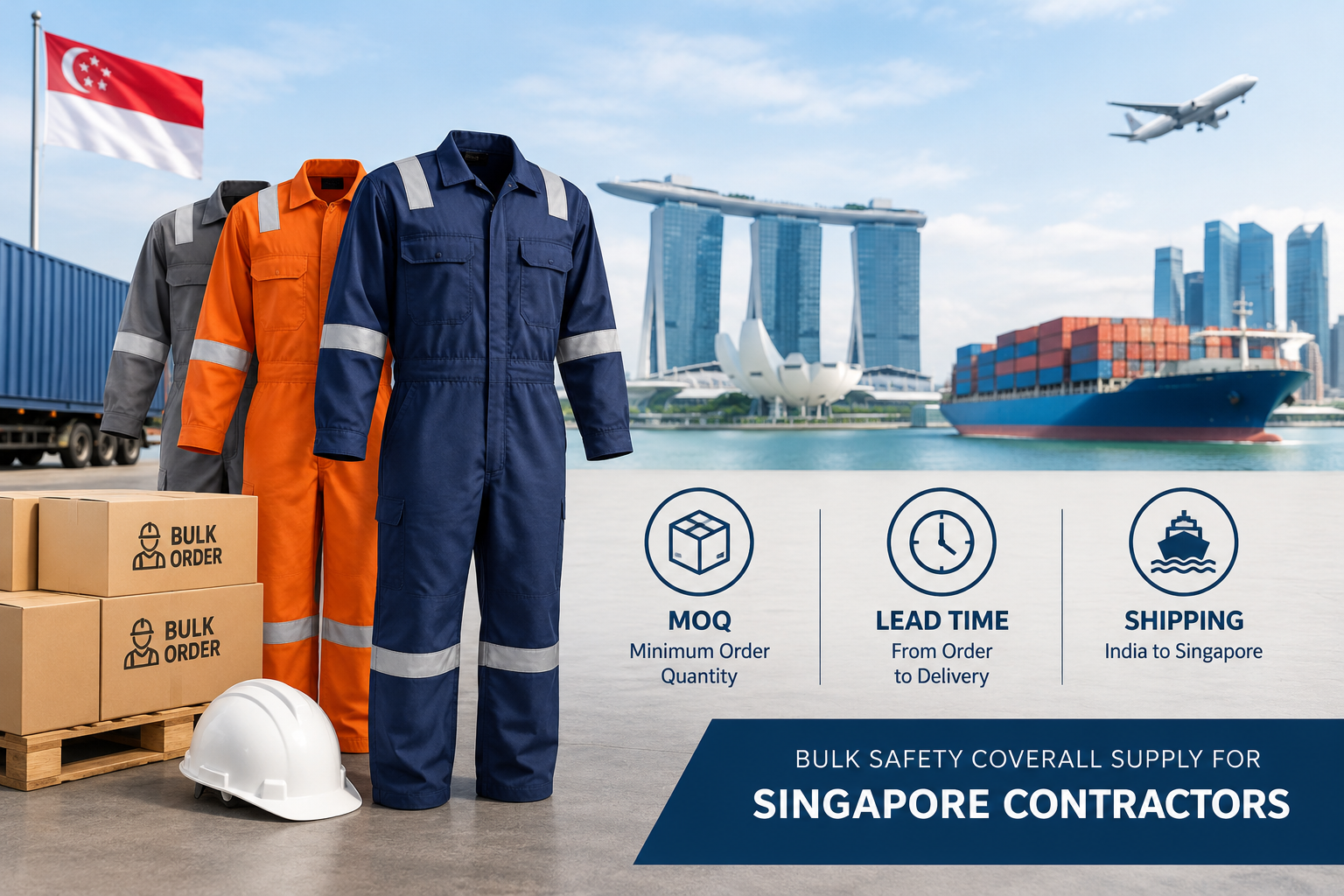
A site manager has a new crew of 120 starting at a Singapore yard in three weeks. Every worker needs a coverall with the company logo on the chest, in the right size, on site before day one. The manager asks a supplier about a safety coverall Singapore order and gets a two-line reply: “MOQ applies. Lead time depends.”
That answer stalls the whole job. Nobody knows how many pieces to order, when the cartons will land, or who books the freight.
Armstrong Products makes industrial coveralls in India and supplies each safety coverall Singapore contractors order. Below is what a bulk coverall order involves, step by step: fabric, fit, MOQ, lead time, shipping, import tax and branding.
Safety coverall Singapore: quick answer on MOQ, lead time and shipping
- MOQ: Armstrong sets no compulsory MOQ for Singapore distributors and contractors ordering from central inventory. The quantity that suits your order varies by product and customisation level, so the team advises on it once it sees your requirement. This is your coverall MOQ in practice.
- Lead time: Armstrong dispatches stock orders within 24 hours. Sea freight from Mumbai-area ports to Singapore takes about 12 days, and air freight about 6 days, based on one forwarder’s estimates. Clearance and delivery in Singapore come on top.
- Shipping: Sea freight in a full or shared container, or air freight for urgent cartons.
- Import tax: Singapore adds 9% GST on imports. Workwear is not on the short list of goods that attract customs duty.
What is a safety coverall, and who orders one in Singapore?
A safety coverall is a one-piece garment that covers the torso, arms and legs. It keeps oil, dust and abrasion off the worker’s own clothes. Sites also use it to show who works for which contractor, since colour and logo make a crew easy to spot.
Search terms vary. Buyers type boiler suit, overall, work coverall or safety coverall Singapore into the same search box and expect similar results. A safety coverall Singapore buyers search for is the same garment under every name. The fabric and the features change.
| Type | Fabric | Suits | Trade-off |
| Cotton coverall | 100% cotton | Workshops, fabrication, maintenance | Not flame resistant |
| Poly-cotton coverall | Cotton and polyester blend | Crews that wash garments often | Feels warmer than all-cotton |
| Polyester coverall | Spun polyester | Yard, logistics and general site work | Breathes less than cotton |
| Hi-vis coverall | Fluorescent fabric with reflective tape | Traffic and low-light areas | Tape needs careful washing |
| FR coverall | Flame resistant fabric | Hot work and process plants | Separate laundry rules |
Pick the fabric first for any safety coverall Singapore order
Singapore is hot and humid all year. A coverall that feels fine in a showroom turns heavy on a deck at noon. Start with the fibre.
Fabric for a safety coverall Singapore crews can wear all day
Cotton lets air through and takes up sweat. Armstrong’s Deluxe 100% Cotton Coverall uses pre-shrunk cotton, so it shrinks less after washing. It comes in khaki, navy blue, orange, red and royal blue. A cotton coverall wrinkles and dries slower than a blend, which most crews accept in exchange for comfort.
Poly-cotton mixes both fibres. The Elite Blended Poly Cotton Coverall is Armstrong’s version, in khaki, navy blue, orange and red. A poly-cotton coverall dries faster and holds colour longer. It also feels warmer, so test one on a real shift before you order 120.
Polyester is a firmer choice. The Classic Workers Uniform Coverall uses spun polyester, heavy duty thread and double stitching at stress points. It comes in navy blue and orange. It breathes less than cotton, so it fits shaded or air-conditioned work better than open decks.
GSM: the weight number to ask about
GSM means grams per square metre and is used to measure how much fabric weighs. Heavier drill is less likely to snag or wear down from rubbing. Lighter drill allows better airflow in hot weather. Ask the supplier to put the GSM of your chosen style in writing, and try a sample before committing to the full quantity.
When plain cotton is not enough: FR coverall options
Welding, grinding and hot work call for flame resistant fabric. Armstrong’s Singapore range runs FR cotton, aramid and modacrylic through the same facility, so an FR coverall order can sit beside a cotton order. Two guides cover that choice in detail: fire retardant coverall vs regular coverall and modacrylic vs aramid IFR coverall.
Design details that decide how a coverall holds up
Fabric gets the attention. Construction decides whether the garment lasts through the contract. These are the features Armstrong lists on three of its work wear coveralls.
| Feature | Deluxe 100% Cotton | Elite Poly Cotton | Classic Workers Uniform |
| Fabric | Pre-shrunk 100% cotton | Cotton and polyester blend | Spun polyester |
| Cut | Raglan sleeve | Full sleeve, action pleats on both legs | Full sleeve, single piece |
| Chest pockets | Two, Velcro flap | One open, one zippered | Two, button-down flap |
| Tool pockets | Leg and back | Leg, arm and back | Leg, arm and back |
| Zip | Two-way concealed Vizlon | Two-way concealed nylon | Two-way concealed nylon |
| Waist | Full elasticised back | Full elasticised back | Half elasticised back |
| Reflective strips | 2 inch on each arm, knee and back | 1 inch on each arm, shoulder and knee | 1 inch on each shoulder and knee |
| Colours | Khaki, navy blue, orange, red, royal blue | Khaki, navy blue, orange, red | Navy blue, orange |
| Sizes | S to 3XL | S to 3XL | S to 3XL |
A few notes from that table. The raglan sleeve gives more arm movement, which helps crews who work overhead. A two-way zip opens from the bottom as well as the top, and that matters on long shifts in heat. Wider reflective strips show up better in low light on a yard or road edge. Some sites also assign one colour per trade, so check that your colour list matches the styles you want.
Reflective strips add visibility, but they do not turn a standard coverall into a full hi-vis garment. For that, see the High Visibility Wear range.
Sizing a mixed crew
A safety coverall Singapore order arrives late when sizes are wrong. Send the headcount with a height and chest measurement for each worker, or at least a size split from S to 3XL. Ask for a sample set in the smallest and largest sizes. Armstrong lets buyers request samples before a bulk order.
Check each sample with arms overhead and in a deep squat. Look at the crotch seam and the shoulder line. Order a small buffer of the common sizes for workers who join late.
MOQ for a bulk safety coverall Singapore order
MOQ is the smallest quantity a supplier accepts per order, often counted per style and colour.
At Armstrong, MOQ is flexible and not compulsory. The Singapore page states that distributors and contractors can order from central inventory without carrying stock or committing to a minimum. The quantity that fits your order varies with the product and the level of customisation. Plain stock styles give you the most freedom. Branded and private label runs depend more on the setup, so the team suggests a suitable quantity once it knows your style, colour and branding.
| Order type | How quantity works | Send with the request |
| Standard style from inventory | No compulsory MOQ | Style, colour, size split |
| Standard style with branding | Varies with the branding method | Logo file, placement, method |
| Private label or OEM | Varies with the spec and fabric | Spec or sample, target quantity |
| Channel partner stock | No MOQ and no stock investment, per the channel partner page | Business details |
Tell the team your crew size, and it will suggest the quantity that fits. A headcount with a size split is the most useful starting point.
Lead time for a bulk coverall order: how long does it take?
Total coverall lead time on a safety coverall Singapore order has three parts: dispatch, freight, and clearance with delivery. Add them up before you set a start date for the crew.
Part one: dispatch. Armstrong ships orders from inventory within 24 hours. Branded and custom orders add steps: artwork approval, a sample if needed, then production. Armstrong gives lead times in the quote for these orders, so ask for a date in writing.
Part two: freight. Estimates from a freight forwarder, Shipa Freight, put sea transit from Nhava Sheva to Singapore at about 12 days for both full and shared containers. Air from Mumbai runs about 6 days.
| Mode | Transit from Mumbai-area ports | Best for |
| Sea, full container | About 12 days | Full crew rollouts and repeat stock |
| Sea, shared container | About 12 days | Smaller or trial orders |
| Air | About 6 days | Urgent cartons and replacement sizes |
Vessel availability, port congestion and cargo cut-off dates can all affect these estimates. Transit times also leave out pickup and paperwork.
Part three: clearance and delivery. Once the cargo clears Singapore Customs using an electronic permit, it’s trucked to your site or store.
Think back to the 120-person crew mentioned earlier. Plain stock coveralls shipped by sea take a day to dispatch, roughly 12 days at sea, plus time for customs clearance and trucking. That’s within three weeks, but there’s not much room for delays. For branded coveralls, you may need to order earlier or fly in the first batch.
Coverall shipping from India to Singapore
Armstrong makes each safety coverall Singapore buyers order in Boisar, Maharashtra. The online store delivers inside India only, so coverall shipping from India to Singapore runs through a bulk quote, not the online cart.
Sea or air freight
If the order isn’t urgent, it can go by sea. That works for planned rollouts and regular orders. But say someone needs to start work earlier, or you’re short of a particular size. You can have those few pieces sent by air. It’s quite common for buyers to use sea freight for the main order and air freight for late additions.
Full container or shared container (FCL vs LCL)
A full container load (FCL) gives you a whole container. A less-than-container load (LCL) shares space with other cargo. LCL fits a smaller bulk coverall order. FCL fits a large crew or a stock programme.
Packing and labelling
Ask the supplier to pack cartons by style, colour and size, and label each one clearly. This makes it easier for storeroom staff to hand out garments to crews without checking every box. If workers collect their uniforms on the day, request individual polybags.
Who books the freight: FOB vs CIF
This comes down to the shipping terms. Under FOB, the buyer books the main freight from the Indian port. Under CIF, the seller pays for freight and insurance up to the Singapore port. Make sure the quote states the agreed term so it’s clear who is responsible for what.
Import GST and duty on a safety coverall Singapore order
Singapore charges 9% GST on imports and applies zero duty to nearly all tariff lines, according to the US Commercial Service country guide. Duty falls on a short list: spirits and wine, tobacco, motor vehicles and petroleum. Workwear is not on it.
Singapore Customs calculates GST on the CIF value, which is the cost of goods plus insurance and freight. Your freight agent files the electronic declaration through TradeNet. Your accountant can confirm how import GST sits in your accounts.
Custom branding on bulk coveralls
Armstrong offers embroidery, screen print, DTG print and vinyl transfer on each safety coverall Singapore crews wear, so you get custom branded coveralls. You can add a company logo on the front and back, employee names, a safety slogan on a label, or the Singapore flag. The full list sits on the customisation and branding page.
| Method | Good for | Note |
| Embroidery | Chest logos and names on cotton and poly-cotton | Stitched, so it lasts through repeat washing |
| Screen print | Large back logos in flat colours | Suits repeat runs of one design |
| DTG print | Multi-colour artwork | Works best on cotton |
| Vinyl transfer | Names, numbers and small marks | Quick for small batches |
Keep logos clear of pockets, zips and reflective strips. Artwork that crosses a seam wears out first.
A contractor that wants its own cut, label and fabric can go further with private label coveralls. Armstrong’s OEM work runs from yarn to finished garment, and an accredited laboratory tests each fabric batch before production.
Where Singapore crews use these coveralls
Armstrong’s Singapore page names marine and shipyard operators, Jurong Island petrochemical plants and construction contractors as its main buyers of a safety coverall Singapore sites use. Facility teams and warehouse crews order too.
| Sector | Coverall that fits | Note |
| Shipyard and marine | Deluxe 100% Cotton for abrasion; FR options for hot work | Large reflective strips help on deck at night |
| Petrochemical | FR cotton, aramid or modacrylic | Choose by hazard and site rules |
| Construction | Cotton or poly-cotton with reflective strips | Colour by trade or contractor |
| Facility and logistics | Elite Poly Cotton or Classic Workers Uniform | Easy care for frequent washing |
Care and replacement planning
Wash each safety coverall Singapore crews wear by the care label. Avoid bleach and fabric softener on treated fabrics, and wash reflective-strip garments inside out. Give each worker two sets, so one set is always in the wash.
Plan the reorder before stock runs low. Sea transit alone takes about 12 days, and branded runs take longer. Replace a coverall when seams open or reflective strips fade.
Common mistakes on a bulk safety coverall Singapore order
- Ordering from photos. Request a sample and wear it for a full shift.
- Reading “safety” as flame protection. A standard coverall is not an FR coverall.
- Sending one size split for every crew. Mixed builds need a measured split.
- Adding branding after the order. Artwork approval can set the whole schedule.
- Counting back from the start date without freight and clearance.
- Leaving the freight term open. FOB and CIF put different tasks on your side.
Safety coverall Singapore buying checklist
- Headcount and size split, with measurements where possible.
- Fabric: cotton, poly-cotton, polyester or FR.
- Colours, by crew or trade.
- Features: pockets, zip, waist, reflective strips.
- Branding: method, file, placement.
- Suitable order quantity discussed for your exact style and branding.
- Lead time with dates for dispatch and delivery.
- Freight mode, port and shipping term.
- Import GST noted in your budget plan.
- Sample approved before the full run.
Why buyers source coveralls from Armstrong
Armstrong Products has made industrial garments since 2009. The factory is in Boisar, Maharashtra, and the corporate office is in Powai, Mumbai. The company reports more than 500,000 garments a year and works from yarn to finished garment under one roof. Its site shows ISO 9001:2015 and ISO 13688:2013 certificates.
For buyers of a safety coverall Singapore contractors rely on, the practical points are simple. Stock comes from central inventory. Samples come before bulk. Branding runs in four methods. OEM suits contractors who want their own label.
Conclusion
A safety coverall Singapore order goes smoothly when you settle five things early: fabric, size split, branding, order quantity and the freight plan. Armstrong’s stock styles, four branding methods and OEM option cover most contractor needs. Share your crew size, request a sample, and work back from your crew’s start date.
To start your safety coverall Singapore order, send your style, colour, size split and logo file through the Request Bulk Quote form. You can also ask for the catalogue. Use Contact Us for a call with a product expert.
FAQs
What is the MOQ for a safety coverall Singapore contractors can order?
Armstrong does not make a minimum compulsory for distributors and contractors ordering from central inventory. The quantity varies by product and customisation level, so branded and OEM orders depend on the setup. Share your headcount, style, colour, size split and branding file through the bulk quote form, and the team suggests the quantity that fits your crew.
How long does a bulk safety coverall Singapore order take to arrive?
Count dispatch, freight and clearance. Armstrong ships stock orders within 24 hours. Sea transit from Mumbai-area ports runs about 12 days, and air about 6 days, based on one forwarder’s estimates. Branded runs add artwork approval and production, and Armstrong gives that lead time in the quote. Clearance and trucking in Singapore come after the cargo lands.
Does Singapore charge import duty on workwear?
Singapore charges no customs duty on workwear. Duty applies to a short list of goods: spirits and wine, tobacco, motor vehicles and petroleum. Imports carry 9% GST, calculated on the CIF value. A freight agent files the TradeNet declaration, and your accountant can confirm how your books treat the GST.
Which safety coverall Singapore fabric suits the heat best?
Cotton breathes best and takes up sweat, so it suits long shifts in open areas. Poly-cotton dries faster and holds colour, which helps crews that wash weekly. Spun polyester breathes least and fits shaded or air-conditioned work. Armstrong’s Deluxe 100% Cotton Coverall fits open decks, and the Classic Workers Uniform fits shaded work. Test a sample in real conditions, then decide.
Can I get coveralls with my company logo and employee names?
Armstrong offers embroidery, screen print, DTG print and vinyl transfer. You can add a logo on the front and back, employee names, a safety slogan on a label, or the Singapore flag. Send the logo file and placement notes with your quote request. Embroidery suits chest logos and names, while screen print handles large back logos in flat colours.
Can I order a sample before a bulk order?
Armstrong accepts sample requests before bulk orders. Ask for the smallest and largest sizes in your crew, since those show fit problems first. Wear the sample through a full shift. Check seams, zip and reflective strips, with arms overhead and in a squat. Approve the full quantity after that. Share your findings with the supplier in writing.
Should I ship by sea or by air?
If you have time to plan your shipment, sending it by sea from Nhava Sheva usually takes about 12 days. For cartons needed sooner, air freight from Mumbai takes roughly 6 days. Get your forwarder to check prices for both and see when each shipment would arrive. You can also send most of the order by sea and use a small air shipment if you’re short on sizes or have people joining late.
Do reflective strips make a coverall high visibility?
Reflective strips improve visibility in low light, but a full hi-vis garment also uses fluorescent fabric. Armstrong’s cotton and poly-cotton coveralls carry reflective strips on the arms, knees, shoulders or back, depending on the style. Check the strip width on each style, because the Deluxe uses 2-inch strips and the other two use 1-inch. For fluorescent garments, look at the High Visibility Wear range.
What is the difference between a safety coverall and an FR coverall?
A standard safety coverall protects against dirt, oil and abrasion. An FR coverall uses flame resistant fabric and suits welding, grinding and hot work. Armstrong’s Singapore range includes FR cotton, aramid and modacrylic options. Match the fabric to the hazard on your site, not to the word “safety” on the label.
Can a contractor order coveralls under its own brand?
Armstrong offers private label and OEM manufacturing. The work runs from yarn to finished garment, and an accredited laboratory tests each fabric batch before production. Send your spec or a sample garment with your target quantity. The quantity that suits a private label run varies with the specifications and fabric, and the team advises on it after reviewing your requirements.