A worker rolls his sleeves to the elbow at 1 pm. Nobody told him to. The coverall is heavy, the air is 45°C, and sweat is running down his back. That rolled sleeve is also bare skin if a flash fire starts. Summer flame resistant clothing exists to fix this problem. It has to stop a flame, and it has to stay buttoned on a body working hard in heat. This guide covers fabric weight, fibre, cut and testing, so buyers can pick summer flame resistant clothing that crews keep on all shift.
Sample request: Tell us your climate, hazard and duty cycle, and we will shortlist lightweight FR coverall fabrics for you to test on site. Request a sample
What Is Summer Flame Resistant Clothing?
Summer flame resistant clothing is protective workwear that resists ignition and stops burning once the flame source is gone, while using lighter, more breathable fabric to limit heat stress. The flame protection of summer flame resistant clothing matches standard FR wear. The comfort has to be better.
Quick answer: Choose the lightest fabric that still meets your hazard’s performance level. Pair it with a breathable cut and a fit that is neither tight nor baggy. Summer flame resistant clothing works only when the crew wears it fully closed.
The category covers FR coveralls, IFR coveralls, FRC coveralls, shirts and trousers. Armstrong Products, a workwear manufacturer since 2009 with its factory in Boisar, Maharashtra, makes FR and IFR coveralls for industrial buyers who want summer flame resistant clothing that suits their climate.
Why Heat Changes the Buying Brief for Summer Flame Resistant Clothing
Heat does not pause the fire risk. A refinery in July holds the same hydrocarbons as one in January. What changes is how long a worker can tolerate the garment. When the clothing is too hot, people unzip it, roll the sleeves or leave it in the locker. Lighter, breathable fabric is one of the simplest ways to cut heat stress, as trade safety guidance on FR clothing in hot weather points out. That is why summer flame resistant clothing deserves its own line in the purchase order.
What the Gulf Rules Mean for Summer Flame Resistant Clothing
The UAE bans outdoor work in direct sunlight from 12:30 pm to 3:00 pm every day between June 15 and September 15, according to the Dubai Media Office announcement. Qatar runs a longer window. Outdoor work there is prohibited from 10 am to 3:30 pm between June 1 and September 15, as The Peninsula reported for 2026.
These rules move heavy work to the early morning and late afternoon. They do not remove heat. Some essential work that cannot stop is exempt, so shutdown and emergency crews can still be outside at peak hours. Summer flame resistant clothing has to cope with that.
What Australian Sites Add
In Australia, sun protection is another factor buyers need to consider. Many look for UPF-rated fabrics that meet AS/NZS 4399, with garment ratings ranging from UPF 15 to 50+. Long sleeves offer protection from both UV rays and sparks, but the fabric needs to be light enough for workers to wear comfortably. Temperatures at inland mining and energy sites can exceed 40°C, making fabric weight just as important for summer flame resistant clothing as it is in the Gulf.
Fabric Weight and GSM: The First Number to Check for Summer Flame Resistant Clothing
Fabric weight matters when buying summer flame resistant clothing. A lighter fabric tends to hold less air and lets more body heat escape. The weight may be given in GSM (grams per square metre) or oz/yd². Suppliers outside the country often use ounces, so it’s useful to know both.
Treated FR cotton coveralls are commonly made from fabrics weighing 7 to 9 oz/yd², or roughly 240–305 GSM. With lightweight inherent FR fabrics, the weight is often closer to 4.5 to 6 oz/yd² (150–205 GSM). These are the ranges you’ll generally see in the market. The exact weight depends on the fabric, so ask for its data sheet.
| Fabric weight (GSM) | Approx. oz/yd² | Feel in heat | Where buyers use it |
| 150 to 200 | 4.5 to 6 | Lightest, best airflow | Shirts, base layers, summer flame resistant clothing for plant crews |
| 200 to 250 | 6 to 7.4 | Light to moderate | Summer coveralls, trousers |
| 250 to 300 | 7.4 to 8.8 | Moderate, more durable | All-season coveralls, welding areas |
| 300 and above | 8.8 and up | Warm, hard-wearing | Winter or high-abrasion jobs |
How to Convert oz/yd² to GSM
Multiply ounces per square yard by 33.9. A 7 oz/yd² cloth is about 237 GSM. A 9 oz/yd² cloth is about 305 GSM. Use one unit when you compare quotes, or the comparison means nothing.
Lighter Is Not Always Better
Very lightweight fabrics tend to wear out faster when exposed to regular abrasion. They may also offer less protection against arc flashes or flash fires, especially in high-risk environments. It’s better to check the hazard requirements first and choose the lightest fabric that meets them. Going for a higher protection rating than necessary only makes the clothing heavier and warmer, even when you’re choosing flame-resistant clothing for summer.
Fibre Choices for Summer Flame Resistant Clothing
Weight matters most, but the type of fibre also affects how summer flame resistant clothing deals with sweat. Cotton-rich fabrics soak up moisture and feel soft against the skin. Synthetic FR fibres tend to dry faster by drawing moisture away, although they can feel sticky when completely wet. Blended fabrics offer a bit of both.
| Option | Breathability | Moisture handling | Durability | Best fit |
| FR treated cotton | Good | Absorbs sweat, dries slowly | Moderate | General industry, welding areas |
| Inherent FR modacrylic blend | Good | Balanced | High | Refinery and petrochemical crews |
| Aramid blend | Very good at low weight | Dries faster | Very high | Arc flash and flash fire roles |
| FR cotton/nylon blend | Moderate | Slower drying | High abrasion resistance | Rugged field work |
Armstrong’s earlier guide on cotton versus polyester-cotton workwear covers how fabric blends affect comfort. This is worth considering with FR clothing too. Treated cotton gets its flame resistance from a chemical finish, while inherent FR fabrics have that protection built into the fibres, so it won’t wash away. On hot worksites where uniforms are washed every day, this is an important factor when choosing flame-resistant clothing for summer.
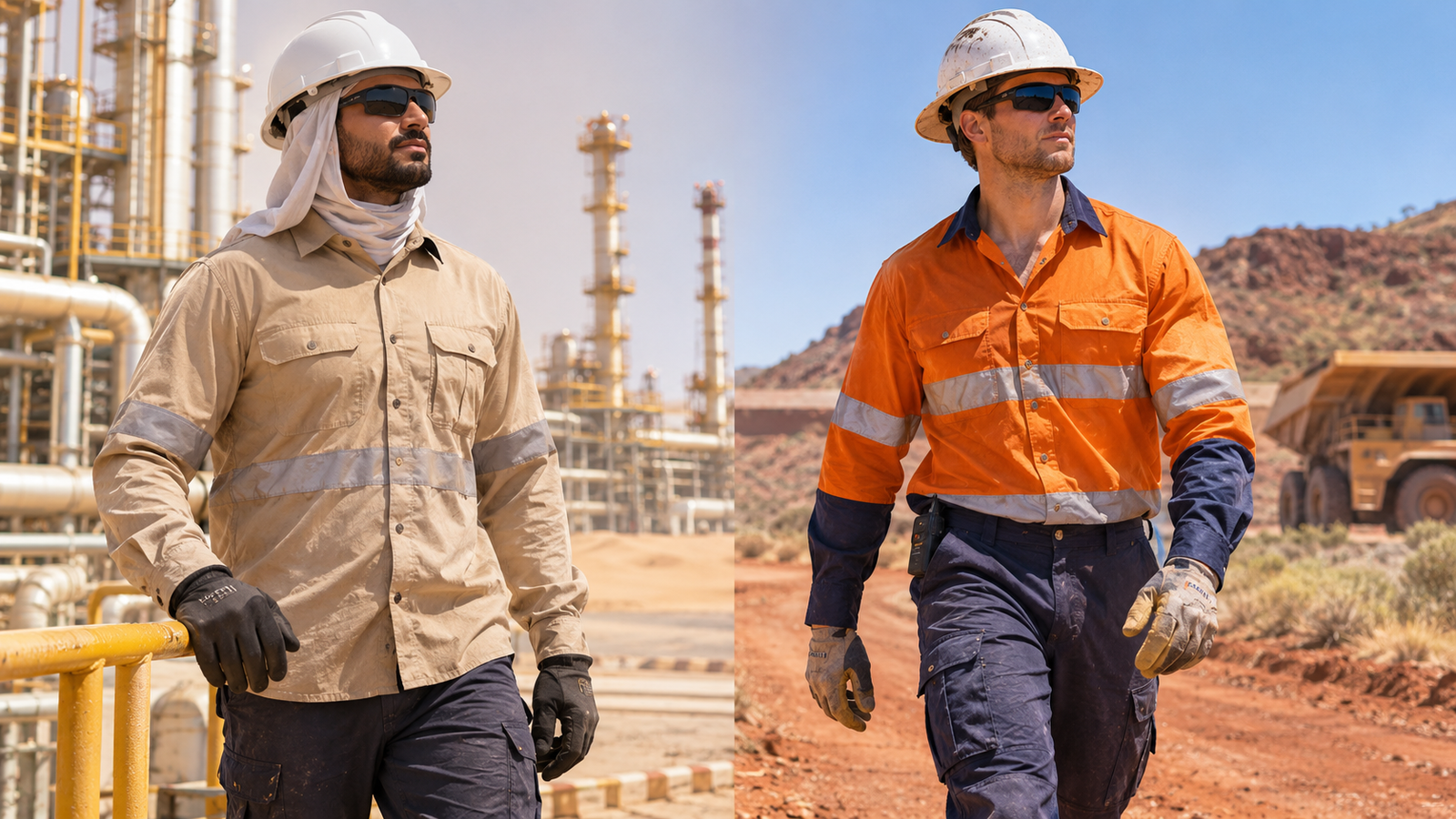
Colour also counts in summer flame resistant clothing. Pale shades reflect more sun than navy or dark grey. Hi-vis orange and yellow work well for visibility, and site rules usually pick between them. The guide on hi-vis class 1, 2 and 3 clothing covers that choice.
Design Features of Summer Flame Resistant Clothing That Reduce Heat Load
Two coveralls made from the same cloth can feel very different. Cut does a lot of the work in summer flame resistant clothing.
- Fit: Tight garments feel suffocating. Oversized garments add weight and bunch up. A relaxed, true-to-size fit lets air move.
- Ventilation: Underarm and back vents let heat escape, provided the vent fabric and trims are flame resistant too.
- Collar and cuffs: Adjustable cuffs let crews open the garment for airflow without exposing skin to sparks.
- Trims: Zips, threads, buttons and reflective tape must all be FR. One cotton thread or plastic zip is a weak point in an otherwise protected garment.
- Two-piece or coverall: A shirt and trouser set vents better than a single-piece suit, though a coverall leaves no waist gap. The hazard decides.
- Layers: A light moisture-wicking base layer under an FR shell can feel cooler than one heavy garment. The base layer must be FR or non-melting.
Rolling sleeves, opening zips and tying the top half around the waist all defeat the garment. Good summer flame resistant clothing makes those habits unnecessary.
Summer Flame Resistant Clothing for GCC and Australia
The two markets share heat but ask different questions.
| Factor | Gulf buyers | Australian buyers |
| Main concern | Heat and humidity on oil, gas and plant sites | Heat plus strong UV on mining, energy and utility sites |
| Seasonal rules | Midday outdoor work bans in summer | Site heat policies and sun-safe rules |
| Frequent asks | Summer flame resistant clothing as FR and IFR coveralls, hi-vis options | UPF-rated summer flame resistant clothing, long sleeves |
| Fabric trend | Light inherent FR blends and light FR cotton | Light cotton-rich drill and breathable FR blends |
| Sample needs | Wear trials in the hottest months | Wear trials plus a UPF test report |
Gulf Oil and Gas Sites
Buyers here usually need summer flame resistant clothing that also meets operator rules. Armstrong’s guide for FR coverall suppliers working with UAE oil and gas contractors covers what procurement teams check. The common brief is a lightweight FR coverall in a pale colour with FR trims and hi-vis tape. Operator approval is a separate step, covered in the guide to Aramco-approved coverall supplier requirements.
Australian Mining and Energy Sites
Here summer flame resistant clothing often does double duty as sun protection. A UPF test report sits beside the flame test report, so ask for both. Fabric tested when new may behave differently after repeated washing, so check whether the claimed rating holds after laundering.
Decision Table: Which Summer Flame Resistant Clothing Fits Your Job?
| Your situation | Weight to start with | Fibre to consider | Garment style |
| Outdoor plant operators, long hot shifts | 150 to 220 GSM | Inherent FR blend | Vented FR coverall |
| Welding and hot work areas | 240 to 300 GSM | FR cotton | Coverall or jacket and trouser |
| Electrical and arc flash roles | Match the arc rating first | Aramid or FR blend | Shirt and trouser or coverall |
| Mixed indoor and outdoor staff | 200 to 250 GSM | FR cotton blend | Coverall with adjustable cuffs |
| Roads or yards needing visibility | 180 to 240 GSM | FR hi-vis fabric | Hi-vis FR coverall |
Treat this as a starting point. The risk assessment decides the final weight of your summer flame resistant clothing.
Buying Checklist for Summer Flame Resistant Clothing
- Write down the hazard: flash fire, arc flash, hot work, or a mix.
- Ask the safety team for the minimum protection level the site requires.
- Request the fabric data sheet for the summer flame resistant clothing with weight in GSM and oz/yd².
- Ask for flame test and arc test reports where relevant, and check the report date.
- Confirm that zips, threads, tape and labels are flame resistant.
- Compare fabric after repeated washing, not only when new.
- Run a wear trial of the summer flame resistant clothing in the hottest month with a mixed group.
- Collect feedback on fit, sweat, movement and ease of use.
- Check size range and tolerances so the whole crew fits.
- Plan branding, labelling and packing before the bulk run.
Common Mistakes When Buying Summer Flame Resistant Clothing
Choosing by price per piece. A cheap coverall that crews will not wear costs more in injuries and replacements.
Ignoring weight on the data sheet. Two fabrics sold as lightweight can differ by a wide margin in GSM.
Over-specifying protection. A higher rating than the hazard needs adds heat and cost to summer flame resistant clothing.
Mixing FR and non-FR layers. A non-FR base layer can melt or burn under the shell. Check every layer.
Skipping wear trials. Summer flame resistant clothing that looks fine on a rack can feel very different after four hours in the sun.
Forgetting laundry. Some finishes lose performance with repeated washing, and some insect repellents may affect FR fabric. Follow the fabric maker’s care guidance.
Care and Maintenance
Wash summer flame resistant clothing as the fabric maker instructs. Avoid fabric softeners and chlorine bleach unless the label allows them, as they can reduce protection or break down the fabric. Inspect each coverall for burns, thin patches, torn seams and worn tape. Mend with FR thread and patches only. Replace garments that fail inspection. Rotate at least two sets per worker in peak summer so each coverall dries fully between wears.
Keep records of wash cycles and issue dates. They help when a client or auditor asks how you manage your FR programme.
Working With Armstrong on Summer Flame Resistant Clothing
Armstrong Products has manufactured industrial workwear since 2009 at its Boisar factory, with its corporate office in Powai, Mumbai. Buyers can discuss fabric weight, fit, OEM manufacturing and private label options for bulk orders of summer flame resistant clothing. Teams can share the climate, hazard and headcount, and Armstrong will suggest options to test on site. Crews that need footwear can pair the coveralls with safety shoes and boots from the same supplier.
Key Takeaways
- Fabric weight is the first number to check for summer flame resistant clothing.
- Compare GSM and oz/yd² in one unit before you compare suppliers of summer flame resistant clothing.
- Match protection to the hazard, then choose the lightest fabric that passes.
- Cut, vents and trims change the comfort of summer flame resistant clothing as much as cloth does.
- Wear trials of summer flame resistant clothing in the hottest month show what data sheets cannot.
- Care routines decide whether protection lasts.
Conclusion
Summer flame resistant clothing succeeds when crews wear it all day without fiddling with it. Start from the hazard, pick the lightest fabric that meets it, and test in real heat before you place a bulk order. Fabric weight, fibre, cut and care each play a part in summer flame resistant clothing. To compare lightweight options for your site, browse the clothing range and ask Armstrong Products for the catalogue and a set of samples to try.
FAQs
What is the best fabric weight for summer flame resistant clothing?
When choosing flame resistant clothing for hot weather, go with the lightest fabric that meets the safety requirements of the job. Most buyers start with 150–250 GSM and then decide what works for their workers. Thicker fabric can take more rubbing and rough use, but it also feels hotter to wear. Before ordering in bulk, check the GSM mentioned in the fabric data sheet, ask for the flame test report and have the crew try the garments during regular work. In the Gulf and Australian mining sites, plant and field workers often prefer fabrics at the lower end of this range. Welders and workers who spend hours crawling or lifting usually don’t mind a little extra weight if the clothing lasts longer.
Is lightweight FR clothing as safe as heavy FR clothing?
Lightweight FR clothing can pass the same flame tests as heavier cloth when the fabric is designed for it. Arc ratings and flash fire results still vary by fabric, so read the test report for the exact cloth you plan to buy. A light garment should never be assumed to carry the same rating as a heavy one. Treat every summer flame resistant clothing fabric as a separate case. If a supplier cannot show the report for the weight you are buying, ask again before you order.
How many GSM is a 7 oz/yd² FR coverall?
About 237 GSM. Multiply ounces per square yard by 33.9 to convert, which puts this cloth near the middle of the common range for treated cotton. A 9 oz/yd² fabric works out to roughly 305 GSM, and a 4.5 oz/yd² fabric to about 153 GSM. Convert every figure in your summer flame resistant clothing quotes to one unit first.
Which is cooler in summer, FR cotton or an inherent FR blend?
It comes down to the fabric’s weight and weave. FR cotton feels soft and absorbs sweat, though it takes longer to dry. Inherent FR blends are often lighter and help sweat dry faster, making them more comfortable during long shifts outdoors. Cotton-rich fabrics are still a good choice for welding and other hot work. If you’re choosing flame resistant clothing for summer, try wearing both fabrics on the job to see which feels better.
Can workers wear FR coveralls with sleeves rolled up in summer?
Rolling the sleeves leaves skin exposed and cancels the protection the garment gives. Most site rules require sleeves down and garments fully closed. If crews keep rolling up, the summer flame resistant clothing is probably too heavy or the fit is wrong, and that needs fixing at the buying stage, not by relaxing the rule on site.
Do Gulf summer work bans change what FR clothing I need?
The bans move heavy work to cooler hours but do not remove heat. Some essential work is exempt, and shutdown crews often work long shifts in high temperatures. Summer flame resistant clothing still needs to be light and breathable for these crews. Pale colours, vented cuts and low-GSM fabric help them stay in the garment through the shift.
What does UPF 50+ mean on FR workwear for Australia?
UPF measures how much ultraviolet radiation a fabric blocks. Under AS/NZS 4399, ratings run from UPF 15 to 50+, and 50+ is the top class. Australian buyers of summer flame resistant clothing should ask suppliers for a UPF test report in addition to the flame test report, and should check that it covers the exact fabric and colour on order.
Should I choose a coverall or a two-piece FR set for hot weather?
A two-piece set vents better and is easier to adjust through the day. A coverall covers the body with no waist gap, which some hazards require. Pick based on the risk assessment first, then on comfort. Both formats work as summer flame resistant clothing when the fabric is light and the fit is right.
How should I test summer flame resistant clothing before a bulk order?
Order samples in two or three weights and give them to a mixed group of workers. Run the trial in the hottest month on real tasks. Collect feedback on sweat, movement, fit and how often people open or roll up the garment. Wash the samples several times too, so you can see how the fabric of your summer flame resistant clothing holds up.
Can Armstrong make summer FR coveralls with custom branding?
Armstrong supports OEM manufacturing and private label for bulk orders, including logos, labels and packing. Share your fabric preference, hazard type and quantity so the team can advise on what to sample first. Custom branding works on summer flame resistant clothing as long as the logo materials, threads and tapes are also flame resistant.