Picture a shutdown crew arriving at a Gulf plant on a Sunday morning. The store holds 600 disposable boiler suits, but half are the wrong size and the zips jam on the first pull. Work stops while someone hunts for a new disposable coverall supplier. A weak order causes that kind of delay, and a clear specification prevents it. Armstrong Products has supplied industrial workwear to oil and gas, construction and manufacturing buyers since 2009. This guide shows UK and GCC buyers how to order a disposable boiler suit in bulk, from fabric and Type ratings to the RFQ itself.
Ready to buy? Fill out the Request Bulk Quote form with your specifications. You can also ask for disposable boiler suit samples in the same request, so the team can work on your quote and samples at the same time.
Key takeaways
- A disposable boiler suit is a single-use hooded coverall made from non-woven fabric. “Boiler suit” is the UK term. Gulf buyers search for “disposable coverall”.
- Most industrial jobs call for a Type 5/6 disposable boiler suit, which covers dry particles and light liquid spray.
- Fabric sets the balance between comfort and barrier in a disposable boiler suit. SMS breathes best. Microporous film resists liquid better.
- A reliable disposable coverall supplier shares test reports, a declaration of conformity and a full size run before you commit to volume.
- Bulk disposable coveralls are quoted against a written specification. Send type, fabric, sizes, packing and delivery port together.
What is a disposable boiler suit?
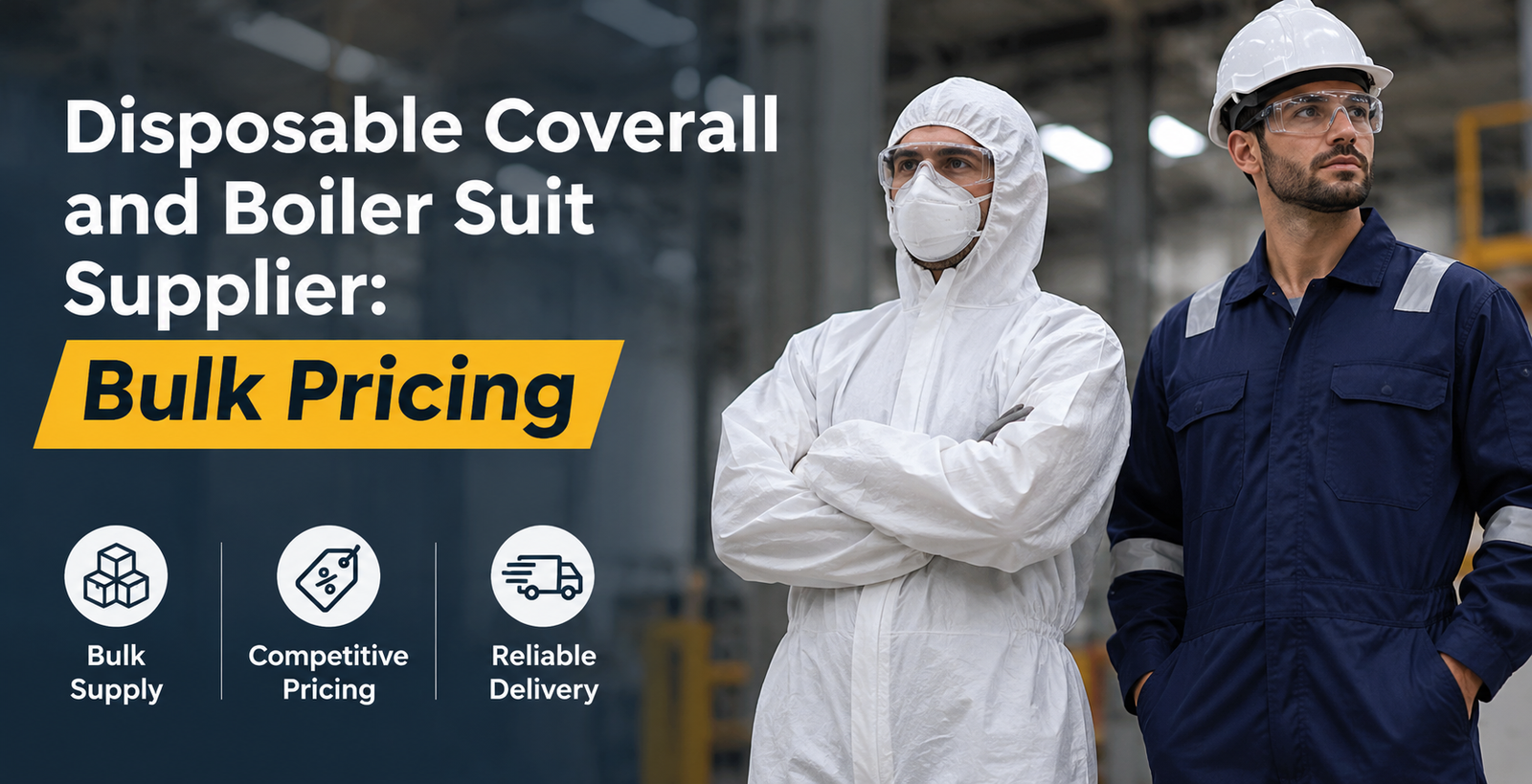
A disposable boiler suit is a one-piece, hooded garment made from non-woven fabric. Workers wear it for one job or one shift, then throw it away. It keeps dust, fibers, paint, and light splashes off the wearer’s clothes and skin.
The name changes by market. UK catalogs say boiler suit. Gulf buyers say coverall or overall. Search data shows the same split. The term “disposable coverall” draws about 590 searches a month in Saudi Arabia and 480 in the UAE, while “disposable boiler suit” sits near 10 in each. In the UK, the picture flips, with about 260 monthly searches for “disposable boiler suit” and 1,000 for “disposable overalls”. The garment is identical in every case. A good disposable coverall supplier answers to all three names.
One limit applies to every disposable boiler suit. It is not a chemical suit. Heavy chemical exposure needs a higher Type rating and a different garment.
Disposable coverall types: Type 4, 5 and 6
European Type ratings show which hazard a suit was tested against. A disposable boiler suit falls under Category III PPE, the category for hazards that can cause serious or irreversible harm. That is why a supplier of disposable boiler suits must hold proper documents.
| Type | Protects against | Standard | Typical work |
| Type 4 | Liquid spray (aerosol tight) | EN 14605 | Chemical handling, industrial cleaning |
| Type 5 | Airborne solid particles | EN ISO 13982-1 | Asbestos removal, insulation, dust and fibres |
| Type 6 | Limited light liquid spray | EN 13034 | Maintenance, painting, light industrial work |
| Type 5/6 | Dust and light spray together | Both standards | The most common disposable boiler suit |
Nearly every disposable boiler suit on the market carries the combined Type 5/6 mark. Dust and liquid behave differently, so one suit can handle one hazard better than the other. A test against EN 14126 adds protection from infective agents and puts a “B” after the Type. EN 1149-5 covers antistatic performance, which matters where sparks are a risk.
Fabric choices for a disposable boiler suit
Fabric decides how a disposable coverall feels and performs. Lakeland, a protective clothing maker, groups the market into three fabric families. Its figures come from its own brands, so ask every disposable boiler suit supplier for its own test data.
| Fabric | Strength | Comfort | Best fit |
| SMS (spunbond meltblown spunbond) | Strong in most tear and burst tests | Most breathable | General maintenance, food processing, light assembly |
| Microporous film laminate | Good | Low breathability | Paint spraying, industrial cleaning, liquid splash |
| Flash-spun polyethylene | Lower in Lakeland’s tests | Low breathability | Fine particle work |
A fourth option joins SMS and film in one suit. The front, arms and legs use film, and a breathable SMS panel covers the back. Heat is a real hazard in Gulf summers, so this design deserves a sample test before you order disposable coveralls in volume.
What GSM tells you
Disposable coveralls are usually listed between 40 and 65 GSM. Thicker fabric may feel stronger, but that doesn’t necessarily mean better protection. The Type rating and test report are what matter. GSM is worth comparing only when the disposable boiler suits use the same fabric.
Design features to check
Small details decide whether a disposable boiler suit protects the wearer. Check these on every sample:
- A hood that fits over a respirator and stays put when the head turns.
- Elastic at the wrists, ankles and waist.
- A zip with a storm flap. Lakeland found that a large share of dust inside a suit enters through an unsealed zip.
- Stitched, bound or taped seams, matched to the hazard.
- An antistatic finish where flammable vapors may be present.
- A gusset or cut that allows bending and squatting.
- A full-size run. Each disposable coverall supplier lists sizes from small to 3XL, and some go to 5XL.
Where UK and GCC teams use disposable overalls
Typical uses cover chemical handling, insulation installation, food and beverage manufacturing, petrochemical work, automotive repair, waste cleanup, healthcare, decontamination and agriculture. In the UK, asbestos removal and spray painting drive much of the demand. In the Gulf, plant shutdowns and turnarounds drive bulk orders of disposable boiler suits, and a disposable coverall supplier with stock of every size saves the most time.
| Job | Suggested spec |
| Asbestos or dust removal | Type 5/6, sealed zip flap, respirator hood |
| Spray painting and coating | Type 5/6, microporous film or combined fabric, antistatic |
| Plant maintenance and turnaround | Type 5/6 SMS, full size run |
| Food and beverage processing | SMS, light colour, no loose fibres |
| Tank and vessel cleaning | Type 4/5/6 where liquid contact is likely |
| Visitors and short site tours | Basic SMS coverall |
Disposable boiler suit vs reusable coverall
Many sites run both. Reusable coveralls suit daily wear. A disposable boiler suit suits short, dirty or contaminated jobs.
| Factor | Disposable boiler suit | Reusable coverall |
| Use pattern | One job or one shift | Daily, over months |
| Laundry | None | Regular washing |
| Flame protection | Not flame resistant unless the data sheet says so | FR and IFR coveralls give flash fire protection |
| Best for | Dust, light spray, contractor crews | Operators, fire risk areas |
| Waste | Higher | Lower |
Armstrong makes reusable workwear at its Boisar, Maharashtra facility, including fire retardant and cotton coveralls. Where flash fire is a hazard, a standard disposable boiler suit is the wrong choice. Read the data sheet before you assume any suit resists flame.
How to choose a disposable coverall supplier
Price lists look alike. Documents and consistency do not. Use this checklist to compare each disposable coverall supplier on your shortlist:
- Ask for the declaration of conformity and the test reports for Type 5 and Type 6.
- Check that the Type, standard and fabric are printed on the garment label.
- Request samples of the disposable boiler suit in every size you plan to order.
- Confirm that later lots match the sample. A strong first batch means little if the second one differs.
- Ask how the disposable coverall supplier packs the order. Cases of 25 are common.
- Check export documents, commodity code and packing list support.
- Ask about branding or private label if you want your logo on the suit.
- Judge how fast and how clear the replies are. They predict delivery behaviour.
Armstrong Products offers customization, branding and OEM or private label manufacturing across its workwear range. Buyers can also request samples before a bulk order.
Bulk pricing: what shapes a quote
A disposable coverall manufacturer or supplier cannot give a fair figure from a title alone. This guide carries no price list for that reason. Four inputs move a bulk quote on disposable boiler suits:
- The specification: Type rating, fabric, GSM and features.
- The quantity, and whether it ships in one lot or in staged call-offs.
- The packing: pieces per case, labelling and any printed branding.
- The destination: port or site, and the Incoterm you want.
Send those four inputs in writing and you get a quote you can compare line by line. A figure given without them tells you very little.
What to put in a bulk RFQ
A vague enquiry brings vague replies. Send the same facts to every disposable boiler suit supplier so the answers line up.
| RFQ item | What to state |
| Type and standards | Type 5/6, with EN ISO 13982-1 and EN 13034 |
| Fabric and GSM | SMS, microporous film or combined |
| Colour | White, blue or site colour |
| Features | Hood, storm flap, cuffs, antistatic finish |
| Sizes | Split by size, for example the share of L and XL |
| Quantity | Total pieces and any staged call-offs |
| Packing | Pieces per case, labels, language |
| Delivery | Port or site, Incoterm |
| Documents | Conformity, test reports, origin papers |
| Branding | Logo, print position, if needed |
Ask for samples at the same time. A written RFQ plus tested samples settles most doubts before any volume ships.
Shipping and compliance notes for the UK and GCC
UK buyers should ask for the declaration of conformity and confirm which conformity marking their site or client accepts. GCC buyers should confirm site approval first. Many project HSE teams ask for test reports against the European standards named above. Check the requirement before you place the order, not after the goods land.
For both regions, ask the supplier of disposable coveralls for a commodity code, a packing list and any certificate of origin the importer needs. Cartons should carry the size and the Type on the outside so the store team can sort them fast.
Storage, wear and disposal
- Keep sealed cartons of disposable boiler suits in a cool, dry store, away from direct sun.
- Do not wash and reuse a disposable boiler suit. Washing can damage the fabric and cut its protection.
- Close the zip all the way and press the flap down. A sealed zip improves dust protection.
- Discard the suit after use under your site waste rules. Contaminated suits, such as asbestos waste, follow stricter rules.
Common mistakes
- Choosing a disposable boiler suit by colour or price and skipping the Type rating.
- Ordering a disposable boiler suit in one size split for a mixed crew.
- Assuming a high GSM means higher protection.
- Using a disposable coverall where flash fire is a risk.
- Approving a sample, then accepting a different lot from the disposable coverall supplier.
- Leaving the zip flap open during dusty work.
Quick decision table
| If you need | Pick |
| Comfort over a long shift | SMS Type 5/6 disposable boiler suit or a combined fabric |
| Stronger liquid resistance | Microporous film Type 5/6 |
| Liquid spray contact | Type 4/5/6 disposable boiler suit |
| Flame protection | FR or IFR coverall, not a standard disposable |
| Your own logo | Supplier with OEM or branding support |
Conclusion
Before placing an order for disposable boiler suits, make sure the specifications are clear. Mention the Type, fabric, size breakdown and delivery port. Review the documents provided by each shortlisted disposable coverall supplier and try out samples before ordering in bulk. This helps keep your workers safe and avoids delays during the shutdown.
Armstrong Products manufactures workwear in Boisar, Maharashtra, with its corporate office in Powai, Mumbai. To discuss a disposable boiler suit requirement for the UK or GCC, send your specification through the Request Bulk Quote form and ask for samples at the same time.
FAQs
What is a disposable boiler suit used for?
A disposable boiler suit protects the wearer’s clothes and skin during dusty, dirty or lightly wet work. Common jobs include asbestos removal, painting, insulation, plant maintenance, cleaning and food processing. Workers use it for one task or one shift and then discard it. It is not built for heavy chemical exposure.
Is a boiler suit the same as a coverall?
The two names describe the same type of one-piece garment. UK buyers say boiler suit. Gulf buyers say coverall or overall. When you send an RFQ, use both names so the disposable coverall supplier finds the right product in its range and the quote matches your need. Add the Type rating as well, because that is what sets the protection.
What does Type 5/6 mean on a disposable coverall?
Type 5 suits are tested for protection against airborne dry particles under EN ISO 13982-1, while Type 6 suits are tested for light liquid sprays under EN 13034. Most disposable boiler suits come with both ratings. Since dust and liquids pose different risks, check the test report to see whether the suit is suitable for the main hazard at your worksite.
Which fabric is better, SMS or microporous film?
SMS fabric allows better airflow and feels more comfortable during long shifts or routine maintenance work. Microporous film offers better protection against liquids, though it can get warmer inside. Your choice should depend on the hazards involved and the weather conditions. Before ordering disposable boiler suits in bulk, let your crew try both types on the job and find out which one they’d prefer to wear again.
How do I find a reliable disposable coverall supplier for the UK or GCC?
Before choosing a supplier, ask for their declaration of conformity, test reports, and labelled samples for every size. Check whether future batches will match the approved samples and if the export paperwork is ready. A supplier who gives you clear answers before you place an order is more likely to manage the shipment properly.
What should an RFQ for bulk disposable coveralls include?
Your RFQ should mention the coverall type, required standards, fabric, GSM, color, features, sizes, quantity, packaging, delivery port, Incoterm, documents, and branding requirements. Send the same details to each supplier to make comparing prices easier and catch anything they’ve missed. Include your sample request in the same email.
Can a disposable boiler suit be washed and reused?
Disposable suits are made for single use. Washing can damage the delicate fabric and reduce the protection it gives. If a suit is only lightly soiled, brushing off dry dirt is the most you should do. For repeated daily wear, a reusable coverall is the safer choice, and it costs the site less waste handling over a year.
Are disposable coveralls flame resistant?
Standard disposable coveralls are not flame resistant. Some limited-use suits carry a flame retardant claim, so read the data sheet and the test standard. Where flash fire is a hazard, workers need FR or IFR coveralls made for that risk instead of a general-purpose disposable boiler suit. Armstrong makes both FR and IFR coveralls for those jobs.
Can I request samples before a bulk order?
Buyers can request samples from Armstrong Products before they confirm a bulk order. Share your requirement through the Request Bulk Quote form and the team will confirm the sample options and the minimum order quantity for your specification. Test each size on real crew members before you approve volume, and note any fit problems at the hood and cuffs.
Can a disposable boiler suit carry my company logo?
Armstrong Products offers customization, branding and private label manufacturing on its workwear range for bulk institutional orders. For a disposable requirement, state the logo, print position and quantity in your enquiry, and the team will confirm what can be supplied. Share an artwork file early so the print position can be checked against the garment.