Picture a purchasing manager in Houston with an RFQ open for 400 jackets. Line one asks for high visibility flame resistant clothing in ANSI Class 3, Type R. Line two asks for NFPA 2112. Line three asks for the company logo on the back and the left chest.
Two suppliers reply by Friday. Both quotes look complete, but only one prices all three lines. The other skips line two. The gap shows up when the sample jacket arrives and its label reads “Not FR.”
It is an easy gap to miss. A hi-vis garment and an FR garment are tested to different standards, in different labs, against different hazards. A jacket with both labels needs two sets of paperwork, and a misplaced logo can break either one.
This guide covers the standards for the US, Canada and Australia, the rules for custom logos, and the factors that set minimum order quantity. It ends with an RFQ checklist you can paste into an email.
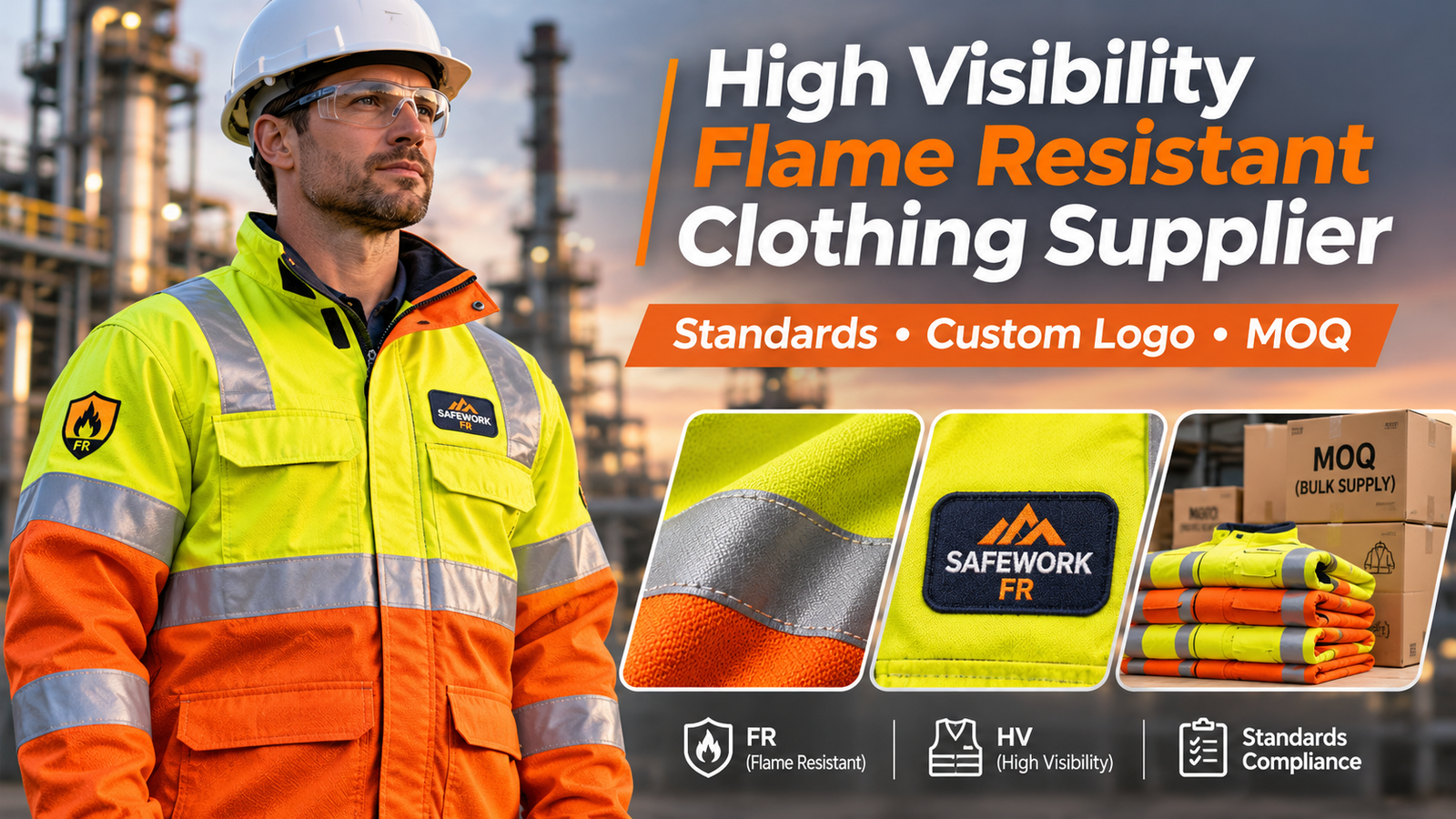
Quick answer: High visibility flame resistant clothing is outer-layer workwear that meets a visibility standard and a flame or arc standard in the same garment. The fluorescent fabric, reflective tape, thread and labels all have to survive wash testing. A logo is acceptable only if it leaves the required fluorescent and reflective area intact.
Sourcing for a live job? Send your RFQ with the standard, class, quantity, sizes and logo files. The Armstrong team will confirm fabric options, test documents and the minimum order quantity for your order.
What high visibility flame resistant clothing means
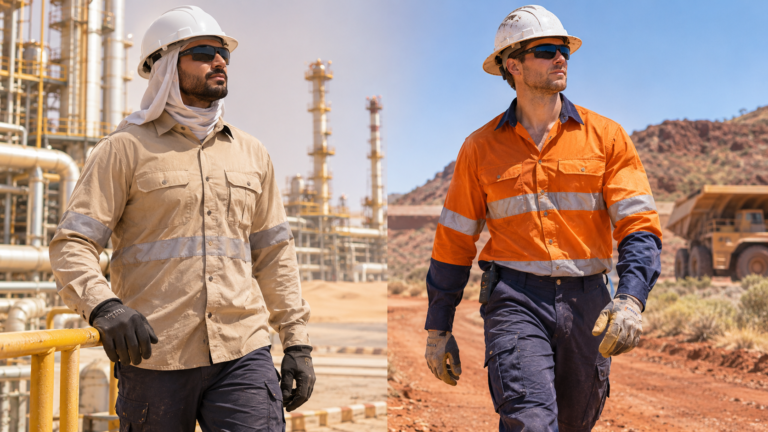
High visibility flame resistant clothing does two jobs. The fluorescent fabric and retroreflective tape help a driver or crane operator spot the worker. The base fabric resists ignition and stops burning once the heat source is gone.
One job never covers the other. A bright yellow cotton shirt is easy to see, and it burns. A navy FR coverall resists flame and vanishes at dusk on a haul road.
Hi-vis, FR and dual-hazard garments
Tenders use three labels, and each means something different. Hi-vis garments are tested for color and for the area of fluorescent fabric and tape, so the fabric underneath may still melt. FR garments are tested against flame or arc and make no promise about visibility. A dual-hazard garment carries both sets of results on one label.
Flash fire protection falls under NFPA 2112. As MCR Safety explains, the aim is to keep predicted body burns under 50%. Arc-rated clothing follows ASTM F1506, which specifies the performance requirements. Its arc rating is expressed as ATPV in cal/cm². If a hi-vis garment carries a flame-resistant claim, ANSI/ISEA 107 references these standards as well as a few others.
If you need the basics first, our comparison of fire retardant and regular coveralls explains how the two differ.
Inherent and treated fabrics in high visibility flame resistant clothing
Inherent FR fabric carries its flame resistance in the fiber. Modacrylic and aramid blends are common examples, and the protection does not wash out. Treated fabric gets a chemical finish after weaving. Cotton and cotton-nylon blends can pass NFPA 2112 with a finish, as long as the supplier shows the test report.
Treated polyester is the weak spot. A product director at Tingley Rubber explained in Safety + Health Magazine that some treated polyester vests pass a basic vertical flame test, then melt and drip in an arc or flash fire.
| Point | Inherent FR | Treated FR |
| Source of protection | The fiber itself | A finish applied to the fabric |
| Wash behavior | Does not wash out | Depends on the finish and the care label |
| Typical blends | Modacrylic, aramid | Cotton, cotton-nylon |
| Ask the supplier for | Fiber content on the label | A test report taken after the stated wash count |
Standards by market: US, Canada, Australia and beyond
Every market names its own standard for high visibility flame resistant clothing, and the tender text decides which edition counts. Match the garment to the paperwork the site will ask for.
| Market | Visibility standard | Flame or arc references | Put on the RFQ |
| United States | ANSI/ISEA 107-2026 | NFPA 2112 for flash fire, ASTM F1506 for arc rating | Type, class, FR standard, ATPV |
| Canada | CSA Z96:22 | Level FR in Z96, CSA Z462 for arc flash work | Class, Level FR, ATPV |
| Australia | AS 4602.1:2024 | Arc rating in cal/cm² and the site hazard category | D, N or D/N, ATPV |
| UK, Europe, Gulf tenders | EN ISO 20471 | EN ISO 11612 | Class, EN ISO 11612 codes |
United States: ANSI/ISEA 107-2026
ISEA announced ANSI/ISEA 107-2026 on October 26, 2026, and it revises the 2020 edition. Classes 1, 2, 3 and E stay, and so do Types O, R and P. The new edition lets smaller sizes up through Medium carry less material in Type R Class 2 and 3, and it points FR garments to NFPA 2112-2023. It also adds an optional nighttime luminance test and a Declaration of Conformity for each style. Garments made to the 2020 edition do not become obsolete.
Labels under recent editions say whether a garment is FR or Not FR and name the FR standard it meets. Read that line first when a sample arrives.
The long-standing Class 3 minimums are 1,240 square inches of fluorescent background and 310 square inches of retroreflective tape. Our guide to class 1, 2 and 3 compared in detail sets those numbers beside EN ISO 20471.
Canada: CSA Z96
CSA Group says the current edition of Z96 is designed to sit close to ANSI/ISEA 107 and ISO 20471. It carries a Level FR for flame resistant hi-vis, and the background color rules for FR garments differ from those for non-FR garments. CSA Z462 covers workplace electrical safety, including arc flash. Provincial regulators decide which edition applies on site, so ask the buyer for the one named in the site rules.
Australia: AS 4602.1:2024
AS 4602.1:2024 replaced AS/NZS 4602.1:2011 in Australia. Standards New Zealand says the 2011 joint edition stays current in New Zealand. Under the 2011 edition, garments were classed D for day, N for night or D/N for both, and a day-only garment is not meant for night wear. Confirm the labeling the buyer expects under the 2024 edition before sampling. The materials standard, AS/NZS 1906.4, covers fabric and tape, and Standards Australia lists it as pending revision.
UK, Europe and the Gulf: EN ISO 20471
EN ISO 20471 specifies how much fluorescent and reflective material each visibility class requires. For Class 3, garments need at least 0.80 square metres of fluorescent fabric and 0.20 square metres of reflective tape. EN ISO 11612 deals with protection against heat and flames. Gulf tenders commonly refer to EN ISO 20471, but the requirements written in the tender take priority.
Why FR hi-vis needs to be the outer layer
One question buyers often have is whether the hi-vis garment also needs to be flame-resistant. If workers face flash fire or arc flash hazards, the answer is yes. The outer garment determines the visibility class, and WC Safety’s guide explains that the outer layer must also be FR-rated.
Wearing a regular hi-vis vest over an FR shirt isn’t enough. The vest may melt onto the clothing underneath, making the combination unsuitable for FR protection.
Class 3 also requires sleeves, which is why FR shirts and jackets are commonly used for these jobs. A vest on its own won’t meet Class 3 requirements.
OSHA doesn’t have a general industry standard specifically for hi-vis clothing. Under 29 CFR 1910.132, employers must document workplace hazards through a written PPE hazard assessment. Buyers should be asked to share this assessment so the required visibility class and FR protection level can be confirmed.
Both sets of properties must survive washing. ANSI/ISEA 107 tests the tape through 25 wash cycles, and an FR hi-vis garment needs wash durability for its flame resistance and its tape, each on its own.
Garments and the class they can reach
Pick the garment first, then the class. The table shows what each style can do on its own.
| Garment | Class it can reach | Fits | Watch for |
| FR hi-vis vest | Class 2 at most alone | Warm sites, quick issue | No sleeves, so no Class 3 on its own |
| FR hi-vis shirt | Class 2 or 3 | Line crews, welders near traffic | Class 3 needs tape on both arms |
| Jacket or parka | Class 3 | Roadside, utility and winter work | A hood can cover shoulder tape |
| FR rainwear | Class 2 or 3 | Wet outdoor work | Ordinary rainwear melts, so ask for the FR test report |
| Coverall | Class 3 | Plant and terminal work | Fit when seated, tape across both arms |
Armstrong’s high-visibility wear range lists a waterproof parka jacket today. Buyers who need an FR version can share the standard and class in an RFQ.
Fabric, weight and color
Bright yellow is not the same as high visibility. Visibility comes from fluorescence, and a garment dyed yellow without the right fabric will not hold up under the standard’s tests.
ANSI/ISEA 107 allows fluorescent yellow-green, orange-red and red. Australia approves yellow-green and orange-red. Choose the color that contrasts with the site. Orange equipment on a yellow-green jacket reads better than orange on orange.
Fabric weight appears in ounces per square yard in the US and in GSM elsewhere. A 7 oz fabric sits near 235 GSM. A lighter shell breathes in summer. A heavier shell lasts through more wash cycles.
For refinery and gas plant work, ask about static dissipative fiber in the blend. Check the zipper too. Metal that sparks has no place on an FR jacket, so look for non-conductive or covered hardware.
Custom logos on FR hi-vis garments
A logo on high visibility flame resistant clothing sits on a garment that is already counted, measured and tested. Every square inch of logo that covers fluorescent fabric or tape can lower the class. Fix the artwork size and position before the pattern is cut, not after.
Three rules help. First, place logos on pockets, contrast panels or the non-fluorescent areas the standard allows. Second, treat thread, patches and labels as part of the garment, so ask for FR-rated thread. Third, test a swatch with the logo on it through the wash count your site requires.
Armstrong’s embroidery, screen print, DTG and vinyl transfer options cover most branding needs. The same team can add employee names, a national flag or a safety slogan on a label.
| Method | Best for | Watch for on FR hi-vis |
| Embroidery | Fleece, softshell, heavy jackets | FR-rated thread, and holes in waterproof shells |
| Screen print | Large runs on flat fabric | Ink over fluorescent areas, cracking on stretch |
| DTG print | Multi-color artwork | Ink behavior on FR fabric, so test a swatch |
| Vinyl transfer | Waterproof shells and rainwear | The film must pass the wash count and the FR report |
Reflective logo film is another option. Ask whether it counts toward the tape area, and do not assume it does.
MOQ and lead time for custom orders
Armstrong’s published position is plain: order requirements vary by product and customization level, and the team confirms the minimum order quantity once it sees your requirement. Buyers can also request samples before a bulk order. We do not quote a single MOQ number here, because a stock jacket with a logo and a new private label pattern are different jobs.
The table shows what moves the number.
| Order type | What moves MOQ | Send with the RFQ |
| Stock fabric, stock pattern, logo added | Decoration setup and number of colors | Artwork files, placement, sizes |
| Stock pattern, custom color or tape layout | Dye lot and tape sourcing | Color reference, tape width and layout |
| New pattern or private label | Pattern work, grading, labels, packing | Tech pack, size chart, label art |
| Inherent FR fabric in a custom color | Fabric lot size | Standard, class, ATPV target, color |
Ask for MOQ per style and per color, not per order. A 400-piece job split across four colors and six sizes is a harder job than one color in one size run. Our private label and OEM service covers production from fabric to finished garment.
Lead time depends on sampling, test documents and the logo approval. Ask for dates in writing for the sample, the sign-off and the production run. Our guide to bulk MOQ, lead time and shipping shows how the same questions play out on a coverall order.
How to choose a high visibility flame resistant clothing supplier
A good supplier answers paperwork questions before it answers price questions. Check these items before you approve a sample.
- Test reports for both the visibility standard and the FR standard, for the exact fabric, with report dates.
- The edition named on each report, such as ANSI/ISEA 107-2026 or 2020, NFPA 2112-2023, CSA Z96:22 or AS 4602.1:2024.
- Wash-cycle evidence for the fabric, the tape and the thread.
- A label sample that shows FR or Not FR, the class, the type, the size and the care line.
- A Declaration of Conformity for each style, if the buyer works to the 2026 edition.
- A pre-production sample with the logo on it.
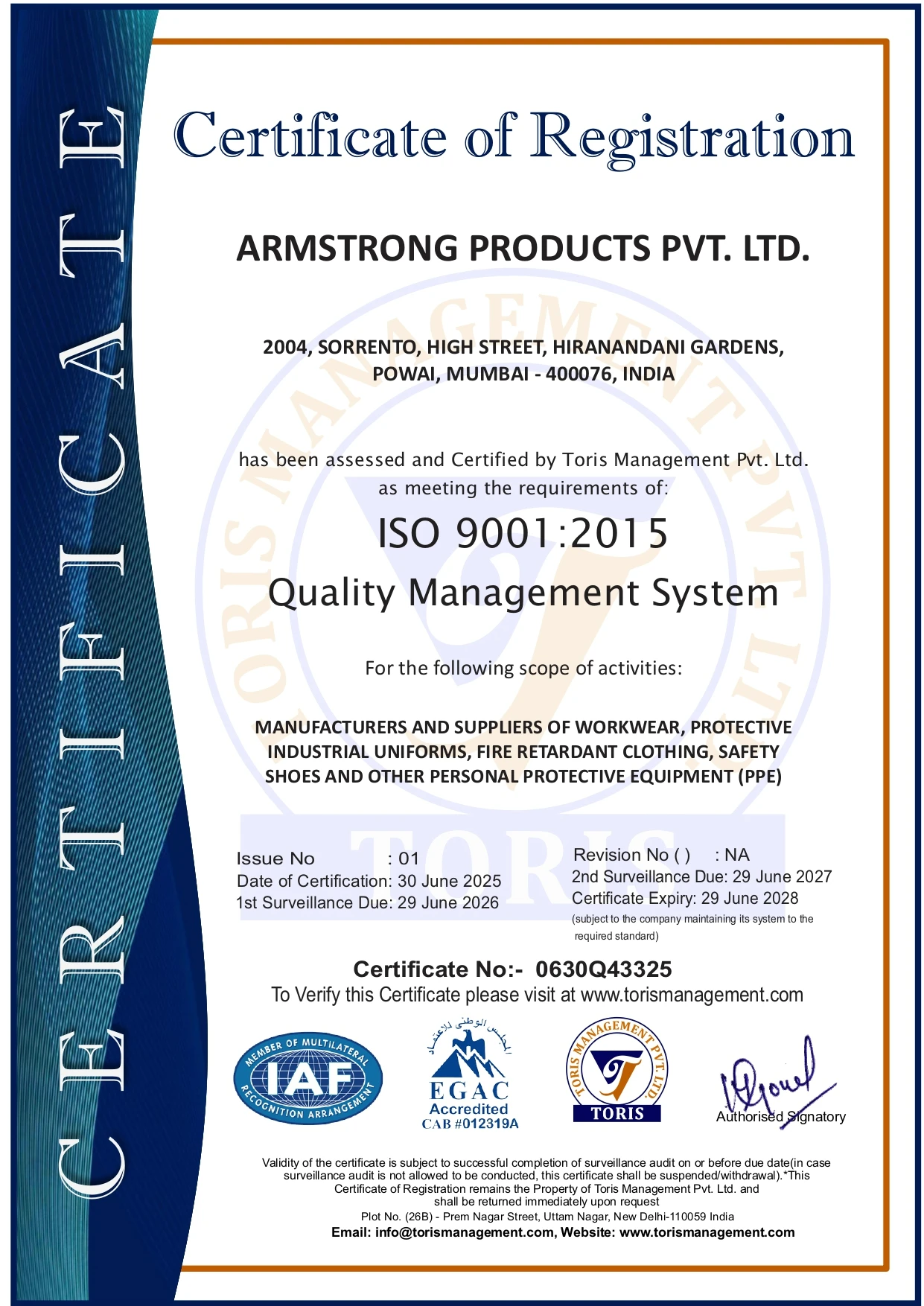
- A quality system, such as an ISO 9001:2015 certificate and batch test records.
- Export paperwork for the destination, including packing details and labels.
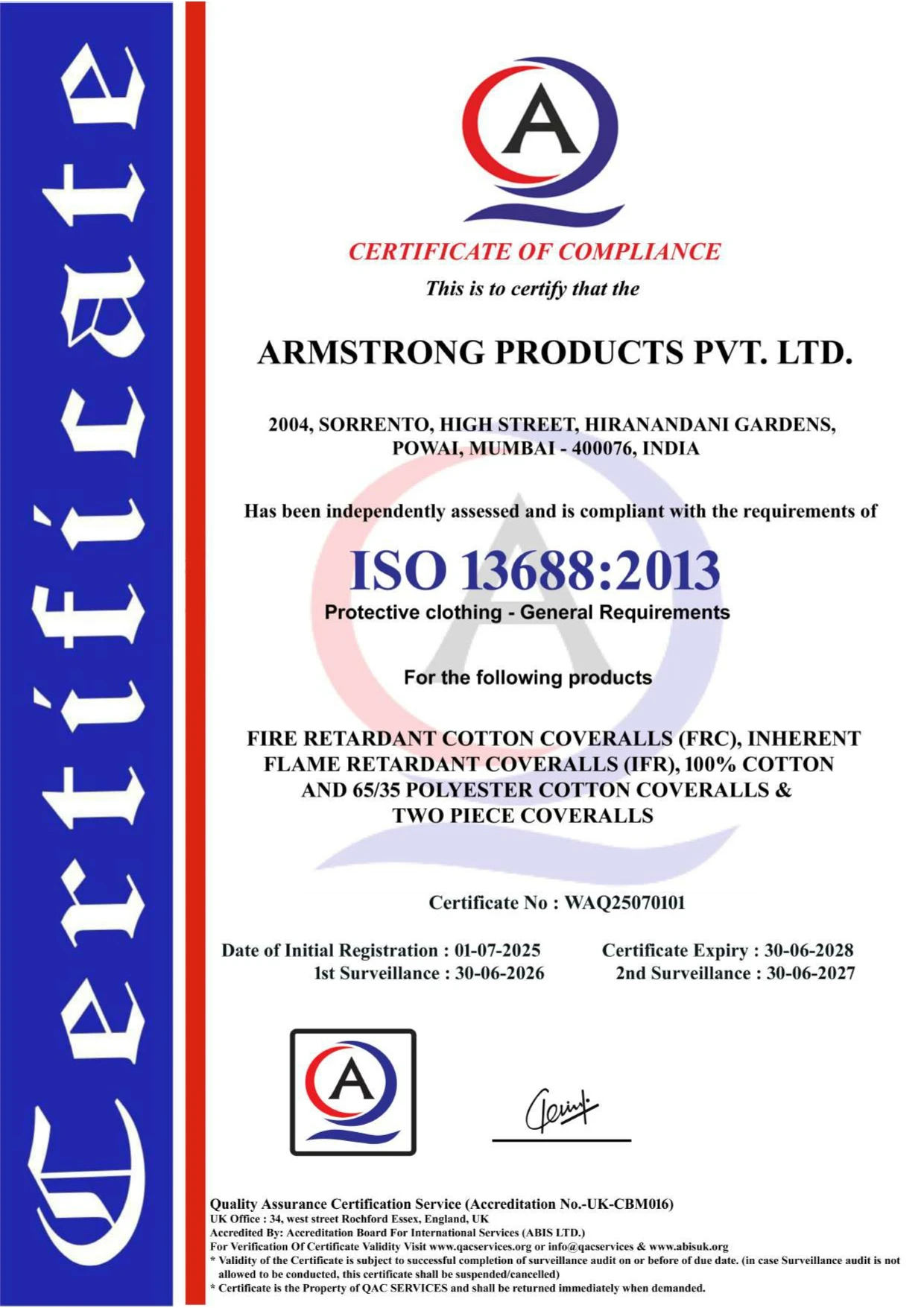
Armstrong Products has manufactured industrial garments, uniforms and safety clothing since 2009. Production runs from the Boisar, Maharashtra facility, and the corporate office sits in Powai, Mumbai. The company holds ISO 9001:2015 for quality management and ISO 13688:2013 for general requirements of protective clothing. It supplies buyers in the Gulf and other international markets. Share the standard you need in your RFQ and the team will tell you which fabric and test documents it can supply for that order.
RFQ checklist for high visibility flame resistant clothing
Paste this list into your email. A complete RFQ saves a week of back-and-forth.
- Market and standard edition: ANSI/ISEA 107-2026, CSA Z96:22, AS 4602.1:2024 or EN ISO 20471.
- Type and class, such as Type R Class 3, or D/N for Australia.
- FR standard and arc rating target, such as NFPA 2112 or ASTM F1506 with an ATPV in cal/cm².
- Garment type, size range and the split by size.
- Fabric: inherent or treated, weight in GSM or ounces, and color.
- Tape: width, type and layout, sew-on or heat transfer.
- Logo: vector files, placement, method and size.
- Quantity per style and color, delivery window and destination.
- Samples needed and the approval steps.
Industries, mistakes and care
Where FR hi-vis gets used
Utility line crews wear it for arc flash and for work beside live traffic. Oil and gas and petrochemical sites use it where flash fire and moving vehicles share a yard. Welders and fabricators working near forklifts and cranes need it too. Australian mining sites often require Day/Night garments underground.
Mistakes that cost a reorder
- Buying a non-FR vest to wear over FR clothes.
- Accepting “FR” on a hang tag with no label or report behind it.
- Writing “Class 3 FR” without the type and the FR standard.
- Approving logo artwork after the pattern is cut.
- Leaving the standard edition off the order.
- Skipping a wash test on a logo swatch.
- Choosing treated polyester for an arc or flash fire hazard.
Care and replacement
Follow the care label, because bleach and fabric softener can hurt some FR finishes. ANSI/ISEA 107 tests the tape through 25 washes, but field wear is faster. Inspect each garment before the shift. Replace it when the tape peels or cracks, or when the fabric fades toward gray. Pull any garment soaked in fuel or oil out of service and wash it before reuse. Repair with FR material only.
Key takeaways
- High visibility flame resistant clothing needs a visibility standard and an FR standard on one garment.
- ANSI/ISEA 107-2026 is the current US edition, and 2020-edition garments stay valid.
- The hi-vis outer layer must be FR rated on its own.
- Logos reduce visible area, so fix size and position before the pattern is cut.
- MOQ depends on fabric, color, pattern and decoration, so send a full RFQ.
Conclusion
When ordering high-visibility FR clothing, check that the garment matches the details in its paperwork. Look at the standard and its edition, then choose a design that meets the required class. The logo shouldn’t cover any part of the fabric needed to meet that class. Before approving the bulk order, get the test reports, check the label, and review a sample with your logo on it.
When you are ready, download the Armstrong catalogue or talk to the product team about your OEM, private label or export requirement.
FAQs
What is high visibility flame resistant clothing?
It is workwear that meets a visibility standard and a flame or arc standard in the same garment. The fabric is fluorescent, the tape is retroreflective, and the base cloth resists ignition. The garment carries labels for both sets of tests. Workers wear it where vehicles, flash fire or arc flash share the same site.
Does all hi-vis clothing have to be FR?
Only when the hazard calls for it. ANSI/ISEA 107 does not require every garment to be FR. A garment that claims flame resistance, though, must meet one of the FR standards the document references and say so on the label. A road crew with no fire risk can wear non-FR hi-vis. A line crew cannot.
Can I wear a regular hi-vis vest over FR clothing?
On a flash fire or arc flash job, no. The outer layer controls the visibility class, and it must be FR rated on its own. A non-FR vest can melt onto the layer beneath it. Buy an FR vest, jacket or shirt that carries both labels, and keep every layer under it FR as well.
Which standard applies to FR hi-vis in the United States?
Two sets of rules apply together. ANSI/ISEA 107-2026 covers visibility, with Types O, R and P and Classes 1 to 3. NFPA 2112 covers flash fire, and ASTM F1506 covers arc-rated clothing. Write the type, class, FR standard and ATPV on your RFQ, and name the edition so the supplier tests to the right one.
What standards cover FR hi-vis in Canada and Australia?
Canada uses CSA Z96, which has a Level FR for flame resistant hi-vis, plus CSA Z462 for electrical safety work. Australia uses AS 4602.1:2024, with AS/NZS 1906.4 for materials. New Zealand still works to the 2011 joint edition. Provincial or state rules and the buyer’s site specification decide which one applies.
Will a company logo affect compliance?
It can. A logo that covers fluorescent fabric or tape reduces the visible area the class depends on. Thread, patches and transfer film also become part of the FR garment. Agree the size and position before cutting, use FR-rated thread, and test a logo swatch through the wash count. Armstrong offers embroidery, screen print, DTG and vinyl transfer.
What sets the MOQ for custom FR hi-vis?
Armstrong decides the MOQ after reviewing the product requirements and the type of customization needed. Fabric lot sizes, custom colors, new patterns, private labeling, and the number of colors in a logo can all affect the minimum order. Ordering too many color and size combinations can also push up the minimum quantity required. Before placing a bulk order, check the MOQ for each style and color, and ask for a sample.
Is inherent FR fabric better than treated fabric?
Both have their uses. Inherent FR fabric has fire protection built into its fibers, so washing won’t remove it. Treated fabric gets its protection from a chemical finish, making test results after the specified number of washes important. Finished cotton blends can meet NFPA 2112 requirements. Treated polyester, however, can be risky in arc and flash-fire conditions because it may melt and drip.
Which documents should a supplier provide?
Ask the supplier for test reports covering both visibility and FR standards for the exact fabric being used. The reports should mention the standard’s edition and date. You’ll also need wash-cycle test results for the fabric, reflective tape, and thread, along with a sample label. If you’re buying to the 2026 edition, request a Declaration of Conformity for each style. Also ask for the ISO 9001:2015 certificate and a pre-production sample showing your logo.
When should FR hi-vis garments be replaced?
The condition of the garment matters more than how long it has been used. Check for cracked or peeling reflective tape, faded or gray fabric, tears, and stains covering the reflective strips. ANSI/ISEA 107 tests reflective tape through 25 washes, but regular worksite use can wear it out sooner. If a garment gets soaked in fuel or oil, take it out of service until it’s washed. Any repairs should use FR materials only.