A maintenance supervisor at a refinery in Jubail once said that his team used eleven sets of FR cotton coveralls over a period of fourteen months. The reason was not that the material caught fire but that the flame resistance gradually ceased to function after a large number of washings, and nobody realized it until a regular audit discovered three of the coveralls, which no longer satisfied the specifications.
The genuine question that underlies each search for nomex coveralls is not which fabric is better in a general sense. Rather, it is whether the laundering, abrasion, and hazards to which my crew is exposed warrant paying two to four times as much for a nomex coverall as for standard FR cotton.
The guide gives a direct answer, showing the different trade-offs depending on job role, climate, and budget, enabling you to decide before placing a bulk order.
What Makes a Nomex Coverall Different
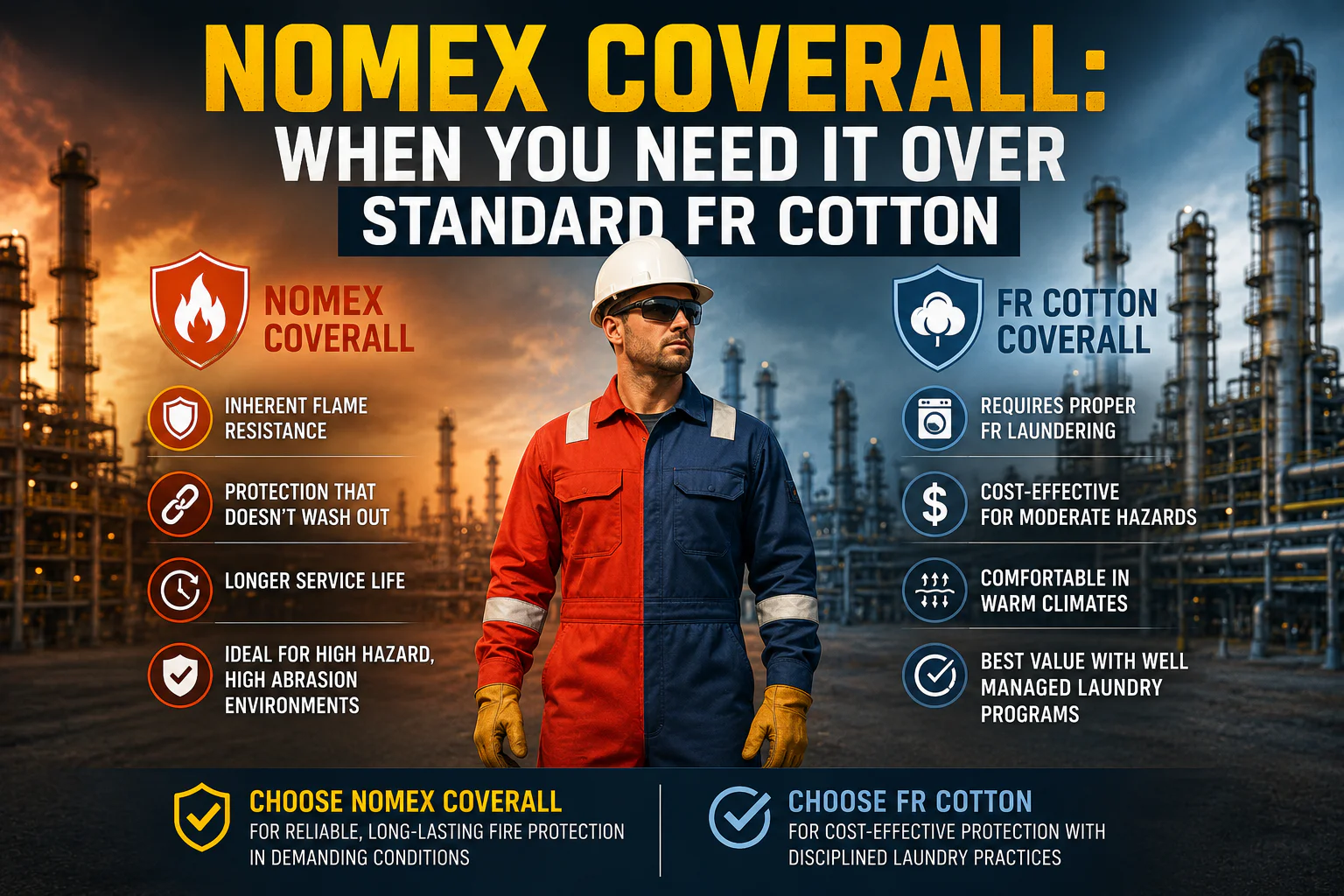
A Nomex coverall is made from an aramid fiber such that flame resistance is inherent in the fiber’s molecular structure rather than being the result of a surface treatment. This difference is more important than any figure given in a specification sheet. The fire resistance of a nomex coverall cannot be washed out, damaged by bleach, or become weaker as a result of repeated industrial laundering; it remains intact for the entire working life of the garment.
Standard FR cotton coveralls function in a different way. Ordinary cotton is used as the base fabric and is then chemically treated (usually by means of a Proban or Pyrovatex process) so that the fibers char and self-extinguish when they come into contact with a flame. The treatment works well under normal conditions, but it is a finish applied to the fabric and not a property of the cotton fiber itself. If the coveralls are washed with the wrong detergent, are exposed to hard water for a long time, or are sent through an industrial laundry that is not calibrated for FR garments, the protection breaks down more quickly than most safety managers anticipate.
Since 2009 Armstrong Products has been making industrial workwear such as its Nomex coverall and FR cotton coverall ranges, and the pattern observed among procurement teams is that buyers who understand the difference between fiber and treatment make better purchasing decisions than those who base their choices solely on the price per unit.
Obtain expert advice on choosing Nomex coveralls that match the specific hazard profile of your facility.
Nomex Coverall vs FR Cotton: The Core Tradeoff
The outcome in every comparison between Nomex and FR cotton depends on four factors: the severity of the hazard, the degree of laundering discipline, the climate, and the expected lifespan of the garment.
| Factor | Nomex Coverall | FR Cotton Coverall |
| Flame resistance source | Inherent to fiber structure | Chemical treatment on cotton base |
| Degrades with laundering | No | Yes, if care instructions are ignored |
| Typical garment lifespan | 3 to 5 years / 150+ industrial washes | 1 to 2 years / 50 to 100 washes |
| Upfront cost | 2 to 4 times higher | Lower |
| Breathability | Lower, heavier weave | Higher, more comfortable in heat |
| Best suited for | High-abrasion, unreliable laundering programs, long service life needs | Standard hazard exposure with controlled, well-run laundering programs |
In facilities where the laundering discipline is poor or where there is severe wear, a Nomex flame-resistant coverall has the lower total cost of ownership, whereas when the laundering procedure is well managed and the hazard level does not require an extra degree of durability, FR cotton is preferable in terms of comfort and initial cost.
When You Need a Nomex Coverall Over FR Cotton
There are three situations in which it is reasonable to switch to a Nomex coverall.
The laundering procedure cannot guarantee that the garments will be safe for use in fire-resistant applications. If the coveralls are sent to a general industrial laundry, which also cleans non-fire-resistant items, or if the workers take the clothes home and wash them using ordinary detergent, then the fire-resistant protection of the cotton is genuinely at risk. However, with a Nomex coverall, this risk is completely eliminated since there is no treatment to be stripped away.
Workers are frequently required to carry out tasks that involve a high degree of abrasion. Compared with FR cotton, Nomex maintains its form and is more resistant to tearing when subjected to daily heavy use. The teams involved in refinery turnarounds, welders, and those who climb structures or handle equipment place more mechanical stress on their clothing than the typical worker on the factory floor, and as a result, the abrasion resistance of the Nomex coverall means that its useful life extends well beyond that of a standard FR cotton coverall of the same age.
Your facility operates a lengthy garment replacement cycle. When your procurement cycle permits coveralls to be replaced only every three to five years, the extended service life of a nomex coverall eliminates the disadvantage caused by its higher unit cost. If FR cotton is purchased on the same replacement schedule, however, it will end up aging beyond the period in which it provides effective protection before the following order is placed.
When FR Cotton Is the Smarter Choice
A Nomex coverall isn’t the obvious or immediate solution, and considering the choice of fabric as a general improvement fails to take into account the actual operating constraints.
The laundering procedure is subject to control and audit. Facilities that carry out dedicated FR-certified industrial laundering, with written records of their wash cycles and no cross-contamination from non-FR garments, are able to obtain the full protective life from FR cotton without having to pay the Nomex premium.
Workers spend their entire shift in hot and humid conditions. Cotton fabric has better breathability. When workers in the Gulf region wear coveralls for twelve-hour shifts, this difference in comfort influences whether they keep the coveralls properly closed and wear them correctly, something that is more important for real safety outcomes than the fabric’s theoretical durability limit.
The budget is a consideration when it comes to a large number of workers. The cost of providing five hundred workers with nomex coverall clothing is considerably higher than the cost of ordering the same number in FR cotton. In cases where facilities have good laundering controls and face only a moderate level of hazard, it is usually more advisable to spend the budget on replacing the FR cotton more frequently together with more rigorous laundering audits.
Nomex Flame Resistant Coverall: Fabric Composition and Ratings
Most Nomex flame-resistant coverall garments use a blend rather than pure aramid fiber. A common composition is 93% Nomex, 5% Kevlar, and 2% antistatic fiber, which adds tear resistance from the Kevlar content and static dissipation for environments with flammable vapors.
These garments are usually tested and certified according to NFPA 2112 for protection against flash fire and to ASTM F1506 for electrical arc performance. The weight of the fabric varies from about 4.5 oz/yd² for the lighter summer-weight Nomex coverall garments to 6 oz/yd² or more for the heavier-duty ones. Since weight has an impact on both comfort and arc rating, a lighter Nomex coverall is not necessarily the safer option when carrying out high-incident-energy tasks.
With regard to electrical work, NFPA 70E establishes the incident energy thresholds that decide what hazard risk category a garment has to satisfy, and buyers should compare the ATPV (arc thermal performance value) rating on the Nomex coverall label with the incident energy calculated for the specific task, not merely with the job title of the person carrying it out.
Cost and Lifespan Comparison
Compared with FR cotton, the unit price of a Nomex coverall seems expensive when you consider the actual service life.
A Nomex coverall, although costing three to four times as much as a standard FR cotton coverall, lasts three to five years compared to the one to two years typical of FR cotton coveralls and thus closes most or all of the gap when the cost is considered on a per-year basis. The advantage of Nomex becomes even more clear when early replacement of FR cotton coveralls due to the loss of flame resistance from laundering is taken into account, since a facility that replaces its FR cotton coveralls after eighteen months because a compliance audit has detected degraded flame resistance is effectively paying for a complete garment cycle that it has never actually used.
The advantage that FR cotton has is in terms of cash flow; small operations or contractors who have tight monthly budgets for procurement are often unable to afford the higher per-unit cost of an order for a Nomex coverall, even though the total cost of ownership over a multi-year period is in favor of Nomex.
Climate and Comfort Factors for Gulf Buyers
The procurement teams dealing with Oman, Qatar, Kuwait, Saudi Arabia, and the UAE have to cope with a climatic factor that is not apparent when simply comparing items on the basis of cost or durability. Since temperatures in the area regularly go above 45°C for long periods, the way workers wear their coveralls changes, and this has a direct effect on their safety.
The advantage of FR cotton in terms of breathability is more significant under these conditions than in temperate climates, because if a worker has to unzip or loosen a hot and heavy Nomex coverall in order to deal with heat stress, they have in effect undermined the protective function of the garment. In response, some facilities specify lighter 4.5 oz Nomex coverall versions for use in the Gulf region, agreeing to a slightly reduced arc rating in order to improve wearability, while keeping the heavier Nomex weights for winter shift work or for use in indoor, climate-controlled processing areas.
The Armstrong facility in Boisar, Maharashtra, produces both its Nomex coverall and FR cotton coverall ranges and has experience in exporting to the Gulf markets, and for most Gulf field crews the recommendation is to decide on the fabric weight according to the specific role rather than adopting a single standard applicable to the entire facility.
Common Mistakes When Choosing Between Nomex and FR Cotton
To buy on the basis of price per unit rather than cost per year of service, a cheaper FR cotton coverall, which has to be replaced twice as often, is not in fact the cheaper option.
If it is assumed that Nomex eliminates the need for laundering audits, then although a Nomex coverall does not lose its flame resistance as a result of being washed, it can still be damaged, torn, or worn until its structural integrity is lost, and failing to carry out inspections on the grounds that “it’s Nomex” is in fact a mistake that occurs in the field.
Applying the same fabric weight in all climate zones. A nomex coverall weighing 6 oz., which is designed for a winter shift in Canada, is not the correct specification for use in Doha in the summer, and similarly, the coverall is not suitable for a summer in Doha.
If problems with FR cotton or cotton that has been treated are regarded as defects of the finished garment, then when FR cotton loses its protective properties as a result of incorrect washing, this is a failure in the laundering process, not evidence that the fabric is unreliable. Attributing the problem to the wrong factor causes facilities to unnecessarily increase their spending on conversions to Nomex when this does not address the real underlying cause.
Ignoring the ATPV rating check, a label on a Nomex coverall that states “Nomex IIIA” indicates the fiber, not the arc rating. You must always check the ATPV in relation to the incident energy calculation for the particular task.
Nomex Coverall Buying Checklist
- Confirm your facility’s actual laundering control level before assuming Nomex is necessary
- Check the ATPV rating against your calculated incident energy, not just the fabric name
- Pick the fabric weight according to the work conditions. Lighter coveralls are a better fit for hot environments, while colder locations or high-arc-risk areas may need heavier materials.
- Check the Nomex coverall labels before buying to make sure NFPA 2112 and ASTM F1506 certifications are included.
- For large quantity orders, ask the supplier for test reports that show how the fabric performs for color retention and shrinkage.
- Do not look only at the purchase price. Consider how long the coveralls are expected to last and calculate the cost over their service life.
- If workers are exposed to flammable vapors, confirm that the fabric includes the required antistatic properties.
- For larger teams, discuss options like OEM branding and custom sizing with your supplier before placing the order.
Industry Applications
Nomex coveralls are most frequently used in the oil and gas refining industry, in petrochemical processing, in work carried out by electrical utilities, and in welding situations, since the combined effects of heavy abrasion, the risk of flash fire, and the need for a long service life make the higher durability a worthwhile investment. In general manufacturing, in construction, and in lighter industrial maintenance jobs, FR cotton coveralls are still widely used because, although there is a real level of hazard the exposure is not severe, and as long as a good laundering procedure is followed, the treated fabric continues to perform as it was designed to.
Maintenance Tips for Nomex Coverall and FR Cotton Garments
No matter how many times it is washed, a Nomex coverall maintains its flame resistance, but proper care will still help to extend its useful life. It is necessary to avoid using bleach and fabric softeners on any flame-resistant garment since both of these substances have the effect of interfering with the fabric’s protective properties over time; in the case of flame-retardant cotton, this interference actually removes the protection, while with Nomex, it mainly reduces the garment’s comfortable lifespan by causing fiber wear. The seams, zippers, and cuffs should be inspected at regular intervals rather than only when damage is obviously apparent. The coveralls should be stored away from direct sunlight and excessive heat because such conditions can cause both types of fabric to break down after many years of being stored between shifts.
Conclusion
Choosing between a Nomex coverall and FR cotton is not as simple as saying one is better than the other. The right choice depends on what the garment has to handle every day, the type of hazard, how it is cleaned, the working environment, and how much the facility can spend on replacements. Nomex is often preferred where garments see heavy use, washing practices are hard to control, or protection needs to last longer. For workplaces with a proper FR laundering process and moderate risk, FR cotton can be a better option.
Armstrong Products manufactures both Nomex coverall and FR cotton coverall lines from its Boisar, Maharashtra facility, built to NFPA 2112 and ASTM F1506 standards, with export experience across US, UK, Canadian, and Gulf markets. If you’re weighing this decision for your own facility’s specifications, talk to our product team for guidance matched to your exact hazard profile.
Talk to Armstrong’s product experts to get the right Nomex coverall or FR cotton spec for your facility.
FAQs
What is the main difference between a Nomex coverall and an FR cotton coverall?
The flame resistance of a Nomex coverall comes from the fiber itself, and this resistance never wears out or deteriorates. FR cotton begins as regular cotton and then undergoes a chemical treatment, although this treatment can lose its effectiveness over time if the cotton is washed in the wrong way or is exposed to bleach and hard water.
How long does a Nomex coverall typically last?
With proper care, most Nomex coverall garments last for three to five years or about 150 or more industrial washes, whereas a standard FR cotton coverall used under the same conditions only lasts for one to two years or 50 to 100 washes.
Is a Nomex coverall worth the extra cost?
The initial cost is often offset over the course of a multi-year service period, particularly in places where there is a lot of abrasive work or in laundries that cannot guarantee consistent washing that is safe with respect to flame resistance. In contrast, facilities that have controlled laundering procedures and involve lower levels of hazard are likely to find that FR cotton offers better value.
Does a Nomex coverall protect against chemical splashes?
It is not inherent; while a Nomex coverall offers protection against flame and arc, it does not act as a chemical-barrier garment by itself. Facilities that face a risk of chemical splashes as well as the hazard of a flash fire generally require extra layers or a specialized outer garment that is resistant to chemicals.
Which is more breathable, Nomex or FR cotton?
Cotton fabric is usually more breathable and comfortable in hot and humid conditions, a fact that is important when people are working long shifts in the Gulf region. Although Nomex has a heavier weave, it gives up some breathability in order to achieve greater durability and resistance to abrasion.
Can FR cotton coveralls lose their flame resistance over time?
Yes, the flame resistance of FR cotton can be lost if the garment is washed improperly, is exposed to bleach, is used in hard water, or goes through a large number of industrial wash cycles. With a Nomex coverall, however, this problem is completely avoided since its flame resistance is inherent to the fiber and not added afterwards.
What certifications should a Nomex coverall carry?
Seek out certification according to NFPA 2112 for protection against flash fire and that provided by ASTM F1506 for electrical arc rating, together with a visible ATPV rating that matches the incident energy calculated for the task for your facility.
Do refinery workers need a Nomex coverall specifically, or does FR cotton work?
Nomex coveralls are often worn in refinery settings since they provide protection against the risk of flash fire, endure high levels of abrasion when handling equipment, and are suitable for the long durations of shifts. In some facilities where there are strict laundering controls, FR cotton has been successfully used in lower-risk refinery positions, but most of the turnaround and maintenance teams still gain from the durability of Nomex.
Is there a lighter-weight nomex coverall option for hot climates?
Yes. Lighter fabric weights around 4.5 oz/yd² are available and commonly specified for Gulf field crews, trading a slightly lower arc rating for improved wearability in high-temperature conditions.
Can Nomex and FR cotton be layered together for higher protection?
Layering is possible and can raise the overall protection category, but the combined rating must be tested as a complete system by the manufacturer rather than assumed by simply adding individual garment ratings together.