An electrician who was responsible for maintenance at a refinery on the Gulf Coast once said to a safety auditor that his team kept two suits in the locker: everybody took the 40-cal suit by default, while no one wanted to wear the 100-cal suit since it made what should have been a ten-minute panel job seem as long as an hour in a sauna. The issue wasn’t with the equipment itself, but with no one having matched up either suit with a real incident energy figure. It is precisely between ‘the suit that we have’ and ‘the suit that the job actually needs’ that both most arc flash injuries and most of the wasted PPE budgets arise.
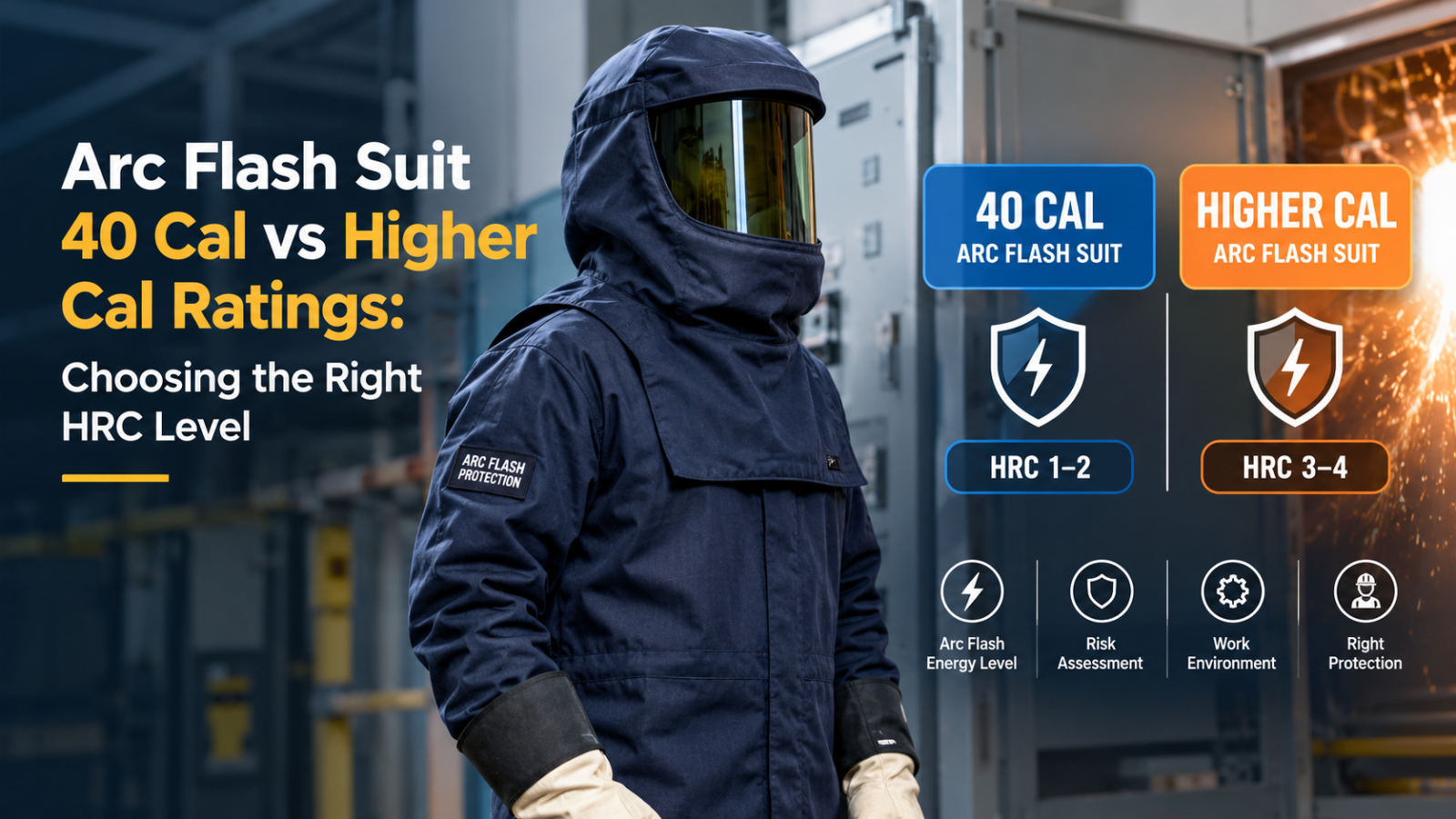
An arc flash suit 40 cal rating is suitable for many types of industrial electrical work, but that does not mean it will work for every panel, switchgear lineup, or voltage level. The actual protection needed depends on the conditions at your facility. This guide explains what a 40-cal rating covers, where it may not be enough, and when it makes sense to choose a higher-rated arc flash suit instead.
What a 40 Cal Arc Flash Suit Protects Against
The figure on the label is a calorie rating in cal/cm² and indicates how much thermal energy the fabric can absorb before there is a 50% chance the person wearing it will suffer a second-degree burn underneath. This is determined by the ASTM F1959 arc rating test, and the resulting figure is recorded as either the garment’s ATPV (Arc Thermal Performance Value) or EBT (Energy Breakopen Threshold), whichever is lower.
A rating of 40 cal/cm² is at the upper end of the range most facilities require for normal operations, and it is the lowest threshold NFPA 70E designates for PPE Category 4, the highest category. Tasks below this figure fall under Categories 1 to 3, while those above it fall into a specialized, less common area.
An arc flash suit 40 cal setup typically includes a jacket and bib overall or a full coverall, a hood with a face shield, gloves, and voltage-rated undergarments. It does not, on its own, protect against arc blast pressure, flying debris, or molten metal projectiles. Those are separate hazards that the calorie rating was never designed to address.
Where the 40 Cal Ceiling Comes From
There was a practical rather than an arbitrary reason why the NFPA’s technical committee set the standard PPE table at 40 cal/cm². Suits designed for exposure levels well above this figure become so heavy, bulky, and restrictive that workers are less likely to wear them properly or indeed at all. The committee compared this risk with the thermal risk and decided that 40 cal was the level at which the standard task tables come to an end.
It doesn’t follow that there are no higher-rated suits available; suits with ratings of 60, 100, and even 140 cal/cm² are in fact made and sold for use in facilities where the incident energy exceeds the Category 4 baseline figure. They are merely not included in the standard task tables and instead require a documented incident energy analysis to support their use.
NFPA 70E PPE Categories and HRC Levels
In the industry the terms “HRC” (Hazard Risk Category) and “PPE Category” are often used as if they were the same, although NFPA 70E switched to using “PPE Category” in its more recent versions. In either case, there are four levels:
| PPE Category (HRC) | Minimum Arc Rating | Typical Task Examples |
| Category 1 | 4 cal/cm² | Panel inspection, low-voltage cover removal |
| Category 2 | 8 cal/cm² | Motor control center work, 480V operations |
| Category 3 | 25 cal/cm² | Switchgear work, transformer maintenance |
| Category 4 | 40 cal/cm² | High-energy work, utility switchgear, substations |
The table plays a central role in the majority of decisions concerning the purchase of arc flash suits, but it should be regarded as merely a starting point rather than the final answer. Two establishments that are both engaged in ‘Category 4’ work may still require different suits since the actual incident energy in the switchgear at one site could be 42 cal/cm², while at another it is 130 cal/cm².
When a 40 Cal Arc Flash Suit Is Enough
A 40-cal arc flash suit that fits properly is sufficient for the vast majority of industrial electrical tasks. This applies to most work on motor control centers, to the maintenance of panels on systems up to 480V having typical fault currents, to general inspections of switchgear, and to routine electrical maintenance in manufacturing plants.
When the arc flash study is carried out at your facility or the equipment labels indicate that the incident energy is at or below 40 cal/cm², the standard and most cost-effective option is to use a suit that is rated for Category 4 at that exact threshold. Since most workers are able to move, kneel, and reach within a 40-calorie suit without experiencing the fatigue associated with heavier-duty gear, this is important for tasks that take more than a few minutes.
When You Need to Go Beyond 40 Cal
In some cases the incident energy figures are so high that they exceed what a 40-cal suit is capable of covering. Utility substations, large switchgear installations on systems with high fault currents, and some particular types of industrial power distribution arrangements can have incident energy well over 40 cal/cm², at times reaching 60, 100, or even 140 cal/cm².
You should never decide to go beyond a 40-cal arc flash suit by guessing; instead, the decision must be based on one of two things: an incident energy analysis carried out by a qualified engineer or the equipment labeling that states a required cal rating higher than 40. In either case, if the result is above 40 cal/cm², a suit with a higher rating is not optional; it is the minimum legal and practical requirement for the task.
Here’s a cautionary point, one that the NFPA has specifically dealt with: when the incident energy exceeds about 40 cal/cm², there becomes a real risk of arc blast, involving pressure waves and the ejection of molten metal, a hazard that thermal personal protective equipment alone is not capable of fully covering. The safer engineering solution at that stage is usually to reduce incident energy by improving coordination of protective devices or using remote switching, rather than relying on a larger suit.
40 Cal vs 60/100/140 Cal Comparison Table
| Cal Rating | Typical Weight | Common Applications | Mobility Impact |
| 40 cal/cm² | 8-12 lbs (full setup) | MCCs, general switchgear, plant maintenance | Moderate, workable for most tasks |
| 60 cal/cm² | 12-16 lbs | Larger switchgear, some utility work | Noticeably reduced dexterity |
| 100 cal/cm² | 18-25 lbs | Utility substations, high fault current systems | Significant, short-duration tasks only |
| 140 cal/cm² | 25+ lbs | Extreme exposure, rare specialized applications | Severe, moon-suit-level restriction |
Rising from 40 cal to 100 cal represents a considerable increase in comfort. It about doubles the amount and weight of the equipment that the worker has to carry, and it changes the whole character of the task from “working while wearing PPE” to “having a short exposure and then removing the suit.”
Weight, Mobility, and Heat Stress Tradeoffs
When buyers choose a higher cal rating than necessary out of caution, they often end up causing a different kind of safety problem: heat stress. A worker wearing a 100-cal suit when carrying out a task that is intended for a 40-cal environment will heat up more quickly, move more slowly, and have a worse view through a fogged face shield. All of this does not make the job safer.
The proper course of action is to match the suit to the documented hazard rather than automatically choosing the highest rating available. When your incident energy analysis indicates 38 cal/cm² at a particular point, a 40 cal arc flash suit is the right and safer option compared to a 100-cal suit since it provides protection against the real hazard without imposing an unnecessary heat load or restricting movement.
How to Determine Your Required Cal Rating
Step 1: The first step is to look at the labels on the existing equipment. Arc flash labels indicating the incident energy or the PPE category are usually found on modern electrical panels and thus represent the quickest way to get an answer.
Step 2: In step 2 you must request or arrange for an incident energy analysis, during which a qualified engineer determines the arc flash energy at various points in your electrical system by taking into account the fault current, the clearing time, and the working distance; this results in a precise figure in cal/cm² rather than a range of categories.
Step 3: In step 3 you should refer to the NFPA 70E task tables. If there is no site-specific study available, the task-based tables in the standard give default PPE category assignments for typical jobs, even though these are more conservative than those obtained from a study carried out for a particular facility.
Step 4: In step 4 you need to consider possible future changes. Changes such as equipment upgrades, an increase in the load, or modifications to the protective devices can affect the incident energy figures. A suit bought in accordance with last year’s study might not correspond to this year’s actual hazard.
Buying Checklist
- Check the required cal rating against a current incident energy analysis or the equipment label. Do not choose the rating based on an estimate.
- Look at the garment label and make sure it shows ASTM F1506 compliance along with a current ATPV/EBT rating.
- Check the hood, face shield, and gloves too. Their ratings should match the suit’s level of protection, rather than checking the jacket alone.
- Check the fit and make sure workers can move comfortably before placing a bulk order, especially when buying suits rated above 40 cal.
- Make sure the undergarments being used with the suit are voltage-rated and made from non-melting fabric.
- Ask the supplier for testing records from the actual production lot rather than relying only on the product specification sheet.
- Keep re-inspection dates in your plan, and budget for replacement when the suit reaches the end of its usable life.
Common Mistakes When Choosing Arc Flash Suit Cal Ratings
One common mistake is simply choosing the highest cal rating available instead of looking at the actual hazard. A heavier suit can add unnecessary heat and discomfort without giving workers any extra protection if that level of protection is not required. The next most common mistake is to treat the jacket’s rating as the suit’s overall rating when the hood or gloves have a lower rating, which reduces overall protection to the weakest part. It is also possible to end up with insufficient protection for facilities with older equipment or higher-than-normal fault currents by omitting the incident energy study and relying instead on general task tables. Furthermore, buyers often fail to realize that putting on two garments with lower ratings does not simply mean adding the two ratings together; layer combinations have to be tested and rated as a system.
Industry Applications by Cal Rating
Because refinery process areas and substations next to utility installations have different levels of exposure, oil and gas facilities often need both 40-cal and higher-rated suits on site. Most motor control and panel work in manufacturing plants is carried out using suits in the 40 cal range. Since higher fault currents are involved, utility and power distribution operations are most likely to call for suits rated above 40 cal. At mining and heavy industrial sites there is a great deal of variation, and therefore they should base their choices on studies specific to the facility rather than on general industry recommendations.
Maintenance and Inspection Tips
Check each suit both before and after it has been used for any tears, contamination, or damage to the closures. Carry out the washing instructions provided by the manufacturer precisely, since using the wrong detergent or wash temperature can reduce the arc-rated fabric’s performance throughout the life of the garment. Keep the suits away from direct sunlight and store the hoods separately so as not to crush the face shield. Replace the garment when the labels become unreadable or when the number of recommended wash cycles has been reached.
Conclusion
Do not choose an arc flash suit just because it has a higher cal rating. Start with the incident energy value for the equipment and choose the suit around that requirement. For most industrial electrical work, a 40-cal arc flash suit provides the protection needed. If the incident energy is higher than that, then a higher-rated suit may be necessary. Once the actual hazard is known, the rest of the selection becomes much easier.
Armstrong Products has manufactured industrial workwear since 2009, with production in Boisar, Maharashtra, and a corporate office in Powai, Mumbai. If your facility needs arc flash suits across a range of cal ratings for different work zones, talk to our product team about matching your incident energy study to the right garment lineup.
FAQs
What does the “40 cal” in arc flash suit 40 cal actually mean?
The figure is 40 calories per square centimeter of thermal energy that the garment can absorb without there being a significant risk of a second-degree burn to the wearer, according to testing carried out in accordance with ASTM F1959.
Is a 40-cal arc flash suit the same as HRC 4?
The 40 cal/cm² figure is the minimum requirement for NFPA 70E’s PPE Category 4, this category being the current name for what was previously known as Hazard Risk Category 4; the terms refer to the same level of protection.
When should I choose a higher cal rating than 40?
Go for a higher-rated suit when the documented incident energy at the equipment is above 40 cal/cm². The required level should come from an incident energy analysis or the equipment label, not an estimate. Utility substations and switchgear with high fault currents are examples where a rating above 40 may be needed.
Does a higher cal rating always mean better protection?
Although higher cal ratings offer better protection against thermal energy, they do so at the cost of added weight, reduced mobility, and greater heat stress; wearing a suit rated considerably above your actual hazard level does not make the task safer and may even introduce new risks.
Can I layer a 20-cal jacket with a 20-cal shirt to get 40-cal protection?
Test and evaluate the garments as a system. It is not possible to obtain a reliable combined rating by simply adding together the two individual arc ratings.
What standard governs arc flash suit testing?
The performance requirements for flame-resistant and arc-rated protective clothing are defined by ASTM F1506, the arc rating being determined using the ASTM F1959 test method.
Do arc flash suits protect against arc blast pressure?
Thermal-rated PPE protects against burn injury from heat exposure. It does not protect against the pressure wave, sound blast, or flying molten metal that can accompany a high-energy arc flash event, particularly above 40 cal/cm².
How often should an arc flash suit be replaced?
Replace the suit when any damage compromises protection, when the manufacturer’s recommended wash cycle limit is reached, when labels become illegible, or when standards change in a way that affects compliance.
What’s included in a full 40-cal arc flash suit kit?
A complete kit typically includes an arc-rated jacket and bib overall or coverall, a hood with a face shield, arc-rated gloves, and compatible voltage-rated undergarments.
Who performs the incident energy analysis needed to choose a cal rating?
A qualified electrical engineer with arc flash study experience performs this analysis, following NFPA 70E guidelines and site-specific electrical system data.