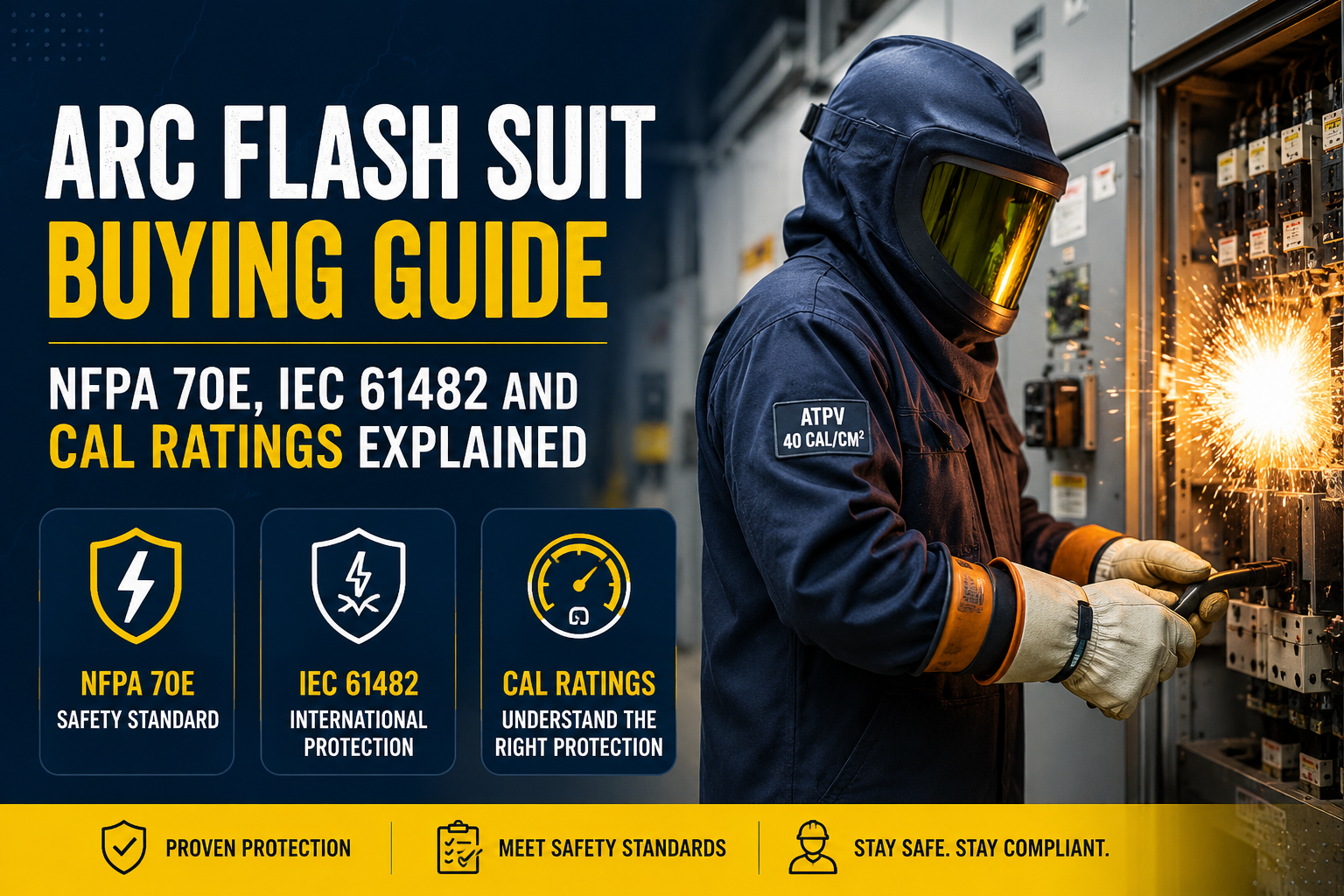
A worker at a substation is given a suit rated at 12 cal/cm². The panel that he is going to open has an incident energy of 27 cal/cm², and the figure had not been verified against the label before the work began. It is actually the gap, not the arc, that leads to most arc flash injuries.
An arc flash suit is a complete protective clothing system, typically consisting of a jacket, bib overalls or pants, and a hood, which is designed to withstand the heat and light from an electrical arc for long enough to allow the person to get to safety. The figure on the label, given in cal/cm², indicates the amount of thermal energy that the suit can absorb before it ceases to protect the skin beneath. Two standards dictate how this value is determined: NFPA 70E in North America and IEC 61482 in Europe and most of the Gulf countries. However, they do not measure the same thing in the same way, and many buyers think that they do.
The guide explains what the cal rating really means, how NFPA 70E’s four PPE categories function, how IEC 61482’s APC classes compare, and the checks you should make before signing a purchase order for a batch of arc flash suits.
What Is an Arc Flash Suit
An arc flash suit guards the worker against the thermal energy emitted during an electrical arc and not against electric shock itself since the two dangers are different and call for different types of protective equipment. An arc can raise the temperature of the air above 19,000°C in a very short time, causing metal to vaporize and throwing molten droplets along with the heat. While a conventional flame-resistant shirt can help in the case of a fire, an arc flash suit is specially constructed and tested so that it can withstand that kind of thermal surge.
The suit is typically constructed from a blend of Nomex, modacrylic, or aramid and may be layered according to its rating; it is available in either a jacket and pants form or as a bib combination with a separate hood that is rated for arcs and includes a face shield. Since higher caliber ratings usually indicate a heavier and more insulated build, it is important to match the rating to the specific job rather than purchasing the highest rating possible. A worker using a 40 cal suit for ordinary 8 cal work would be experiencing unnecessary heat stress and having reduced mobility with no increase in safety.
Understanding Arc Ratings: ATPV, EBT, and Cal/cm²
The number found on every arc flash suit label, expressed in cal/cm², is based on one of two laboratory measurements.
The ATPV (Arc Thermal Performance Value) is the amount of incident energy at which there is a fifty percent chance that the fabric will transmit enough heat to cause a second-degree burn without the fabric itself breaking open.
EBT (Energy Breakopen Threshold) comes into effect when the fabric breaks down as a result of thermal stress before it has reached its insulating limit. The figure that is lower, either the ATPV or the EBT, is the one that appears on the garment.
A third value, ELIM (Incident Energy Limit), appears on garments that have been tested according to the more recent versions of either standard. It represents the energy level at which there is a 0% chance of a second-degree burn, which means that it is always a more conservative figure than either ATPV or EBT. When a supplier provides you with both an ATPV and an ELIM value for the same garment, you should use the ELIM number to ensure a greater safety margin.
By themselves none of these figures have any significance; it is only in comparison with the incident energy that your equipment is actually capable of producing that they become important, which is how the various categories function.
NFPA 70E and Arc Flash PPE Categories
The US standard for electrical safety in the workplace, NFPA 70E, includes in Table 130.5(C) a system of personal protective equipment (PPE) categories based on the task, which employers may apply in the event that a complete incident energy study has not been carried out. This should be regarded as a conservative remedy and not as a substitute for a proper engineering evaluation when fault currents are high.
| PPE Category | Minimum Arc Rating | Typical Required Gear |
| Category 1 | 4 cal/cm² | Arc-rated shirt and pants or coveralls, face shield |
| Category 2 | 8 cal/cm² | Arc-rated clothing, balaclava or hood, and a face shield |
| Category 3 | 25 cal/cm² | Full arc flash suit (jacket and pants or bib), arc-rated hood |
| Category 4 | 40 cal/cm² | Heavy multi-layer arc flash suit, arc-rated hood, full coverage |
The category that a task belongs to is determined by the incident energy at the worker’s location as calculated according to IEEE 1584, not by the worker’s job title or by how routine the task appears. Wearing a Category 2 suit when carrying out a Category 4 job does not provide partial protection; it fails at the level that is specified for it, and that level is well below the amount of energy that the equipment can release.
In the United States OSHA does not have a separate arc flash PPE regulation; rather employers satisfy the requirement by means of 29 CFR 1910.132, the general rule on PPE hazard assessment, and also by means of 29 CFR 1910.269 in the case of work involving electric power generation, transmission, and distribution. NFPA 70E addresses the practical gap by specifying how the assessment and the selection of PPE should actually proceed.
IEC 61482 and the European Arc Protection Class System
Outside North America, arc-rated garments are tested in accordance with IEC 61482, the standard dividing into two separate test methods that cannot be easily converted into one another.
IEC 61482-1-1 (Open Arc method): The ATPV, EBT, or ELIM values obtained by the Open Arc method according to IEC 61482-1-1 are given in kJ/m² and can be converted into the more familiar cal/cm² figure; this method is the one that is closer to the American testing approach.
IEC 61482-1-2 (Box Test method): According to the IEC 61482-1-2 (Box Test method), a garment is assigned APC 1 (having been tested with an arc of 4 kA, approximately 168 kJ) or APC 2 (having been tested with an arc of 7 kA, approximately 320 kJ). The outcome is either a pass or a fail rather than being on a graded scale, and this type of classification is the most commonly used in procurement specifications in Europe and in the Gulf region.
A garment that has been tested using the Box method and has an APC 2 rating cannot be taken as being equivalent to a particular NFPA 70E category since the two methods involve different arc geometries and yield non-comparable results, a kind of detail that is often overlooked when a buyer based in the Gulf refers to a US specification sheet.
NFPA 70E vs IEC 61482: Quick Comparison
| Basis | NFPA 70E (US) | IEC 61482 (EU / Gulf) |
| Governing body | National Fire Protection Association | International Electrotechnical Commission |
| Test methods | Open arc, ATPV/EBT | Open arc (1-1) and Box test (1-2) |
| Rating unit | cal/cm² | kJ/m² (Open arc), APC 1 or 2 (Box test) |
| Result type | Continuous scale | Continuous scale (1-1) or pass/fail class (1-2) |
| Where it’s used | United States | EU, UK, and widely referenced across Gulf procurement specs |
| PPE category system | Table 130.5(C), Categories 1-4 | No direct category equivalent |
When a procurement specification refers to standards applicable to the same shipment, you should ask the supplier to provide separate test certificates instead of accepting a single claim stating ‘IEC 61482 and NFPA 70E compliant’ with no numbers given. That one-line claim, lacking a laboratory report to support it, is one of the most common shortcuts that less capable suppliers adopt.
How to Choose the Right Arc Flash Suit for Your Job
Start With the Incident Energy, Not the Job Title
The right starting point should always be the incident energy at the worker’s location, not an estimate made because the task seems ordinary or not. If there is an arc flash study and the equipment is labeled, then the label will directly state the required category or the incident energy value. However, if no such study has been carried out, the task-based table in NFPA 70E provides a conservative starting point, even though it does not take the place of a proper study when dealing with high-fault-current systems.
Garment Rating vs System Rating
It is in this area that many purchase orders go wrong. The arc rating stated on a jacket refers to the rating obtained when that particular jacket is tested by itself. When a worker wears a jacket made by one manufacturer with pants from a different manufacturer, the combined outfit does not automatically receive either of the two garments’ individual ratings. A multi-layer system must have its own rating that has been tested and certified for that specific combination. A suit assembled by combining components without first having a verified assembly rating will appear to be compliant in writing but will not actually be compliant in reality.
Wherever possible, if your buying process involves providing a large crew, stick to complete kits from one manufacturer or obtain written system-rating documentation for any combination that involves more than one manufacturer before the equipment ships.
Fabric and Construction
Suits that have a rating of 25 cal/cm² or higher generally use a blend of Nomex and Kevlar or of modacrylic and aramid. Blends with higher performance reduce the weight of the garment at any given level of protection, a factor that is important in Category 3 and 4 work since heat stress and mobility become real operational concerns, not merely comfort issues. FR-treated cotton is a fabric that has been treated rather than one that is naturally resistant, and the treatment breaks down with frequent washing, so it is not suitable on its own as a main material for a primary arc flash garment, even though it may be included as one layer in a blend.
Arc Flash Suit Procurement Checklist
Before you approve a purchase order for arc flash suits, confirm:
- The cal/cm² rating on the quote matches the incident energy or PPE category from your site’s arc flash study
- Whether the rating is ATPV, EBT, or ELIM, and which one the supplier is quoting against
- A system rating certificate exists for the exact jacket, pant, and hood combination being shipped, not three separate component ratings
- The test standard used (NFPA 70E/ASTM F1959 or IEC 61482) matches what your site’s compliance program actually requires
- Fabric composition and GSM, since these affect both protection level and wearability in Gulf heat conditions
- Sizing range covers your full crew, including any workers who’ll need larger hoods or extended-fit garments
- Laundering and care instructions are documented and can realistically be followed on site
- The supplier can provide the actual lab test report, not just a compliance statement on the product page
Common Mistakes When Selecting Arc Flash Suits
When buyers take the highest Cal rating available, they assume that more protection always means it is safer; this is not the case. Wearing a 100 cal suit when carrying out an 8 cal task causes heat stress and restricts movement without providing any corresponding increase in safety, and workers who find the equipment uncomfortable are more likely to leave some of it out.
A common mistake is to regard the statement “certified under NFPA 70E and IEC 61482” as a general claim rather than determining which standard applies to each garment and asking for the actual test data; another mistake is to assume that the rating of a jacket is automatically transferred when it is worn with pants from a different product line, even though, as has already been explained, this is not the case without a verified system rating.
Industries That Require Arc Flash Suits
Arc flash suits are used in any situation where workers are working on energized electrical equipment that has a fault current above a certain threshold. This applies to power generation and transmission utilities; to oil and gas installations that use high-voltage switchgear; to petrochemical plants; to manufacturing sites having industrial control panels; to data centers; and to maintenance contractors who carry out work on substations or on LT/HT panels. It is typically the facility and safety managers in these industries who arrange for arc flash suits to be purchased, usually as part of wider FR workwear and PPE programs.
Maintenance and Inspection of Arc Flash Suits
Because arc-rated fabric breaks down due to use, contamination, and incorrect washing, a suit should not be bought once and then forgotten. Each time the clothing is used, it should be inspected for any tears, signs of the fabric wearing thin, or damaged stitching, as a hole weakens the level of protection rated at that particular place even if the rest of the garment is in good condition. The specific washing instructions provided by the manufacturer should be followed rather than general guidelines for workwear, since fabric softeners and some detergents can decrease the fabric’s arc resistance over time. Garments that are damaged must be removed from service and either had professionally repaired using matching arc-rated material or replaced, not simply patched with ordinary fabric.
Conclusion
When selecting an arc flash suit, you should match a documented cal rating to a documented hazard rather than choosing the highest rating listed on a supplier’s catalog page. Since NFPA 70E and IEC 61482 carry out the testing for ratings in different ways, it is at the stage when a procurement process treats “certified to both” as a single, interchangeable claim that the majority of compliance gaps begin. Most of the problems that occur in practice can be avoided by making sure the incident energy figure is correct, by checking whether you are obtaining a rating for an individual garment or for a tested system, and by asking the suppliers for the actual laboratory report rather than a marketing statement.
Armstrong Products have been making industrial protective workwear since 2009, with their manufacturing carried out at a facility in Boisar, Maharashtra, and their corporate activities based in Powai, Mumbai. For any teams that are sourcing flame-resistant and arc-rated workwear for use in the oil and gas, utility or industrial sectors as part of their procurement programs, and the Work Wear range, as well as our previous guide on IFR Coveralls versus FR Coveralls, provides the information regarding fabrics and certification that goes with all of the above. Should you be looking at potential suppliers for an arc flash PPE program, you should contact our team to go over the specifications of your site.
FAQs
What is the difference between flame-resistant clothing and an arc flash suit?
Flame-resistant (FR) clothing has the property of self-extinguishing and of resisting ignition caused by flame contact, though it is not always tested for thermal energy from an arc flash. An arc flash suit is a particular type of FR clothing that has undergone testing according to ATPV, EBT, or APC standards set out by NFPA 70E or IEC 61482, resulting in it having a documented cal/cm² or class rating for arc exposure. All arc flash suits are flame resistant, but not all FR garments are considered to be arc rated.
What cal rating should I have?
The incident energy at each working location is given by the arc flash risk assessment carried out in accordance with IEEE 1584 and recorded on the equipment labels. The figure obtained or the PPE category that it corresponds to in NFPA 70E’s task table shows you the minimum CAL rating that is required. Trying to determine this solely from the voltage level omits the fault current and clearing time factors, which are the ones that actually influence the calculation.
Can I mix an arc flash jacket and pants from different brands?
If you do it without having a verified system rating, you will no longer possess a certified combination even though each component has its own individual rating. The more secure method is to buy complete kits from a single manufacturer or to obtain the documented test data for the system rating relating to the specific combination before using it.
Is IEC 61482 accepted in the Gulf region?
IEC 61482 is frequently cited in procurement specifications throughout the Gulf, particularly in connection with projects that follow European engineering standards or those involving EPC contractors operating in both regions. Furthermore, some Gulf operators also refer directly to NFPA 70E, especially on projects where engineering supervision is provided by people in the United States, so it is necessary to check the list of approved standards for the particular project before placing an order to prevent a mismatch.
Does a higher cal rating always mean better protection?
The higher the rating, the greater the thermal protection, but it generally also means that the garment is less mobile and more bulky. If a task is overrated, this will cause heat stress. restrict movement and provide no corresponding safety benefit since the aim should be to match the suit to the real hazard rather than trying to maximize the number.
What’s the difference between ATPV and EBT?
ATPV is the temperature at which heat passing through the fabric would cause a second-degree burn, while EBT is the temperature at which the fabric breaks open physically under thermal stress before it reaches that insulating limit. The value that is lower is taken as the garment’s official rating since this is the failure mode that would actually happen first.
How often should arc flash suits be replaced?
Arc-rated clothing does not have a definite expiry date, but it should be removed from service as soon as the fabric shows signs of tearing; thinning; contamination that cannot be removed by washing; or damaged seams. The real service life of such garments is more determined by regular inspection prior to each use together with washing according to the manufacturer’s specifications than by referring to a calendar date.
Do arc flash suits protect against electric shock?
An arc flash suit offers protection against thermal burns caused by the heat and light generated during an arc event; it does not act as electrical insulation in the case of a shock. Protection against shock is provided by separate rubber insulating gloves and sleeves, which are rated for the system voltage and are worn either underneath or alongside the arc-rated garments.
What’s required at Category 3 versus Category 4 under NFPA 70E?
A system rated at 25 cal/cm² is required in the case of Category 3, usually consisting of a complete arc flash suit jacket and pants together with an arc-rated hood. For Category 4 the minimum rating is 40 cal/cm², and this is achieved using heavier materials, frequently involving a multi-layer construction, the suit still comprising a full jacket, bib or pants and a hood. The difference between the two categories shows a considerable rise in the amount of incident energy that the equipment can generate, not merely an extra margin of safety.
Who typically specifies arc flash suits in a procurement process?
The technical specifications are generally the responsibility of safety managers and HSE teams, who base their work on the site’s arc flash study, while the procurement or purchasing teams look after the evaluation of suppliers, the handling of large quantities, and the delivery schedules. For EPC and contractor projects, the client’s approved vendor list or engineering standard determines the test standard the supplier must meet.