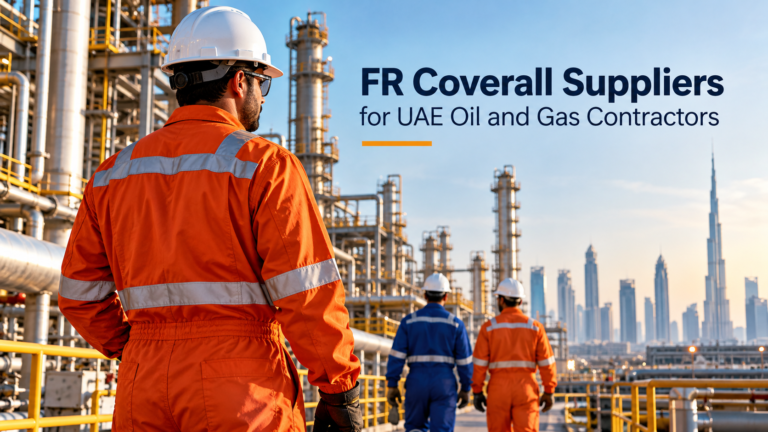

A flash fire in a refinery is often over in three seconds. What a worker has on at that moment decides whether they walk away or spend months in a burn unit. That single fact is why fire-retardant clothing sits near the top of every safety procurement checklist for oil, gas, and petrochemical sites across Saudi Arabia.
For buyers sourcing PPE for the Kingdom, the decision is not just picking a coverall with an “FR” label. It means checking fabric science, reading certification paperwork correctly, and confirming a supplier can actually manufacture at the volume a project needs, on schedule, batch after batch.
This guide walks through what procurement teams, safety managers, distributors, and importers should verify before placing a purchase order for fire-retardant clothing in Saudi Arabia. It also covers inherently fire-retardant (IFR) coveralls, a specification that comes up often in GCC oil and gas tenders and applies equally to buyers in the UAE.
Why fire-retardant clothing matters on Saudi oil and gas sites
Saudi Arabia’s industrial sector runs on hydrocarbons, and hydrocarbon work carries a specific hazard: flash fire. A flash fire can start in seconds when vapor from oil, gas, or petrochemical processing meets a spark. Ordinary cotton or polyester workwear can melt onto skin or continue burning after the flame source is gone. Fire retardant clothing is built to self-extinguish and limit how much heat reaches the body.
Regulatory pressure is rising, not falling
The Saudi Standards, Metrology and Quality Organization (SASO) has expanded its enforcement of fire safety requirements across industrial sectors in recent years. The Kingdom’s High Commission for Industrial Security (HCIS) also holds specific expectations for flame-resistant clothing on regulated sites. For a procurement team, this means fire-retardant clothing is no longer a discretionary safety upgrade. It is a compliance requirement tied to site access, insurance terms, and contractor eligibility on many EPC and operator tenders.
Arc flash and welding add another layer of risk
Flash fire is not the only hazard on a Saudi industrial site. Electrical work brings arc flash exposure, and welding or fabrication work brings sparks and molten metal splash. A single coverall rated only for one hazard may leave a worker unprotected against another. Buyers should map the actual job task to the hazard, not assume one FR garment covers every risk on site.
A larger workforce raises the stakes for procurement
Saudi Arabia’s industrial expansion under Vision 2030 keeps adding new refineries, gas processing plants, and petrochemical complexes. Each new facility brings a large, rotating workforce into flash-fire-risk zones, on rig sites, in tank farms, and around processing units. More workers on site means procurement teams are not sourcing a handful of coveralls anymore. They are managing recurring bulk orders across multiple sizes, shift rotations, and contractor crews, often with tight delivery windows tied to project milestones. Getting the fabric and certification decisions right the first time avoids reordering an entire batch mid-project.
Certifications and standards fire retardant clothing buyers in Saudi Arabia must check
Certification is where most procurement mistakes happen. A supplier can print “flame resistant” on a hangtag without ever running the garment through independent lab testing. Buyers need to know which standard applies to their project and ask for the test report, not just the label.
| Standard | Where it comes from | What it actually tests | Where it’s commonly required |
| NFPA 2112 | United States | Vertical burn, thermal shrinkage, and heat resistance under simulated flash fire conditions | Widely referenced on Saudi and GCC oil and gas tenders, including Aramco and ADNOC-linked contracts |
| EN ISO 11612 | Europe, adopted internationally | Flame spread plus separate heat hazards: convective heat, radiant heat, and molten metal splash | Tenders with European engineering firms; sometimes required alongside NFPA 2112 |
| SASO ISO 13688 | Saudi Arabia (adapted from ISO 13688) | General design, sizing, labeling and ergonomic requirements for protective clothing | Mandatory baseline for any PPE entering the Saudi market through SABER |
| Aramco SAMSS-005 | Saudi Aramco internal specification | Vendor and fabric-level approval specific to Aramco projects | Aramco-approved supplier and contractor lists |
A garment can pass one standard and fail another. NFPA 2112 is stricter on vertical burn durability after repeated laundering, while EN ISO 11612 covers a wider spread of heat hazards. Before ordering, ask the supplier which standard the test report actually references, and request the accredited lab’s name.
Import compliance is part of the certification picture too
Saudi Arabia requires imported PPE to move through the SABER platform, run by SASO. Regulated products need a Product Certificate of Conformity (PCoC) confirming the product design meets Saudi technical regulations, plus a Shipment Certificate of Conformity (SCoC) issued for every individual shipment before customs clearance. A fire-retardant clothing supplier that already understands this process saves a buyer weeks of delay at the port. A supplier that has never handled a Saudi-bound shipment often becomes the bottleneck.
IFR coverall vs treated FR fabric: what buyers should understand
“Fire retardant” covers two very different manufacturing approaches, and this is where the term “IFR coverall” comes in. Buyers who confuse the two often end up with the wrong garment for their job.
Inherently fire retardant (IFR) fabric, such as Nomex, has flame resistance built into the fiber itself at the molecular level. It cannot wash out. Treated FR fabric starts as ordinary cotton or a cotton blend, then gets a flame-retardant chemical finish applied afterward. The finish works, but industrial laundering, repeated exposure to oils, and time can wear it down.
| Factor | Inherently FR (IFR), e.g. Nomex | Chemically treated FR cotton |
| Source of flame resistance | Built into the fiber | Applied as a surface finish |
| Performance after repeated industrial washing | Stays protective for the life of the garment | Can weaken if laundering is not managed to spec |
| Typical weight and feel | Lighter aramid blends now common; some heavier weaves run warm | Breathes well, familiar cotton handfeel |
| Best suited for | Long-duration rig, refinery and turnaround work in high-risk zones | Shorter contracts and moderate-risk zones where laundering is tightly controlled |
An IFR coverall makes sense for a technician doing years of rotational shifts on a live production platform. A treated FR coverall can be the right call for a shorter contract with a controlled, in-house laundering program. Neither option is automatically the “correct” one. The job task and the laundering setup should drive the choice.
How to evaluate a fire-retardant clothing supplier before you order
A price quote and a product photo tell a buyer almost nothing about whether a factory can deliver consistent, certified garments at scale. Use this checklist before committing to a supplier for fire-retardant clothing in Saudi Arabia:
- Ask for the current, unexpired test certificate for the exact fabric and garment style being quoted, not a generic company brochure.
- Confirm the testing lab is independently accredited and that the certificate lists a garment construction close to what you are ordering.
- Check for an active ISO 9001 quality management certification covering the actual manufacturing site.
- Request evidence of batch-level testing or traceability, so a defect in one production run can be traced and contained.
- Ask whether the supplier has prior experience with SABER registration and Saudi shipment documentation.
- Verify in-house manufacturing capacity against your order volume and delivery timeline. A trading company reselling someone else’s stock carries different risks than a factory with its own production lines.
- Review the supplier’s history with bulk institutional orders of a similar size, not just retail-scale sales.
What a factory audit should actually check
A factory audit is where claims get tested against reality. Buyers, or a third party acting on their behalf, should look at cutting and stitching quality control stations, fabric storage conditions, seam strength testing equipment if available on site, and how finished garments are inspected before packing. Watch how the factory handles a defective batch. A supplier that can walk through its own rejection and rework process with specific numbers is usually more reliable than one that simply says quality is “always good.”
Procurement best practices for bulk fire-retardant clothing orders
A few habits separate procurement teams that get this right from teams that end up with a warehouse full of the wrong garment.
Order a small sample batch and have real crew members wear it on shift before committing to full volume. Fabric that reads fine on a spec sheet can still feel wrong to a worker in 45-degree heat, and a rejected batch after delivery costs far more time than a short wear trial upfront.
Match the test certificate to the exact fabric weight, weave, and garment style on the purchase order, not just the fabric family name. A supplier can hold a genuine NFPA 2112 certificate for one fabric construction while quoting a lighter, cheaper variant that was never tested. Ask the supplier to confirm, in writing, that the certificate covers the specific style code being ordered.
Build shipment certificate lead time into the delivery schedule for every batch, not only the first one. Each shipment into Saudi Arabia needs its own Shipment Certificate of Conformity, so a project with staggered deliveries needs a staggered documentation plan to match.
Keep a small buffer stock of correctly sized, certified garments on hand. When a coverall gets damaged or a new hire needs an odd size mid-project, the buffer stops a site supervisor from reaching for a non-compliant substitute out of convenience.
Finally, keep one file per order with the PO specification, the test certificate, factory audit notes, and shipment documentation together. When an operator’s HSE team or a Saudi customs auditor asks for proof, having it assembled in one place saves days.
Product quality checks before a bulk order
Certification confirms the fabric performs in a lab. Garment construction determines whether that protection holds up on a real worksite for months of daily wear.
Seam strength matters as much as fabric rating. A flame-resistant fabric stitched with the wrong thread type, or with weak seams at high-stress points like the crotch and underarm, can fail under movement long before the fabric itself wears out. Reinforced stitching at pockets, knees, and cuffs extends garment life on physically demanding sites.
Fit matters too, more than buyers often expect. A coverall that is too loose can gap open during a flash fire and expose skin at the collar or wrist. One that is too tight restricts movement and speeds up fabric wear. Request a size chart validated against the actual workforce, not a generic international sizing template.
Climate is a real design factor in Saudi Arabia. Heavy aramid layering built for cooler climates can cause heat stress in desert conditions. Ask suppliers about breathable weave options and moisture management, especially for outdoor summer work. Antistatic treatment, tested to EN 1149-5 is also worth confirming for anyone working near flammable vapors or fine dust.
Common procurement mistakes with fire-retardant clothing
Even experienced buyers repeat a few avoidable errors when sourcing FR workwear for Saudi and wider GCC projects.
Trusting a brand name or a hangtag without asking for the underlying test report is the most common one. A label that says “flame resistant” is a marketing claim until a certificate backs it up. Skipping the factory audit stage on a first large order is another. So is ordering a full bulk batch before confirming sizing against a sample run, which can mean re-ordering an entire shipment after workers report a poor fit.
Some buyers also overlook SABER and SASO documentation until the shipment is already at the Saudi port, which can delay clearance by weeks. And treated FR cotton sometimes gets ordered for long-duration, high-risk roles where an inherently FR fabric would hold protection longer, simply because the buyer never asked the supplier to explain the difference.
Armstrong Products: a fire retardant clothing supplier built for GCC compliance
Armstrong Products has manufactured industrial workwear and PPE since 2009, with a dedicated production facility in Boisar, Maharashtra, and a corporate office in Powai, Mumbai. The company is ISO 9001 certified and produces Nomex inherently fire-retardant coveralls alongside a wider range of industrial safety uniforms, high-visibility workwear, and PPE.
For procurement teams sourcing fire-retardant clothing for Saudi Arabia and the wider GCC, working with a manufacturer that understands both the fabric science and the export documentation reduces risk on both ends of the shipment. Armstrong’s in-house manufacturing setup allows bulk institutional orders to be produced with consistent batch quality, which matters for large workforce rollouts where every coverall on site needs to meet the same specification.
Conclusion
Choosing fire retardant clothing for a Saudi oil and gas site is a safety decision wearing the disguise of a procurement decision. The certificate behind the fabric, the stitching at the seams, and the factory that built the garment matter just as much as anything on the quotation. Buyers who check the test reports, confirm SABER documentation early, and audit the factory before a bulk order end up with workwear that actually performs the day it matters. Buyers who skip those steps usually find out the gaps the hard way, on site, under a flame.
FAQ’s
What is fire-retardant clothing?
Fire retardant clothing is workwear made or treated to resist ignition and self-extinguish quickly if it does catch fire, limiting heat transfer to the skin and reducing burn severity.
What is the difference between fire-retardant and fire-resistant clothing?
The terms are often used interchangeably in the industry, but there is a technical distinction. “Fire retardant” usually refers to fabric treated with a flame-resistant chemical finish, while inherently fire-resistant fabric, like Nomex, has the protection built into the fiber itself and cannot wash out.
Which certification does Saudi Aramco require for FR coveralls?
Saudi Aramco projects commonly reference the internal specification SAMSS-005 alongside NFPA 2112. Buyers supplying Aramco-linked contracts should confirm which specification a given tender calls for, since requirements can vary by project and facility type.
What is an IFR coverall, and why do GCC buyers ask for it by name?
IFR stands for inherently flame retardant. An IFR coverall is made from fiber, such as Nomex, that holds its flame resistance for the life of the garment rather than relying on a surface treatment that can weaken over time. GCC oil and gas tenders often specify IFR coveralls by name for long-duration, high-risk roles where consistent protection matters more than upfront cost.
Do fire retardant clothing suppliers need SASO or SABER approval to ship to Saudi Arabia?
Yes. Imported PPE moving into Saudi Arabia goes through the SABER platform. Regulated products need a Product Certificate of Conformity confirming design compliance, plus a Shipment Certificate of Conformity for each individual shipment before customs will release it.
How long does certified FR clothing stay protective after washing?
It depends on the fabric type. Inherently FR fabric keeps its protection for the working life of the garment. Chemically treated FR cotton can lose effectiveness if industrial laundering is not managed according to the supplier’s specification, so ask for the manufacturer’s documented wash-cycle guidance.
Can fire retardant clothing be customized with company logos and branding?
Yes, most manufacturers can add company branding, reflective tape placement, or department color-coding to FR garments, as long as the added materials do not compromise the certified fabric’s flame resistance rating.
What should a factory audit check before placing a bulk PPE order?
Look at cutting and stitching quality control, fabric storage conditions, how finished garments are inspected before packing, and how the factory handles a defective batch. A supplier that can explain its rejection and rework process with real numbers is usually a safer bet than one offering vague reassurance.
Is EN ISO 11612 accepted on Saudi oil and gas tenders?
Often, yes, particularly on projects involving European engineering or EPC partners. Some tenders ask for both EN ISO 11612 and NFPA 2112 coverage, so confirm the exact requirement with the project’s HSE documentation rather than assuming one standard covers both.
How do procurement teams verify a supplier’s certificates are genuine?
Ask for the certificate number and the name of the accredited testing lab, then contact the lab directly or check its accreditation status independently. A legitimate supplier will not hesitate to provide this information.