A facilities manager in Jebel Ali needs 3,000 coveralls before a new workforce ramp-up next month. The site runs outdoors through the peak summer months, and the current supplier’s fabric felt thin the last time samples arrived. The specification looks simple on paper: cotton, standard sizing, company logo. Getting it right is not as simple as it looks.
Choosing a cotton coverall supplier UAE procurement teams can rely on comes down to three things that rarely get enough attention: the fabric itself, the GSM, and the stitching that holds the garment together after the fortieth wash. This guide walks through all three, plus what to check before you commit to a bulk order.
Why cotton still makes sense for industrial sites in the UAE
Cotton absorbs sweat and lets air move through the fabric, which matters more in the UAE than almost anywhere else. Summer site temperatures regularly pass 45°C, and synthetic fabrics that do not breathe well trap heat against the body. For workers doing physical labor outdoors for eight or ten hours, that difference affects comfort and, over a full shift, safety.
Cotton has real limits too. It wrinkles more than synthetic blends and wears down faster under heavy abrasion, which is why some buyers move to poly-cotton blends for the roughest sites. For general industrial use, warehousing, light manufacturing, and facilities maintenance, cotton remains a strong default because the comfort gain in UAE heat usually outweighs the durability trade-off, especially once the fabric weight and stitching are specified correctly.
What goes into a good cotton coverall
Fabric type and weave
Most industrial cotton coveralls use a twill weave rather than a plain weave. Twill has a diagonal rib pattern that holds up better under repeated flexing and abrasion, which is why it shows up in denim and heavy workwear as well as coveralls. A supplier who cannot tell you whether their base fabric is twill or plain weave, or why they chose one over the other, has not thought carefully about the garment.
GSM: why the number on the label matters
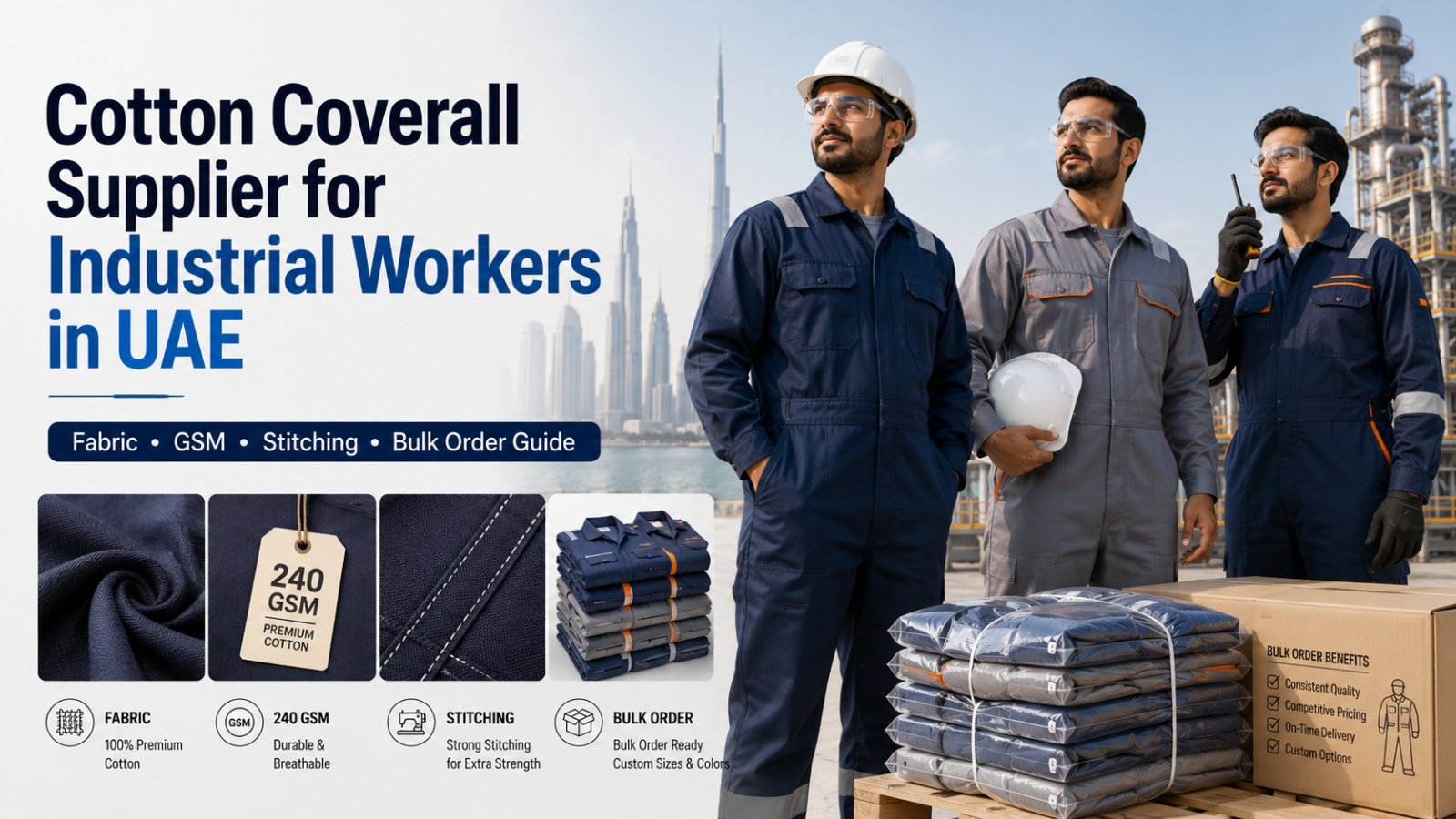
GSM stands for grams per square meter, and it is the standard way to measure how heavy and dense a fabric is. Industrial cotton coveralls generally fall between 180 and 270 GSM. Lighter fabric in the 180 to 220 range breathes better and suits hot outdoor sites where comfort drives compliance, meaning workers are more likely to keep the coverall zipped up and worn correctly. Heavier fabric in the 240 to 270 range holds up better against abrasion, grease, and rough handling, which matters more in workshops and maintenance bays than on an open construction site.
There is no single correct GSM. The right number depends on the work environment, and a supplier worth using will ask about your site conditions before recommending one. Fabric strength claims should also be backed by testing against ISO 13934-1, the standard method for measuring how much force a fabric withstands before it tears.
Stitching that holds up under daily wear
Fabric quality only gets you halfway. Seams fail before fabric does on most coveralls that come back for warranty claims. Main seams on a well-made coverall use a lock stitch, which resists unraveling if one thread breaks. Raw edges get a safety stitch, sometimes called an overlock, to stop fraying after repeated washing. High-stress points, pocket corners, the crotch seam, and belt loops get bartacking, a dense reinforced stitch that spreads load across a wider area instead of concentrating it on a few threads.
Ask a supplier to show you a cross-section of their seam construction, not just a finished garment. The seam allowance, stitch density, and thread type tell you more about durability than the outer fabric ever will.
PPE and workwear standards that apply to cotton workwear in the UAE
Cotton coveralls without flame-resistant or chemical-resistant claims still fall under general protective clothing rules, and a few certifications are worth checking for regardless.
| Standard or body | What it covers | Why it matters |
| ISO 13688:2013 | General requirements for protective clothing: fit, ergonomics, sizing, colorfastness, ageing, marking | The baseline standard nearly all workwear gets measured against, even garments without a specific hazard rating |
| ISO 13934-1 | Tensile strength testing for fabrics | Confirms a fabric’s GSM and weave actually deliver the strength a supplier claims |
| ISO 9001 | Quality management systems for the manufacturing facility | Shows the factory follows a documented, repeatable process rather than one that varies by shift |
| OEKO-TEX STANDARD 100 | Fabric testing for harmful substances | Relevant if your buyers or end clients ask about chemical safety in fabric close to the skin |
| ESMA, ECAS conformity scheme | UAE product registration and conformity assessment | Required for import clearance into the UAE regardless of garment type |
| GSO | Regional GCC technical regulations | Sets baseline standards that UAE and other Gulf states build country-specific rules on top of |
None of these standards are optional line items to skip past. A supplier who cannot produce a current ISO 9001 certificate with a verifiable number, or who has never heard of ISO 13688, is not one to trust with a bulk order.
How to choose a cotton coverall supplier in UAE
Use this checklist during supplier shortlisting before requesting a sample:
- Factory location, and whether production happens in-house or through a subcontractor
- GSM range offered, and whether the supplier can explain why they recommend a specific weight for your site conditions
- Weave type and fabric sourcing, including whether test reports are available per batch
- Stitch construction details: lock stitch, safety stitch, and bar tacking at stress points
- ISO 9001 certificate number you can independently verify
- Sample turnaround time and how many revision rounds are included
- Sizing range and whether it matches the body types of your actual workforce, not a generic chart
- Packing and labeling standard for UAE import requirements
- Past order history with similar UAE-based industrial clients
A supplier who answers every point clearly, without needing to check with someone else first, has usually done this work many times before.
Bulk ordering: sizing, sampling, and lead times
Bulk orders fail most often on sizing, not fabric. UAE industrial workforces are frequently multinational, and a size chart built around one population rarely fits everyone comfortably. Ask your supplier for a size range built from actual measurement data, not a generic small-to-extra-large spread, and request a few units across the range before committing to the full order.
Sampling matters just as much for a coverall as for a branded garment. Approve a physical sample in the actual fabric weight and color you plan to order, not a similar reference piece from a catalog. Lead time varies with order size and whether the fabric needs to be sourced specially, so ask for a range rather than a single date, and confirm how that range changes if you need part of the order delivered earlier than the rest. Construction and facilities projects in the UAE often need the first batch of workwear on-site before the full workforce mobilizes, and a supplier who can split production into phases gives you more control over that timeline.
Common mistakes buyers make sourcing cotton coveralls in bulk
The most frequent mistake is specifying a GSM without connecting it to the actual work environment. A buyer copies a number from a previous order or a competitor’s spec sheet, and the coveralls arrive either too heavy for outdoor comfort or too light for the abrasion the job actually involves.
Skipping a physical sample is close behind. Photos and fabric swatches do not show how a seam holds up after real wear, and disputes over quality almost always trace back to an order approved from a picture instead of a finished garment.
Buyers also tend to underestimate how much sizing affects both comfort and compliance. Workers in an ill-fitting coverall will roll sleeves, leave zippers open, or avoid wearing the garment correctly, which defeats the purpose of specifying protective workwear in the first place.
Assuming ISO 9001 alone proves quality is another common gap. The certificate confirms a documented process exists. It says nothing about the specific fabric, GSM, or stitching in your order, which is why sample approval and batch-level test reports still matter even from a certified factory.
Why Armstrong Products fits this role for UAE buyers
Armstrong Products has manufactured industrial workwear and personal protective equipment since 2009, with its production facility in Boisar, Maharashtra, and its corporate office in Powai, Mumbai. The company is ISO 9001 certified and has supplied workwear to marine, offshore, oil and gas, and construction clients across international markets, including the Gulf.
For UAE procurement teams, that means a manufacturer with real export experience, an in-house production setup that can be audited on-site or remotely, and cotton workwear built around the fabric weights and stitching standards this guide covers rather than a one-size-fits-all catalog item.
Conclusion
Sourcing cotton coveralls for a UAE workforce comes down to specifics most buyers skip past: the right GSM for your site conditions, a stitching standard that survives daily wear, and a cotton coverall supplier UAE teams can actually verify through ISO certification and a physical sample. Before you place a bulk order, confirm the fabric weight against your work environment, request a sample in the exact fabric and color you plan to order, and check the supplier’s ISO 9001 certificate independently rather than taking a scanned copy at face value.
FAQ’s
What GSM is best for cotton coveralls in the UAE?
There is no single best answer. Lighter fabric between 180 and 220 GSM suits hot outdoor sites where breathability matters most. Heavier fabric between 240 and 270 GSM suits workshops and maintenance environments with more abrasion and rough handling.
How do I choose a cotton coverall supplier in UAE?
Check the factory’s GSM range, weave type, stitching standard, and ISO 9001 certificate number before requesting a sample. A supplier who can explain their fabric choices for your specific site conditions, rather than offering one standard option, is usually the safer pick.
What stitching standard should a cotton coverall use?
Look for lock stitch main seams, safety stitch or overlock finishing on raw edges to prevent fraying, and bar tacking at pockets, the crotch seam, and other stress points.
Is cotton better than poly-cotton for UAE industrial sites?
Cotton breathes better and suits comfort-first environments like general warehousing or outdoor labor. Poly-cotton blends hold up better under heavy abrasion. The right choice depends on the specific work environment more than a general rule.
Does a cotton coverall need flame-resistant certification?
Only if the work environment involves fire or heat hazards. Standard cotton coveralls for general industrial use fall under ISO 13688’s general protective clothing requirements rather than flame-resistant standards like ISO 11612.
What documents should a UAE coverall supplier provide?
At minimum, an ISO 9001 certificate with a verifiable number, fabric test reports referencing ISO 13934-1 for tensile strength, and export documentation covering ESMA or ECAS registration for UAE import.
How long does a bulk cotton coverall order take?
It depends on order size and whether the fabric needs special sourcing. Ask your supplier for a lead time range specific to your quantity and fabric weight rather than a general estimate, and confirm whether phased delivery is possible.
Can one supplier handle both cotton and flame-resistant coveralls?
Some can, but the fabric handling and finishing processes differ. Confirm a supplier’s specific experience and test certificates for whichever garment type you actually need rather than assuming general capability covers both.
Why does sample approval matter for a bulk coverall order?
A sample shows how the actual fabric weight, color, and seam construction hold up, which photos and swatches cannot. Approving bulk production without a physical sample is one of the most common causes of quality disputes.
What sizing range should a UAE bulk order use?
A range built from real measurement data for your actual workforce, not a generic small-to-extra-large chart. UAE industrial teams are often multinational, and mismatched sizing leads to workers wearing coveralls incorrectly.