A procurement manager at a mid-sized EPC contractor placed a bulk order for 2,000 FR coveralls last year. The quote was good. The factory had a website full of certification logos. Six weeks after delivery, a site safety officer pulled three random units for inspection and found the fabric weight was 15% under specifications. The whole batch had to go back. By the time replacements arrived, the project was a month behind schedule, and the original “savings” on the order had turned into a five-figure loss.
This happens more often than most buyers admit out loud. The factory wasn’t a scam. It just never got checked properly before the order went in. Most problems with PPE manufacturers don’t show up on a quote sheet. They show up on the factory floor. They show up in the paperwork. Sometimes they show up in a certificate that looks completely real, right up until somebody actually calls the lab that issued it and asks if it’s genuine.
This guide covers what to check before a bulk order goes out: what a factory audit should cover, what the paperwork needs to include, and which red flags are serious enough to stop the order until you get a straight answer.
Why a factory audit matters before a bulk order
One bad garment is annoying. A defective batch of 2,000 is a different problem altogether, because whatever’s wrong with one unit, fabric weight, seam strength, or sizing, doesn’t stay contained to that one unit. The second bulk production starts, and that same flaw is sitting in every piece coming off the line.
This is why the audit has to happen before the purchase order, not after the shipment lands. Once a factory has cut fabric for 2,000 units, there’s no cheap way to fix a problem that should have been caught in a sample. Replacement costs money. Re-inspection costs time. And if the garments have already been shipped to a job site, you’re now managing a recall on top of everything else.
A factory audit, whether it’s a document review, a video call, or someone walking the floor in person, exists to catch the gap between what a supplier claims and what their production line can actually deliver. The cost of running that check is small next to the cost of skipping it.
What “ISO certified PPE supplier” actually means
Buyers hear “ISO certified” and treat it as one stamp of approval. Most buyers assume it does. ISO 9001:2015 is really about how a company runs itself: whether it writes its processes down, fixes mistakes when they show up, and keeps output consistent from one batch to the next. None of that touches the garment’s actual protective performance.
Protective clothing has its own standard. ISO 13688:2013 covers topics such as ergonomics, fabric ageing, sizing, and labelling, specifically for PPE garments. A factory can have ISO 9001:2015 and have never gone through a 13688 assessment at all. The reverse happens too, just less often.
CE marking is a separate thing again. It’s a declaration that a product meets EU health and safety requirements, and it applies to each product line, not to each factory. A supplier can be CE marked on FR coveralls and have no CE marking at all on their hi-vis jackets.
When a supplier says “we’re ISO certified,” ask which standard, for which products. A factory holding 9001 and 13688 with CE marking on the specific product you’re ordering is in a different category than one holding 9001 alone and letting the phrase “ISO certified” do the rest of the talking.
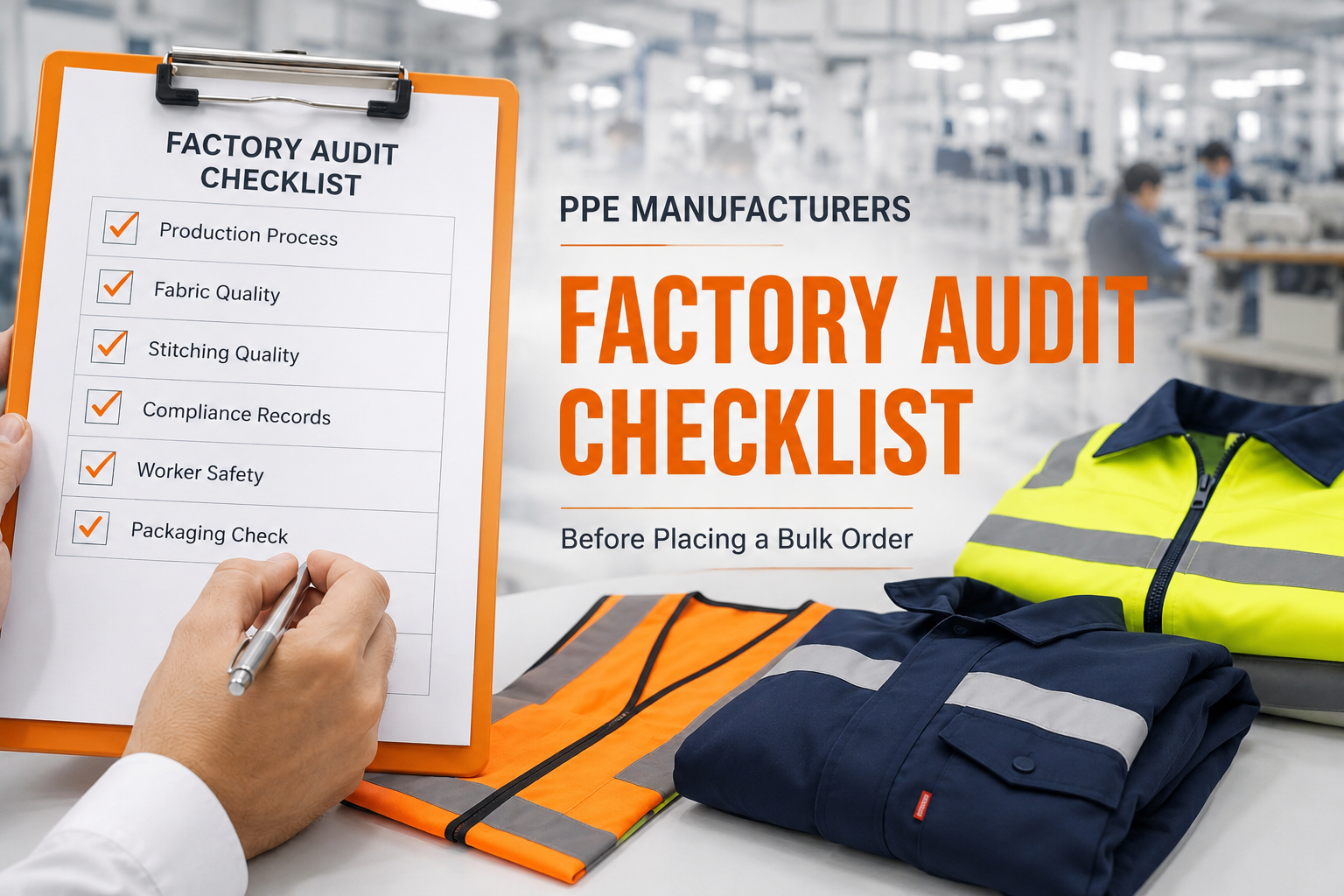
The PPE factory compliance checklist
Run through this before any purchase order goes out:
- Documented hazard assessment that maps to the specific PPE standard required (FR, hi-vis, chemical-resistant, or general workwear)
- Fabric mill certificates showing GSM, fibre composition, and treatment, not just a product-specific sheet
- Confirmation of whether production is fully in-house or partially subcontracted
- Certification scope checked against the actual product being ordered, not just the factory’s general claim
- Sample garments tested before the bulk run are confirmed
- Batch consistency records from previous orders, if this isn’t a first-time supplier
- Wash and durability data for treated FR fabric, specifically, since treated fabric loses performance after repeated washing
- Size range that covers your actual workforce, confirmed against past sizing complaints, if any exist
- Accredited lab name and accreditation number on any test certificate, not just a logo
- Reflective tape or trim sourced and tested separately for hi-vis garments, since trim performance is tested apart from the base fabric
- A written replacement or reorder policy in case of a quality issue post-delivery
None of this replaces legal or compliance review for your specific industry. It’s the floor, not the full audit.
Factory audit checklist for PPE suppliers: what to check on a visit or video audit
A document review tells you what a supplier claims. A factory audit tells you whether the floor backs that claim up. Here’s what actually matters once you’re looking at the production line, in person or on a video call.
Production floor and equipment
Look at stitching consistency across multiple units pulled at random, not just the one sample the factory hands you. Check whether the cutting room is organised by fabric lot or whether different batches get mixed together during cutting, since that mixing is exactly how fabric substitution slips through unnoticed. Ask whether incoming fabric is logged lot-by-lot or just received in bulk without tracking.
Quality control checkpoints
Good QC happens at three points: when fabric arrives, during stitching, and at final inspection before packing. Ask where the factory’s checkpoints actually sit. A factory that only inspects at the end catches defects after the labour cost has already been sunk into the garment. Ask for a rejection rate, even an approximate one, and ask whether rejected units get reworked or scrapped. A factory with no answer to either question and no sample retention policy for past orders is one that isn’t tracking its own quality control checklist at all, which means you’re the first line of defence, not the last.
Documentation and traceability
Ask the factory to trace one finished garment batch back to its raw fabric lot. A supplier with real traceability can usually pull this in minutes: lot number, mill certificate, cutting date, QC sign-off. A supplier without it will start improvising an answer. This is the exact paper trail an OSHA-style audit or a client compliance review asks for after the fact, so if the factory can’t produce it now, you won’t be able to produce it later either.
Document review vs on-site audit vs video audit
| Method | What it catches | What it misses | Best used for |
| Document review | Certificate validity, scope match, fabric specs on paper | Real production conditions, batch-to-batch consistency | First-pass shortlisting of new suppliers |
| Video audit | Floor layout, QC stations, equipment condition | Fabric handling detail, the physical feel of materials | Overseas buyers working with distance constraints |
| On-site audit | Everything above, plus hands-on sample inspection | Time and travel cost | Large bulk orders and new supplier relationships |
None of these entirely replaces the others. A document review narrows the shortlist. A video or on-site audit confirms what the documents claimed.
Red flags that should pause a bulk order
No accreditation number on a test certificate. A real certificate names the lab and includes an accreditation number you can look up independently. A certificate with neither is a claim, not proof.
A supplier who hesitates on mill certificates. If a factory is quick to send a product brochure but slow to send the actual fabric mill certificate, that hesitation usually means the fabric in production doesn’t fully match what was tested.
No sample testing offered before the bulk run. A supplier confident in their own consistency will offer this without being asked twice.
Sizing that drifted on a previous reorder. If you’ve worked with this supplier before and sizes shifted batch to batch, that’s a quality control gap, not a one-time mistake.
The costliest one by far is certificate scope mismatch. A certificate covering cotton coveralls says nothing about FR welding suits, even if both products come from the same factory. This sounds like an obvious distinction until you’re standing in front of an auditor who’s just pulled the certificate and matched it against the wrong product line, and now the entire shipment is in question because nobody checked the scope before the order went out. This single gap has cost buyers more in replacement and audit costs than almost any other mistake on this list, because it isn’t caught until someone outside your own team is already looking for it.
Why Armstrong Products passes this checklist
Armstrong Products has been manufacturing industrial workwear and PPE at its Boisar, Maharashtra, manufacturing facility since 2009, with its corporate office located in Powai, Mumbai. The company holds ISO 9001:2015 for quality management and ISO 13688:2013 for protective clothing, both independently audited, with CE marking on applicable product lines.
Production runs in-house rather than through subcontracted units, which keeps the documentation chain intact from fabric intake through final inspection. Clients include ONGC, Adani, L&T, JSW Steel, Halliburton, Hitachi, Toyota, Godrej, Schlumberger, and Worley, all of which run their own supplier audits as a matter of course before placing orders at scale.
None of this replaces a buyer’s own audit. It’s the starting documentation any procurement team should expect to see before that audit even begins.
Conclusion
Most bad bulk orders trace back to the same root cause: a factory that never got properly checked before the purchase order went out. The checklist matters more in the weeks before an order than in the weeks after a complaint, because by the time a defect shows up on the floor, the fabric’s already cut and the cost is already locked in. Vet PPE manufacturers the way you’d vet any safety-critical supplier, before the invoice, not after.
FAQs
What’s the difference between a PPE manufacturer and a PPE supplier?
A manufacturer makes the garments. A supplier may manufacture, resell, or both. Always confirm which one you’re actually buying from.
What does ISO 9001:2015 actually certify for a PPE factory?
It certifies the factory’s quality management system, not the protective performance of any specific garment. A factory can hold this certification and still need a separate certification, like ISO 13688:2013, for the PPE itself.
Is CE marking the same as ISO certification?
No. CE marking is a product-level declaration of EU compliance. ISO certification covers a company’s management system or a product category standard. A factory can have one without the other.
How do I verify a supplier’s certification is real?
Ask for the certificate directly and check the accreditation number against the issuing body’s public registry. Most accredited labs and certification bodies have a lookup tool or a contact line for exactly this purpose. Don’t rely on a logo printed on a brochure. If a supplier resists providing you with the certificate number for independent verification, treat that resistance itself as information. A two-minute phone call to the certifying body settles the question for good.
What should I ask for before placing a bulk PPE order?
Mill certificates, sample units for testing, batch consistency records if it’s a reorder, and written confirmation that the certification scope covers the exact product you’re buying.
Can a video audit replace an on-site factory visit?
For a lot of buyers, yes, especially overseas ones where travel isn’t practical. A video audit shows floor layout, equipment, and QC stations clearly enough to catch most red flags. What it can’t replace is the hands-on sample check, so for large or first-time bulk orders, pairing a video audit with a small physical sample shipment covers most of the gap.
What’s a reasonable sample lead time before a bulk PPE order?
This varies by garment complexity, but most reliable suppliers can turn around samples within one to two weeks of a confirmed spec.
How often should an existing PPE supplier be re-audited?
Annually at minimum, and immediately whenever the spec changes, the order volume jumps significantly, or there’s been any quality complaint on a recent batch.
What happens if a factory substitutes fabric mid-order without telling the buyer?
The garments may still look correct on the outside while failing the actual performance standard they were ordered to meet. This is one of the hardest issues to catch without mill certificate verification and pre-shipment fabric testing, because the visible defect doesn’t show up until the garment is tested or, worse, used in a real hazard event.
Does Armstrong Products allow on-site or video factory audits before bulk orders?
Yes. Buyers can request either through the Contact Us page before confirming a bulk order.