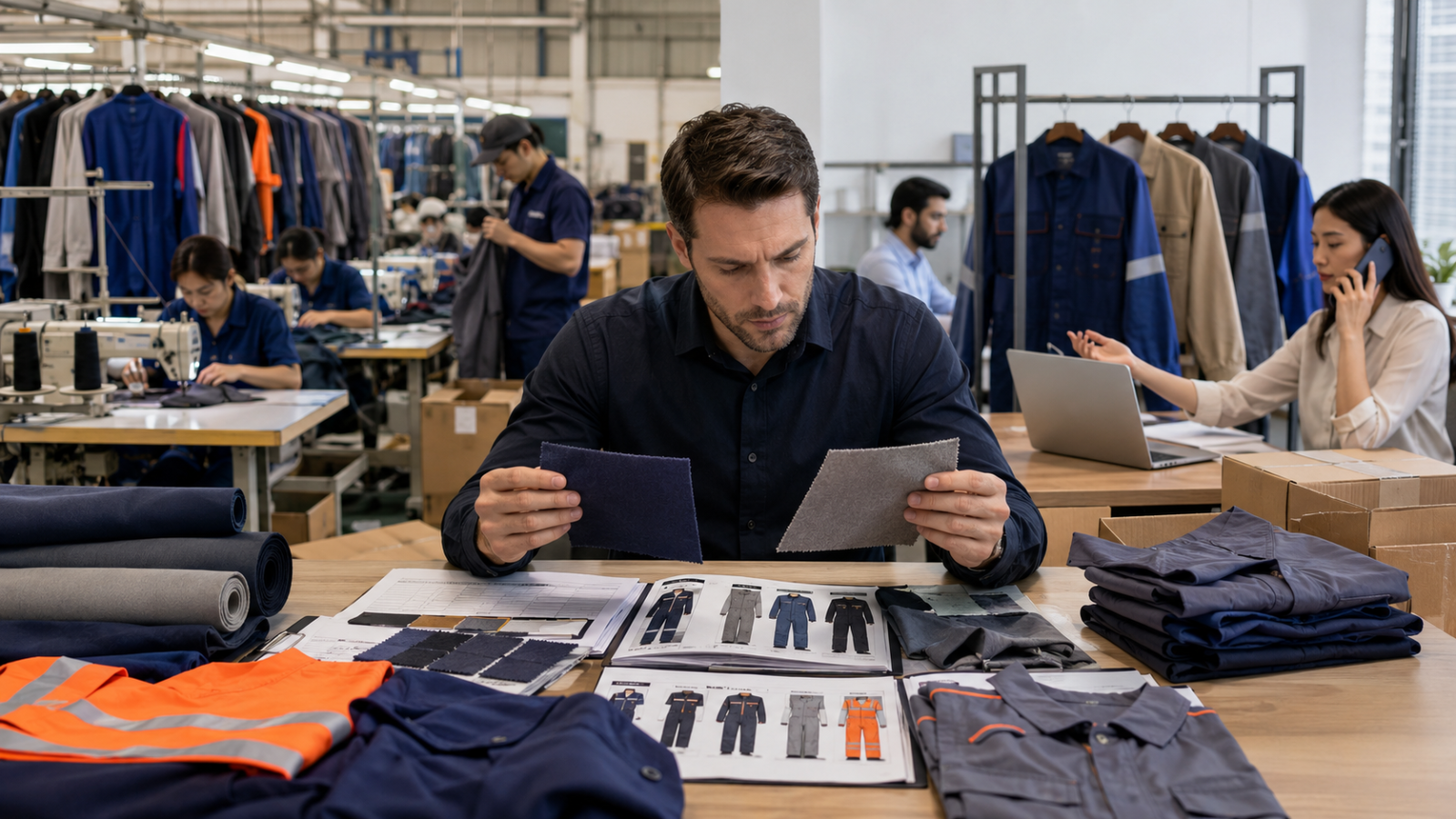
A procurement manager once told me she’d quoted three different workwear companies for the same bulk order. Different names, different websites, different sales contacts. It wasn’t until a factory audit photo showed up twice, once from each of two “different” suppliers, that she realized she’d been quoting the same factory through two separate middlemen the whole time.
That’s more common than most buyers realize. A workwear company can mean a factory that owns its own production line, or it can mean a business that sources from several factories and manages the order on your behalf. Both call themselves suppliers. Both show up looking similar on a directory site. The label alone won’t tell you which one you’re actually talking to.
This guide isn’t about which type is better. It’s really about figuring out which one fits the order sitting in front of you.
What a workwear company actually is, and why the label hides two different businesses
A work clothing manufacturer runs its own production, full stop. Fabric goes in one end, finished garments come out the other, and the same team handles the cutting, the stitching, and the quality checks the whole way through. Nobody’s standing between you and the factory floor.
A trading company operates on a completely different model, even if it calls itself a workwear or workplace uniform supplier on its website. Your order is placed with whichever factory in that trading company’s network can handle it, sometimes with that fact made clear up front, sometimes not. The trading company handles communication and logistics. The actual sewing happens elsewhere, by people you’ll probably never talk to directly.
None of this makes either model dishonest. Both are entirely legal, both show up constantly across this industry, and either one can get you a good order delivered on time. What you can’t do is tell them apart just from the name on the website. “Workwear company” and “supplier” get used by both sides equally, so the only real way to know is to ask the question outright.
What you get from buying directly from an industrial workwear manufacturer
Going straight to a manufacturer puts you a lot closer to where the actual work happens. The fabric sourcing, the certification paperwork, the quality checks, it’s all sitting under one roof, which means there’s nobody in between who has to relay that information secondhand before it reaches you.
It’s really about figuring out which one fits the order sitting in front of you.
What a workwear company actually is, and why the label hides two different businesses
A work clothing manufacturer runs its own production, full stop. Fabric goes in one end, finished garments come out the other, and the same team handles the cutting, the stitching, and the quality checks the whole way through. Nobody’s standing between you and the factory floor.
A trading company operates on a completely different model, even if it calls itself a workwear or workplace uniform supplier on its website. Your order is placed with whichever factory in that trading company’s network can handle it, sometimes with that fact made clear upfront, sometimes not. The trading company handles communication and logistics. The actual sewing happens elsewhere, by people you’ll probably never talk to directly.
None of this makes either model dishonest. Both are entirely legal, both show up constantly across this industry, and either one can get you a good order delivered on time. What you can’t do is tell them apart just from the name on the website. “Workwear company” and “supplier” get used by both sides equally, so the only real way to know is to ask the question outright.
What you get from buying directly from an industrial workwear manufacturer
Going straight to a manufacturer puts you a lot closer to where the actual work happens. The fabric sourcing, the certification paperwork, the quality checks, it’s all sitting under one roof, which means there’s nobody in between who has to relay that information secondhand before it reaches you.
This matters most with certified PPE. A manufacturer holding the test reports directly can hand them over without delay, because there’s no trading layer that has to go back to the factory to ask for paperwork it doesn’t keep on file. Repeat orders also tend to come out more consistently, since the same production team is doing the work every time, rather than whichever factory happened to have capacity that month.
Factory audits are simpler, too. A buyer who wants to walk the floor, in person or over video, deals directly with the people running it. There’s no scheduling around a trading company’s access to someone else’s facility.
Where a manufacturer relationship works less well
A manufacturer that only really does one or two garment categories can be a tough fit if you’re trying to place ten different product types in a single order. Coveralls come from one kind of setup, high-visibility vests from another, safety footwear and corporate uniforms from somewhere else entirely. They rarely all come out of the same factory floor. So a buyer with a genuinely mixed order can end up juggling four or five separate manufacturer relationships instead of just one.
What you get from buying through a trading company or a workplace uniform supplier
A trading company earns its place for a real reason. One point of contact can cover an order spanning several product categories, pulling from whichever factory specialiZes in each, without the buyer having to manage five separate manufacturer relationships directly.
This setup tends to suit smaller or first-time buyers particularly well. Building a direct factory relationship usually only makes sense once order volume justifies it, and a trading company can bridge that gap while a buyer figures out what they actually need long term. Some trading companies also bring real expertise to sourcing decisions, knowing which factory handles which speciality well, which is a genuine service rather than just markup.
Where a trading relationship needs more scrutiny
Quality control sits one step removed in this setup. The trading company isn’t running the production line, so any certification claim it makes has to be traced back to the actual factory before it means anything. Accountability can also get blurry if something goes wrong mid-order. Whose responsibility is a defect, the trading company that took the order or the factory that made it? A good trading partner has a clear answer ready. Not all of them do.
Workwear manufacturer vs trading company
| Factor | Direct Manufacturer | Trading Company / Supplier |
| Production control | Full, in-house | Indirect, depends on the factory used |
| Certification documentation | Held directly, easier to verify | Passed along, needs extra verification |
| Order flexibility | Best for focused product categories | Better for varied, multi-category orders |
| Lead time consistency | Tends to be steady across repeat orders | Can vary depending on which factory fulfils the order |
| Best fit for | Larger, repeat, certification-sensitive orders | Smaller, first-time, or highly varied orders |
How to figure out which one fits your order
Three questions tend to settle this faster than any general rule about which model is better.
Is this a one-time order or the start of a recurring relationship? A single order rarely justifies the work of vetting and building a direct relationship with a manufacturer. A recurring need usually does, eventually.
Does the order need certified, hazard-specific PPE, or is it general workwear? Certification-heavy orders benefit from being closer to the source, where test reports and documentation are kept in one place. General uniforms carry less of that risk either way.
Is the order concentrated in one product category or spread across several? A buyer ordering nothing but FR coveralls at scale has a clear case for going direct. A buyer ordering coveralls, vests, footwear, and corporate shirts in one go has a real reason to consider a trading company instead.
Answer those three honestly, and the right path usually becomes obvious without needing a tiebreaker.
What to check regardless of which type of workwear company you choose
A few things matter no matter which path gets chosen. The certification scope must match the actual product being ordered, not just the company’s general certification claim. A sample order, even a small one, should happen before any bulk commitment goes through. And accountability needs to be clear from the start: if something’s wrong with the shipment, the buyer should already know exactly who’s responsible for fixing it, not find out for the first time when the problem shows up.
Where Armstrong Products fits as a workwear company
Armstrong Products, based in Mumbai, was founded in 2009 and manufactures industrial workwear and PPE in-house. The company holds ISO 9001:2015 certification for its quality management system and runs production in-house rather than sourcing from external factories.
Customisation and branding options are handled within the same production process, along with warehousing and direct delivery for bulk orders. Armstrong has supplied workwear and safety products to clients across oil and gas, construction, shipping, and government projects, working as a direct manufacturer rather than a trading layer between the buyer and the factory.
For a buyer weighing a manufacturer against a trading company, Armstrong sits clearly on the manufacturer side of that decision.
Conclusion
The right workwear company isn’t the one that sounds more trustworthy on a sales call. It’s the one whose business model actually matches the order in front of you, whether that’s a manufacturer who owns the entire production chain or a trading company built to handle a varied, multi-category order. Knowing the difference before quoting saves a lot of confusion later.
Talk to Armstrong Products directly about your workwear requirements: Contact Us
FAQs
Is a workwear company always the manufacturer?
No. The term gets used by both manufacturers and trading companies, so it doesn’t tell you which one you’re actually dealing with. Ask directly.
What’s the real difference between a workwear supplier and a work clothing manufacturer?
A manufacturer owns and runs its own production. A supplier, often a trading company, sources from one or more factories and manages the order without necessarily owning any of the production itself.
Is it cheaper to buy directly from a manufacturer?
It depends entirely on the specific order, the product category, and the volume involved, not on which business model is used. Neither path is inherently cheaper across the board.
Can a trading company offer certified PPE?
Yes, often. The certification still needs to be verified against the actual factory producing the garment, not just taken on the trading company’s word.
What questions should I ask to find out who I’m really buying from?
Ask directly whether the company owns its production or works with partner factories. A straightforward answer is a good sign in itself.
Is a smaller workwear company automatically less reliable than a larger one?
No. Size and reliability aren’t the same thing. A smaller manufacturer with tight quality control can outperform a larger trading company with looser oversight, and vice versa.
How do industrial workwear manufacturers usually handle bulk and custom orders together?
Most run custom specifications alongside standard stock production, since the same facility and quality process covers both. Lead times can differ between the two, so it’s worth confirming upfront.
Do workplace uniform suppliers handle returns or replacements differently from manufacturers?
Sometimes. Since a trading company isn’t the one producing the garment, replacement timelines can depend on how quickly it can coordinate with the actual factory. Ask about this before placing the order, not after a problem comes up.
Should I switch from a trading company to a direct manufacturer once my order volume grows?
Often, yes, once volume reaches a point where a direct relationship is worth managing. There’s no fixed threshold, but recurring orders, certification requirements, or a desire for tighter quality control usually tip the decision.
Is Armstrong Products a manufacturer or a trading company?
Armstrong Products is a manufacturer. Production runs in-house, and buyers can reach out through the Contact Us page to discuss requirements directly.