
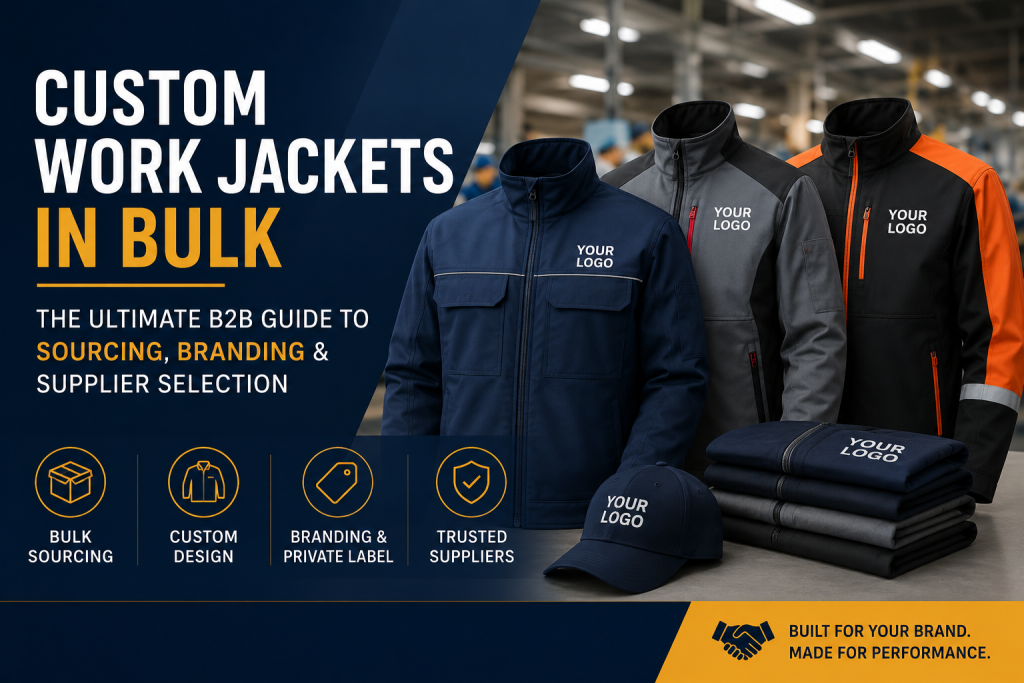
A procurement manager who is placing an order for 500 jackets cannot tolerate a supplier who handles it as if it were a retail transaction. When scaled up, the sizing, the positioning of the branding, the consistency of the fabric from one batch to another, and the scheduling of deliveries all have to be maintained. This is in fact what distinguishes buying jackets from sourcing custom work jackets for an entire workforce.
The guide includes all the information that a B2B buyer should have before placing a bulk order: which types of jackets are worth keeping in stock, how to assess a wholesale jacket supplier, the difference between OEM and private label branding, and the questions that reveal a weak workwear jacket manufacturer before a purchase order is issued. Each section is addressed to procurement teams, distributors, and corporate buyers who are sourcing branded workwear for their own employees or clients.
What Are Custom Work Jackets, and Why Do Bulk Buyers Need Them?
Custom work jackets are made to match a buyer’s exact requirements. This can include the fabric, insulation, safety features, size range, and branding. Instead of buying ready-made jackets from a store, businesses order them directly from a manufacturer in larger quantities.
There are three practical reasons why bulk buyers need such a degree of control. If a large number of people are involved in the sizing process, this helps to avoid the problems that arise when ready-made ranges are designed for individual retail customers. When a jacket is acting as a representation of the company at a client’s site rather than just being worn by the employee, brand consistency becomes important. Also, since safety compliance demands that the choice of fabric and method of construction corresponds to the real hazards present at the site, a standard jacket range very seldom takes these factors into account.
A manufacturer handling bulk orders for custom work jackets will usually let buyers choose the following:
- Fabrics and insulation that suit the local climate and the risks workers may face
- The same sizing and fit across every production batch
- Standard customization options such as logo placement, color matching, and branded trims
- Bulk-order pricing rather than standard retail rates
- Enough production capacity to handle larger repeat orders
Types of Custom Work Jackets for Industrial and Corporate Buyers
It is seldom possible to find a single style of jacket that will suit a diverse workforce, and when buyers order large quantities of work jackets, they usually need at least two or three different styles produced simultaneously.
- Insulated jackets for people working in cold-storage areas, winter conditions, or facilities where low temperatures continue throughout the shift.
- Hi-vis safety jackets for construction, logistics, and roadside teams working around traffic or moving vehicles.
- Custom industrial jackets for everyday use in plants and warehouses, designed to offer both durability and comfort.
- Flame-resistant and arc-rated jackets for oil and gas sites, electrical maintenance work, and other areas where flash fire or arc flash risks are present.
- Branded corporate jackets for field teams, site supervisors, and employees who regularly meet clients.
Flame-resistant options sit in a category of their own, since the fabric technology and certification requirements differ from standard workwear. Buyers evaluating FR jackets specifically can review Armstrong’s guide to fire-resistant clothing jackets for a closer look at certification and selection criteria.
Sourcing Custom Work Jackets in Bulk: What B2B Buyers Need to Know
The rules governing bulk sourcing are different from those applying to a single retail purchase. A wholesale jacket supplier operating on a large scale should be able to answer four questions clearly before a buyer agrees to place an order.
What is the minimum order quantity, and does this quantity depend on the complexity of the product?
Simple color changes generally have a lower minimum order quantity than a completely custom-made combination of fabric and trim.
What is the time taken from approving a sample until it is shipped?
Custom-branded bulk work jackets generally have a lead time of several weeks, which is longer than that for a standard item taken from existing stock.
Can the Supplier Maintain the Same Sizing Across Repeat Orders Placed Months Apart?
As your workforce grows, new orders should follow the same sizing and fit as the original batch. Workers should not receive jackets with a different cut simply because they came from a later production run.
What Happens if a Batch Fails the Quality Check?
A reliable supplier should have a clear process for repairing or replacing any items that fail inspection. The buyer should not be left to cover the cost of defective stock.
| Minimum order quantity | Determines whether small pilot orders are even possible before scaling up |
| Sample approval process | Confirms fit, fabric, and branding before committing to the full run |
| Batch-to-batch consistency | Keeps reorders matching the original specification |
| Lead time against your calendar | Prevents rushed production that raises defect risk |
Custom Branded Jackets: OEM and Private Label Options Explained
The different branding options distinguish a general wholesale jacket supplier from a manufacturing partner who can help a buyer develop their own product line. These two models are most frequently mentioned in business-to-business sourcing discussions.
OEM workwear jackets are made according to the buyer’s exact specifications, using the fabric choices, construction details, and branding that the buyer desires, but they are produced using the manufacturer’s current production capabilities. This arrangement is appropriate for buyers who know exactly what they want and who need a manufacturing partner to carry out their requirements on a large scale.
With private label work jackets, a buyer can take an existing product design and add their own branding, labeling, and packaging without having to start the design process all over again. This is ideal for distributors and corporate buyers who want a quicker route to market than is possible with a full custom development process.
When dealing with custom branded jackets based on either of the two models, the products usually have embroidered or heat-transfer logos, match the brand’s colors, include custom neck labels, and come with branded packaging for distribution. A manufacturer that provides both options allows a customer to begin with private label and then switch to full OEM once the order volumes make it worthwhile to carry out the additional development work. Since Armstrong Products offers both options via its Private Label and OEM manufacturing program, buyers who are developing a more extensive range of branded uniform items can also look at Armstrong’s guide to corporate workwear suppliers for other sourcing considerations in addition to those relating to jackets.
How to Choose a Workwear Jackets Manufacturer
Simply comparing prices fails to take into account the factors that actually affect whether a large order reaches on time and remains satisfactory in the field. Those assessing an industrial jacket manufacturer should go through a structured checklist.
- Make sure the factory has a valid ISO 9001:2015 certification.
- Request physical samples and check them before approving the complete production order.
- Ask for written details about where the fabric comes from and which insulation materials will be used.
- Check that the size chart includes every size required by your workforce.
- Find out how the branding is added and whether it can withstand repeated industrial washing.
- Make sure the minimum order quantity suits the way you usually place repeat orders.
- If the order is being shipped outside the manufacturer’s home country, check whether the supplier has handled export documents before.
- Ask whether the supplier can store the goods or deliver them in stages for projects being rolled out across several sites.
| Certification | Self-declared quality claims | ISO 9001:2015-certified facility |
| Samples | Photos only | Physical pre-production samples |
| Branding durability | No wash-testing data | Branding tested against industrial laundering |
| Sizing | Limited standard range | Full size range with custom fitting options |
| Scale | Struggles above small batch orders | Established bulk and repeat-order capacity |
Insulated vs Hi-Vis vs FR Custom Work Jackets
Buyers often default to one jacket type across an entire workforce when the hazard profile usually calls for two or three. Hi-vis categories in particular are governed by a specific standard rather than a general “safety” label, and ANSI publishes the current requirements for high-visibility safety apparel that North American buyers should check against before finalizing a spec.
| Primary purpose | Cold weather and cold storage protection | Visibility in low-light or traffic-adjacent work | Flash fire and arc flash protection |
| Key spec to check | Insulation weight and shell waterproofing | Compliance with ANSI/ISEA 107 or EN ISO 20471 | Compliance with NFPA 2112 or EN ISO 11612 |
| Typical buyer | Cold storage, utilities, winter construction | Road crews, construction, logistics | Oil and gas, electrical maintenance, refineries |
| Customization focus | Lining warmth level, shell durability | Reflective tape placement, class rating | Certified fabric only, limited trim customization |
Common Mistakes B2B Buyers Make When Sourcing Bulk Jackets
Procurement teams often make a few avoidable mistakes when they work under tight deadlines.
Skipping the physical sample stage. A photo or spec sheet does not show how a branded logo sits on the actual fabric or how the insulation feels once the jacket is on a body rather than a hanger.
Treating all jacket categories as interchangeable. A hi-vis jacket rated for visibility does not automatically meet a cold storage insulation requirement, and an insulated jacket built for warmth rarely carries flame resistance unless specifically built for it.
Underestimating branding lead time. Custom branded jackets need extra production steps beyond a blank garment run. Buyers who treat branding as an afterthought often end up with a rushed logo application that does not survive repeated washing.
Not establishing a documented procedure for placing repeat orders with a single supplier. Since the size of the workforce increases and decreases during the contract period, buyers should check how easy it is to order smaller batches without triggering the full minimum order quantity each time.
Disregarding workforce sizing information, since standard size charts do not always show the true body-size distribution within a particular crew, this results in expensive exchange cycles after the bulk order has arrived.
Maintenance Tips for Bulk Custom Work Jackets
Jackets that are bought in bulk last longer when a maintenance routine is established for the entire batch rather than for each individual item.
- Wash insulated and hi-vis jackets according to the manufacturer’s care label rather than a generic laundering schedule shared across all workwear categories
- Protect reflective trim from heavy rubbing during industrial washing, as repeated abrasion can reduce its visibility over time.
- Hang jackets up or keep them in a well-ventilated storage area instead of packing them tightly into bins. Compression can flatten the insulation and make the jackets less warm after repeated use.
- Keep a record of how long each garment has been in use and compare it with the service life given by the manufacturer. This helps you replace garments on time instead of waiting for visible damage.
- Decide when to reorder based on the number of workers who need garments. Place the next order early enough for production to begin before the existing stock runs short.
Industries That Rely on Bulk Custom Work Jackets
Many sectors rely on having branded, specially designed jackets instead of using off-the-shelf outerwear.
- Oil and gas and petrochemical operators, sourcing FR and insulated jackets for process areas and outdoor field crews
- Construction and infrastructure companies that need hi-vis, weather-resistant jackets for large teams working across changing site conditions.
- Logistics and warehousing businesses that require the same branded jackets across distribution centers located in different climates.
- Facility management and corporate service providers, using branded jackets as part of a client-facing uniform program
- Distributors and workwear retailers, sourcing private label jackets under their own brand for resale to end customers
Why Armstrong Products Fits This Role
Armstrong Products has been making industrial garments and workforce uniforms since 2009, producing them in Boisar, Maharashtra, and having its corporate office in Powai, Mumbai. The company is certified under ISO 9001:2015 for quality management and under ISO 13688:2013 for general protective clothing requirements.
Armstrong’s range of workwear and its winter wear collection includes insulated, high-visibility, and general industrial jacket types, and offers OEM and private label manufacturing, which is designed for customers who need custom-branded jackets made in bulk rather than selecting them from a standard catalog. Customers who are sourcing a broader range of uniforms can also look at Armstrong’s high visibility wear range together with its jacket selections in order to have the entire crew’s outerwear manufactured by a single supplier.
Key Takeaways
| ISO 9001:2015 certification | Confirms baseline manufacturing quality for bulk production |
| Physical sample approval | Verifies fit, fabric, and branding before full production |
| OEM vs private label clarity | Determines development time and design control |
| Batch-to-batch sizing consistency | Keeps reorders matching the original workforce fit |
| Certification match to hazard type | Hi-vis, FR, and insulation each need separate verification |
Conclusion
When ordering custom work jackets in large quantities, it is necessary to check a manufacturer’s capabilities, to understand the distinction between OEM and private label branding, and to select the appropriate type of jacket according to the real hazard or climate that the workforce encounters. Those who go through a structured supplier checklist before making a bulk order prevent the problems that arise from treating a bulk purchase as if it were a retail transaction.
Get in touch with Armstrong Products to discuss fabric specifications, OEM or private label branding, or lead times for an upcoming bulk jacket order.
FAQ’s
How does a custom work jacket differ from an off-the-shelf work jacket?
With a custom work jacket, the buyer decides the requirements regarding the type of fabric, the level of insulation, branding, and the range of sizes, after which the jacket is made by a manufacturer instead of being taken from current retail stock. Although off-the-shelf jackets are available more quickly, they offer limited options for branding, maintaining a consistent fit across the workforce, and choosing the fabric to match the particular hazards at a site.
What is the usual minimum order quantity for bulk work jackets?
The minimum order quantities depend on the manufacturer and on the extent of the customization involved. For simple choices regarding color or size from an existing range, the minimum order quantity is generally lower than that for a completely custom fabric, insulation, and branding combination, so buyers should check the exact minimum required by their particular specification rather than assume one general figure applies.
What is the difference between OEM and private label work jackets?
In the case of OEM workwear jackets, they are completely made according to the buyer’s own specifications and branding, thus allowing full control over the design features. As for private label work jackets, an existing product design is used, and the buyer’s branding, labeling, and packaging are added to it, which generally enables the buyer to get the product to market more quickly with less initial development work than in the case of a full OEM build.
Which certification should a wholesale safety jacket carry?
A wholesale safety jacket built for visibility should carry ANSI/ISEA 107 certification in North American markets or EN ISO 20471 in international markets, depending on the buyer’s region. Jackets that also need flame resistance require a separate certification such as NFPA 2112 or EN ISO 11612 since visibility and flame protection are tested and certified independently.
How much insulation does a bulk insulated work jacket need for cold storage use?
Insulation requirements depend on the specific temperature range and shift length involved, so buyers should share their facility’s actual operating temperature with the manufacturer rather than choosing insulation weight based on general assumptions. A jacket built for outdoor winter construction and one built for a sub-zero cold storage facility often need meaningfully different insulation and shell specifications.
Can a manufacturer of workwear jackets make both insulated and hi-vis jackets as part of the same order?
Since manufacturers who offer a wide variety of products can generally produce insulated jackets, hi-vis jackets, and ordinary industrial jackets in the same bulk order, procurement is simplified for a mixed workforce. It is important for buyers to make sure that the lead times and minimum order quantities are based on the total order rather than being treated as separate minimum requirements for each type of jacket.
What is the time taken to apply branding to a bulk order of jackets?
The time required for branding will vary according to the method employed, with embroidery usually taking longer than either heat transfer or screen printing when dealing with large numbers of items. Buyers should include the branding time in their total project timeline, apart from the time taken to produce the base garments, as custom jacket branding generally involves an extra production stage rather than something done in parallel.
What documentation should a workwear jackets manufacturer provide before a bulk order ships?
A reliable manufacturer should provide fabric composition details, relevant certification documents for any safety-rated jackets, and confirmation of the agreed sizing chart before production begins. For safety-rated categories like hi-vis or FR jackets, buyers should also request test reports confirming the specific standard the garment is certified against. Keeping this paperwork on file gives procurement a ready answer if a client or internal auditor later asks for proof that the jackets meet the specification agreed at the order stage.
Does it give better value to buy custom industrial jackets in bulk rather than placing smaller repeat orders?
With bulk orders, the cost of setting up production is distributed over a greater volume, so the value per unit is generally higher. However, buyers should consider this in relation to storage costs and the risk of ordering more than the current workforce requires, especially for sizes or branding that might change before the entire stock is used.
How Should a Distributor Evaluate a Private Label Work Jacket Supplier Before Committing to Resale?
Before moving ahead, a distributor should ask for samples with the branding they plan to use. It is also important to check that the supplier’s minimum order quantity fits the expected resale volume.
The fabric, stitching, and overall finish should match the quality customers will expect. Looking at the manufacturer’s current clients and past export experience can also show whether they are capable of supporting larger orders as the business grows.