
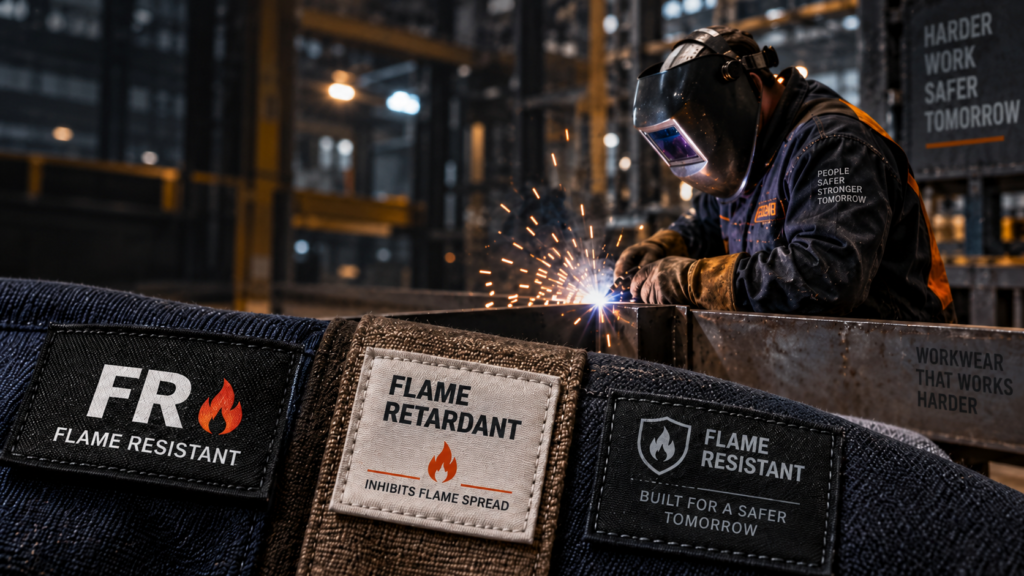
A purchase order asks for flame retardant coveralls. The quote that comes back says flame resistant. The data sheet says FR, and the sample label says nothing at all. Everyone on the email thread assumes the three terms mean the same thing.
They do not always mean the same thing, and that gap is where bad orders begin. This guide settles the flame resistant vs flame retardant question in plain terms. You will see what each phrase describes, where the trade mixes them up, and which details on a label carry the real information.
Quick answer: Flame retardant describes a chemical treatment or additive that slows burning. Flame resistant describes how a fabric behaves near fire: it resists ignition and stops burning once the flame source is gone. Suppliers use both phrases for the same garment, so the flame resistant vs flame retardant wording alone proves nothing. Fiber content, the test standard, and the test report tell you what you are buying.
Flame Resistant vs Flame Retardant: The Short Answer
Start with the words behind the flame resistant vs flame retardant question. Retardant comes from the verb retard, which means to slow down. A flame retardant is a substance that slows flames. A flame resistant fabric is one that resists them.
In a lab, both words point to the same behavior. The fabric is slow to ignite, burns less, and goes out once the flame source is removed. A 2014 Hydrocarbon Engineering article on heat and flame clothing said the trade had no clear split between the two terms. It added that the European man-made fiber body CIRFS was working on official definitions.
So the flame resistant vs flame retardant debate has no neat winner. The useful question is how the protection was built into the cloth and which test proves it.
| Point | Flame resistant | Flame retardant |
| What the word describes | How the fabric behaves near fire | A chemical or finish that slows burning |
| Where the word shows up | Protective workwear | Furniture, curtains, foam, plastics, and treated cotton |
| Where the protection sits | In the fiber, or bonded into cotton during manufacture | Often a finish applied to the cloth |
| Wash behavior | Workwear grades are tested for wash life | Varies by finish; light finishes can wash off |
| Proof to request | Test report to a heat and flame standard | Test report plus a wash-cycle claim |
What Does Flame Resistant Mean on Workwear?
On a coverall, flame resistant means the cloth resists ignition and stops burning soon after the flame source leaves. It chars rather than melting or dripping. That gives the wearer a few seconds to move away.
It does not mean fireproof. A worker caught in a flash fire still takes heat through the fabric. Good flame resistant clothing lowers the burn injury. It cannot prevent it.
What Does FR Mean in Workwear?
FR is the short form on most tenders and labels. In the majority of cases, it stands for flame resistant. Some suppliers expand it as flame retardant instead. The letters tell you the intent of the garment. They do not tell you the fabric route or the standard.
How Flame Resistant Fabric Is Made
Two routes produce flame resistant fabric. In the first, the fiber carries the protection. Modacrylic blends and aramid blends such as Nomex fall here. In the second, a flammable cloth such as cotton gets a chemical finish at the fabric stage. Both routes can pass the same test. Armstrong’s longer comparison of IFR and FR clothing covers the choice between them.
What Does Flame Retardant Mean?
Flame retardant is the older and broader term. Makers add flame retardant chemicals to plastics, foam, paints, textiles, and building products. A flame retardant fabric is any cloth that carries such a treatment. Curtains, upholstery, and tents often use it.
Light finishes of that kind can fade with washing. That suits a curtain that rarely meets a washing machine. It does not suit a coverall laundered every week.
Workwear sellers use the word too. Treated cotton coveralls often carry the flame retardant label, and some tenders use it for fiber-based garments as well. When you read flame retardant on a coverall, take it as a prompt for questions.
Why Flame Resistant vs Flame Retardant Gets Mixed Up
Suppliers use the terms in different ways. Some say inherently flame retardant for modacrylic, while others say inherently flame resistant for the same fiber. Product listings often put both words in one paragraph for a single coverall.
The result is a flame resistant vs flame retardant muddle that a buyer cannot fix by reading the catalog headline. A test report fixes it.
FR vs Flame Retardant vs Flame Resistant: A Label Decoder
Use this table when a quote or data sheet arrives with unfamiliar wording.
| Term on the document | Usual meaning | Ask the supplier |
| FR | Flame resistant, sometimes flame retardant | Which one, and to which standard |
| Flame resistant | Fabric resists ignition and self-extinguishes | For the test report |
| Flame retardant | Chemical treatment or additive | For the wash-cycle claim and the report |
| Fireproof | No workwear fabric meets this | Treat it as a warning sign |
| Self-extinguishing | Stops burning after the flame leaves | For the test method used |
| Limited flame spread | Lowest tier, for brief contact with small flames | Whether heat protection is also needed |
| Inherent or treated | Where the protection comes from | For the composition in writing |
Fire Resistant vs Fire Retardant: Do the Same Rules Apply?
For clothing, yes. Tenders swap fire and flame, and the same questions apply. Ask what the fabric is made of, what standard it meets, and how it holds up in the wash.
Building products add a twist. A fire resistant door or wall usually carries a rating in minutes or hours. That rating describes how long the element holds back fire. A fire retardant coating on timber slows the spread of flame across the surface. Check which product group a document is describing before you compare terms.
Does Flame Retardant Wash Out?
The flame resistant vs flame retardant gap shows up most in the washing machine. It depends on the finish and the fabric. Surface sprays and furniture-grade finishes wash out. Finishes made for workwear go on during manufacture and get tested across repeated washes. Makers publish wash-cycle claims, and the figures differ from maker to maker. Treat any single number you read online with caution.
Fiber-based fabrics keep their protection through the wash. They can still wear thin, tear, or pick up oil and fuel, and each of those problems cuts the margin of safety.
For buyers, two steps matter. Get the wash-cycle claim in writing, and ask which test report supports it. Then follow the care label. Makers of FR clothing advise against bleach, starch, and fabric softener.
What the Standards Add to Flame Resistant vs Flame Retardant
Standards test how a garment performs. They do not settle the argument over words. Three show up most often on FR tenders.
EN ISO 14116 covers limited flame spread. It aims to cut the chance of clothing burning in occasional, brief contact with small flames, and it points to ISO 11612 where heat protection is also needed. ISO 11612 covers clothing that protects against heat and flame, including radiant, convective, and contact heat and molten metal splashes. NFPA 2112 covers garments for flash fire exposure.
| Standard | Focus | Typical fit |
| EN ISO 14116 | Limited flame spread | Under-layers and low-risk tasks |
| ISO 11612 | Heat and flame | Refinery, foundry, and hot-work jobs |
| NFPA 2112 | Flash fire | Oil, gas, and petrochemical sites that call for it |
Arc flash and welding carry their own standards. Armstrong covers them in separate guides on arc flash suit ratings and on welding suits and jackets.
What to Check on Each Garment
The flame resistant vs flame retardant wording on a data sheet changes by garment. Use this table to know where to look.
| Garment | What to check |
| FR coverall | Fabric composition, GSM, FR thread, zips, tape, standard marked |
| IFR coverall | Modacrylic or aramid share, antistatic yarn, standard marked |
| FRC coverall | Type of cotton finish, wash-cycle claim, care label |
| FR shirt and trouser set | Same fabric lot for both pieces, fit at wrists and ankles |
| FR hi-vis vest or jacket | FR base cloth, FR reflective tape, hi-vis class label |
| FR winter jacket | Outer shell, lining, and wadding, since a non-FR lining weakens the garment |
A boiler suit follows the same logic as a coverall. The trims matter as much as the cloth. Ordinary polyester thread in an FR seam melts first, and the seam opens.
Flame Resistant vs Flame Retardant Clothing: Which Should You Specify?
The better question is which protection matches your hazard. Use the table to find your starting point.
| Your situation | Specify | Reason |
| Operators near hydrocarbons | Garments tested to a heat and flame or flash fire standard | The label word does not decide it |
| Welders and hot-work crews | Garments tested for welding | Sparks and spatter need their own test |
| Electrical maintenance | Arc-rated garments with the rating on the label | Fiber type alone gives no arc rating |
| Site tents, curtains, camp furniture | Flame retardant treated products | A different product group from workwear |
| Base layers | Cotton or FR-rated underwear | Polyester and nylon can melt onto skin |
Fiber-based and treated-cotton garments both have a place. Contract length and laundry control usually decide between them. The fire retardant coverall vs regular coverall guide shows when plain cotton is enough, and the Nomex vs FR cotton post covers the step up to aramid.
Buyer Checklist for Flame Resistant vs Flame Retardant Labels
- Ask the supplier to write down whether the protection is inherent or treated.
- Request fabric composition with percentages, plus GSM.
- Ask for the test report for the fabric and for the finished garment, with the standard number.
- Check the trims: thread, zips, snaps, tape, and labels.
- Get the wash-cycle claim and the care label wording in writing.
- Match the standard to the hazard in your risk assessment, not to a catalog headline.
- Approve a sample before bulk production. Wash it once as the label directs and inspect the seams.
- Confirm sizes across the team, since gaps at the wrist or ankle reduce protection.
Common Mistakes With Flame Resistant vs Flame Retardant Claims
Buying curtain-grade flame retardant products for workwear is the first one. A finish meant for a fabric that rarely gets washed will not survive a plant laundry.
Reading FR as a certificate comes next. The letters are a category, and they say nothing about the test behind them.
Some buyers accept a fabric report as proof for the whole garment. Seams, zips, and tape can fail even when the cloth passes.
Laundry causes quiet damage. Contractor camps often wash mixed loads with bleach or softener, and both can undo a treated finish.
The last mistake is believing the word fireproof. Brief crews on the limits of FR clothing before the first shift.
Where These Labels Come Up by Industry
Oil and gas, petrochemical, and chemical plants raise the flame resistant vs flame retardant question most often, since flash fire risk is part of daily work. Power and utility teams meet it through arc hazards. Steel plants and foundries meet it through molten metal splash. Construction crews meet it wherever hot work happens.
Each site has a different mix of hazards, so the right answer differs. A site safety officer can map the exposure by job role before the order goes out.
Care Tips That Protect the FR Property
- Wash by the label. Skip bleach, starch, and fabric softener.
- Keep fuel-soaked or oil-soaked garments out of service until cleaned as directed.
- Check seams, cuffs, knees, and tape after each wash.
- Repair with FR thread and FR patches only.
- Retire garments with burn marks, thin patches, or failed tape.
How Armstrong Products Builds and Labels FR Workwear
Armstrong Products has manufactured industrial workwear since 2009. Production runs at the Boisar, Maharashtra facility, and the corporate office sits in Powai, Mumbai. The range includes FR coveralls, IFR coveralls, and FRC coveralls, along with work wear sets and high visibility wear. Armstrong holds ISO 9001:2015 and ISO 13688:2013 certificates.
Buyers can ask for fabric composition, GSM, trim details, and a sample before bulk production. They can also ask Armstrong to set out the fabric route and the test standard in writing, which settles the flame resistant vs flame retardant wording before the order goes out. Armstrong also offers OEM and private label manufacturing, so distributors can put a clear, accurate label on garments under their own brand. The company supplies procurement teams across the Middle East, including the UAE, Saudi Arabia, Qatar, Kuwait, and Oman.
Key Takeaways
- Flame retardant names a treatment. Flame resistant names a result. Suppliers swap them.
- FR on a label is a category, not a certificate.
- Light flame retardant finishes can wash out. Workwear grades are tested for wash life.
- The standard number and the test report settle the question.
- Trims, linings, and base layers decide whether the garment performs as a system.
Conclusion
The flame resistant vs flame retardant question looks like a vocabulary quiz, and it behaves like a procurement risk. Two words describe the same behavior in a lab and different products in a catalog. Skip the debate and read the evidence: composition, standard, test report, wash claim, and trims.
If you want help matching a garment to your site hazards, ask for the Armstrong catalog or talk to the product team about bulk, OEM, private label, or export requirements through Contact Us.
FAQs
Is flame retardant the same as flame resistant?
Not always. Flame retardant usually names a chemical treatment or additive that slows burning, while flame resistant describes how a fabric behaves near fire. Suppliers use both words for the same workwear garment, so the label alone proves nothing. Ask for the fabric composition and a test report to a named standard.
What is the difference between flame resistant vs flame retardant clothing?
The words point to different ideas. Flame resistant describes the result: the cloth resists ignition and stops burning when the flame leaves. Flame retardant describes the method: a chemical slows burning.
Workwear can be either, so the practical difference sits in the composition, the standard, and the wash life. A buyer who asks for those three items gets a clearer answer than any catalog headline gives.
What does FR mean on workwear?
FR stands for flame resistant in most cases, though a few suppliers expand it as flame retardant. The letters show the intent of the garment. They say nothing about the fiber, the finish, or the standard behind it. Request the composition and the test report to see how the protection was built and verified.
Is fire resistant the same as fire retardant?
In clothing, the two terms follow the same logic as flame resistant and flame retardant, and sellers swap them. In building products, the picture changes. A fire resistant door or wall usually carries a rating in minutes or hours, which describes how long it holds back fire. A fire retardant coating on timber slows the spread of flame across the surface. Check which product group a document describes before you compare terms.
Does flame retardant wash out of clothes?
Light surface finishes and furniture-grade treatments can wash out. Finishes made for workwear go on during manufacture and are tested across repeated washes. Published wash-cycle claims differ from maker to maker, so get the figure in writing with its test report. Follow the care label, and avoid bleach, starch, and fabric softener.
Can a flame retardant fabric be used for protective workwear?
It can, when the fabric meets a heat and flame standard for the job and keeps that performance through washing. Many treated cotton coveralls do this. A flame retardant fabric made for curtains, tents, or sofas does not qualify, since nobody tested it for industrial laundering or for body protection. Judge the specific fabric and its test report, not the phrase on the product page. If the page gives no report, treat the claim as unproven until the supplier sends one.
Which is better for workers in the flame resistant vs flame retardant debate?
Neither word decides it. A garment tested to a standard that matches the hazard beats one chosen by label wording. Long contracts and heavy laundering often favor fiber-based fabrics, while short jobs with controlled washing can work with treated cotton. Start with the hazard, then compare composition, wash life, and comfort.
Is flame resistant clothing fireproof?
Fireproof is the wrong word for any workwear. Flame resistant clothing resists ignition and goes out soon after the flame source leaves, which gives the wearer a few seconds to move clear. Heat can still pass through the fabric and cause burns.
A garment soaked in fuel or oil loses much of its margin and should leave service until it is cleaned as the label directs. Brief crews on this limit before the first shift.
What should I ask a supplier about flame resistant vs flame retardant claims?
Ask whether the protection is inherent or treated, and request the composition with percentages and GSM. Ask for the test report on the fabric and on the finished garment, with the standard number. Get the wash-cycle claim and the care label wording in writing, and check the thread, zips, tape, and labels. Approve a sample before bulk production, and wash it once as the label directs.
How do I read an FR label?
Check the garment label for the standard number or hazard marking first. Read the fabric composition, size, and washing instructions too. If the label only mentions FR or flame retardant, ask the supplier for the fabric details and test report before placing an order.