
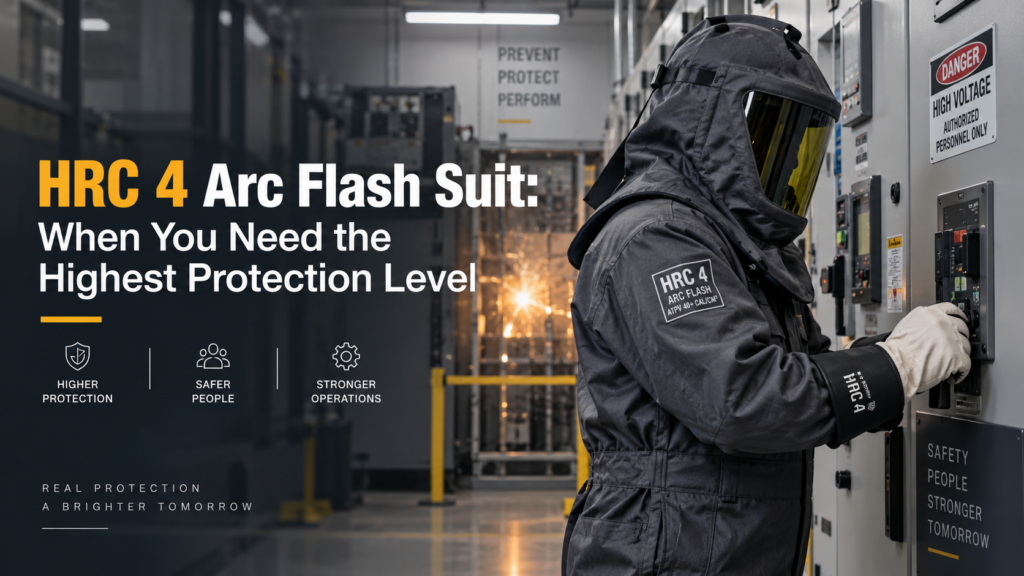
A technician stands in front of open medium-voltage switchgear. The breaker has to come out. A fault occurs, and the air in front of him turns into a fireball in a fraction of a second. His clothing decides what happens next.
That is the moment an HRC 4 arc flash suit is built for. It sits at the top of the arc flash clothing ladder with a system arc rating of at least 40 cal/cm². Most electrical tasks call for something lighter. A few tasks call for an HRC 4 arc flash suit and nothing less.
This guide covers when a task needs an HRC 4 arc flash suit, what the kit contains, how the fabric is built, and what to check before a bulk order. It also explains why the label “HRC 4” is outdated and what to write in your specification instead.
Quick answer: An HRC 4 arc flash suit is a multilayer, arc-rated clothing system with a minimum arc rating of 40 cal/cm². HRC means Hazard Risk Category, a term NFPA 70E dropped in its 2015 edition. The current term is PPE Category 4. You need the suit when your risk assessment or the NFPA 70E table method places a task in Category 4.
What Is an HRC 4 Arc Flash Suit?
An HRC 4 arc flash suit is the highest-rated clothing system in the NFPA 70E category method. It combines arc-rated layers, a hood, and gloves. The full HRC 4 arc flash suit set carries a rating of at least 40 cal/cm².
The unit needs a quick explanation. One cal/cm² is the heat energy that lands on one square centimeter of surface. A garment’s arc rating is the energy level at which there is a 50% chance of a second-degree burn under the fabric. Older HRC tables described an HRC 4 arc flash suit as cotton underwear, an FR shirt and pants, and a multilayer flash suit of three or more layers.
HRC 4 vs PPE Category 4: Same Level, Newer Name
NFPA 70E introduced hazard risk categories in its 2000 edition. The 2015 edition renamed them PPE categories and kept the four arc ratings of 4, 8, 25, and 40 cal/cm². That is why hazard risk category 4, arc flash PPE category 4, and HRC 4 all describe the same level.
Suppliers still print HRC in catalogs, and many buyers still write it in tenders. Write both terms in your specification so nobody has to guess.
| Old term | Current term | Minimum arc rating | Clothing system |
| HRC 1 | PPE Category 1 | 4 cal/cm² | Arc-rated shirt and pants, or coverall |
| HRC 2 | PPE Category 2 | 8 cal/cm² | Arc-rated shirt and pants or coverall, plus hood or face shield with balaclava |
| HRC 3 | PPE Category 3 | 25 cal/cm² | Arc flash suit jacket and pants, or coverall, plus suit hood |
| HRC 4 | PPE Category 4 | 40 cal/cm² | Multilayer HRC 4 arc flash suit system with hood and gloves |
When Do You Need an HRC 4 Arc Flash Suit?
You need an HRC 4 arc flash suit when a task falls into Category 4. You also need an HRC 4 arc flash suit when an incident energy study puts the exposure above 25 cal/cm² and up to 40 cal/cm². Two methods determine this, and they do not mix.
Two Ways to Decide
NFPA 70E allows an incident energy analysis or the PPE category method.
The analysis calculates the energy at the worker’s distance, often with IEEE 1584-2018. The suit’s arc rating must meet or exceed that number. The category method reads the answer from tables. Equipment type, voltage, fault current, and clearing time give a category from 1 to 4. Two rules apply. You cannot use an analysis result to pick a category from the table. And one piece of equipment gets one method only.
Typical Work That Calls for an HRC 4 Arc Flash Suit
The tables push the highest categories toward higher voltage and higher fault current. Switching and energized work inside medium-voltage switchgear is a common example of HRC 4 arc flash suit work, and so is work on substation equipment. Treat that as a pointer only. Your site study or the current table has the final say.
When an HRC 4 Arc Flash Suit Is More Than You Need
A Category 4 kit is heavy and can get very hot to work in. If the study shows 8 cal/cm² at the working position, using an HRC 4 arc flash suit may only add heat stress and make the task harder to perform. It does not provide any practical benefit in that situation. PPE should be selected for the task, not simply for the site.
When an HRC 4 Arc Flash Suit Is Not Enough
NFPA 70E has no Category 5. When the calculated energy rises past 40 cal/cm², even an HRC 4 arc flash suit stops being the main answer. Teams look at de-energizing the equipment, changing the work method, or adding engineering controls. Heat is only part of an arc event. Pressure and noise injure people as well, regardless of what the fabric does with the heat.
What Is Inside an HRC 4 Arc Flash Suit Kit?
An HRC 4 arc flash suit is a system. The arc rating belongs to the full set, and layered systems must be verified as a complete assembly. A jacket from one maker paired with a hood from another may not carry the rating you specified.
| Component | Job | What to check |
| Arc flash suit hood | Covers head, face and neck | Rating of the hood itself, anti-fog window, fan option |
| Jacket | Covers the upper body | Rating label, closure type, cuffs that fit over gloves |
| Bib overalls or trousers | Cover the lower body | Leg zips for boots, seat and knee reinforcement |
| Coverall (one-piece option) | Replaces jacket and bibs | Easier to put on, less independent movement |
| Gloves | Protect hands from shock and arc heat | Rubber insulating gloves with protectors, or arc-rated gloves |
| Hard hat, safety glasses, hearing protection, leather footwear | Complete the system | Fit under or with the hood |
Many suppliers call a jacket and bib set an arc flash switching suit, a type of HRC 4 arc flash suit. The name comes from switching work, a common Category 4 task. A two-piece set often gives more ease of movement than a one-piece coverall.
The hood causes most comfort complaints because it traps heat. Some hoods carry a battery-powered fan, so ask about fan options before you finalize a kit.
Fabric and Construction of an HRC 4 Arc Flash Suit
Fabric choice sets the weight, the feel, and the wash life of an HRC 4 arc flash suit. Two fiber families dominate the market.
Inherent fabrics, such as aramid and modacrylic blends, carry protection in the fiber itself. Treated fabrics, such as FR cotton, rely on a finish applied to the cloth. Both families appear in HRC 4 arc flash suit kits. The difference shows up after repeated washing, so ask for wash-life test data.
| Point | Inherent aramid or modacrylic blend | Treated FR cotton |
| Source of protection | The fiber | A finish on the fabric |
| Arc rating in layered builds | Reaches 40 cal/cm² | Reaches 40 cal/cm² |
| Wash-life question | Fiber stays the same | Finish must survive wash cycles |
| Hand feel | Varies by blend | Closer to ordinary cotton |
| What to request | Test report for the layered build | Test report plus wash-life data |
Layer count is just as important as the fabric used in an HRC 4 arc flash suit. Suits differ in construction, but the same idea applies: Category 4 protection usually comes from multiple layers working together, not from a single heavy fabric.
Then look past the fabric. Thread, zippers, labels and reflective trim all sit on the garment. A seam that opens in a flash lets heat in. Ask whether the arc rating applies to the finished garment or only to the fabric roll.
Under the HRC 4 arc flash suit, wear cotton or arc-rated base layers. NFPA 70E still prohibits certain flammable synthetic materials, because melting fibers cause deeper burns.
Fit also changes protection. A loose HRC 4 arc flash suit snags on equipment. A tight one loses the air gap between layers and between cloth and skin. Test sizes with the hood and hard hat on.
Standards Behind the HRC 4 Arc Flash Suit Label
Standards give the label its meaning. Four references matter most for a buyer.
- NFPA 70E sets when an HRC 4 arc flash suit and other arc-rated clothing is required, and defines the four categories.
- ASTM F1959 is the test method that produces the ATPV or EBT value printed on the label.
- ASTM F1506 is the performance specification for arc-rated clothing, including labeling.
- IEC 61482 covers arc protective clothing for international markets. Part 1-1 is the open arc test. Part 1-2 is the box test, which classifies garments as Arc Protection Class 1 or 2.
One change deserves attention. The 2027 edition of NFPA 70E removes manufacturer self-declaration as a route to PPE conformity. Ask for independent test reports on every HRC 4 arc flash suit you buy, and check the exact edition text for your market.
HRC 4 Arc Flash Suit Buying Checklist
Use this list when you prepare a tender or compare quotations.
- Write “PPE Category 4, minimum system arc rating 40 cal/cm² (HRC 4)” in the specification.
- Ask for the arc rating of the full HRC 4 arc flash suit system, hood included.
- Request the test report for the finished garment, with the method and the ATPV or EBT value.
- Confirm fiber content and gsm of each layer.
- Check the rating of thread, zippers, labels, and trim.
- Match glove class to the system voltage, and confirm protectors are included.
- Plan a size run, then trial each size with hood, hard hat, and base layers.
- Get care instructions and wash-life limits in writing.
- Define the HRC 4 arc flash suit kit contents: hood type, jacket and bibs or coverall, bag, labeling.
| Your study or table result | What to specify |
| Up to 8 cal/cm² | Lighter arc-rated clothing (Category 1 or 2 level) |
| Above 8, up to 25 cal/cm² | Category 3 arc flash suit |
| Above 25, up to 40 cal/cm² | HRC 4 arc flash suit rated at 40 cal/cm² |
| Above 40 cal/cm² | Re-plan the task: de-energize, change the method, add controls |
Common Mistakes When Buying an HRC 4 Arc Flash Suit
- Buying an HRC 4 arc flash suit on the cal number alone. A 40 cal/cm² label tells you nothing about heat stress, fit, or wash life.
- Writing “FR” and stopping there. All arc-rated clothing is flame resistant, but not all flame resistant clothing carries an arc rating. A plain FR coverall is not an HRC 4 arc flash suit.
- Mixing parts from different makers. The HRC 4 arc flash suit rating may not survive the swap.
- Specifying Category 4 for the whole site. Use the study, and put the suit where the task needs it.
- Skipping size trials. An HRC 4 arc flash suit that does not fit gets worn wrong or left in the storeroom.
Comfort, Heat and Mobility
An HRC 4 arc flash suit is the heaviest arc flash clothing a worker will wear. Plan for it. Choose fan-ventilated hoods where heat is a problem, and decide work and rest cycles with your safety team. Offer both a coverall and a jacket-and-bib set so workers can pick the one that moves best for their task.
Care, Inspection and Replacement of an HRC 4 Arc Flash Suit
Inspect the HRC 4 arc flash suit before and after every use. Look for tears, burn marks, contamination, damaged closures, and a cracked hood window. Wash the garments as the manufacturer instructs, and dry them without high heat if the label says so. Store the HRC 4 arc flash suit kit in a clean, dry bag away from sunlight.
Replace the HRC 4 arc flash suit after any arc exposure, after damage that affects protection, when the label becomes unreadable, or when the maker’s wash limit is reached. Keep one record per kit so the storeroom knows which suit is in service.
Industries That Use an HRC 4 Arc Flash Suit
| Industry | Typical use |
| Power utilities and substations | Switching and energized work on medium-voltage equipment |
| Oil and gas plants | Switchgear rooms and large motor feeders |
| Steel and heavy manufacturing | Plant substations and large drive switchgear |
| Mining | Medium-voltage distribution and mine substations |
Bulk Orders and OEM Notes for HRC 4 Arc Flash Suits
Bulk buyers should settle four things early: kit contents, size curve, label content, and bag packing. OEM and private label buyers need the label wording agreed before production, because arc rating labels follow set rules under ASTM F1506.
Armstrong Products has manufactured industrial workwear since 2009 at its Boisar, Maharashtra facility, with its corporate office in Powai, Mumbai. Buyers who already source FR coveralls from us can plan arc-rated garments in the same program, including an HRC 4 arc flash suit.
Key Takeaways
- An HRC 4 arc flash suit is the same level as arc flash PPE category 4, with a minimum system arc rating of 40 cal/cm².
- Task tables or an incident energy study determine when you need one. Do not mix the two methods on one piece of equipment.
- The rating belongs to the full HRC 4 arc flash suit kit, so buy and verify it as a system.
- Ask for test reports on the finished HRC 4 arc flash suit, not only the fabric.
- Above 40 cal/cm², the answer is a different work method, not a thicker suit.
Conclusion
An HRC 4 arc flash suit protects workers at the top of the NFPA 70E category ladder. It earns its place on a small number of tasks: switching and energized work on medium-voltage equipment. Everywhere else, a lighter arc-rated garment does the job with less heat stress.
Buy the HRC 4 arc flash suit as a system, write PPE Category 4 and HRC 4 in the specification, and ask for test reports on the finished garment. When the task goes beyond 40 cal/cm², change the task.
Planning a bulk, OEM, or private label order for arc-rated and FR workwear? Request our catalog and tell our product team your arc rating, fabric, and quantity needs.
FAQs
What does HRC 4 mean on an arc flash suit?
HRC 4 stands for Hazard Risk Category 4, the highest level in the older NFPA 70E classification. An HRC 4 arc flash suit has a minimum system arc rating of 40 cal/cm². NFPA 70E dropped the HRC term in its 2015 edition and now uses PPE Category 4. Catalogs, labels, and tenders still use HRC, so you will see both terms for the same level of protection.
Is HRC 4 the same as PPE Category 4?
An HRC 4 arc flash suit and a PPE Category 4 suit protect at the same level. The 2015 edition of NFPA 70E renamed the categories and kept the four arc ratings of 4, 8, 25 and 40 cal/cm². Older documents say HRC; newer ones say PPE Category. Put both terms in your specification so a supplier cannot read it two ways.
When is an HRC 4 arc flash suit required?
An HRC 4 arc flash suit is required when a task falls in Category 4 under the NFPA 70E table method. It is also the right choice when an incident energy analysis shows exposure above 25 cal/cm² and up to 40 cal/cm². The table method looks at equipment type, voltage, fault current, and clearing time. The analysis calculates the energy at the worker’s distance. Pick one method per piece of equipment, and let your electrical safety study give the final answer for each task.
What is included in an HRC 4 arc flash suit kit?
Most kits come with an arc flash suit hood, a jacket, bib overalls or a coverall, and gloves. A hard hat, safety glasses, and a carry bag are often included too. Hearing protection and leather footwear may also be required. Because suppliers do not always include the same items, spell out the full kit in your tender so every quote is for the same HRC 4 arc flash suit.
What if the incident energy is above 40 cal/cm²?
NFPA 70E does not have a category above 4. If the calculated incident energy is more than 40 cal/cm², the job should be looked at again before work starts. That may mean de-energizing the equipment, changing how the task is done, or using controls such as remote operation. Even if a suit has a higher arc rating, the worker can still be exposed to dangerous pressure and noise. The suit should be treated as a backup layer of protection, not the main safety measure.