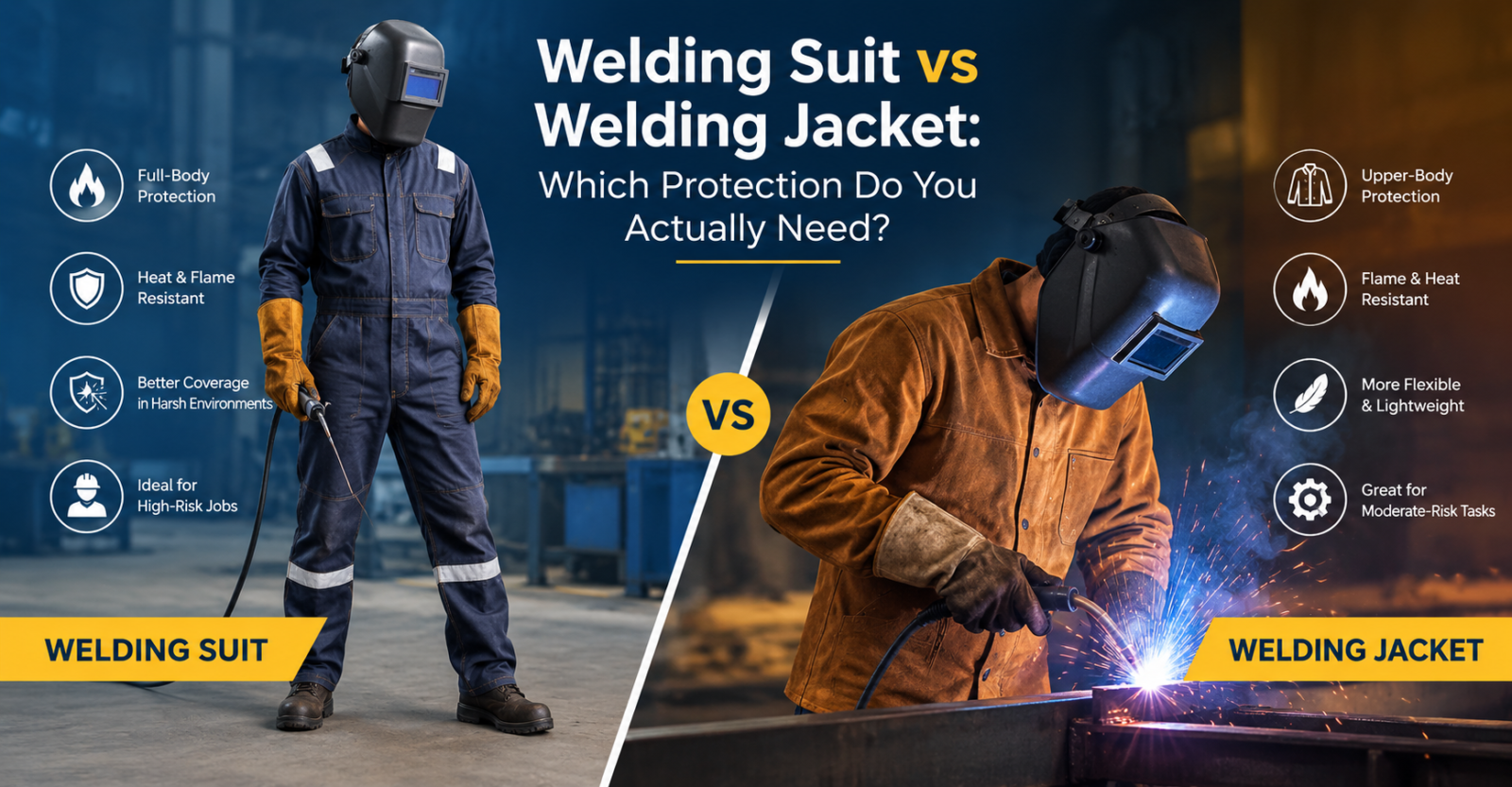
A welder welding overhead on a pipe rack has to cover his legs, whereas a welder sitting at a bench and using a TIG torch on thin sheet metal only needs sleeves that go past the elbow. If you buy the wrong type of clothing for either job, you will either spend too much on protection no one will use or leave the worker vulnerable when a spark actually hits.
The genuine issue underlying the debate between “welding suit and welding jacket” is seldom given a clear answer since a great deal of the information available online is aimed at an individual hobbyist who is purchasing just one item from a retail store, rather than at a safety manager who is sourcing personal protective equipment for forty welders working across three shifts. This guide answers the question the way a procurement team needs: by welding process, exposure area, and what a bulk order should specify before you request quotes.
Quick Answer
A welding jacket provides cover for the torso, arms, and shoulders and is therefore suitable for bench work, TIG welding, and light MIG welding as long as the sparks remain above the waist. A suit, on the other hand, is a one-piece garment that covers the entire body, including the legs and lower back, and is appropriate for overhead welding, work in confined spaces, stick welding, and any task in which sparks or slag may fall below the waist. When welders are mostly standing at a fixed position during a shift, a jacket is generally sufficient. However, when they have to climb, kneel, or work overhead, a suit should be the safer choice.
What Is a Welding Jacket?
A welding jacket is a two-piece protective suit worn over normal clothes that extends from the neck to the waist and from the shoulders to the wrists. It is designed to prevent sparks, spatter, and the radiant heat from a welding arc or torch from getting to the skin or setting the clothing underneath on fire. Most welding jackets fasten at the front with a snap or zip, fit loosely in the shoulders to allow arm movement, and use leather, FR cotton, or an aramid blend for the shell.
The jacket design works because it shields the exposed areas. The parts of a welder’s body closest to the arc are his hands and forearms; his torso is affected by the dropping spatter and radiant heat, while his legs, when he is sitting or standing on a bench, are generally protected by the workbench.
What Is a Welding Suit?
A one-piece welding suit is a type of coverall that provides jacket-level protection and extends it down through the legs to the ankles as a single, continuous garment. It eliminates the gap at the waist that would remain with a two-piece suit of a jacket and trousers, and most oil and gas, shipyard, and structural steel contractors require this format for any welder working at ground level, in a pit, or inside a vessel.
The disadvantage is that it generates more heat and reduces mobility. A one-piece suit stays warmer throughout the shift and takes longer to remove in an emergency because you have to remove the entire garment rather than a jacket, which you can discard in seconds. This is a real cost, which is why a suit isn’t the default solution for every welder on the floor.
Welding Suit vs Welding Jacket: Key Differences
| Factor | Welding Jacket | Welding Suit |
| Coverage | Neck to waist, shoulders to wrists | Full body, neck to ankle |
| Best for | Bench work, TIG, seated MIG | Overhead, confined space, stick welding |
| Heat retention | Lower, easier to shed | Higher, full-body insulation |
| Doffing speed | Fast (single zip or snap) | Slower (full garment removal) |
| Typical fabric | Leather, FR cotton, hybrid | FR cotton, Nomex/aramid blend |
| Bulk unit cost | Lower per piece | Higher per piece |
| Common buyer | Fabrication shops, workshops | Refineries, shipyards, structural steel contractors |
Fabric Comparison: Leather, FR Cotton, and Nomex Blends
Leather performs better than any woven fabric in resisting sparks and molten spatter since it doesn’t catch fire like treated fibers can and is more durable when subjected to the abrasion caused by grinding and heavy stick welding; it is also the heaviest and least breathable of the options, a fact that is important when working during summer in a shed without air conditioning.
FR cotton treated with a flame-retardant treatment such as Pyrovatex offers better breathability and comfort at the expense of some spark resistance. It is suitable for TIG welding and lighter MIG welding when sparks are minimal, and it is cheaper to produce in large quantities than leather or aramid.
Nomex and various aramid blends lie between the two in this regard. Unlike chemically treated cotton, aramid blends are naturally flame resistant, so the protection does not disappear over the garment’s life, as it can with chemically treated cotton after 50 to 60 washings. This means that for a welder who works five or six shifts each week, an aramid blend is the better long-term option, even though its initial cost per unit is higher.
When a Welding Jacket Is the Right Choice
It is appropriate to use a jacket when the welder is seated or standing at a fixed bench and is carrying out TIG or light MIG welding on sheet metal or small assemblies, the workbench or table itself preventing sparks from dropping below waist level. The jacket is also suitable for short-duration jobs such as tack welding, spot repairs, or work in a fabrication shop where the worker must move between stations and quickly remove their protective clothing between tasks.
When You Need a Full Welding Suit
A one-piece suit is the safer choice as soon as a welder is working above shoulder height inside a tank or vessel, in a pit, or on scaffolding, since sparks and slag fall under the influence of gravity, and in those positions a jacket leaves the legs and lower back exposed. Because stick welding and heavy MIG welding on structural steel generate more spatter than TIG welding, contractors employed on pipeline, shipyard, and refinery turnaround jobs prefer to specify a suit as the basic garment rather than a jacket with separate trousers.
Standards and Welding PPE Requirements
Welding jackets and clothing are personal protective equipment designed to protect welders from metal splatter and high temperatures using fire-resistant, thermally insulating materials. The standard that applies to this equipment is EN ISO 11611, which specifies performance criteria for protective clothing used in welding and related processes, including requirements for flame spread, splatter resistance, and electrical resistance. In the United States, ASTM F1506 is the standard for flame-resistant textiles used in industrial protective clothing in general, and welding garments are usually tested to it. In the United States, OSHA has the authority to impose fines for failure to comply with the PPE policy outlined in 1910.132. GlobalSpecGlobalSpec
A bulk buyer who is purchasing welding suits or jackets for export should ask the supplier which of the relevant standards the fabric and the finished garment meet, rather than simply assume that ‘flame resistant’ on the specification sheet is enough.
Bulk Procurement Checklist
- Confirm the fabric GSM (240 GSM to 280 GSM is the common industrial range) and whether it is treated FR cotton or inherently flame-resistant aramid
- Ask for EN ISO 11611 or ASTM F1506 test certificates, not just a manufacturer claim
- Check the type of closure before ordering: Metal snap closures are better suited to heat exposure than plastic zips on the front of a welding jacket.
- Choose sizes from your workers’ actual measurements: Don’t rely on a basic S-to-XXL size range. Welders often need extra room around the shoulders so they can move their arms comfortably while working with a torch and gloves.
Buying Checklist for Procurement Teams
- Check the hazards involved in each job before deciding whether workers need FR coveralls or regular ones.
- Ask the supplier for a test certificate for the actual fabric being supplied, rather than relying on a general compliance letter from the company.
- Ask about OEM branding and private label options if the garments will carry your company’s safety identity
Common Mistakes Buyers Make
The most common mistake is ordering jackets for an entire welding crew without first checking which welders actually work overhead, since this leaves the most hazardous positions inadequately protected while the less hazardous ones endure an unnecessary heat load. Another frequent error is treating “flame resistant” as a single, fixed standard rather than investigating whether the flame resistance comes from treatment or is an inherent property, because treated FR cotton loses effectiveness after repeated industrial washing, whereas inherent aramid does not. A third mistake is skipping a proper size trial and instead ordering a compressed range from S to XXL, which forces welders who are either larger or smaller to work in poorly fitting clothing, increasing discomfort and the likelihood that the fabric will loosen and catch on equipment.
Industry Applications
Because shipbuilding and structural steel fabrication involve a lot of overhead and vertical welding, they tend to use one-piece suits. Similarly, oil and gas pipeline construction and work during refinery turnarounds usually call for aramid blend suits for crews working inside vessels or in confined spaces. In contrast, in automotive fabrication and general metalworking shops, where welding is done at the bench and TIG or light MIG is primarily used, companies tend to choose jackets with separate flame-resistant trousers.
Maintenance and Care
Leather jackets must be regularly conditioned to avoid cracking and should never be put through a normal washing cycle. Cotton garments treated with flame retardant have a limited number of effective washings, usually between 50 and 60, after which the flame-retardant treatment fails, and the garment should then be retired even if it shows no visible signs of wear. Although aramid blends maintain their protection throughout the life of the fabric, they still need to be checked for thinning in high-friction areas such as the elbows and cuffs, since physical wear can reduce the fabric’s barrier thickness even when the fibers themselves have not lost their flame resistance.
Conclusion
The choice between a welding jacket and a full suit depends largely on where the sparks are likely to land. For welders working at a fixed bench on TIG or light MIG jobs, a jacket is usually enough. But when the work involves overhead welding, tight spaces, or heavy stick welding, a one-piece suit provides better coverage. For a larger crew, it makes more sense to choose the garment based on the job rather than giving everyone the same thing. That way, workers get protection where they actually need it.
Armstrong Products has manufactured industrial workwear since 2009, with production from its Boisar, Maharashtra, facility and corporate operations in Powai, Mumbai, supplying FR coveralls, IFR coveralls, and welding-specific protective clothing to procurement teams across oil and gas, shipbuilding, and heavy fabrication. Contact Us to discuss bulk requirements, sizing runs, or OEM branding for your welding crew’s PPE.
FAQs
What is the main difference between a welding suit and a welding jacket?
The main difference is the area covered: a jacket protects the torso, shoulders, and arms down to the wrist, while a suit is a single piece of clothing that provides the same protection all the way down to the ankles. The decision depends on whether the welder’s legs are exposed to spark drop while carrying out the job; this is more a matter of posture and welding position than the welding process itself.
Is a welding suit safer than a welding jacket?
A suit provides greater overall coverage, something that is important when welding overhead, in confined areas, or at height where sparks drop below waist level, but when the work is carried out at a bench and the legs are protected by the table, a jacket worn with ordinary FR trousers gives just as much practical protection at a lower heat load and cost.
Which fabric is best for a welding jacket, leather or FR cotton?
Leather resists both sparks and wear, which is why it is the usual choice for stick welding and heavy MIG welding. Cotton fabric, on the other hand, breathes better and suits TIG welding or lighter fabrication jobs with fewer sparks. Fabric choice depends more on the welding process than on personal preference.
How often should a welding suit or jacket be replaced?
Treated FR cotton welding garments generally need to be replaced after around 50 to 60 industrial washes, even if they still look usable. Leather and inherent aramid garments can usually last longer, but you should still check them regularly. Pay close attention to areas such as the elbows, cuffs, and chest, where thinning or wear can reduce the protection. Physical damage can affect the garment even when there is no specific washing limit.
Do welding suits meet EN ISO 11611?
Protective clothing made from certified material and built to the standard’s specifications can meet EN ISO 11611, the standard drawn up specifically for welding protective clothing. The purchaser should ask the supplier for the test certificate rather than accepting a ‘flame resistant’ claim listed on the specification sheet.
Can one welding jacket work for both TIG and stick welding?
A cotton jacket designed for TIG welding won’t withstand the spatter produced by stick welding on structural steel; in that case, a heavier leather or reinforced hybrid jacket works better. By selecting the right fabric for each welding process, rather than buying a single jacket type for a crew that uses multiple processes, each welder gets the protection they need for the work they’re doing.
What GSM is standard for industrial welding suits?
Welding suits used in industry usually have a GSM between 240 and 280 when made from FR cotton, and aramid blends may be lighter because of the fiber’s natural strength. Since GSM alone does not indicate the level of protection, customers should pair it with the fabric’s certified standard rather than treat weight as the only important specification.
Are welding suits more expensive than welding jackets in bulk orders?
The per-unit cost of a one-piece suit is generally greater than that of a jacket alone because it requires more fabric and covers a larger portion of the body. When comparing the total cost of a program, consider that a jacket usually must be matched with separate FR trousers to achieve the same level of coverage as a suit, which reduces the price difference when you consider the complete outfit.
What should I ask a manufacturer before placing a bulk welding suit order?
Ask for the fabric’s certified standard (either EN ISO 11611 or ASTM F1506), check its GSM and find out if the fabric is treated or natively flame resistant, and inquire about the degree of flexibility regarding sizes based on the actual measurements of your workforce. A manufacturer that can answer all three questions without hesitation is usually better positioned to support a recurring bulk order.
Can welding jackets and suits be customized with company branding?
Industrial manufacturers generally offer OEM and private-label options for large orders, such as adding the company logo, assigning colors by department, and providing custom sizing. Verify this during the quoting phase, since branding and customization needs can affect minimum order quantities and lead time.