
A procurement officer working for one of the contractors at Ras Laffan once sent us a sample of coveralls and included the following question: does it really meet the required specifications or does it merely have ‘Nomex’ printed on the label? That question is at the heart of every Nomex coverall purchase order in Qatar. The gas plants in Qatar do not buy flame-resistant clothing on trust; instead, they buy according to a written specification, the coverall having to conform exactly to each and every part of it or else it is rejected when it arrives.
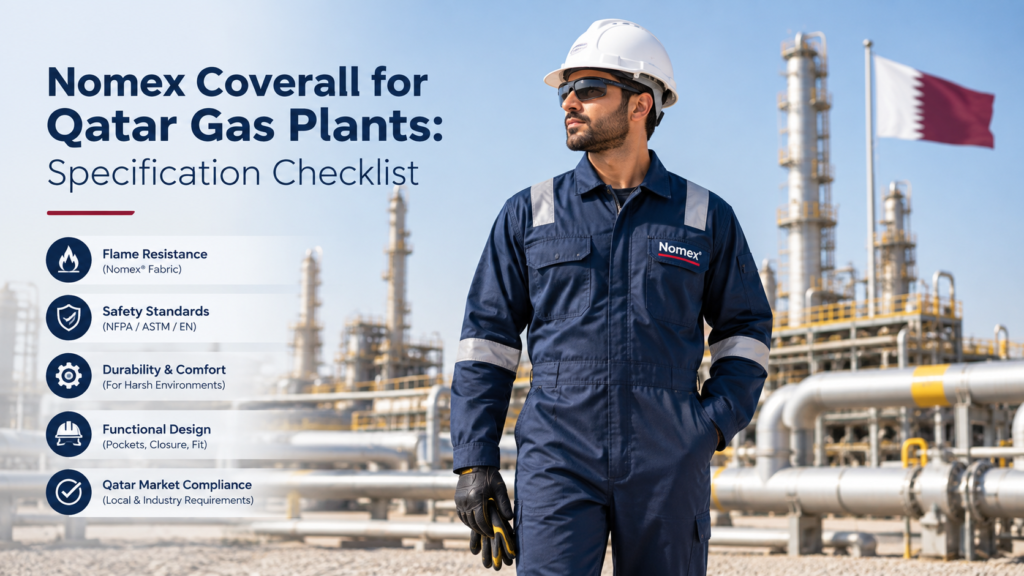
The checklist sets out exactly what is included in a Nomex coverall Qatar specification: the fabric composition, the weight, the relevant standards, the stitching, and the documentation that a supplier has to provide before any coverall is shipped. It is designed for a buyer who has to approve a large order and cannot afford for a shipment to fail inspection at Ras Laffan or Mesaieed.
Quick answer: For Qatar gas plant work, a Nomex coverall will generally use a Nomex meta-aramid and Kevlar blend, with 93/5/2 Nomex/Kevlar/antistatic fiber being a typical specification. Fabric weight can fall between 150 and 210 GSM, depending on the exposure involved. Check that the garment has EN ISO 11612 and EN ISO 13688 certification and an EN 1149-5 antistatic rating. The manufacturer should also be able to provide the mill test certificate and batch traceability records.
What Counts as a Nomex Coverall Qatar Buyers Can Trust, and Why Gas Plants Specify It
Nomex is the name that DuPont gives to a meta-aramid fibre which does not melt, drip or support combustion; when it comes into contact with a flame the fibre swells and forms a char layer rather than burning through. It is because of this one feature that the health and safety teams from Ras Laffan and Mesaieed included Nomex on their approved fabrics list for use in situations involving flash fire or arc flash, preferring it to FR cotton or FR-treated blends.
Most commercially available Nomex coveralls are not made of pure Nomex; the standard mixture consists of 93% Nomex meta-aramid, 5% Kevlar para-aramid, and 2% antistatic fiber, and the product is known as either Nomex IIIA or Nomex Delta-C, depending on the manufacturer. Kevlar is included in order to provide tear strength, which is missing in plain Nomex. The antistatic fiber – typically a carbon or metal filament woven into the fabric – is the one that inspectors check first, since a coverall that produces static in a gas plant poses a hazard rather than offering protection.
Nomex Coverall Qatar Specification at a Glance
| Spec item | Typical requirement |
| Fiber blend | 93% Nomex meta-aramid, 5% Kevlar, 2% antistatic fiber |
| Fabric weight | 150 to 210 GSM (4.5 to 6 oz/yd²) |
| Primary standard | EN ISO 11612 (heat and flame) |
| Garment standard | EN ISO 13688 (general PPE requirements) |
| Antistatic rating | EN 1149-5 |
| Thread | Nomex or Kevlar sewing thread, never polyester |
| Seam type | Safety-stitched or triple-stitched, no single-pass seams |
| Closures | FR tape-covered metal zipper, snap buttons over exposed metal |
At its plant in Boisar, Maharashtra, Armstrong Products produces Nomex, IFR, and FRC coveralls in accordance with this specification range, and prepares the export documentation for approval by Gulf contractors. Contact us if you want to place a bulk order.
Nomex Coverall Qatar Fabric Composition: The Line Item Buyers Get Wrong Most Often
In a Qatar gas plant procurement file, the biggest warning sign is a supplier giving a quotation for “Nomex coverall” without stating the blend percentage. You should ask for the exact fiber ratio on the fabric label, not just the brand name.
The 93/5/2 blend is the standard used in the market for a reason; Kevlar by itself would be more expensive and would increase the weight without providing much additional protection against fire when used in coveralls. Likewise, Nomex on its own tends to tear more quickly at the seams and at the corners of the pockets after repeated washing. Although the antistatic fibre makes up only about 2% by weight, it is the one that QatarEnergy and the HSE auditors at Ras Laffan specifically inquire about, as zones classified as Zone 1 and Zone 2 hazardous areas require a demonstrated path for the dissipation of charge through the garment.
Certain suppliers replace the meta-aramid blend with a cheaper alternative and still print ‘Nomex’ on the packaging. The only means of detecting this before the coverall gets to the site is to have a mill test certificate that specifies the actual fibre supplier, not just the manufacturer of the garment.
GSM and Fabric Weight: Matching the Grade for Nomex Coverall Qatar Buyers
The amount of heat protection that a coverall provides and the comfort of wearing it during a 10 or 12-hour shift in Qatar’s climate depend on the fabric’s weight.
- The 150 GSM (4.5 oz) grade is the lighter option. It is generally used for general plant access, control room visits, and similar jobs where workers may face flash fire exposure occasionally but are not dealing with continuous heat.
- 180 to 200 GSM (5.5 to 6 oz): This type is used by personnel working on hot tasks, by those who provide welding support, or by the crews involved in turnarounds and shutdowns who need greater thermal protective performance without having to switch to a heavier aluminized suit.
- 210 GSM and above: Such grades are reserved for particular tasks involving high exposure, generally being specified by the client’s HSE department rather than selected by the supplier.
It is sometimes the case that buyers choose the thickest fabric that is available, on the assumption that it is safer in all situations. However, this is generally not the correct decision. For example, wearing a 200 GSM coverall in the outdoor summer conditions in Qatar where a 150 GSM one had been specified increases heat stress, and heat stress in itself has a documented history of causing injuries on Gulf gas plant sites.
Nomex Coverall Qatar Standards and Certification: What the Documents Should Actually Say
The standard EN ISO 11612 relates to protection against heat and flame for both the fabric and the finished garment, with testing carried out under conditions of convective heat, radiant heat, and limited flame spread. EN ISO 13688 is the general standard for PPE clothing regarding requirements such as ergonomics and sizing, areas that EN ISO 11612 alone does not cover. In some cases, gas plant contracts in Qatar require all three certificates: those specified by EN ISO 11612, EN 1149-5 for antistatic performance in hazardous areas, and OSHA guidance on PPE selection.
The American standard corresponding to EN ISO 11612 is NFPA 2112, and this is the one more frequently used by operators based in the United States. While some contracts at Ras Laffan accept either standard, others specify that only EN certification is accepted. Before placing an order, confirm which standard the client’s HSE department requires, since a supplier certified only to NFPA 2112 cannot meet an EN ISO 11612 requirement without the client’s written approval.
Documents to request from the supplier before payment:
- Fabric mill test certificate showing fiber composition and GSM
- Garment-level EN ISO 11612 and EN ISO 13688 test reports from an accredited lab
- EN 1149-5 antistatic test report
- Batch and lot traceability records
- Country of origin and manufacturer registration details
Nomex Coverall Qatar Seam, Thread, and Construction Checklist
A Nomex coverall can pass every fabric test and still fail in the field if the construction is wrong. Seams are the weak point in almost every flame resistant garment.
Thread has to be Nomex or Kevlar based. Polyester thread melts at a fraction of the temperature Nomex fabric can handle, so a garment sewn with the wrong thread has a built-in failure point at every seam, no matter how good the base fabric is. This is worth checking on a sample garment directly, since polyester thread often looks identical to Nomex thread until it is tested.
The seams must be safety-stitched or triple-stitched, not just single-stitched. Zippers should have FR tape covering the metal teeth because exposed metal close to the skin when there is a flash fire presents its own risk of causing a burn. Snap buttons and all other metal fasteners should be placed underneath a fabric flap rather than being positioned directly on the outer surface.
FR Coverall vs IFR Coverall: Where Nomex Coverall Qatar Buyers Should Land
| Feature | Nomex Coverall (IFR) | Treated FR Cotton Coverall |
| Flame resistance source | Built into the fiber, permanent | Chemical treatment, can wash out over time |
| Typical weight | 150 to 210 GSM | 240 to 320 GSM |
| Best suited for | High heat, flash fire, arc flash zones | General industrial FR requirements, lower budget |
| Laundering sensitivity | Low, resistance does not degrade | Higher, harsh detergents reduce treatment life |
| Relative cost | Higher | Lower |
Common Mistakes Buyers Make When Specifying a Nomex Coverall Qatar Order
Omitting the request for the mill certificate is the most costly error on this list; a shipment arriving without traceable fabric documents may be held up at customs or rejected during the client’s goods inward inspection, and at that stage the pressure on the buyer’s schedule is already being felt, not the supplier’s.
If you place an order on the basis of the brand name alone without attaching a written Nomex coverall Qatar specification to the purchase order, you will encounter the second most common problem. Since “Nomex coverall” does not refer to a single specification, two different suppliers may ship a product marked as Nomex which has completely different GSM values, blend ratios, and certification levels. You must therefore state the exact fiber percentage, weight, and standard in the purchase order line item, not merely the name of the fabric.
Sizing is also underrated. When working on the Gulf gas plant, the crew frequently wear a base layer or a cooling vest under their coverall, particularly during the summer shutdown periods. A coverall that fits properly over a bare torso becomes too tight when a layer is worn under it and thus hampers movement precisely where flexibility is most important.
The use of standard reflective tape is a lesser but still common problem, since some suppliers opt for standard reflective tape instead of using tape that is rated for flame resistance. In the event of a flash fire, ordinary reflective tape can melt onto the skin and thus nullify the benefits of an otherwise compliant coverall.
Where a Nomex Coverall Qatar Order Actually Gets Used
Ras Laffan Industrial City and the LNG trains operated by QatarEnergy are the main source of demand, but Nomex coveralls are used in a broader range of positions. Contractors carrying out turnarounds and shutdowns specify them for teams working beside actively running process units. The operators of the petrochemical plant in Mesaieed also use the same fibre blend for jobs that involve a risk of electrical arc as well as flash fire. When EPC contractors are submitting bids for QatarEnergy’s upstream projects, they usually have to include approved specifications for flame-resistant clothing as part of their HSE prequalification package before they are allowed to mobilise.
Maintenance and Care: Protecting the Investment
Although treated FR cotton is more expensive initially than Nomex coveralls, the higher cost only becomes worthwhile if the clothing is looked after during its useful life.
Wash the item using water that is cold to warm in conjunction with a gentle detergent. Even though bleach and fabric softener do not have a direct effect on the Nomex fibre itself, they both harm the antistatic fibre after multiple washes. The garment should be air dried or tumble dried on a low heat setting rather than on a high heat setting since the high heat cycling speeds up the fatigue of the fabric at areas of stress such as the crotch seam and underarm.
After each wash cycle you should inspect the coveralls for any signs of thread pull, seam separation, or fabric thinning at the knees and elbows. A Nomex coverall with a torn seam is not any longer a certified garment because the certification relates to the complete and intact construction and not merely to the fabric.
Nomex Coverall Qatar Buying Checklist: Before You Sign the Purchase Order
- Keep the written Nomex coverall Qatar specification with the purchase order so there is no confusion about what has been ordered.
- Get the fiber blend confirmed in writing. A common blend is 93/5/2 Nomex/Kevlar/antistatic.
- GSM matches the exposure category specified by the client’s HSE department
- EN ISO 11612 and EN ISO 13688 certificates provided, or NFPA 2112 if that is the required standard
- EN 1149-5 antistatic test report included
- Nomex or Kevlar thread used throughout, verified on a sample garment
- Seams are safety-stitched or triple-stitched
- Zipper and metal fasteners are FR tape-covered or flap-protected
- Reflective tape is FR-rated, not standard reflective material
- Check that mill test certificates and batch records are available so the fabric can be traced back to its production batch.
- Make sure the sizing allows room for layers underneath the coverall without making the garment too tight.
Key Takeaways
Before ordering a Nomex coverall for Qatar gas plant work, go through the basics carefully. Check the fiber blend, fabric GSM, and the required EN ISO 11612 and EN ISO 13688 certifications, along with the EN 1149-5 antistatic rating. It is also important to look at the thread and seam construction and make sure all the required paperwork is ready. Missing any of these details can lead to a shipment being rejected at goods inward, even when the coveralls appear to meet the requirements.
Conclusion
The difference between a coverall with “Nomex” on the label and one that actually meets a Qatar gas plant’s requirements is often found in the paperwork. Buyers sometimes ask for these details only after a problem comes up. Before placing the order, check the fiber blend, GSM, EN certification, and thread type. These four details can tell you whether the coverall really matches the specification.
Armstrong Products manufactures the Nomex coverall Qatar contractors specify, along with IFR and FRC coveralls, at the same specification range, with export documentation prepared for Gulf HSE prequalification processes. /contact-us about your fabric grade, standard, and volume requirements before your next bulk order.
FAQs
What is the material used in a Nomex coverall?
A typical Nomex coverall consists of 93% Nomex meta-aramid fibre, 5% Kevlar para-aramid and 2% antistatic fibre. The Nomex fibre gives the garment its basic flame resistance, the Kevlar contributes to its tear and abrasion strength, and the antistatic fibre provides a path for the dissipation of charge, which is necessary when working in hazardous areas such as those found at Qatar’s LNG and refinery sites.
What standard is applicable to shipments of Nomex coveralls to Qatar?
The heat and flame protection for most gas plant operators in Qatar, including those associated with QatarEnergy, is specified according to EN ISO 11612, together with EN ISO 13688 for the general requirements relating to personal protective equipment construction and EN 1149-5 for antistatic performance. In some cases NFPA 2112 is accepted as an alternative. It is necessary to verify the client’s particular HSE requirements before placing an order since the two standards relate to different parameters.
What criteria are used for selecting the Nomex coverall Qatar GSM?
GSM, which stands for grams per square metre, is the first item that the HSE department of a Qatar gas plant checks when looking at a form for ordering Nomex coveralls, as it determines the weight of the fabric and the level of heat protection. Coveralls with a lighter GSM, around 150, are suitable for general plant access and for jobs which involve occasional exposure to flash fire. Those with a higher GSM, in the range from 180 to 210, are used for positions that are nearer to having sustained heat or requiring hot work support. Usually, the client’s HSE department states the grade that is required rather than letting the supplier decide.
Can a Nomex coverall be washed with regular detergent?
Nomex coveralls must be washed using a mild detergent in cold to warm water without employing bleach or fabric softener since bleach causes the antistatic fibre to break down after a number of washings and fabric softener leaves a residue which can interfere with the garment’s moisture-wicking properties. The service life of the clothing is longer if it is air dried or dried in a tumble dryer on a low heat setting than if it is dried at high heat.
What is the difference between Nomex IIIA and Nomex Delta-C?
The two are commercial brand names based on the same blend of 93/5/2 Nomex, Kevlar, and antistatic fibre, and are marketed by different mills under their own proprietary names. The practical differences lie mainly in the weave and the finish rather than in the fibre chemistry. Buyers should look at the actual test certificates rather than supposing that one name performs better than the other.
Do Nomex coveralls need antistatic certification for gas plant work?
At most of the gas plants in Qatar, antistatic certification in accordance with EN 1149-5 is necessary for all components located in Zone 1 and Zone 2 hazardous areas, since a static discharge in the vicinity of flammable gas concentrations could cause ignition. The requirement refers to the finished garment and not merely to the raw fabric, and therefore the test report should refer to the sewn coverall and not just to the fabric roll.
How long does a Nomex coverall last before it needs replacing?
The length of time that coveralls can be used depends more on how often they are washed and on the conditions to which they are subjected than on a set calendar date. Most operators check the coveralls after every wash for any signs of seam separation, fabric thinning, or degradation of the antistatic fibres and dispose of the garment as soon as any of these indications are observed. Coveralls used heavily in field roles during turnaround or shutdown periods have a shorter service life than those used in office or control room situations.
What documents should a Nomex coverall supplier provide before shipment?
A supplier must submit a fabric mill test certificate that includes information on the fibre composition and the GSM, together with garment-level EN ISO 11612 and EN ISO 13688 test reports from an accredited laboratory, an EN 1149-5 antistatic test report, and records showing batch or lot traceability; if any of these documents are missing it will be difficult to get the shipment cleared at the client’s goods inward inspection.
Is Nomex better than FR cotton for Qatar’s climate?
Nomex has its flame-resistant protection built into the fiber, so it does not wear away with repeated industrial washing. Treated FR cotton can lose some of its protective performance over time as it goes through repeated laundering. Nomex can also provide the same level of protection with a lighter fabric in many cases, which can be useful in Qatar’s hot summer weather. FR cotton is generally the more affordable choice when the job has a lower exposure risk and the extra cost of Nomex is not necessary.
Can Armstrong Products supply Nomex coveralls that meet Qatar gas plant specifications?
Armstrong Products manufactures Nomex, IFR, and FRC coveralls at its Boisar, Maharashtra facility, built to the fiber blend, GSM, and EN standard ranges gas plant contractors typically specify. Export documentation, including mill certificates and batch traceability records, is prepared as part of the standard order process for Gulf procurement teams.