
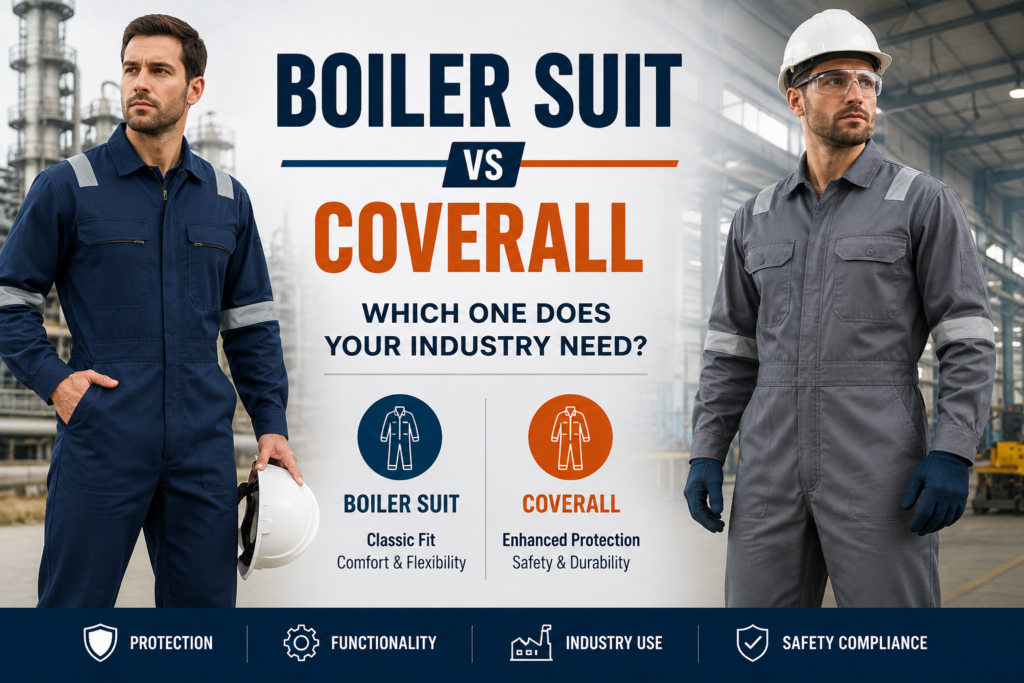
A procurement manager working at a mid-size fabrication plant once put to us a straightforward question: the purchase order she had issued stated “boiler suit,” her site supervisor always referred to the same item as a “coverall,” and the vendor’s quote used both terms for the same line item. No one was incorrect, but no one could be certain that the fabric specification on the invoice corresponded to what the welders actually needed on the shop floor.
It’s a common mistake, and money is lost if the error is not sorted out. In most technical contexts, a boiler suit and a coverall refer to the same type of basic garment: a one-piece protective suit that covers the torso, arms, and legs in a single piece. However, when you’re purchasing in large quantities for an industrial workforce, what’s on the invoice label becomes less important than the fabric itself, the GSM, the flame resistance rating, and the fit for your particular job site. This guide explains the differences between a standard boiler suit and an industrial-grade coverall and tells you which specifications your industry should ask for.
What Is a Boiler Suit?
A boiler suit is a one-piece work garment with full-length sleeves and legs, a single front zipper or button fastening, and no gap between the top and bottom sections. The name came from 19th-century workers in boiler rooms, who needed a suit that wouldn’t get caught on machinery and would keep soot and ash out through the waistband. That remains the main purpose now: complete coverage, no gaps, and as little excess fabric as possible.
In both British and Indian usage, the term “boiler suit” is used generally. It can mean either a simple cotton one-piece worn by a warehouse worker or a flame-retardant one-piece worn by a refinery technician. The word describes the garment’s shape but says nothing about the material, certification, or whether it suits the specific hazard you’re facing.
What Is a Coverall?
A one-piece suit has the same overall shape, but the term is used more precisely in industrial and safety situations, particularly in North America and in technical personal protective equipment documentation. If a safety manager refers to a ‘coverall,’ they generally have in mind a garment that conforms to specific specifications: one that has a stated gram per square meter (GSM) and a stated fabric (such as cotton, poly-cotton, an aramid blend, or a disposable non-woven material) and often also meets a compliance standard like EN ISO 11612 or NFPA 2112.
To sum up, the term ‘boiler suit’ refers to the style. ‘Coverall’ typically has the specification sheet attached. That is the actual difference that procurement teams should care about, not the word itself.
Look through Armstrong’s range of industrial coveralls and workwear to see how each product states the fabric and certification.
Boiler Suit vs Coverall: Key Differences
| Factor | Boiler Suit (general use) | Industrial Coverall (spec-driven) |
| Typical fabric | 100% cotton or poly-cotton | Cotton, poly-cotton, FR-treated cotton, aramid blend, or disposable non-woven |
| GSM range | Usually 180 to 240 GSM | Specified per job, commonly 220 to 280 GSM for FR grades |
| Flame resistance | Rarely rated | Often certified to EN ISO 11612 or NFPA 2112 when required |
| Closure | Zip or button, minimal extras | Reinforced zip, chest and tool pockets, reflective strips, elasticated waist |
| Buyer intent | Retail, general labor, light workshop use | Procurement for oil and gas, chemical, cement, manufacturing sites |
| Certification paperwork | Usually none | Test reports, colorfastness and shrinkage certificates typically supplied |
Whatever word finally appears on the purchase order, if your team is working around heat, sparks, chemicals, or moving machinery, then the type of garment you actually need is the industrial coverall side of this table.
Why the Two Terms Cause So Much Confusion
The situation is due as much to regional differences as to technical ones. In the UK, the term “boiler suit” is used universally within the trade and even in the fashion retail sector, which is why a simple search for the phrase yields as many results for denim workwear as it does for industrial personal protective equipment. In North America, “coverall” is the preferred term, while “overall” generally denotes a garment with a bib and straps, differing completely in design. In India and the Gulf, both terms are used depending on whether the supplier or contractor who prepared the tender document had used one or the other.
This is no issue at all provided that the purchase order is prepared by someone who thinks the vendor will be able to read between the lines. When a vendor quotes ‘boiler suit’ without also specifying the fabric or the GSM, they are in fact quoting a shape, not a safety garment. That gap is what procurement teams need to address before agreeing to a large order.
Boiler Suit Features Procurement Teams Should Actually Check
Omit the label and request these five items each time you receive a quotation, whether the supplier calls it a boiler suit or a coverall.
- Fabric composition: The material is made up of 100% cotton, which breathes more efficiently and is suitable for general labor. Blends of polyester and cotton last longer when it comes to resisting wear. Where there is a risk of flame or arc flash, cotton that has been treated with flame retardant or aramid must be used.
- GSM (fabric weight): The GSM (fabric weight) for warm climates and ordinary maintenance should be lighter, ranging from 180 to 220, while a higher GSM, between 240 and 280, is more suitable for abrasive and high-contact environments.
- Certification, if the job needs it: If certification is required, then for a flame or flash fire hazard, specifically request compliance with EN ISO 11612 or NFPA 2112, not just ‘fire resistant’ stated on a specification sheet without a standard being attached.
- Closure and pocket layout: The arrangement of the closure and the pockets. Front zips that are hidden and have a storm flap help to reduce the risk of getting caught on the machinery. The tool pockets located on the thighs and on the chest are more important than they may seem, since they help to get rid of loose items that a worker might have in their hands on a factory floor.
- Reusable versus disposable: When it comes to reusable and disposable types, a cotton or aramid boiler suit is designed to be washed over and over again. On the other hand, a disposable coverall, which is generally made from a non-woven fabric, is a one-off garment used for brief tasks involving high levels of contamination, such as spray painting or chemical cleaning.
The guide that Armstrong already has on coveralls and two-piece workwear presents the wider safety argument in favor of one-piece suits when you are still deciding between coveralls and separate shirt and trouser uniforms.
Industrial Boiler Suit Applications by Sector
You can’t find a one-size-fits-all solution when it comes to an industrial boiler suit. The requirements of a construction site are very different from those of a refinery.
Oil and gas: In the oil and gas sector, the type of boiler suit used has to be capable of withstanding both flash fire and arc exposure. In such cases, FR-treated cotton or fabric that is inherently flame resistant (IFR) is a necessity, not an optional feature. Contractors working in refineries and in the upstream sector generally specify coveralls that are rated according to NFPA 2112 or EN ISO 11612 and often include an antistatic treatment in accordance with EN 1149-5.
Cement and heavy manufacturing: In the case of cement and heavy manufacturing, abrasion resistance and dust protection are more important than flame resistance, unless the site includes a kiln or furnace area. A heavier GSM poly-cotton coverall generally performs better than a lightweight cotton one when it comes to wear life.
Construction: Workers moving around on vehicles and cranes usually wear high-vis boiler suits with reflective strips. The relevant standard is either ANSI/ISEA 107 or EN ISO 20471 for visibility.
Marine and offshore: For marine and offshore use, a waterproof or water-resistant coating is applied to a standard fabric base, since a cotton coverall quickly loses most of its practical value when soaked.
General workshop and maintenance: For general workshops and maintenance work, a simple cotton boiler suit without flame-resistance treatment or high-visibility features is usually adequate, and you don’t need to specify more than that. Buying certified flame-resistant coveralls for a maintenance team working in a low-hazard environment is an unnecessary expense.
Protective Boiler Suit: FR vs Cotton vs Disposable
| Type | Best for | What to check before ordering |
| Standard cotton boiler suit | General labor, warehouses, light maintenance | Fabric weight, stitching quality, wash durability |
| FR-treated / IFR coveralls | Oil and gas, welding, electrical, chemical plants | Certification standard (EN ISO 11612, NFPA 2112), wash-cycle FR retention |
| Disposable coverall | Spray painting, asbestos cleanup, short chemical exposure tasks | Fabric type (Tyvek-style non-woven vs SMS), single-use fit, seam sealing |
| Hi-vis coverall | Construction, roadside, night-shift industrial work | ANSI/ISEA 107 or EN ISO 20471 class rating |
Boiler Suit vs Coverall vs Jumpsuit: A Quick Clarifier
A jumpsuit is tailored to fit closer to the body and typically omits the tool pockets and reinforced sections that are required in industrial clothing. Both boiler suits and coveralls are looser-fitting, designed for ease of movement compared to everyday clothes, and built with function as the top priority. When a supplier provides a ‘jumpsuit’ for a job on the factory floor, check the fit and pocket placement before assuming it meets the same requirements as a coverall.
Buying Checklist Before You Place a Bulk Order
- Confirm fabric type and GSM in writing, not just “cotton” or “heavy duty” on the quote
- Ask for the specific certification standard if the job involves flame, arc, or chemical exposure
- Request a sample garment before committing to a bulk production run
- Check pocket and closure layout against your team’s actual tools and movement needs
- Clarify whether the price includes test certificates for colorfastness and shrinkage
- Confirm sizing charts match your workforce, not a generic size range
- Ask about OEM branding or private label options if you need company identification stitched or printed on
Common Mistakes Buyers Make
Sorting by name rather than by specification; indicating “boiler suit” on a purchase order without specifying the fabric, GSM, or including a certification requirement leaves the matter completely to the vendor.
If the treatment of FR material is assumed to last forever, cotton that has undergone FR treatment will lose some of its effectiveness after having been washed repeatedly in an industrial setting. Ask your supplier how many wash cycles the treatment is rated for before it is no longer safe to use in a zone where there is a risk of fire.
For each role on-site, buy one GSM; a single fabric weight is generally not suitable for both a warehouse packer and a welder, and splitting the order by role usually costs less than specifying a higher-risk tier for all employees.
Omitting the sample stage: a bulk order without a pre-production sample is a common point of failure, especially for fit and stitching quality, particularly with a new supplier.
Maintenance Tips to Extend Garment Life
Follow the instructions on the fabric care label when washing cotton and poly-cotton boiler suits, not a general factory laundry cycle, because high temperatures speed up fabric deterioration and can cause the flame-retardant treatment to break down faster than expected. When storing the garments, lay them flat or use wide hangers to prevent permanent creasing close to the seams. Check zippers and pocket stitching on garments used often, since a faulty zipper on the shop floor can cause far greater operational disruption than it may seem at first.
Conclusion
The details stated on the purchase order are of less importance than the specifications associated with it; whatever your team chooses to call it a boiler suit or a coverall, the same questions need to be answered in order to protect both your workers and your budget: what fabric, what GSM, what certification, and what fit is required for the job in question. Make sure you have those four answers in writing before placing a large order, and the label will become routine rather than a potential risk.
Armstrong Products has been making industrial coveralls and boiler suits since 2009 at our factory in Boisar, Maharashtra, and our corporate operations are located in Powai, Mumbai. Should you be deciding on a large order and would like us to check the fabric and certification specifications against the real requirements of your industry, please contact our team to talk about your needs.
FAQs
Is a boiler suit the same as a coverall?
Yes, in ordinary day-to-day use, both terms refer to a single-piece article of clothing that covers the torso, the arms, and the legs. The practical difference becomes apparent when purchasing: in a procurement situation, ‘coverall’ is generally accompanied by specifications relating to the fabric, its GSM, and certification, while ‘boiler suit’ is usually used in a general way without such details.
What is the difference between a boiler suit and an overall?
In general, and especially in North America, the term ‘overall’ refers to a type of garment consisting of a bib and braces with shoulder straps, as opposed to a full one-piece suit. A boiler suit has full-length sleeves and a single front closure that provides complete coverage of the body with no gap at the waist.
What industries need a boiler suit that is FR-rated?
Coveralls are generally required for any work involving oil and gas, petrochemicals, welding, electrical maintenance, or any activity close to an open flame or an arc flash; these should be FR-treated or inherently flame-resistant and are usually certified according to EN ISO 11612 or NFPA 2112.
Can a cotton boiler suit be used in a flame-risk environment?
Untreated cotton is not suitable for use where there is a risk of flame or flash fire. In situations involving heat, sparks, or an open flame, use only cotton that has been treated to be flame resistant or fabric that is inherently flame resistant.
What GSM is best for an industrial boiler suit?
A fabric that is lighter, with a weight of about 180 to 220 GSM, is suitable for general labor and for use in warm climates, while a heavier fabric, weighing between 240 and 280 GSM, is more durable in abrasive and high-contact industrial environments, even though it may feel warmer to wear for an entire shift.
Do disposable coveralls work as a substitute for a reusable boiler suit?
Disposable coveralls suit short-duration tasks with high contamination, such as spray painting or a one-time chemical clean-up. They do not replace a reusable, wash-durable boiler suit for everyday industrial use.
How often should FR-treated boiler suits be replaced?
Washing frequency and fabric type affect replacement timing, but most suppliers provide a maximum number of industrial washes after which FR retention falls below the certified standard. Rather than assume the protection is indefinite, check this number with your supplier.
Are hi-vis boiler suits required by law on construction sites?
Requirements differ by country and site policy, but in many cases where construction or roadside work is being carried out, mandatory high-visibility clothing that meets either ANSI/ISEA 107 or EN ISO 20471 is included in local safety regulations.
What should I ask a supplier before placing a bulk boiler suit order?
Request the type of fabric, the GSM, any relevant certification standards, and a pre-production sample; an accurate sizing chart for your workforce; and also find out if the test certificates for colorfastness and shrinkage are included.
Can boiler suits be customized with company branding?
Yes, the majority of industrial suppliers provide embroidered or printed branding, and a number of them offer complete OEM or private label manufacturing for companies that order in large quantities.