

A torn boiler suit on a rig floor is not a small problem. In the UAE, where oil and gas, construction, and marine industries run around the clock, one weak seam can stop a shift. Procurement teams feel this pressure every time a bulk order goes out. Pick the wrong boiler suits workwear supplier, and you end up with garments that fade, shrink, or fail a safety audit within months.
This guide walks through what UAE buyers, distributors, and safety managers need to check before an order goes out: fabric choices, compliance standards, factory evaluation, and the mistakes that quietly cost companies money later. If you’re comparing boiler suit manufacturers for the first time, or auditing a supplier you already use, work through this checklist before you sign anything.
What Is a Boiler Suit and Why UAE Industries Depend on It
A boiler suit is a one-piece work garment that covers the torso, arms, and legs in a single layer. Workers in oil fields, power plants, shipyards, and factories wear it because it protects the body without the gaps a shirt-and-trouser combination can leave. Dust, grease, sparks, and chemical splashes all have fewer entry points on a one-piece suit. One layer, fewer gaps.
UAE industries lean on boiler suits for a simple reason: the work environment is harsh, and the workforce is large. A single EPC contractor in Abu Dhabi or Dubai might need thousands of suits across different sites, shifts, and job roles. That volume makes fabric consistency, sizing accuracy, and delivery timing just as important as the safety features themselves.
Boiler Suits vs Coveralls: Is There a Difference?
Not really. “Boiler suit” and “coverall” are the same garment, just called differently depending on where you’re buying. British and Middle Eastern buyers usually say boiler suit. American and Indian suppliers tend to say coverall. Once flame resistance enters the picture, the naming adds another layer. The same garment may be listed as an FR coverall, FRC (flame-resistant clothing), or IFR coverall (inherent flame-resistant coverall), depending on whether the flame resistance comes from a chemical treatment or is built into the fiber itself. When you compare quotes from different manufacturers, check the garment specification. Don’t rely on the name on the product listing.
Boiler Suit Workwear Standards Every UAE Buyer Should Check
Certification tells you whether a garment was tested or just sewn. Before you approve a bulk purchase order, ask the supplier which standards their boiler suits meet, and ask for the certificate itself. A claim on a product page isn’t proof.
| Standard | Issuing Body | What It Covers |
| ISO 13688:2013 | International Organization for Standardization | General design, sizing, ergonomics, and labeling requirements for all protective clothing |
| EN ISO 11612 | International Organization for Standardization | Protection against heat and flame for FR boiler suits and IFR coveralls |
| EN 1149-5 | European Committee for Standardization | Antistatic properties for suits used near flammable dust or gas |
| EN 13034 | European Committee for Standardization | Limited protection against liquid chemical splash |
| NFPA 2112 | National Fire Protection Association (US) | Flame-resistant garments used in oil and gas, the standard most FRC and IFR coverall specs point to |
| ISO 9001:2015 | International Organization for Standardization | Quality management system of the manufacturer, not the garment itself |
In the UAE, standardization and conformity assessment now sit under the Ministry of Industry and Advanced Technology (MoIAT), which absorbed the Emirates Authority for Standardization and Metrology (ESMA) into its structure in 2020. MoIAT and the GCC Standardization Organization (GSO) generally accept internationally recognized marks such as CE, alongside the specific EN or NFPA standard relevant to the job. Large operators like ADNOC often set their own vendor-approval requirements on top of this, so always confirm what your end client expects before finalizing a specification.
A boiler suit does not need every certification on this list. A warehouse worker’s suit and a refinery technician’s FR suit have completely different requirements. Match the certification to the actual job risk, not to whichever standard sounds the most impressive.
Fabric and Design Choices That Matter in the Gulf Climate
Fabric decides how a boiler suit performs on the job and how long it lasts in storage between orders. UAE temperatures push fabric choices toward breathability without giving up durability.
| Fabric | Typical Weight | Best For | Trade-off |
| 100% Cotton | 240–260 GSM | General industrial work, comfort in heat | Shrinks more than blends if not pre-shrunk |
| Poly-Cotton Blend | 200–220 GSM | High-volume workforces, faster drying | Slightly less breathable than pure cotton |
| FR-Treated Cotton | 260–320 GSM | Oil and gas, welding, electrical work | Heavier; needs proper care to keep FR properties |
| Aramid/Modacrylic Blend | 180–220 GSM | Extreme flash-fire risk zones | Higher unit cost, specialist supplier needed |
For UAE outdoor and semi-outdoor roles, poly-cotton blends are a common middle ground. They hold color better under repeated washing and handle high humidity along the coast without losing shape as fast as pure cotton. For FR requirements, treated cotton remains the standard choice for most industrial roles, with aramid blends reserved for high-risk zones like flare stacks or welding bays.
A good fabric choice still needs the right construction behind it. Check these design details before approving any sample:
- Triple-stitched seams at the shoulders, crotch, and knees
- Concealed or storm-flap zippers that keep dust and sparks out
- Elasticated back panels for movement without loose fabric near machinery
- Reflective tape placement if the suit doubles as high-visibility wear
- Reinforced knee and elbow panels for crawling or kneeling work
How to Evaluate a Boiler Suit Manufacturer Before You Order
A product sample tells you how one suit looks. It does not tell you whether the factory can deliver five thousand identical suits on schedule. Use this checklist before you commit to a supplier.
Manufacturing capability
- Confirm in-house cutting, stitching, and finishing, rather than outsourced production spread across multiple small units
- Ask for monthly production capacity and current lead times
- Check whether the factory can handle mixed-size orders without delaying the full shipment
Quality control matters more than a nice product photo. Ask how fabric batches get tested for shrinkage and colorfastness before cutting, and confirm the factory runs in-line inspection during stitching rather than one check right before packing. For large orders, request a pre-shipment inspection report, not a summary email promising everything looks fine.
Certifications
- Verify ISO 9001 for the manufacturer’s quality system and ISO 13688, or the relevant EN/NFPA standard, for the specific garment
- Cross-check certificate numbers directly with the issuing body when the order value is high
Factory audit
- Visit in person if you can, or ask for a recent third-party audit report
- Check working conditions and machine maintenance, since both affect stitch consistency
- Review how the factory stores fabric rolls. Damp storage or direct sunlight can quietly break down FR treatment months before anyone notices it on the shop floor
The manufacturers who answer these questions without hesitation, documents already in hand, are usually the ones worth sticking with.
Procurement Best Practices for Bulk Boiler Suit Orders
Plan sizing around your actual workforce: A standard S–XXL chart rarely fits a mixed international crew the way it looks on paper. Ask the supplier for a size chart in centimeters and inches, and get one full sample size run stitched before the bulk order goes into production.
Decide on customization early too. Logos, embroidered names, and specific color codes all push back production timelines when they get added after the fabric is already cut, so lock in branding requirements at the start.
Build shipping time into your schedule: Sea freight from India to UAE ports typically runs one to two weeks, plus customs clearance. Air freight is faster and costs more. Either way, build that transit time into your reorder schedule so a delayed shipment doesn’t leave a site short on safety stock.
Private label and OEM orders raise one extra question: does the minimum order quantity jump once your branding gets involved? Some manufacturers barely notice. Others double it.
Keep a written specification sheet: Once you approve a sample, write down the exact fabric GSM, stitch type, and certification. Nobody remembers these details correctly six months later, and that’s usually when quality quietly drifts.
Common Mistakes UAE Buyers Make When Sourcing Boiler Suits
Even experienced procurement teams run into the same few problems repeatedly.
Buyers sometimes approve a sample cut from a small production batch, then get a full order made from a completely different fabric lot. The color looks close enough in the photos. It rarely matches once five hundred suits are unpacked side by side. Always ask whether the sample fabric is from the same lot as the bulk run, not just the same specification on paper.
Skipping the factory audit for a repeat supplier is another one. Fabric suppliers change. So does labor. A quick annual check-in, even a video call walkthrough of the floor, catches problems while they’re still small.
Ordering FR suits without checking the care instructions causes trouble too. Flame-resistant treatment on cotton weakens after repeated industrial washing if the laundry uses the wrong detergent. Get a care guide from your supplier and hand it straight to whoever runs your laundry contract.
Certification isn’t a one-time box to tick. Standards get revised. ISO 13688 and EN ISO 11612 both go through periodic reviews, and a certificate from three years ago may not reflect what’s current. Ask for the latest one before every large reorder.
Why Armstrong Products Is a Trusted Boiler Suit Manufacturer
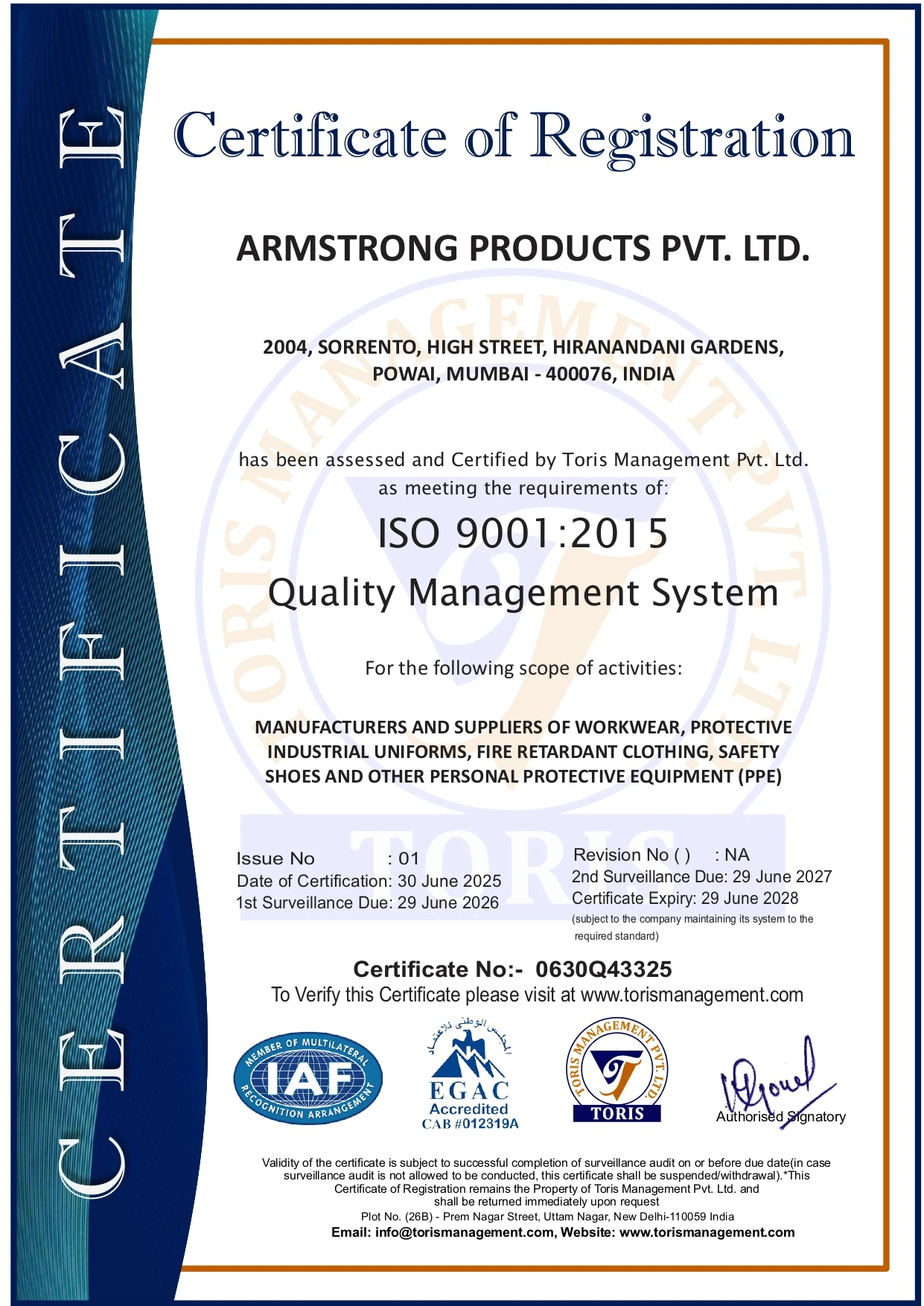
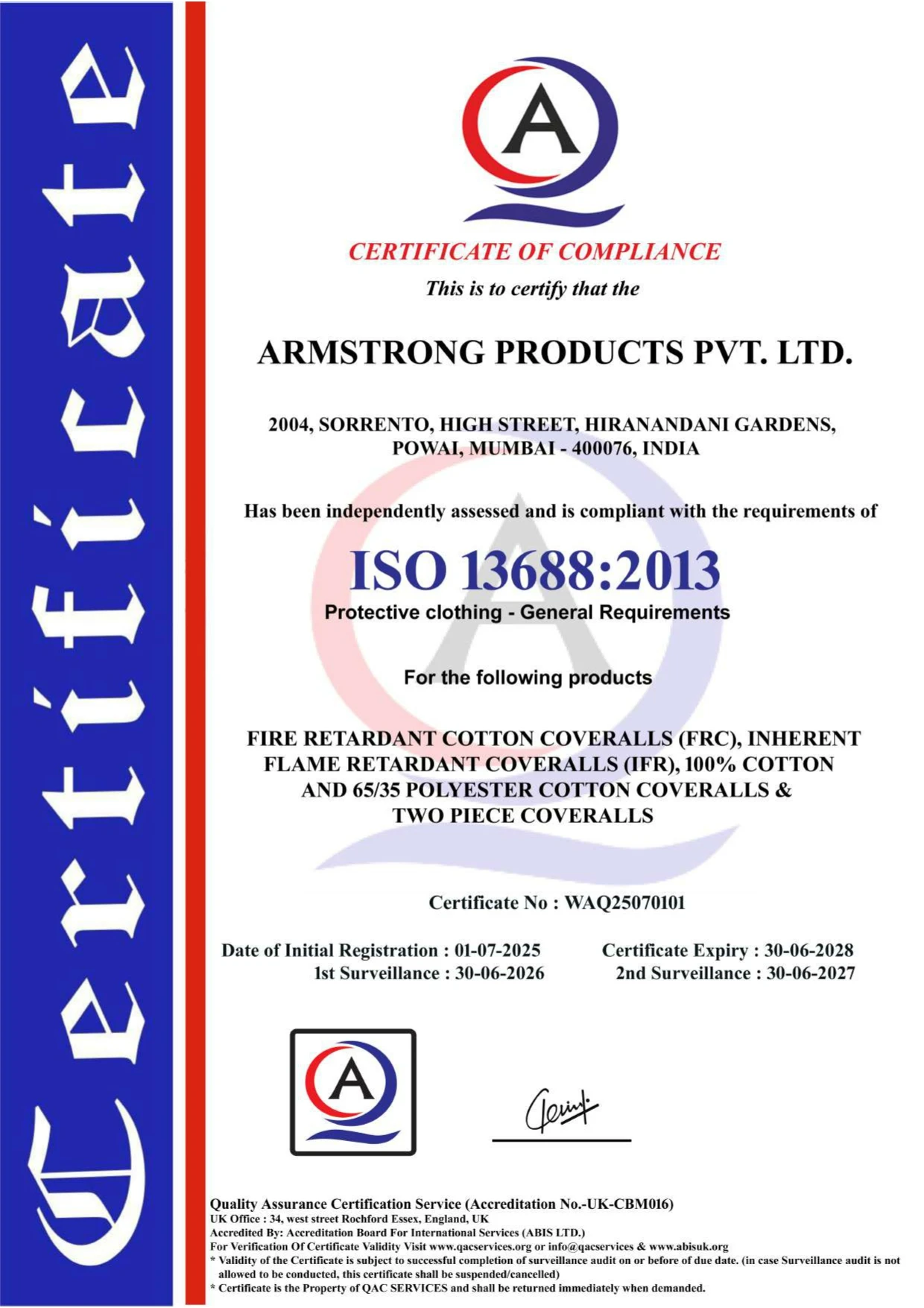
Armstrong Products has manufactured industrial workwear since 2009, with production based at its facility in Boisar, Maharashtra, and its corporate office in Powai, Mumbai. The company holds ISO 9001:2015 certification for its quality management system and ISO 13688:2013 certification for protective clothing, covering the exact standard buyers should check when sourcing boiler suits.
Armstrong supplies coveralls, including FR coveralls and IFR coverall options for flame-risk roles, and boiler suits in 100% cotton and poly-cotton blends, alongside high-visibility wear, winter wear, and safety footwear, to industrial names including ONGC, Adani, L&T, Halliburton, Schlumberger, Weatherford, and JSW. The company also offers OEM manufacturing, private label production, and a channel partner network for distributors looking to source boiler suits and workwear at scale for the UAE and wider Gulf market.
Conclusion
Every problem in this guide traces back to the same root cause: a buyer who took a supplier’s word for something instead of checking it. A certificate that was never verified. A fabric sample that never matched the bulk run. A factory audit that got skipped because the supplier had been reliable last year. Sourcing boiler suits and workwear for UAE industries doesn’t have to be complicated, but it does need someone on your team willing to ask for the paperwork and actually read it. Run your next supplier review against the checklists in this guide before the purchase order goes out, not after the shipment lands.
Ready to review your boiler suit specification with a certified manufacturer? Contact Armstrong Products to request samples and bulk pricing details for your UAE operation.
FAQ’s
What is a boiler suit and how is it different from a coverall?
A boiler suit and a coverall are the same garment. Both describe a one-piece protective suit covering the torso, arms, and legs. The term used depends on regional preference rather than any difference in design. Add flame resistance, and the same garment gets called an FR coverall, FRC, or IFR coverall instead.
What is the best fabric for boiler suits in UAE’s climate?
Poly-cotton blends, for most general industrial roles. They resist shrinking and dry faster than pure cotton in Gulf humidity. Flame-resistant needs call for treated cotton, still the standard choice, with aramid blends reserved for extreme flash-fire risk areas.
Which certifications should a boiler suit manufacturer hold?
Two baseline certifications: ISO 9001:2015 for the manufacturer’s quality system, ISO 13688:2013 for the garment itself. Add EN ISO 11612, EN 13034, or NFPA 2112 on top of that if the role involves flame or chemical exposure, depending on which hazard applies.
Are Indian boiler suit manufacturers reliable for bulk UAE orders?
Reliability comes down to the individual factory’s quality control process and audit history, not the country. Plenty of Indian manufacturers already supply large industrial clients across the GCC and hold internationally recognized certifications.
Can boiler suits be customized with company logos and colors?
Yes. Embroidered logos, printed branding, and custom color matching are all standard on bulk orders. Just confirm the minimum order quantity first, since adding branding sometimes pushes it higher.
What is the typical lead time for a bulk boiler suit order shipped to the UAE?
One to two weeks in transit by sea freight from India, plus customs clearance time. That covers shipping only. Production time depends on order size and customization, so get the full timeline before you promise a delivery date to anyone downstream.
Do boiler suits need to be flame resistant for oil and gas work?
In most cases, yes. Roles near flammable gas, welding, or open flame typically require FR-treated fabric certified to EN ISO 11612 or NFPA 2112. Confirm the exact requirement with your site’s safety officer or client specification.
How do I check if a boiler suit meets ISO 13688 requirements?
Ask for the certificate number, then cross-check it directly with the certifying body rather than trusting the PDF you were emailed. A genuine certificate lists the manufacturer’s name and the specific product category it covers.
What sizes and fits are available for a mixed workforce?
A standard S to XXL range covers most manufacturers, with custom sizing available from some for outlier body types. Get the size chart in both centimeters and inches before the bulk order, and run one full sample size set through first.
What should I look for during a factory audit of a boiler suit manufacturer?
Check in-house production capability, fabric storage conditions, in-line quality checks, and working conditions on the floor. Ask to see recent pre-shipment inspection reports from other bulk orders, and don’t skip the fabric storage room. That’s where FR treatment quietly degrades if humidity or sunlight gets in.