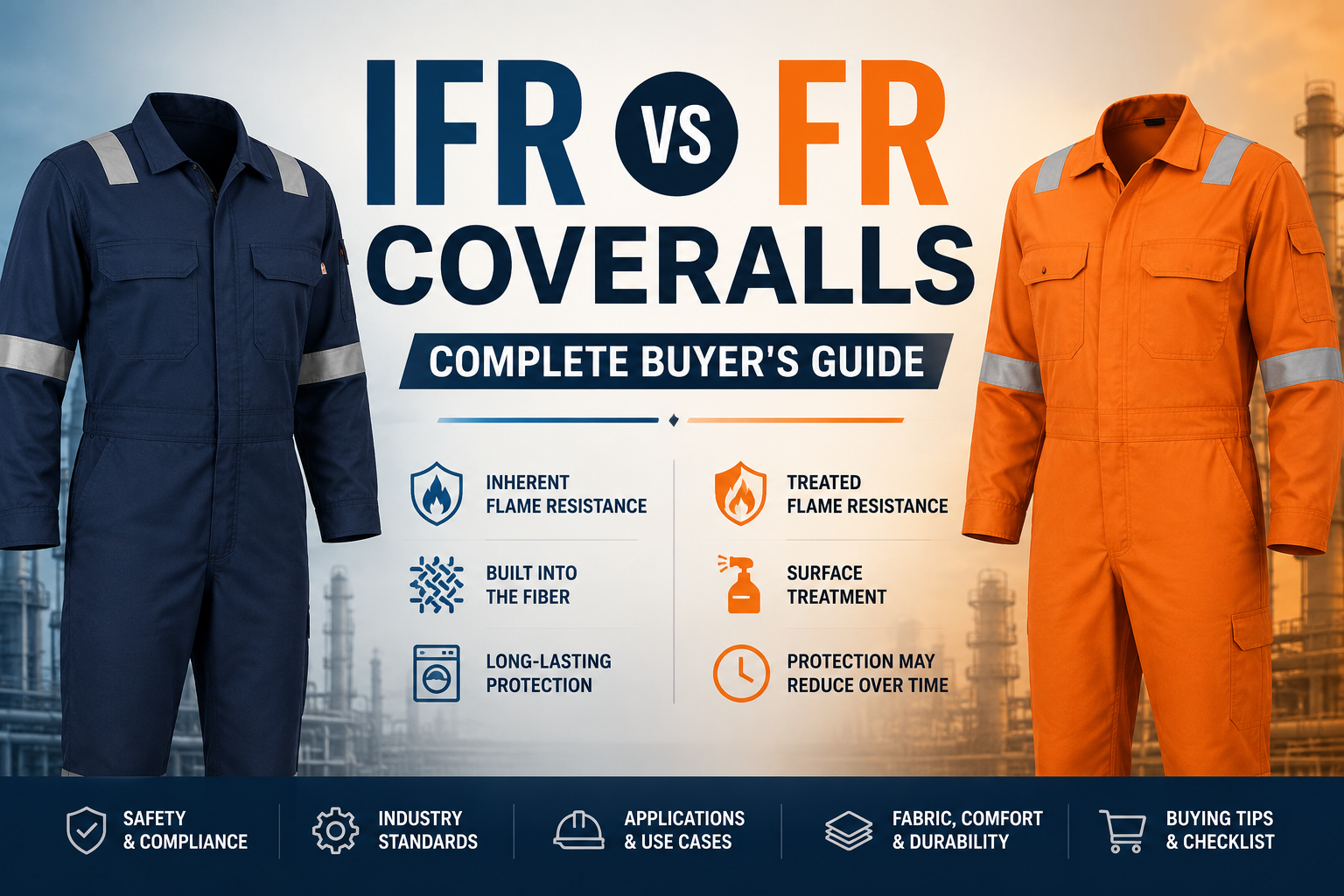
A worker standing three feet from a flash fire has less than a second before the outcome is decided. That is the plain reason procurement teams still argue over IFR coveralls and FR coveralls long after the purchase order is signed. Get the fabric choice wrong, and no safety manual fixes it after the fact.
This guide breaks down IFR coveralls vs. FR coveralls in plain terms: what actually separates the two, which industries need which, what standards apply, and how to check a supplier before committing to a bulk order. If you buy protective clothing for a refinery, an EPC contractor, a distribution business, or an export program, this is written for you.
What is an FR coverall?
FR stands for flame resistant. An FR coverall starts out as an ordinary fabric, usually cotton or a cotton-polyester blend, and goes through a chemical treatment that stops it from sustaining a flame. The treatment gets applied during finishing, and the finished garment is tested afterward to confirm it self-extinguishes instead of continuing to burn.
Most FR coveralls sold in India and the Gulf use proban-treated cotton or FR-viscose blends. Cotton breathes well in hot climates, and that matters on sites where a full shift under direct sun already puts stress on a worker’s body before gloves, a helmet, and a harness get added on top.
The catch is durability. The chemical finish degrades over time. Bleach, fabric softener, and harsh industrial detergents strip it faster than normal washing would. A coverall that passes flame testing on day one may not pass the same test after a hundred industrial washes, unless the supplier can show wash-cycle data to back that claim.
What is an IFR coverall?
IFR stands for inherently flame resistant, sometimes written as inherent flame retardant clothing. The flame resistance here is not a coating sitting on top of the fabric. It is a property of the fiber itself. Aramid fibers such as meta-aramid and para-aramid, along with modacrylic blends, carry a molecular structure that resists ignition on their own, without any added chemical processes.
Because the protection is built into the fiber, it does not wash out. An IFR garment made today should perform close to the same after two hundred washes as it did after the first one, provided the fabric has not been physically damaged through cuts, abrasion, or contamination.
The tradeoff shows up in weight, feel, and sourcing cost. Aramid fabric generally costs more to manufacture than treated cotton, and buyers sometimes assume that automatically makes IFR the stronger choice in every situation. That assumption is not always correct. The right fabric depends on the actual hazard at the work site, not on which term sounds more advanced on a product sheet.
IFR coveralls vs FR coveralls: key differences
| Factor | FR coverall (treated) | IFR coverall (inherent) |
| Source of flame resistance | Chemical finish applied to cotton or a cotton blend | Built into the fiber structure itself (aramid, modacrylic) |
| Effect of repeated washing | Protection can fade with harsh detergents or high wash counts | Protection stays intact for the working life of the garment |
| Typical fabric | Proban-treated cotton, FR-viscose blends | Meta-aramid, para-aramid, modacrylic blends |
| Comfort in hot, humid climates | Breathable, familiar cotton feel | Lighter aramid blends exist, though some constructions feel warmer in high humidity |
| Garment lifespan | Shorter, tied to chemical retention and wash count | Longer, tied to fabric integrity rather than a coating wearing off |
| Upfront investment | Lower | Higher |
| Best suited for | General flash fire risk, lower frequency exposure, bulk uniform programs | High-frequency exposure, arc flash zones, long-duration continuous wear |
Not every job site needs aramid.
A maintenance crew working occasional hot-work permits in a low-risk facility may be fully compliant and adequately protected in a well-made treated FR coverall. A drilling crew standing near live wellheads for a full shift, day after day, is a different calculation entirely.
Which standards apply to IFR and FR coveralls?
In India, the standard most buyers now ask about is IS 15748:2022, which covers protective clothing against heat and flame for industrial workers and currently falls under the Bureau of Indian Standards’ mandatory ISI mark scheme. Internationally, EN ISO 11612 is the standard used across Europe, the Middle East, and much of Asia for heat and flame protection. NFPA 2112 is the standard followed in the US oil and gas sector, and it focuses specifically on flash fire rather than the broader set of heat hazards EN ISO 11612 covers. If the job involves electrical arc risk rather than open flame, the coverall also needs a separate arc rating tested to IEC 61482-2 or ASTM F1959, since flame protection and arc flash protection are two different tests measuring two different hazards.
| Standard | Region | What it tests |
| IS 15748:2022 | India | Heat and flame protection for industrial workers, under mandatory BIS ISI certification |
| EN ISO 11612 | Europe, Middle East, most of Asia | Limited flame spread, convective heat, radiant heat, and molten metal splash, graded A through F |
| NFPA 2112 | United States | Flash fire protection, specific to oil, gas, and petrochemical work |
| IEC 61482-2 | International | Arc flash protection, tested and rated separately from flame standards |
| ASTM F1506 / F1959 | United States | Arc-rated protective clothing performance and arc rating in cal/cm² |
| ISO 14116 | International | Limited flame spread only, for occasional or brief contact with small flames in lower-risk settings |
A coverall stitched from an inherently flame-resistant fiber is not automatically compliant with every standard on this list. Certification happens at the garment level, not the fabric level, and it is specific to the exact construction, seams, and closures used. Always ask a supplier for the actual test report and a certificate number you can verify, not just a claim printed on a product datasheet.
Where IFR workwear is the stronger choice
IFR workwear earns its higher upfront cost in environments where exposure is frequent, prolonged, or paired with electrical risk. That covers most of upstream and midstream oil and gas work, petrochemical refining, LNG terminals, and utility substations where arc flash is a daily possibility rather than a rare event.
- Continuous, multi-shift wear near live process equipment
- Combined flame and arc flash exposure on the same job role
- Sites where laundering happens through a shared industrial facility, not controlled in-house
- Export contracts where the end client specifies inherent fiber by name
- Roles where garment replacement cycles are hard to enforce, so wash-durable protection matters more
Where FR coveralls still make sense
Treated FR cotton still holds a solid place in industrial procurement, and dismissing it as outdated is a mistake plenty of buyers make after reading one too many marketing pages from an aramid supplier.
- General maintenance and utility roles with occasional, brief flame exposure
- Bulk uniform programs for large workforces where cost per unit affects the entire budget
- Hot, humid site conditions where cotton’s breathability improves worker compliance
- Government and PSU tenders that specify treated FR cotton to a known Indian standard
- Short-term or seasonal contract labor where garment life expectancy is already limited
How to evaluate a coverall supplier before you place a bulk order
A product catalog tells you what a supplier wants to sell. It does not tell you what they can actually manufacture at scale, consistently, batch after batch. Before signing off on a bulk order, work through this list.
- Ask for the actual test certificate, with a certificate number you can independently verify
- Confirm whether testing was done at the fabric level, the garment level, or both
- Check whether the manufacturer allows a factory audit or third-party inspection
- Ask how the supplier maintains consistency across different production batches
- Confirm OEM or private label capability if your program needs its own branding
- Check the supplier’s experience with export documentation if you are importing
- Request a physical sample before committing to full quantity
- Ask about batch rejection and rework rates, not just the quality of the first sample you were shown
Questions worth asking during a factory audit
- Where does manufacturing actually happen, and can that location be verified
- What quality checks run before a batch is cleared for dispatch
- Is there a dedicated quality team separate from the production line
- What happens to a batch that fails an internal check, and how often does that occur
- How is fabric traceability maintained from the raw roll to the finished garment
Common mistakes procurement teams make
A few patterns show up again and again in flame-resistant workwear purchasing, and most of them are avoidable with a bit more scrutiny before the order is placed.
Buyers sometimes assume any coverall labeled “FR” automatically meets every relevant standard, when in practice the label alone confirms nothing without a certificate behind it. Others buy on brand recognition rather than checking test documentation or skip a factory audit entirely on a large export order because the supplier’s website looked professional. A less obvious mistake is ignoring wash life when calculating replacement cycles, which quietly inflates the real cost of a treated FR program over a few years. Treating IFR and FR as interchangeable across every role on a site, regardless of actual exposure, rounds out the list.
Manufacturing capability: what a serious supplier should show you
Armstrong Products Pvt. Ltd. has manufactured industrial workwear and PPE since 2009, with a dedicated manufacturing facility in Boisar, Maharashtra, and a corporate office in Powai, Mumbai. The company holds ISO 9001:2015 certification for its quality management system and a certificate of compliance to ISO 13688:2013, the general requirement standard for protective clothing. Any buyer evaluating an FR or IFR coverall supplier, Armstrong included, should expect this level of documentation as a baseline rather than a bonus.
Beyond certification, look for a manufacturer that can show OEM and private label capability if your program needs its own branding, warehousing that supports repeat bulk orders without long lead times, and export experience if the coveralls are headed outside India. A supplier that can walk you through fabric sourcing, in-house cutting and stitching, and finished-garment testing in one conversation is usually easier to work with long-term than one that outsources each step to a different vendor.
Conclusion
The IFR coveralls vs. FR coveralls decision comes down to one question: how often, and how severely, will the wearer face heat, flame, or arc risk? High frequency, high severity work calls for inherent fiber protection that does not fade with each industrial wash. Lower risk, cost-sensitive programs can often run safely on well-made treated FR cotton, provided the certification behind it is genuine and the wash life is actually tracked rather than assumed.
Whichever category fits your operation, the fabric only protects your workforce if the certification behind it is real and the manufacturing behind it is consistent. That is worth more scrutiny than most purchase orders currently get.
If you are evaluating suppliers for a bulk IFR or FR coverall order, Armstrong Products can walk you through fabric options, certification documents, and sample requests based on your site’s actual risk profile. Contact Armstrong Products to start that conversation.
FAQ’s
What does IFR stand for in coveralls?
IFR stands for inherently flame-resistant. The fire resistance comes from the fiber itself, not from a chemical coating applied afterward.
What does FR mean in FR coveralls?
FR stands for flame resistant. Most FR coveralls are made from cotton or a cotton blend treated with a flame-resistant chemical finish during manufacturing.
Is IFR always better than FR?
No. IFR performs better in high frequency, high heat, or arc flash environments where wash durability matters most over years of use. FR still works well in lower-risk settings where cost and comfort in hot, humid climates carry more weight. The right choice depends on the actual hazard at the site, not on brand reputation or which term sounds more technical.
Do FR coveralls lose their flame resistance after washing?
Chemically treated FR fabric can lose effectiveness over repeated industrial washing, especially if bleach or fabric softener gets used. Ask your supplier for wash-cycle test data before assuming a garment’s protection lasts as long as the fabric itself does.
Which standard should I check before buying flame-resistant coveralls in India?
IS 15748:2022 is the current Indian standard for heat- and flame-protective clothing for industrial workers, now under BIS’s mandatory ISI certification scheme. For export markets, check EN ISO 11612 or NFPA 2112 depending on the destination country.
Are IFR and FR coveralls tested to the same standards?
Yes, in the sense that standards like EN ISO 11612, NFPA 2112, and IS 15748 apply to a garment’s tested performance, not to whether the fabric is inherent or treated. A garment from either category can pass or fail the same test. Certification depends on actual results, not on which fabric family it came from.
How long do IFR coveralls typically last compared to FR coveralls?
IFR garments generally outlast treated FR garments in industrial use, since the flame resistance does not depend on a chemical layer wearing down over time. Actual lifespan still depends on how the garment gets used, stored, and maintained day to day.
Can FR coveralls be used for arc flash protection?
Not unless they carry a separate, tested arc rating. Flame resistance and arc flash protection are measured through different tests. Look for IEC 61482-2 or ASTM F1959 compliance and an actual arc rating in cal/cm² before assuming any FR or IFR garment covers arc flash risk on its own.
What should I ask a coverall manufacturer before placing a bulk order?
Ask for a test certificate with a verifiable certificate number, confirm whether a factory audit is possible, check OEM and private label capability if you need custom branding, and request a physical sample before signing off on quantity.
Is a coverall labeled “IFR” automatically certified to international standards?
No. The fabric type does not equal certification. Only a finished garment that has been tested and certified to a specific standard, backed by a certificate you can verify, should be treated as compliant.