
A procurement head at a US-based EPC firm spent three months qualifying an Indian workwear manufacturer. The samples were good. The certifications checked out. The pilot order arrived on time and the quality matched what was promised. Eighteen months into the contract, the fourth production run arrived with fabric from a different supplier, visible shade variation across the size range, and no update from the manufacturer that anything had changed.
The certifications were still valid. The manufacturer was still ISO 9001 certified. The quality management system was, on paper, intact. What had changed was a fabric sourcing decision made without telling the buyer, and the QC system that was supposed to catch it had not.
This is the kind of gap that standard supplier qualification checklists do not always catch. This guide covers what procurement teams sourcing industrial workwear from India should actually look for, beyond the documentation that every manufacturer can produce.
Why procurement teams source workwear from India
Manufacturing scale and production capability
India has a large and established industrial garment manufacturing base, with facilities capable of producing at volumes that serve multinational supply chains across oil and gas, construction, utilities, and heavy manufacturing. The combination of production scale, fabric sourcing infrastructure, and a workforce with decades of garment manufacturing experience makes it a practical sourcing destination for bulk workwear programs.
For international buyers in the US, UK, UAE, Canada, and Australia, Indian manufacturers also offer meaningful capacity across the full range of industrial workwear categories: standard workwear, FR garments, high-visibility clothing, and multi-hazard combinations. The manufacturing infrastructure to produce to international compliance standards is available. Whether a specific manufacturer has actually built and maintained that capability is the question that separates qualified sourcing decisions from catalog browsing.
Certification and compliance standards available
Indian workwear manufacturers operating for international export markets can and do hold ISO 9001:2015 for quality management, ISO 13688:2013 for protective clothing, and CE marking for European and UK markets. FR garments can be certified to EN 11612 and NFPA 2112. High-visibility garments can be tested and certified to EN ISO 20471 and ANSI/ISEA 107.
The certification landscape looks similar across many manufacturers at the product page level. What differs is whether the certificates are current, product-specific, and backed by a quality system that actually controls production rather than documents it.
What defines a reliable workwear manufacturer
In-house manufacturing vs outsourced production
The first structural question for any Indian workwear manufacturer is whether they actually make the products themselves. A manufacturer running their own production facility controls the cutting lines, the fabric inspection, the stitching, and the finishing. When something goes wrong on a batch, they can trace it through their own production records and fix it in the next run.
A trading company or agent placing your order with an external factory does not have that control. The factory makes the decision to switch fabric suppliers, change thread specifications, or modify production processes, and the intermediary finds out when the buyer complains. The quality management system the agent presented during qualification covers their own office, not the factory floor where your garments are made.
Asking directly: do you manufacture in-house, and can I audit the facility where my order will be produced? A genuine manufacturer answers with a specific location and a yes. An intermediary tends to redirect toward the documentation.
Production capacity for bulk orders
Confirmation of in-house manufacturing is the start, not the end. The follow-up question is whether the facility has the physical capacity to handle your order volume without compromising quality on other clients’ orders running in parallel.
A factory that produces 5,000 units per month and receives a 4,000-unit order with a six-week deadline is in a different position than the same factory with a 3,000-unit order and eight weeks. Asking for monthly production capacity by garment type, current order backlog, and how your order would be scheduled within that is not unreasonable due diligence. It is the question that determines whether the lead time commitment is real or optimistic.
Workwear manufacturing quality: what to evaluate
Fabric quality and GSM
Fabric is where most long-term workwear quality issues originate. Two garments that look identical on a product specification sheet can perform very differently after 30 industrial laundry cycles depending on GSM weight, fiber composition, weave construction, and how the fabric was finished.
Request the fabric specification sheet and test reports separately. The specification sheet tells you what the fabric is. Test reports for shrinkage, colorfastness, and tensile strength tell you how it performs. A garment specification that looks right on paper but shrinks 4% in chest width after the first commercial laundry cycle at your site’s operating temperature is a sizing problem across every unit in the order.
For FR garments, request the treatment method and rated wash cycle count as separate questions from the general fabric specification. An inherent FR fabric carries its protective property in the fiber and retains it for the garment’s life. A treated FR fabric has a surface coating that degrades with washing, and how fast it degrades depends on wash temperature and the detergents used. For programs running frequent industrial laundry cycles, the distinction affects the compliance lifespan of the garment significantly.
Stitching and seam construction
Seam failures account for more mid-contract workwear problems than fabric failures in most industrial programs. The shoulder seam, crotch seam, and pocket joins carry the physical load of movement and heavy use across a shift. Double stitching at these stress points, polyester thread rather than cotton thread, and higher stitch count per inch all contribute to how long the garment holds up under industrial conditions.
On any sample garment, apply firm tension to the main stress-point seams before approving a bulk order. Uneven stitching and loose thread ends visible with basic inspection are consistent indicators of production inconsistency. A pull test on the seam gives you tensile data if you need documented results, but physical inspection eliminates the worst options before you get that far.
Batch-to-batch consistency
Consistent quality across multiple production runs is harder to maintain than consistent quality on a single order, and it is what long-term supply relationships actually depend on.
The situation described in the opening of this guide, a fabric supplier change that shifted shade and quality without buyer notification, is not unusual. It happens when a manufacturer’s QC system does not include controls on incoming material changes, or when those controls exist on paper but are not followed consistently in practice.
Ask specifically: what happens when your fabric supplier changes? How is incoming fabric inspected against specification before production begins? What is the acceptable tolerance for shade variation between production batches? A manufacturer with real batch consistency controls answers these questions with specific processes. One without tends to answer with general assurances.
Certifications to verify before qualifying an Indian workwear manufacturer
ISO 9001:2015 quality management
ISO 9001:2015 confirms that a documented quality management system is in place at the manufacturing facility. Third-party auditors have verified that production processes, defect tracking, and quality controls are documented and followed. This is meaningful as a facility-level credential.
What it does not confirm is that the product you are ordering meets the specific performance standard you need. A facility can hold ISO 9001 and produce non-compliant garments. The QMS certification and the product certification are different things that answer different questions.
ISO 13688:2013 protective clothing
ISO 13688:2013 covers the general requirements that every protective clothing garment must meet: ergonomics, sizing, aging characteristics under use, labeling, and the technical documentation manufacturers are required to supply. It is the baseline standard for protective clothing, and it applies alongside product-specific certifications like EN 11612 or EN ISO 20471, not instead of them.
Ask for the actual ISO 13688 certificate. Check the edition and the date. The standard was amended in 2021, and a certificate issued against the pre-amendment version may not reflect current requirements.
CE marking and product-specific standards
CE marking on garments sold into UK or European markets confirms that applicable safety directives have been assessed. The CE mark on the label tells you the directive assessment happened. The product-level test certificate tells you which standard was actually tested.
For FR garments: EN 11612 covers heat and flame protection for European and international markets. NFPA 2112 is the US standard for flash fire environments, widely referenced in global oil and gas procurement. For high-visibility garments: EN ISO 20471 for international markets, ANSI/ISEA 107 for North American operations. Both require garment-level testing, not fabric-level testing. A fabric FR certificate is not a substitute for an EN 11612 garment certificate.
How to evaluate a workwear manufacturer before placing an order
Factory audit and transparency
A manufacturer confident in their production operation welcomes audit access. The audit lets you verify production capacity claims against actual floor capacity, inspect incoming fabric inspection records, see how in-process quality checkpoints work, confirm what is subcontracted and what stays in-house, and check whether the production standards you saw documented are the ones being applied on a regular production run.
For international buyers who cannot travel to India for a site visit, third-party audit reports from Bureau Veritas, SGS, or Intertek are a workable alternative. Ask whether current reports exist and whether they can be shared. A manufacturer who cannot provide either option has not been independently verified, and the quality claims rest entirely on what they say about themselves.
Sample evaluation process
Samples that look good at the RFQ stage are necessary but not sufficient. The sample tells you what the garment looks like on day one under favorable conditions. What you need to know is how it performs after 30 wash cycles at your site’s laundry temperature, with your site’s detergent, across the full size range you intend to order.
Request samples in your most commonly ordered sizes, not just the middle of the size range. Run them through your actual laundry process. Measure shrinkage before and after. Check colorfastness against an unwashed sample. Stress-test the shoulder and crotch seams. The results from your conditions tell you more about long-term performance than any certificate produced under standardized lab settings.
OEM and customization capability
International buyers who need garments produced under their own brand, with their own labels, certifications in their name, and compliance documentation formatted for their destination market, need OEM capability confirmed separately from general manufacturing capability. Not every Indian manufacturer offers this, and among those who do, the infrastructure for handling export documentation correctly varies significantly.
For domestic buyers, customization requirements typically include logo embroidery, department color coding, and modified garment specifications. Confirm whether this is handled in-house or subcontracted. In-house gives the manufacturer direct control over consistency across a large run. Subcontracted customization introduces a handoff where errors can develop without the main manufacturer’s quality system catching them.
Export documentation and compliance
For international buyers sourcing from India, the documentation package that comes with a shipment determines whether goods clear customs and can be legally placed into service at the destination.
A complete export documentation package from an Indian workwear manufacturer should include the commercial invoice, packing list, certificate of origin, test certificates for each garment type, ISO certification documents, compliance declarations for the destination market, and country-specific compliance paperwork where required. For regulated PPE categories, the test certificates are what allow the goods to clear customs, not just the shipping documents.
Confirm the documentation package before the order is placed, not when the shipment is in transit. Finding out that a certificate is missing or formatted incorrectly at the destination port is significantly more expensive than confirming the package is complete during supplier qualification.
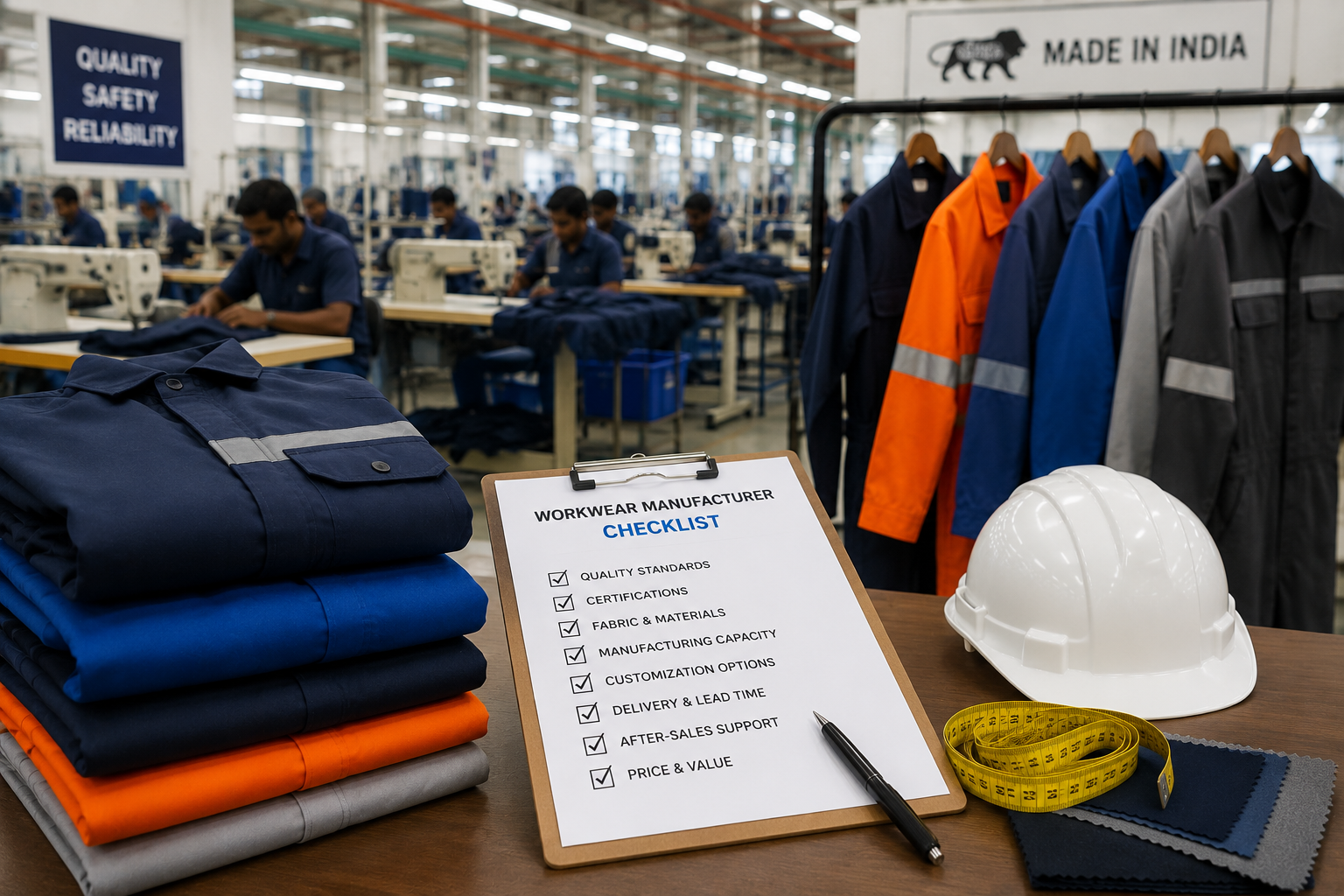
Workwear manufacturer evaluation checklist
| Area | What to check |
| Manufacturing | In-house or outsourced? Monthly production capacity for your garment types? |
| Fabric | GSM, composition, test reports for shrinkage, colorfastness, tensile strength? |
| FR garments | Inherent or treated? Wash cycle rating? EN 11612 or NFPA 2112 certificate – garment level? |
| Hi-vis garments | EN ISO 20471 or ANSI/ISEA 107 certified? Retroreflective wash durability data? |
| Certifications | ISO 9001:2015, ISO 13688:2013, CE marking – actual certificates, current editions? |
| Samples | Full size-run samples tested under your laundry conditions before bulk order? |
| Batch consistency | Incoming fabric inspection process? Dye lot controls? QC report per shipment? |
| Customization | In-house or subcontracted? OEM capability confirmed? |
| Export documentation | Full compliance package confirmed before order ships? |
| Factory audit | Site visit available? Third-party audit reports available to share? |
| Lead time | Production start date and delivery date confirmed separately? |
Common mistakes when choosing an Indian workwear manufacturer
Treating certification lists as equivalent to verified compliance.
A supplier’s website listing ISO 9001, ISO 13688, CE marking, EN 11612, and NFPA 2112 does not confirm that current, product-specific certificates exist for each standard against each garment in your order. Certificates have dates. Standards have editions. A certificate from three years ago may reference an edition that has since been revised. Requesting the actual certificates and checking the date and edition on each one is the step that separates verified compliance from assumed compliance.
Confusing pilot order quality with ongoing production quality.
Pilot orders attract more supervisory attention than subsequent production runs. The manufacturer knows it is being evaluated. When the contract is six months old and the fourth production run is just another batch in the schedule, that level of attention is not guaranteed. Before approving a manufacturer for volume, ask specifically how quality is controlled on a routine production run, what the in-process checkpoints are, and what happens when an incoming fabric lot does not match specification. A manufacturer with real systems gives you specific answers.
Not confirming fabric sourcing transparency.
The fabric a manufacturer uses on the pilot order is not necessarily the fabric they will use on every subsequent order. Fabric supplier changes, raw material availability, and cost management decisions can all result in a different fabric appearing in a later production run without the buyer knowing. Ask whether fabric supplier changes are disclosed before production begins and how incoming fabric is checked against the original specification. This question rarely gets asked and frequently matters.
Skipping the export documentation conversation for international orders.
Documentation gaps discovered at the destination port cost significantly more to resolve than documentation gaps caught during the qualification stage. Confirm the complete documentation package before the order ships, including which compliance declarations are required for your specific destination market, and whether the manufacturer has produced that documentation for that market before.
Why manufacturing quality matters
Armstrong Products has manufactured industrial workwear and PPE since 2009. The manufacturing facility is in Boisar, Maharashtra, with the corporate office in Powai, Mumbai.
The facility holds ISO 9001:2015 certification for its quality management system and ISO 13688:2013 certification for protective clothing, with CE marking across the garment range.
The client list includes ONGC, L&T, JSW Steel, Adani, Halliburton, Weatherford, and Worley. These are organizations with formal vendor qualification processes, on-site audit requirements, and compliance documentation standards that go well beyond catalog review. Supplying them across multiple contract cycles means the production quality, batch consistency, and export documentation have been tested against independent scrutiny on a recurring basis.
OEM and private-label manufacturing is available for buyers who need garments produced under their own brand or compliance documentation formatted for specific export markets. Factory audit access is available for buyers who want to verify production capability directly.
Conclusion
Qualifying a workwear manufacturer in India is not fundamentally different from qualifying any supplier for a long-term, volume-based procurement program. The questions that matter are the same ones that matter everywhere: who actually makes the product, what controls are in place to maintain quality across multiple production runs, are the certifications current and product-specific, and does the manufacturer have the export documentation infrastructure to serve your market.
What makes India-specific qualification worth its own attention is the gap that sometimes exists between what appears in a manufacturer’s documentation and what happens on a production floor six months into a contract. The certification may be real. The pilot order may have been excellent. The fabric sourcing transparency and batch consistency controls may or may not hold up over time depending on how thoroughly those questions were asked and answered before the contract started.
The buyers who have the smoothest long-term sourcing relationships with Indian manufacturers are almost always the ones who asked the harder questions early, not the ones who discovered the answers later.
FAQs
What should I look for when choosing a workwear manufacturer in India?
Start by confirming whether production is in-house or outsourced to third-party factories. In-house manufacturing means direct control over quality at every production stage. Then verify certifications with actual certificates rather than product page listings. Request fabric test reports covering shrinkage and colorfastness under your site’s laundry conditions. Ask specifically about batch consistency controls and export documentation capability before placing volume orders.
How do I verify an Indian manufacturer’s certifications are genuine?
Request the actual certificate documents, not a product page listing certification names. Each certificate should specify the standard, the edition tested against, the test method, the date of issue, and the certifying body. For ISO 9001 and ISO 13688, the certifying body should be an accredited third-party auditor. For product-specific standards like EN 11612, the certificate should reference the specific garment, not just the fabric. Cross-check the certifying body against public accreditation registries if the certificate details are unclear.
Can Indian workwear manufacturers produce FR clothing for international markets?
Yes, established Indian manufacturers produce FR workwear certified to EN 11612 for European and international markets and NFPA 2112 for North American operations. The key is confirming that the certificate is garment-level, current, and references the specific garment being ordered. A fabric-level FR certificate does not satisfy the requirement for the finished coverall.
What is the typical lead time for bulk workwear orders from India?
For straightforward bulk orders from manufacturers with available in-house production capacity, four to eight weeks is typical. Customized programs with OEM branding, multiple garment types, or export documentation requirements take longer. Get a confirmed production start date and a confirmed delivery date as two separate commitments, and ask what the escalation process is if production falls behind.
How do I conduct a factory audit of an Indian workwear manufacturer remotely?
Request current third-party audit reports from recognized bodies such as Bureau Veritas, SGS, or Intertek. A manufacturer who has been through formal third-party audits recently will have current reports they can share. Also request the ISO 9001 certificate with the name of the certifying body, and verify that the certifying body is accredited through the International Accreditation Forum network. Video facility tours are a supplemental option but do not substitute for independent audit documentation.
Can I get OEM or private-label workwear from an Indian manufacturer?
Yes. OEM manufacturing, where garments are produced under the buyer’s own brand with the buyer’s labels and compliance documentation in the buyer’s name, is available from established Indian manufacturers. Confirm this capability specifically before qualifying the supplier, and ask for examples of markets and compliance documentation they have produced for international OEM clients.
What export documentation should an Indian workwear manufacturer provide?
Commercial invoice, packing list, certificate of origin, bill of lading, test certificates for each garment type, ISO certification documents, and compliance declarations for the destination market. For regulated PPE categories, the test certificates are what allow goods to clear customs and be placed into service at the destination. Confirm the complete package before the order ships, not after it arrives at the destination port.
How is batch consistency managed across large workwear production runs?
Ask specifically about incoming fabric inspection against specification, dye lot controls for color-coded programs, in-process quality checkpoints during production, and whether a QC report is issued with each shipment. A manufacturer with real batch consistency controls answers these questions with specific processes and documented checkpoints. One without tends to answer with general assurances about their commitment to quality.