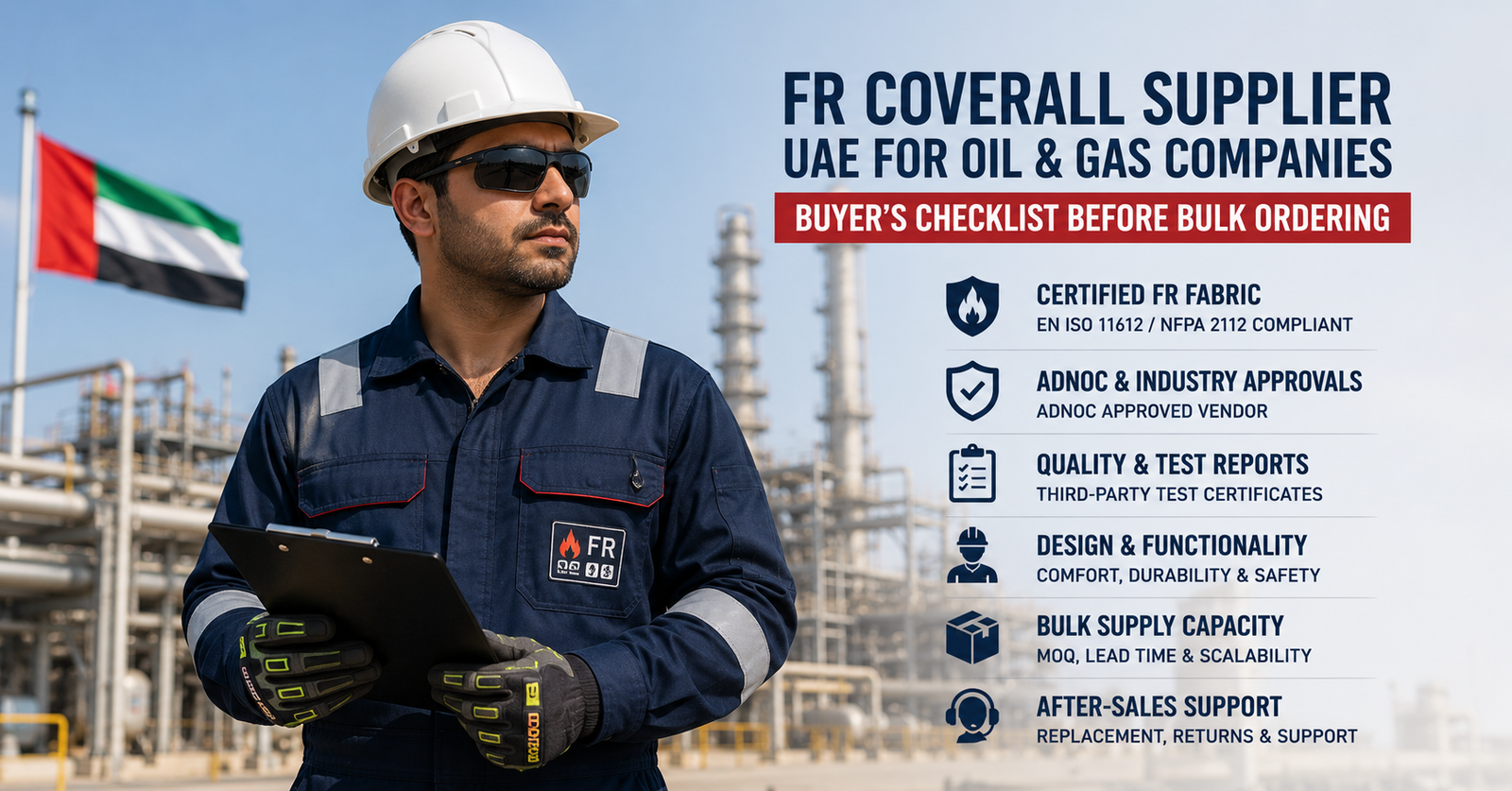
The shutdown date is fixed. You need 4,000 coveralls on site three weeks before it. Four suppliers have quoted; all of them say NFPA 2112, all of them attach a certificate, and on paper the quotes look almost identical.
They are not identical. The differences between one flame-resistant coverall and another show up eight weeks later, when one batch arrives with reflective tape that peels after twelve washes, or when the fabric in the production run turns out to be a different reference from the one on the test report.
This is where most flame-resistant coverall problems start. Not in the factory, and not on the rig. In the shortlist.
If you buy FR workwear for oil and gas sites in the UAE, Saudi Arabia, Oman, or Qatar, the checklist below is what separates a supplier who can prove compliance from one who can only claim it. It is written for procurement teams, HSE managers, contracts staff, and distributors who need to run the same set of questions past every vendor before releasing a bulk order.
Why coverall selection works differently in the Gulf
A flame-resistant coverall has to do two things at once here. It has to survive a hydrocarbon flash fire, and it has to be wearable through a twelve-hour shift in July.
Get the second part wrong and you lose the first part. Crews unzip to the waist. Sleeves get rolled. Hoods come off. An FR coverall that is technically certified but too heavy for the site stops being protective the moment people stop wearing it properly. Every HSE manager working in the Gulf has seen this.
Site conditions add their own pressure. Fine dust works into the weave and into zips. Salt air on offshore platforms attacks trims. Wash frequency is high because shifts are long and hot, and high wash frequency is exactly what exposes the difference between fabric types.
So the specification for oil and gas workwear UAE buyers need is not just a standard number. It is a standard number, plus a fabric weight and construction that people will actually keep zipped up.
Comfort is a compliance issue
If a coverall is uncomfortable enough that the crew modifies how they wear it, your compliance record and your risk exposure both change, no matter what the certificate says. This is worth raising with any supplier who only wants to talk about test values.
Ask them what fabric weights they supply for flame-resistant coveralls for summer conditions in the Gulf and what construction they recommend for continuous outdoor work. A manufacturer will have an answer with numbers in it. A trader will tell you their fabric is very good quality.
The standards that matter, and what each one tests
Tenders in the region usually name more than one standard. They are not interchangeable, and knowing what each covers stops you from accepting a certificate that does not apply to your hazard.
| Standard | What it protects against | What to check on the certificate |
| NFPA 2112 | Hydrocarbon flash fire | Third-party certification, predicted body burn in the 3-second flash fire test, minimum heat transfer performance values, no melting, dripping or separation |
| EN ISO 11612 | Heat and flame, across hazard codes A to F | Which letter codes are certified and at which performance level, not just the standard number |
| EN 1149-5 | Static discharge in flammable atmospheres | Whether the site HSE specification requires it, and whether the tested garment matches the supplied one |
| IEC 61482 or NFPA 70E | Arc flash | The arc rating value, and whether the same garment carries both flash fire and arc protection |
| EN ISO 20471 | Visibility | Class level, tape placement, and that the tape itself is flame resistant |
The short version of the NFPA 2112 versus EN ISO 11612 question: NFPA 2112 is built around the flash fire scenario common on rigs, refineries, and tank farms and sets a pass-or-fail threshold. EN ISO 11612 covers a wider set of heat hazards and grades performance in levels, which is why tenders that mention it usually also specify which codes they want.
Many Gulf tenders ask for both. That is not duplication. It tells the supplier the garment has to handle flash fire and meet graded heat performance at the same time.
What “ADNOC-approved coverall” actually means
Buyers use this phrase constantly, and it causes confusion.
There is no UAE federal law that makes NFPA 2112 compulsory. What happens instead is that major operators write standard compliance, color, and reflective tape requirements into their own HSE specifications, and site access depends on meeting them. In practice that makes certification mandatory even though no law says so.
The same logic applies across the region. Operators in Saudi Arabia embed their own requirements, which is why buyers sourcing IFR coveralls Saudi Arabian teams will wear are usually working from a written client specification rather than a general standard.
So the first thing on your checklist is not a supplier question at all. It is, “Do you have the current written specification from the end client, and is it the current version?” Specifications get revised. Ordering to a spec that was updated four months ago is one of the more expensive mistakes in this category.
Reading a test certificate without getting fooled
A PDF with a laboratory logo proves very little on its own. A genuine report will show you:
- The issuing laboratory and its accreditation
- The exact test method and the version of the standard used
- The specific fabric reference, composition and weight tested
- The date of testing
- A report number you can quote back to the laboratory
That last point is the one buyers skip. Contact the laboratory and confirm the report number is real and belongs to that fabric. It takes one email. Counterfeit and recycled certificates are a known problem in this market, and the cost of finding out after delivery is not comparable to the cost of checking.
Also confirm the certificate covers the fabric being supplied to you in the color and weight you ordered. One report does not automatically cover an entire range.
Treated FR or IFR: decide on service life, not on the label
This is the technical decision that changes everything downstream, and it comes down to where the protection lives.
In treated FR fabric, a chemical finish is applied to the material. In an IFR coverall, the protection is built into the fiber itself, which means it cannot wash out or wear away.
| Factor | Treated FR | IFR (inherently flame resistant) |
| Source of protection | Chemical finish on the fabric | Built into the fibre |
| Effect of washing | Performance can reduce over the wash life, and the wrong detergent speeds that up | Performance stays for the life of the garment |
| Typical service life | Shorter, and wash counts need tracking | Longer, holding protection well past 100 industrial washes |
| Best fit | Lower exposure roles, shorter contract durations, visitor and contractor stock | Core crew, offshore, long service cycles, high wash frequency |
Neither option is wrong. They are answers to different questions. A three month contractor deployment and a permanent offshore crew have different exposure profiles and different wash volumes, and the sensible specification follows from that.
What does go wrong is mixing the two on one site without tracking which is which. Treated FR garments need wash cycle records. IFR garments do not. Once both are in the same laundry cycle and the same store room, nobody knows which garment has how much service life left, and the tracking system quietly stops meaning anything.
Laundering belongs in the purchase decision
Send FR garments to a laundry using ordinary detergents, bleach, or fabric softener, and you can damage performance regardless of which fabric type you bought. Softener in particular leaves a residue that is itself flammable.
Agree the laundering method before the order ships, not after. Ask the supplier for written care instructions, and pass them to whoever runs the site laundry. This single step prevents a category of failure that has nothing to do with the manufacturer at all.
How to evaluate an FR coverall supplier UAE buyers can rely on
Now to the checklist itself. Run every shortlisted vendor through the same questions, and the differences appear quickly.
Manufacturer or trader?
Plenty of companies presenting as an FR coverall supplier on the UAE side are trading operations buying finished stock and re-labeling it. That is not automatically a problem, but it changes what they can control and what they can fix.
Four questions sort it out on a single call:
- Who owns the factory, and where is it?
- What is your monthly stitching capacity for coveralls?
- Can you show me the production floor on a video call this week?
- Do you hold fabric inventory, or do you buy fabric only after receiving an order?
A manufacturer answers all four immediately. A trader hesitates on the first, gives a vague number on the second, offers photos instead of live video on the third, and avoids the fourth.
Fabric sourcing and traceability
Ask for the mill name and the fabric reference used in your FR coveralls. Then ask whether the garment label will carry a batch number that traces back to that fabric lot.
Batch traceability matters more than most buyers realize. If a performance question comes up in month seven, traceability is what lets you isolate one production lot instead of pulling every coverall on site.
Trims, thread and tape
Here is where certified garments quietly fail and where most supplier websites say nothing at all.
A coverall made from certified flame-resistant fabric, stitched with ordinary polyester thread, is not a flame-resistant coverall. Polyester thread melts. Seams open. The same applies to reflective tape that is not FR rated and to zips, buttons, and hook and loop closures that are not designed for the application.
Get it in writing that the thread, tape, and closures are all FR compatible. Any manufacturer who builds these garments regularly will confirm it without hesitation, because they buy those trims on purpose.
Quality control stages
“Strict quality control” means nothing. Ask which stages exist and what records come out of them:
- Inward fabric inspection against the specification, before cutting
- Sampling-based inspection during production
- Inline checks on stitching, seam strength and measurements
- Final inspection before packing
- Retained records you can request later
If a supplier cannot name the stages in order, they are describing a process they do not run.
Factory audit readiness
Genuine FR coverall manufacturers expect audits. Ask whether they can host a physical audit and how much notice they need. A virtual walkthrough is a reasonable first step and reveals a surprising amount.
During the walkthrough, look at the cutting table, the stitching lines, the trims store, and the finished goods area. Ask to see fabric inward inspection records for a recent lot. The reaction to that request tells you more than the records themselves.
Capacity, lead time and shutdown planning
Shutdown dates do not move. Your delivery has to be planned backwards from the date crews need the garments in hand, not from the date the last container leaves.
Ask what capacity is already committed for the period you need and how the supplier handles a mid-production specification change. Ask what happens if the size trial comes back with a different size curve than expected. These questions test planning discipline rather than sales enthusiasm.
Export documentation and delivery
Documentation errors cause customs delays, and customs delays hit shutdown schedules directly.
Review the full document set before dispatch: packing list, shipping marks, invoice details, HS classification, and any conformity documents needed for entry into the destination market. Confirm who prepares each one and who checks it. An experienced exporter treats this as routine. A first-time exporter finds out at the port.
Twelve things to confirm before releasing a bulk order
- Current written HSE specification from the end client, confirmed as the latest version
- Standard and version agreed, including EN ISO 11612 hazard codes where they apply
- Test certificates matching the exact fabric reference being supplied
- Certificate report numbers verified directly with the issuing laboratory
- FR thread, FR reflective tape and compatible closures confirmed in writing
- Fabric weight and construction suited to summer site conditions
- Colour and reflective tape layout matched to the operator’s requirements
- Size trial completed with actual site crew before the production run starts
- Batch traceability label specified on every garment
- Laundering instructions agreed and passed to the site laundry
- Production capacity and delivery schedule confirmed against the shutdown date
- Full export documentation set reviewed before dispatch
Screenshot that list and use it as your scorecard for every FR coverall vendor on the shortlist.
Mistakes that turn a bulk order into scrap
A buyer approves a sample, and the production run comes from a different fabric lot with a different weight. Nobody checked the reference number on the sample against the reference on the certificate.
A team skips the size trial to save two weeks. The crew is multinational with a wide size range; the standard size curve does not fit, and several hundred garments sit unused.
One certificate gets accepted for an entire range across three colors and two weights. It covered one.
Garments go to a site laundry using softener because nobody told the laundry otherwise.
An order is placed against a specification the client revised in the previous quarter, and the reflective tape layout no longer matches. The garments are compliant with a standard and rejected at the gate anyway.
Every one of these flame-resistant coverall failures is preventable at the checklist stage. None of them is fixable after delivery.
How Armstrong Products manufactures FR coveralls
Armstrong Products has been manufacturing PPE and industrial workwear since 2009. Production runs from our own facility in Boisar, Maharashtra, with the corporate office in Powai, Mumbai.
Cutting and stitching are handled in house rather than subcontracted, which is what makes fabric traceability and inline quality checks possible in the first place. Fabric is sourced against the client specification, with batch records maintained through production. FR thread and FR reflective tape are used on flame-resistant garments as standard, because the alternative is a garment that fails at the seams.
Quality control runs through inward fabric inspection, sampling-based checks during production, inline stitching and measurement verification, and a final inspection before packing. Records are retained and available on request.
We produce under private label and on an OEM basis for distributors and trading partners, and we export to Gulf markets with the documentation prepared as part of the order rather than as an afterthought. Audits, virtual or physical, are welcome with reasonable notice.
Conclusion
Every supplier on your shortlist will tell you their flame-resistant coverall meets the standard. Most of them believe it. The checklist exists because belief and evidence are different things, and only one of them survives a site audit.
Work through the twelve points before the purchase order goes out. The suppliers who can answer all twelve without stalling are the ones worth putting into a bulk order.
Send us your specification, the standards named in your client’s HSE requirements, and your delivery window. We will confirm fabric, trims, and production schedule against it before you commit to anything. You can reach the team through our Contact Us page.
FAQs
1. What is a flame-resistant coverall?
A flame-resistant coverall is a one-piece protective garment made from fabric that resists ignition and will not melt, drip, or continue burning after the flame source is removed. It is worn in oil, gas, and petrochemical environments to reduce burn injury during a flash fire.
2. What is the difference between an FR coverall and an IFR coverall?
The difference is where the protection comes from. Treated FR fabric gets its flame resistance from a chemical finish applied to the material, so performance can reduce across the wash life. In an IFR coverall, the protection is part of the fiber itself and stays for the life of the garment, which is why IFR is usually specified for core crews on high wash frequency sites.
3. Is NFPA 2112 certification mandatory for FR coveralls in the UAE?
Not by federal law. Major operators write it into their own HSE specifications, and site access depends on meeting those specifications, so in practice it functions as a requirement on most oil and gas projects.
4. What does EN ISO 11612 cover that NFPA 2112 does not?
EN ISO 11612 covers a broader set of heat hazards, including convective heat, radiant heat, molten metal splash, and contact heat, and grades each at performance levels. NFPA 2112 focuses specifically on hydrocarbon flash fire with a pass or fail threshold.
5. Do FR coveralls also protect against arc flash?
Only if the garment is separately rated for it. Flash fire protection and arc protection are tested under different standards. Check the label for an arc rating value, and if arc exposure is part of the job, specify it in the tender rather than assuming the FR garment covers it.
6. What documents should a supplier provide with a bulk order?
Ask for the test certificate matching the exact fabric reference supplied; the laboratory report number; fabric composition and weight details; written confirmation that thread, tape, and closures are FR compatible; care and laundering instructions; batch traceability details; and the complete export document set.
7. How do we check whether a supplier actually manufactures or just resells?
Ask to see the production floor on a live video call, not photographs. Ask for monthly stitching capacity as a number. Ask whether they hold fabric inventory or buy per order, and ask for fabric inward inspection records from a recent lot. Then ask whether they can host a physical audit and how much notice they need. A manufacturer answers all of it in one conversation. A reseller redirects to product photos and reassurance.