
Imagine onboarding 200 new employees next month. Their uniforms are still stuck in a production backlog because your supplier missed a deadline again. Operations are scrambling, your brand image takes a hit, and the procurement team is fielding angry calls.
This is exactly why choosing the right company uniform suppliers is one of the most important sourcing decisions a business can make. A wrong choice costs far more than the price of a shirt. It costs time, trust, and brand credibility.
This guide walks you through every metric you need to compare company uniform suppliers from fabric quality and certifications to pricing structures and on-time delivery rates. Whether you are sourcing for a 50-person team or a 5,000-employee operation, the framework here applies.
Why Comparing Company Uniform Suppliers Matters
Most procurement teams make one common mistake. They evaluate suppliers on price alone. A supplier offering ₹150 per unit less per piece can end up costing three times more when defects, rework, and delays are added to the equation.
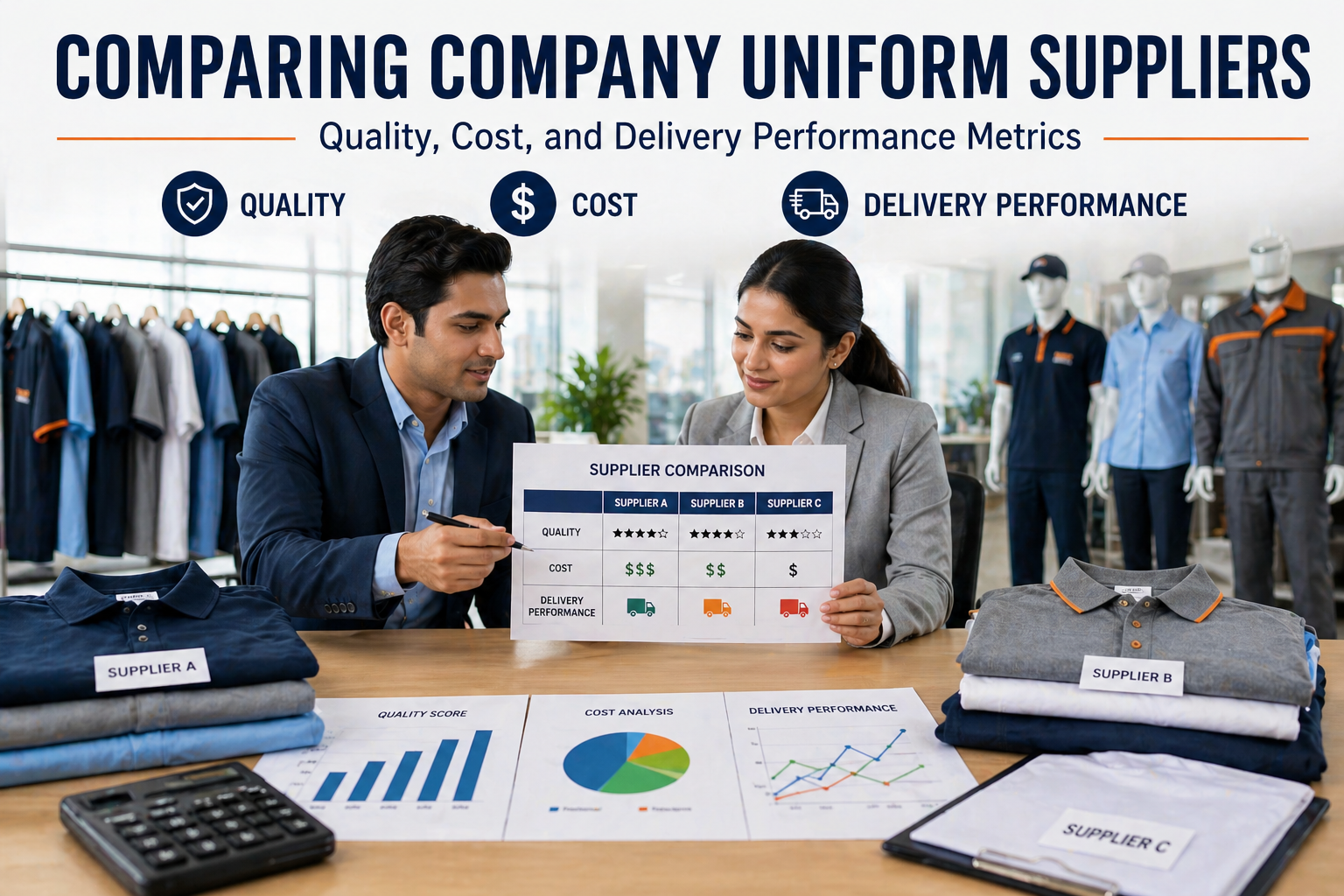
The smarter approach uses three pillars:
- Quality — Does the uniform hold up after 50 washes?
- Cost — Is the total cost of ownership genuinely competitive?
- Delivery — Does the supplier meet deadlines consistently?
Together, these three pillars form the QCD framework: Quality, Cost, and Delivery, which procurement professionals use globally to rate vendor performance.
Pillar 1: Quality Metrics for Company Uniform Suppliers
Fabric Quality and Durability
The foundation of any good uniform is the fabric. When evaluating company uniform suppliers, ask for fabric specification sheets before placing a trial order. Key parameters include:
- GSM (grams per square meter): Higher GSM generally indicates a thicker, more durable fabric. For industrial and workwear uniforms, a minimum of 200 GSM is recommended.
- Thread count and weave pattern: Tighter weaves resist tearing and abrasion.
- Colorfastness rating: Good suppliers test fabrics for colorfastness under ISO 105-C06 or equivalent standards. A rating of 4 or above on a 5-point scale means the color will not fade significantly after repeated washing.
For Indian working conditions specifically, cotton blends and moisture-wicking fabrics perform better than pure synthetic fabrics. The climate demands breathability alongside durability.
At Armstrong Products, corporate wear and workwear are sourced with precisely these fabric parameters in mind, ensuring employees are comfortable and presentable across all sectors.
Defect Rate
The defect rate measures the percentage of delivered units that fail to meet agreed quality standards. It is calculated as:
Defect Rate = (Number of Defective Units ÷ Total Units Delivered) × 100
A defect rate below 1% is considered excellent. Anything above 3% signals systemic issues at the manufacturing end. ¹
When you request samples from corporate uniform manufacturers, inspect them carefully for:
- Uneven stitching or loose threads
- Misaligned collar or cuffs
- Color variations across the same batch
- Sizing inconsistencies
Compliance with Standards
Reputable company uniform suppliers will have certifications that back up their quality claims. Look for:
- ISO 9001 — Quality management systems
- Oeko-Tex Standard 100 — Confirms fabrics are free from harmful chemicals
- BSCI — Business Social Compliance Initiative, important for ethical sourcing
- EN ISO 11612 — For flame-resistant workwear
- EN ISO 20471 — For high-visibility garments
For industries like oil and gas, construction, and manufacturing, certifications are not optional. A supplier without them creates a compliance liability for your business.
Armstrong Products works with clients in heavily regulated sectors such as ONGC, L&T, and JSW, which makes certification compliance a core requirement. You can explore the full range of high-visibility workwear and safety clothing on the website.
Pillar 2: Cost Metrics for Company Uniform Suppliers
Unit Price vs. Total Cost of Ownership
The unit price is what you pay per piece. The total cost of ownership (TCO) is what you actually spend when you account for everything, including defects, rework, returns, replacements, and the administrative cost of managing supplier issues.
A supplier charging ₹800 per piece with a 5% defect rate is almost always more expensive in the long run than a supplier charging ₹950 per piece with a 0.5% defect rate.
When calculating TCO, include:
- Base price per unit
- Shipping and logistics costs
- Cost of returned or rejected goods
- Replacement cost for defective pieces
- Time spent on quality inspections
MOQ and Pricing Tiers
Minimum order quantities (MOQs) vary widely among corporate uniform manufacturers. Basic designs typically start at 100–500 pieces, while fully customized uniforms may require 1,000 or more units. ³ Understanding MOQ tiers helps you plan procurement cycles better and avoid over-ordering.
Ask suppliers for a tiered pricing sheet. For example:
- 100–499 units: ₹X per piece
- 500–999 units: ₹Y per piece
- 1,000+ units: ₹Z per piece
Negotiating based on annual volume rather than per-order quantity often gives better rates.
Hidden Costs to Watch
Some company uniform suppliers advertise attractive base prices but add costs later through:
- Logo embroidery or screen printing charges (sometimes quoted separately)
- Packaging and labeling fees
- Revision charges for design changes
- Sample charges that are not credited to bulk orders
Always ask for an all-inclusive quote before signing a purchase order.
Price vs. Longevity
A uniform that lasts 18 months is almost always more cost-effective than one that needs replacing every 6 months, even if the initial price is higher. Ask suppliers for washability test data, specifically, how the uniform looks and fits after 50 washes at standard temperatures.
Pillar 3: Delivery Performance Metrics
On-Time Delivery Rate
On-time delivery (OTD) is the percentage of orders delivered on or before the agreed date. It is arguably the single most important metric when comparing company uniform suppliers.
OTD Rate = (Orders Delivered On Time ÷ Total Orders) × 100
A reliable supplier should maintain an OTD rate of 95% or above. Anything below 90% will regularly disrupt your operations.
When evaluating suppliers, ask for OTD data from the past 12 months. Cross-check this with customer references if possible.
Lead Time and Lead Time Variability
Lead time is the number of days from order confirmation to delivery. For customized corporate uniforms, typical lead times in India range from 10 to 21 days for standard orders and 25 to 45 days for large or complex orders.
Lead time variability is equally important. A supplier who consistently delivers in 18 days is more reliable than one who delivers in 12 days for one order and 30 days for the next. High variability makes planning difficult.
OTIF Performance
OTIF stands for On Time In Full. It measures not just whether a delivery arrived on time but also whether the correct quantities and specifications were delivered. A supplier could technically meet the delivery date by sending partial quantities, which hurts your operations just as much as a late shipment.
Track OTIF separately from OTD to get a complete picture.
Return Merchandise Rate (RMA)
The RMA rate measures the percentage of delivered goods returned due to defects or specification mismatches. A high RMA rate from a supplier is a strong warning signal. It means:
- Their quality control is inconsistent
- Your teams are spending time on returns logistics
- Your operations are disrupted by stock gaps
How to Build a Supplier Comparison Framework
When you are evaluating multiple company uniform suppliers simultaneously, a structured framework prevents bias and speeds up decision-making. Here is a simple approach:
Step 1 — Define your requirements clearly. Specify fabric type, GSM, size range, branding requirements, and required certifications before approaching any supplier.
Step 2 — Request samples. Never commit to a bulk order without inspecting physical samples. Check stitching quality, sizing accuracy, colorfastness, and logo fidelity.
Step 3 — Request a factory audit or reference list. Reputable corporate uniform manufacturers welcome factory visits or can provide third-party inspection reports from agencies like SGS or Intertek.
Step 4 — Place a trial order. A 50–100-unit trial order reveals a great deal of production quality at scale, actual lead time, packaging quality, and responsiveness to communication.
Step 5 — Score and compare. Use a weighted scorecard across quality, cost, and delivery metrics. Assign weights based on your priorities. For safety-critical industries, the weight quality is higher. For businesses managing tight budgets, weighing TCO more heavily.
Red Flags When Selecting Company Uniform Suppliers
Not every supplier who claims quality actually delivers it. Watch for these warning signs during evaluation:
- Unwillingness to share fabric specifications or certifications
- No physical samples or only digital mockups
- Vague delivery timelines with no commitment to a written schedule
- Excessive minimum order quantities that prevent trial orders
- No references or verifiable client list
- Pricing that seems too low to be sustainable
What Sets the Best Corporate Uniform Manufacturers Apart
The top corporate uniform manufacturers in India share a few common traits. They have in-house production facilities, which give them control over every stage from fabric cutting to stitching and final inspection. They maintain quality control at each step rather than only at the final stage. They offer flexible customization, color matching, logo embroidery, and branding without compromising turnaround times.
They also communicate proactively. If a delivery is delayed, they will inform you in advance. If a fabric specification is not available, they suggest alternatives with comparable performance. That kind of transparency is worth as much as the technical metrics.
India’s corporate uniform manufacturing landscape is clustered around key textile hubs, Maharashtra, Punjab’s Ludhiana belt, and Telangana, which offer labor cost efficiencies of 30–50% compared to Western counterparts while supporting vertically integrated supply chains from spinning to stitching.
Armstrong Products serves clients across industrial, corporate, and healthcare sectors with exactly this approach. From corporate wear and medical wear to safety footwear, every product category is backed by consistent quality standards and pan-India delivery capability. Clients such as ONGC, Adani, L&T, Godrej, and Taj Hotels trust Armstrong because the metrics quality, cost, and delivery consistently align with their expectations.
Summary: Key Metrics at a Glance
| Metric | What to Measure | Target Benchmark |
| Defect Rate | % of faulty units delivered | Below 1% |
| Colorfastness | ISO rating after washing | 4 or above / 5 |
| On-Time Delivery Rate | % of orders on schedule | 95% or above |
| Lead Time Variability | Standard deviation of delivery days | Minimal |
| OTIF Rate | On time and correct quantity | 95%+ |
| RMA Rate | % of goods returned | Below 1% |
| Total Cost of Ownership | All-in cost per uniform per year | Lowest across comparable quality tier |
Conclusion:
Selecting company uniform suppliers is not a one-time transaction. It is an ongoing relationship that directly affects your brand image, your employees’ daily comfort, and your procurement budget.
Most businesses that struggle with uniform procurement are not making bad decisions; they are making incomplete ones. They focus on the unit price and overlook defect rates, lead time variability, and hidden costs. When all three pillars of the QCD framework, quality, cost, and delivery, are evaluated together, the right supplier becomes much easier to identify.
Start with clear specifications. Back them with sample testing. Place a trial order before committing to bulk. Build a scorecard and revisit it after each order cycle. Over time, this process turns supplier selection from a one-off gamble into a repeatable, data-driven decision.
The best company uniform suppliers are not just manufacturers. They are operational partners, ones who understand your brand standards, respect your timelines, and fix problems before you have to ask.
If you are sourcing uniforms for a corporate, industrial, or healthcare environment, explore Armstrong Products’ full range of workwear and corporate clothing solutions, or get in touch with the team directly.
FAQs
Q1. What is the most important metric when comparing company uniform suppliers?
On-time delivery rate and defect rate are the two metrics that matter most in day-to-day operations. OTD directly affects your ability to onboard staff and meet operational deadlines, while the defect rate determines how often you deal with replacements and rework. Ideally, evaluate both together alongside the total cost of ownership rather than focusing on any single figure.
Q2. What certifications should I look for in corporate uniform manufacturers?
For general corporate wear, ISO 9001 (quality management) and Oeko-Tex Standard 100 (chemical safety) are the baseline. For industrial or workwear applications, look for EN ISO 11612 (flame resistance) and EN ISO 20471 (high-visibility garments). If ethical sourcing matters to your business, BSCI certification is an important indicator of labor practice compliance.
Q3. What is a good defect rate for a uniform supplier?
A defect rate below 1% is considered industry-standard for a reliable supplier. Rates between 1–3% are acceptable but warrant attention and regular quality reviews. Anything above 3% is a signal of systemic quality control issues and should prompt a reassessment of the supplier relationship.
Q4. How do I calculate the total cost of ownership (TCO) for uniforms?
TCO goes beyond the unit price. Add together the base price per unit, logistics costs, cost of defective units and their replacement, time spent on quality inspections, and any additional fees (embroidery, packaging, revisions). Divide the annual spend by the number of functional uniform sets delivered to get a true per-unit cost that reflects actual value.
Q5. What is OTIF, and why does it matter for uniform procurement?
OTIF stands for On Time In Full. It measures whether an order was delivered by the agreed date AND with the correct quantities and specifications. A supplier can technically meet a delivery date by shipping only part of an order, which disrupts operations just as much as a late shipment. Tracking OTIF gives a more accurate picture of supplier reliability than OTD alone.
Q6. How many pieces should I order for a trial before committing to a bulk order?
A trial order of 50 to 100 units is generally sufficient to assess production quality at scale, actual lead time, packaging standards, and how responsive the supplier is to feedback. For highly customized orders with complex branding or unusual fabric specifications, a trial order of at least 100 units is advisable.
Q7. What hidden costs should I watch for when getting quotes from uniform suppliers?
Common hidden costs include logo embroidery or screen printing quoted separately from the garment, packaging and labeling fees, revision charges for design changes after samples are approved, and sample charges that are not credited toward the bulk order. Always request an all-inclusive quote that itemizes every cost before signing a purchase order.
Q8. Can I source different uniform types, corporate, industrial, and medical, from a single supplier?
Yes, and it is often more efficient to do so. A supplier that covers multiple categories allows you to standardize quality expectations, simplify procurement administration, and negotiate better volume pricing. Armstrong Products, for example, supplies corporate wear, industrial workwear, medical wear, and uniform footwear under one roof, making multi-category sourcing straightforward.