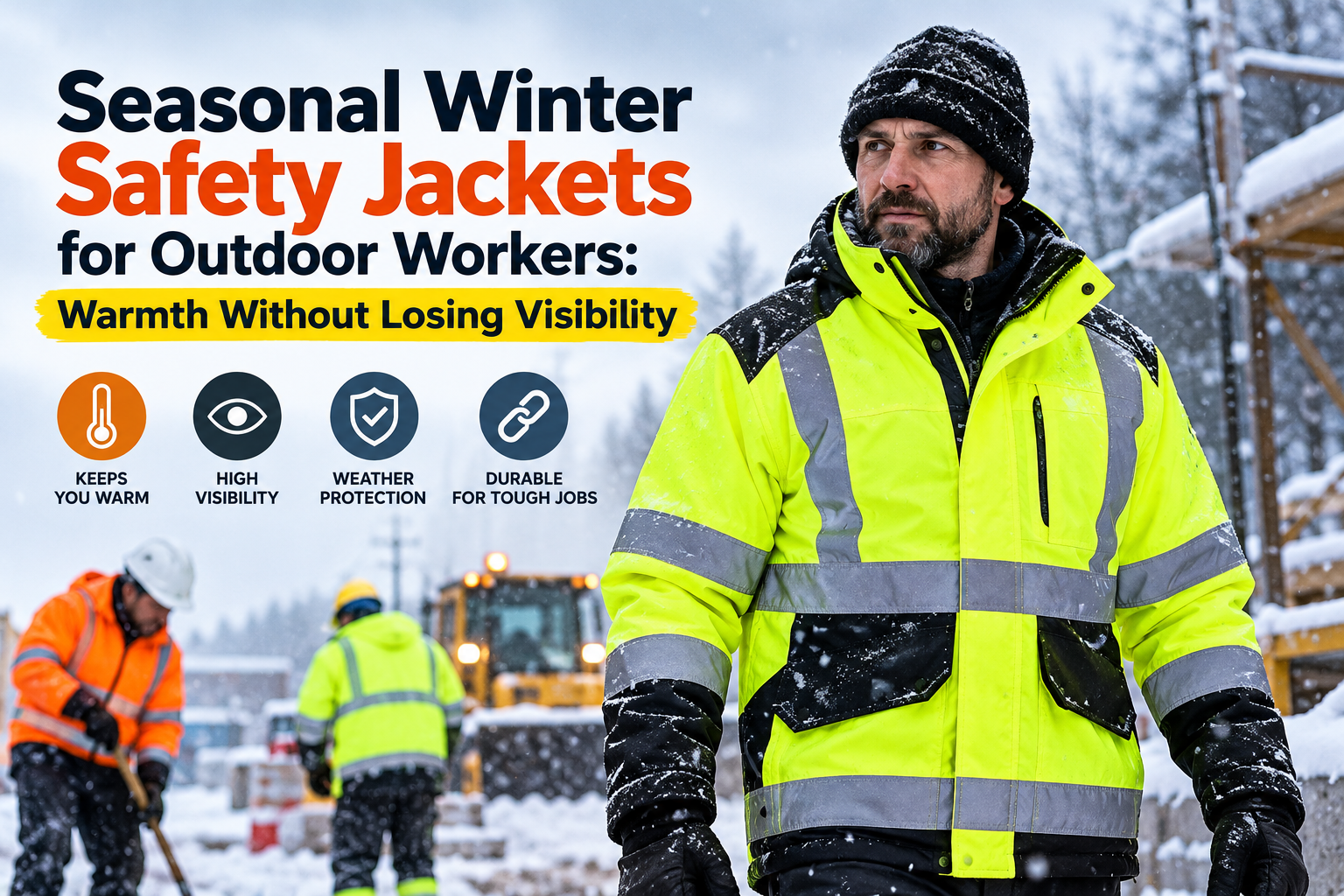
Picture a flagger on a highway shoulder at 5:40 a.m. in January. The sky is black and the air stings. She pulls on the thickest coat in her locker, and it happens to be dark grey. A truck driver sees her at the last second, or not at all.
Every winter, workers on roads, construction sites, and plant yards face the same problem. They need to stay warm, but their clothing must also keep them visible. When temperatures drop, warmth often comes first. A properly designed safety jacket that winter crews can wear throughout their shift helps solve this problem. It keeps workers warm without covering the reflective tape that drivers, crane operators, and forklift drivers need to see.
Armstrong Products has made workwear and PPE since 2009, with production at our Boisar facility in Maharashtra. This guide uses that experience to help procurement and safety teams choose a winter jacket that does both jobs.
Quick answer: what a safety jacket winter buyer needs
- Fluorescent fabric and sewn reflective tape make the wearer visible by day and under headlights.
- Insulation or lining holds heat, and the shell cuts wind and rain.
- The tape must stay visible with the hood up and the jacket zipped.
- Size the jacket for the layers underneath, then test arm movement.
Safety Jacket Winter Basics: What the Job Needs
Definition: a winter safety jacket is an insulated or lined jacket made from fluorescent fabric with sewn retroreflective tape. It keeps outdoor workers warm and visible in cold, dark or wet conditions.
Buyers search for it under many names: hi-vis winter jacket, high visibility winter jacket, insulated hi-vis jacket and reflective winter jacket. All four describe the same garment family.
A plain warm coat gives you a lining and a shell. It gives you no fluorescent color and no tape. The visibility half of any safety jacket winter shortlist comes from design: fluorescent fabric, correct tape placement and enough coverage for the class your site requires.
Winter adds a second demand. The jacket must stay visible when it is zipped, hooded, and worn over a fleece. Many jackets look right on a hanger and fail that test.
Why Winter Makes Workers Harder to See
Winter shifts start and end in the dark. Low sun glares off wet roads and into windscreens. Fog shortens the distance at which a driver can pick out a human shape. Rain smears headlights across the road surface.
Thick fog is a common problem on northern India’s highways during winter. Conditions are quite different at work sites in the Gulf, where cold desert nights are sometimes followed by rain. For those working in the hills and mountains, temperatures can stay below freezing for weeks. Whatever the location, workers still need clothing that makes them easy to spot.
Bulky jackets can get in the way. Loose sleeves cover reflective bands, front flaps hide chest tape, and large hoods block the tape on the shoulders. Dark fabric at the bottom leaves less fluorescent material exposed. Workers might feel visible in their jackets, but that doesn’t mean drivers can spot them easily. A safety jacket winter crews rely on must keep them warm while leaving the high-visibility features clearly exposed.
Types of Winter Safety Jackets
The safety jacket winter market splits into six main styles. Each suits a different job.
| Style | Best for | Watch for |
| Hi-vis parka (long, hooded) | Roadside work, night shifts, long periods standing | Bulk can bury tape; check it with the hood up |
| Quilted parka | Yards, workshops, gates, loading docks | Not a visibility garment unless it carries rated tape |
| Bomber (short) | Drivers and crews who move between cab and site | Short cut leaves hips and lower back exposed |
| Softshell | Active work in mild cold | Handles light rain only |
| 3-in-1 (shell plus liner) | Big temperature swings in one shift | Two parts to track; sizing must fit both |
| PVC rain jacket | Heavy rain | Does not breathe; sweat builds up |
Parkas and quilted jackets cover most winter work in India and the Gulf. Layered systems and heavier fills suit mountain and cold-region projects.
Armstrong’s Winter Jacket Range
Our Winter Wear category lists three jackets. Only one of them is a true safety jacket winter option for traffic zones, so each section below starts with where the jacket works best.
High Visibility Parka Jacket
This is the jacket for crews who need warmth and visibility in one garment. The High Visibility Parka Jacket sits in both our High Visibility Wear and Winter Wear categories. It comes in green, in sizes S to 3XL. The product page calls it waterproof and reflective, and names road workers, site managers and outdoor crews as its users.
For roadside crews, this is the safety jacket winter choice in our range. Use it for night shifts and for any site where moving vehicles share space with people on foot. Before you order for a full crew, ask us for the reflective tape specification and the visibility class your client needs. Then wear a sample with the hood up and the zip closed.
Parka Quilted Jacket
The Parka Quilted Jacket is built for cold weather workwear where warmth comes first. It comes in black and royal blue, in sizes S to 3XL. The listing describes it as insulated and durable, and we supply it in bulk.
This is not a high visibility garment. Use it for workshop yards, security posts, loading docks and other spots away from moving traffic. Where a site rule requires visibility, add a reflective vest from our High Visibility Wear range on top of the jacket.
Penguin Skin Jacket
The Penguin Skin Jacket is a lightweight PVC rain jacket available in brown and gray, from size S to 3XL. It works well in heavy rain but offers little warmth. Since PVC doesn’t allow much airflow, you may sweat during physically demanding work. It’s better suited to wet weather and less strenuous tasks. Wear warm layers underneath when it’s cold.
Brown and gray give no visibility. Skip this jacket on roads and in vehicle zones. Never wear it over a hi-vis garment, because it covers the tape.
| Jacket | Colours | Sizes | Main job | Visibility role |
| High Visibility Parka Jacket | Green | S to 3XL | Warmth plus visibility for roadside and site work | Main visibility garment; confirm tape spec and class |
| Parka Quilted Jacket | Black, Royal Blue | S to 3XL | Insulation for cold yards and workshops | None alone; add a reflective vest where site rules ask |
| Penguin Skin Jacket | Brown, Gray | S to 3XL | Heavy rain protection | None; keep out of traffic zones |
Need another color, a different tape layout, or a logo in a set position? Our site lists customization and branding and private label and OEM manufacturing for bulk orders. You can browse the full Winter Wear category for current listings.
Visibility Features a Safety Jacket Winter Order Must Keep
Five checks decide whether a safety jacket winter pick stays visible once the layers go on.
Color comes first. Fluorescent yellow-green and fluorescent orange-red are the two standard hi-vis colors. Pick the one that contrasts with your background. Snow and dry dust favor one color; green hillsides another. Ask the client what they require before you buy.
Tape coverage comes second. Retroreflective tape throws headlight beams back toward the driver. Bands around the torso, over the shoulders and around the sleeves outline a person’s shape from a distance.
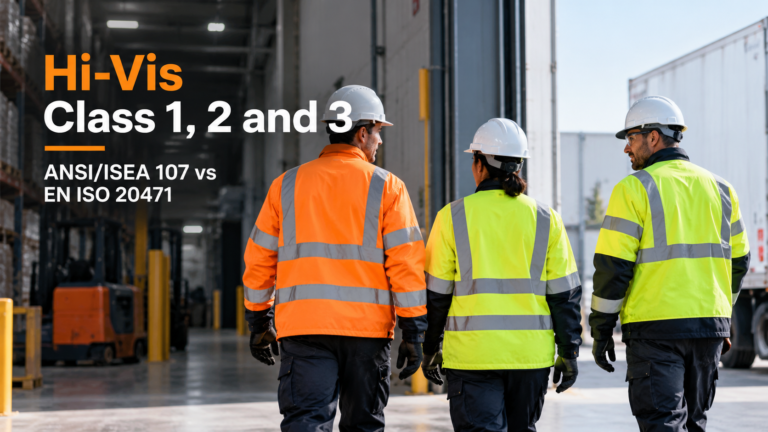
The third check is the class. EN ISO 20471 sorts garments into three classes by the minimum area of material.
| Class | Fluorescent material | Retroreflective material | Typical use |
| 1 | 0.14 m² | 0.10 m² | Low speed, low traffic areas |
| 2 | 0.50 m² | 0.13 m² | Moderate traffic speeds |
| 3 | 0.80 m² | 0.20 m² | Fast roads, poor light, complex sites |
Class 3 needs a garment with sleeves, which is why jackets and coveralls reach it and most vests do not. North America uses ANSI/ISEA 107, which follows the same three-class idea and adds Type R for roadway work. Dark panels, big pockets, and thick hoods can cut the visible area, so ask whether the class applies to the finished jacket and not only the fabric.
The fourth check is the hood and collar. With the hood up, shoulder tape should still show. A detachable hood helps, because crews wear it only in wind and rain.
The fifth check is the arm-raise test. Zip the jacket, raise both arms, sit down, and turn around. Note where the tape sits each time. Repeat the test in a dark room with a torch. It takes five minutes and catches most design flaws.
Warmth Features That Matter on the Job
Winter safety jackets usually come with quilted polyester insulation or a fleece lining. Thicker insulation keeps workers warmer, but it can also make them sweat when they’re moving around. Someone digging trenches won’t need the same level of warmth as someone standing at a gate all day. Choose the insulation based on the work being done rather than the lowest temperature in the forecast.
Check the material used on the outside of the jacket, too. Windproof fabric helps keep the cold wind out, while a water-repellent finish is usually enough for light rain. If workers spend hours in wet conditions, they’ll need a waterproof jacket with taped seams. Before buying, check the specifications to see what level of protection the jacket offers.
A high collar, adjustable cuffs, and a drawcord hem help keep cold air out. Loose cuffs can let in drafts whenever workers lift their arms. Drivers may find a two-way zip more comfortable because they can open the bottom while sitting. A storm flap behind the zip also helps block wind, but make sure it doesn’t cover the reflective tape on the chest.
Ventilation is worth checking, especially for jobs that involve a lot of physical activity. Underarm zips or cuffs that open can help workers cool down. Otherwise, they may end up sweating while working and feeling cold once they stop.
Cold-weather clothing must also meet certain standards. EN 342 covers temperatures around -5°C and below, with insulation measured for the entire clothing set. EN 14058 covers cooler conditions, and EN 343 rates rain protection and breathability. If your site or client names a cold-protection standard, ask the supplier for the matching test report.
Layering Under a Hi-Vis Jacket
Good layering splits warmth across three layers, so workers can adjust through the shift. This is how to layer under a safety jacket winter crews wear without hiding the tape.
The base layer is a snug synthetic or wool piece that moves sweat away from the skin. Skip cotton here. Cotton holds moisture and cools the body when work slows.
The mid layer is a fleece or a light insulated vest. Add it on cold mornings and drop it at midday.
The outer layer is the jacket. It provides visibility and blocks the wind and rain.
Safety Jacket Winter Fit and Layering
Size a safety jacket winter order with the layers on. Fit each worker in the base and mid layer they will wear on the job. The jacket should close without strain across the chest. Both arms should rise above the head without the hem lifting past the belt, and the sleeves should still cover the wrist bone.
If workers sit in vehicles, check that the jacket does not ride up at the back. Avoid hooded sweatshirts under the jacket, because the extra hood pushes the jacket collar and hides shoulder tape. Our parkas run from S to 3XL. Pick sizes on fitting day, not from the t-shirt size on file.
Which Jacket Fits Which Job
No single safety jacket winter choice suits every site. Use the table as a starting point, then confirm site rules with your client.
| Work | Main winter risk | Jacket choice | Check before ordering |
| Highway and road crews | Low light, fast traffic, wet road | Hi-vis parka with a waterproof shell | Class set by the road authority; tape visible with hood up |
| Construction sites | Cold mornings, moving plant, dust | Hi-vis parka over a light mid layer | Tape still shows under harness straps and tool belts |
| Utilities and power work | Roadside traffic, electrical or hot work | Hi-vis parka for roadside tasks; FR outerwear for hot work | FR need set by the task, not the season |
| Oil and gas yards | Cold nights, vehicle traffic, ignition sources | FR-rated outerwear in hazardous zones | Site rules on FR; never assume a parka is FR |
| Mining and quarries | Dust, heavy plant, cold pits | Hi-vis parka in the colour that contrasts with dust | Fluorescent colour visible against the pit wall |
| Ports and logistics yards | Wind, rain, forklifts | Hi-vis parka with a hood for rain | Hood and collar leave shoulder tape clear |
| Gates, security posts and loading docks | Standing still in the cold | Parka Quilted Jacket, plus a reflective vest where rules ask | Vest sits on top of the jacket |
Hot Work and Winter: Check for Flame Resistance
Standard hi-vis parkas and quilted jackets are not flame resistant unless the maker says so and shows the test report. Polyester shells can melt and stick to skin when sparks land on them. A safety jacket winter buyers pick for hot work areas needs flame resistance on the label and on paper.
If your crew welds, grinds, or works near ignition sources, specify FR or IFR outerwear for the outer layer. A non-FR jacket over an FR coverall removes the coverall’s protection in a flash fire.
Our guides on IFR vs FR clothing and flame-resistant clothing for welders explain the difference. Ask our team what FR and IFR options can be made for your site.
Buying Checklist for Bulk Orders
Run through this list before you approve any safety jacket winter purchase order. It covers the points that go wrong most often when buying bulk winter jackets for workers.
- Confirm the visibility class your client or road authority requires.
- Ask for the test report on the finished jacket, not only the fabric.
- Choose the fluorescent color that contrasts with your site background.
- Request a sample and wear it for a full shift.
- Run the arm-raise test with hood up, zip closed, and harness on.
- Decide between water-repellent and waterproof, and check for taped seams.
- Fit the crew with their real layers on, then plan the size run.
- Mark logo positions away from the tape bands.
- Ask how the supplier keeps shade and tape consistent across repeat orders.
- For export orders, confirm packing, labeling and documents for the destination.
As a winter workwear manufacturer, we can label cartons by size and crew, which saves time on a site with several teams. OEM and private label options are available for buyers who want their own brand on the jacket. Our team supplies procurement teams across the Gulf, including the UAE and Saudi Arabia.
Common Mistakes
The most common safety jacket winter mistake is judging by color alone. A bright jacket without enough tape, or with tape in the wrong places, still fails at night.
Other errors repeat across sites:
- Wearing a dark rain shell over a hi-vis jacket, which hides the tape.
- Sizing from a T-shirt and then finding the sleeves ride up over fleece.
- Choosing a heavy fill for active crews, who then sweat and chill.
- Treating a quilted parka as flame resistant.
- Ordering a full crew without wearing a sample first.
Care and Maintenance
Care decides how long a safety jacket winter order stays in service. Follow the label first. As a general rule, wash at a moderate temperature with mild detergent, and skip bleach and fabric softener. Both can wear down tape and fluorescent dye.
Dry the jacket fully before storage. A damp jacket in a locker grows mould and smells. Keep it away from direct heat, which can lift the tape edges.
Inspect the tape every few weeks in heavy-use months. Peeling, cracking, and a dull, dirty surface mean the tape no longer reflects well. Retire the jacket when that happens. Check the tape wash rating on the label so you know what the maker expects.
Key Takeaways
- A safety jacket winter buyers trust combines fluorescent fabric, reflective tape, insulation and a weather shell.
- Class, tape position, and fit decide visibility more than color does.
- Test every sample with the hood up, the zip closed, and the layers on.
- Match insulation to activity so crews do not sweat and chill.
- Standard parkas are not flame resistant; specify FR or IFR for hot work.
Conclusion
Winter work asks crews to stay warm and stay seen at the same time. The right safety jacket winter teams choose holds heat, sheds wind and rain, and keeps fluorescent fabric and tape in view when it is zipped, hooded, and layered. Test a sample, check the class and size with layers on, and match the jacket to the job.
Our range covers a hi-vis parka for traffic zones, a quilted parka for cold yards and a PVC rain jacket for wet spells, so you can build a safety jacket winter plan site by site. Request our catalog, ask for samples, or talk to our product team about bulk, OEM and export requirements.
FAQs
What is a safety jacket for winter?
A winter safety jacket is an insulated or lined jacket made from fluorescent fabric with sewn reflective tape. A safety jacket winter crews rely on keeps the wearer warm in cold, wet or dark conditions and makes the wearer visible to drivers and plant operators. People also call it a hi-vis winter jacket, a high visibility parka or a reflective winter jacket.
How warm does a safety jacket winter crews wear need to be?
It depends on the lowest temperature, the wind, and how much the crew moves. A worker who stands at a gate needs more insulation than one who digs trenches. EN 342 covers clothing for cold at about minus 5 degrees Celsius and below, and EN 14058 covers cooler conditions. Test a sample on a real shift and ask workers whether they sweat or shiver. Adjust the mid-layer before you change the jacket. Cold stress builds slowly, so ask the crew how they felt at the end of the shift, not only the start.
Can I wear a regular winter coat over a hi-vis vest?
A coat under a vest works, because the vest sits outside and stays visible. A coat over a vest hides the vest and defeats its purpose. Where a site needs a vest, put the vest on top of the warm coat. A single hi-vis parka is easier to manage, since the tape, the color and the warmth sit in one garment that the worker cannot cover by mistake.
Which color is better, yellow-green or orange-red?
Neither wins everywhere. Fluorescent yellow-green stands out against most backgrounds and is the common choice for road and construction work. Fluorescent orange-red shows up better against green hillsides, vegetation, and some dusty sites. Check your client’s rules first, because some sites fix the color. Pick the color that contrasts with the setting where the crew spends most of the shift.
Which visibility class does a safety jacket for winter need for road work?
The road authority or client decides which safety class is required. Class 3 is generally needed when working near fast-moving traffic or in low-light conditions, while Class 2 is often suitable for areas with moderate traffic. Since Class 3 requires sleeves, jackets and coveralls are usually a better choice than vests. Before buying, ask the supplier for the class marking and test report for the finished jacket, not just the fabric. If the client hasn’t specified a class in writing, check with the site safety officer before ordering in bulk. Choosing the wrong class could mean replacing the clothing for the entire crew.
Does a winter hi-vis jacket need to be waterproof?
Waterproof is worth having for wet shifts, and water-repellent is enough for light showers. Waterproof shells need taped seams to keep water out at the stitching. They also trap sweat, so look for underarm vents or wear a lighter mid-layer. For long periods of heavy rain, choose a waterproof shell. For dry cold, a windproof quilted jacket may feel better and cost less to replace.
How should I layer under a safety jacket winter crews wear?
Start with a close-fitting wool or synthetic base layer. Add a fleece or lightweight insulated vest before putting on your safety jacket. Avoid cotton against your skin, as it absorbs sweat and can leave you feeling cold when you slow down. Try the jacket on with all your layers to make sure it fits well. Also, check that the hood and collar don’t cover the reflective tape. If the work gets physically demanding, take off the middle layer to reduce sweating.
How do I wash a hi-vis jacket without damaging the tape?
Always check the care label before washing. In most cases, a moderate wash temperature and mild detergent will do. Avoid bleach and fabric softener, and let the jacket dry completely before storing it. Keep it away from direct heat, as this can loosen the reflective tape. Check the tape’s wash rating on the label. If it starts cracking, peeling or losing its brightness, it’s time to replace the jacket.
Are winter safety jackets flame resistant?
Most winter safety jackets aren’t flame resistant. Regular quilted jackets and hi-vis parkas often have polyester outer shells, which can melt when exposed to sparks or flames. If flame resistance is required, look for FR or IFR outerwear supported by proper test reports. Crews involved in welding, grinding, or work near ignition sources should wear suitable flame-resistant outer garments. A regular non-FR jacket should never be worn over an FR coverall.
Can Armstrong supply branded or private label winter jackets in bulk?
Armstrong Products lists OEM and private label manufacturing, plus customization and branding for bulk institutional and industrial orders. We manufacture at our Boisar facility in Maharashtra and have supplied buyers since 2009, including procurement teams across the Middle East. Minimum order quantities depend on the product and the level of customization, so share your requirement through the bulk quote form. Buyers can also request samples before a full order.