
A shipment of 500 coveralls arrives at a Saudi facility. The labels are correct, and the color matches the order. But when the inspector asks for the fabric lot number, a problem arises. The supplier’s test report shows a different lot number. The shipment is put on hold until the mismatch is sorted out.
That delay began months earlier, in the paperwork of a coverall Aramco order. A coverall Aramco buyer needs two kinds of proof. One proves who you are. The other proves what you ship. We could not find a public one-page Aramco coverall specification, so buyers judge the file you send.
This guide covers both kinds of proof. You will see how Aramco supplier registration is routed, what a manufacturer file holds, which standards a flame-resistant file should carry, and how to keep sample and bulk lots matching. Armstrong Products has made industrial workwear since 2009 at its Boisar factory. We wrote this for procurement managers, HSE teams, EPC contractors, and distributors who supply Saudi Arabia.
Quick answer: A supplier of an Aramco-approved coverall must show a valid registration route with Aramco, proof that it manufactures the garment, test reports that match the hazard in the purchase order, and lot records that link the bulk order to the approved sample.
What “Aramco Approved” Means for a Coverall
There is no single stamp called “Aramco approved coverall.” The phrase covers two separate things. The first is supplier standing. Aramco requires every company that supplies goods or services to register, and its supplier page says registration and qualification do not guarantee future business. The second is product acceptance. A project, a contractor or a purchase order sets that, usually in writing.
Some web pages quote clause numbers for the Aramco FR coverall. We could not match those numbers to any public Aramco document, so we do not repeat them. Other pages call any FR garment a coverall Aramco will take, which tells you nothing. Ask your buyer for the current specification in writing. Confirm the revision before you quote.
The coverall Aramco approval process has four main parts: registration route, manufacturing plant, product compliance, and delivery. Even experienced suppliers can miss out on orders if they focus only on company registration and overlook product documentation. Others may have all the required test reports but haven’t registered through the correct route. Both requirements must be in place to secure a coverall Aramco order.
Proof 1: Your Registration Route
Every coverall Aramco supplier starts here. Aramco sets the route by location and supplier type. Its supplier page lists separate paths for Saudi-based companies, for GCC and wider Middle East countries, and for several Asian and African countries. Suppliers in all other geographies are told to contact the appropriate Aramco affiliate company. The affiliate decides if there is a business need and if the supplier is financially and technically acceptable.
| Where you are based | Route named on Aramco’s supplier page |
| Saudi Arabia | Dhahran office, through the e-Marketplace platform, with full Saudi document set |
| UAE, Bahrain, Kuwait, Oman, Qatar and several others | Dhahran office, through the e-Marketplace link for the region |
| Other Asian and African countries | International Suppliers page |
| Everywhere else | Contact the relevant Aramco affiliate |
Check the page before you start, because routes and country lists change. An Indian maker should read the international path first and then speak to the Aramco affiliate that covers Asia. Many Indian makers also work through a Saudi distributor or contractor that already holds a vendor profile. In that case, your product file must satisfy two readers: the distributor and the end user.
Our post on vendor qualification for Saudi oil and gas contractors lists the company documents in more detail. Use it as a companion to this guide.
Proof 2: That You Make the Coverall
Aramco’s material supplier guide (January 2020) draws a line between vendors and manufacturers. A vendor supplies but does not manufacture. The guide states that vendors do not go through the inspection process most manufacturers face. A factory that sells a coverall Aramco end users will wear should expect that closer look. Buyers of a coverall for an Aramco project want the maker named, not hidden behind a trader.
Aramco’s out-of-kingdom manufacturer registration form (version 12/2018) shows what the review covers. Check Aramco for the current version before you submit.
| Section of the file | What to prepare for a coverall maker |
| Quality package | ISO 9001 certificate, quality manual, procedures for nonconforming product, internal audit and corrective action |
| Plant detail | Factory location map, key equipment list, organization chart, manufacturing flow chart |
| Technical package | Company profile, product catalog with specifications, raw material list |
| Customer proof | Major user list and past supply jobs |
| Compliance letter | Letter stating compliance with the engineering specifications the buyer names |
The form also warns that a plant site visit by Aramco inspectors may be part of registration. A clean cutting room, a labeled fabric store, and readable stitching records all help on that day.
For a coverall, the flow chart should show the real steps: fabric receipt, lot check, cutting, FR thread stitching, trim fitting, inspection and packing. Inspectors want to see where a lot number is recorded. If your records stop at the fabric store, they stop too early.
Proof 3: The Product File
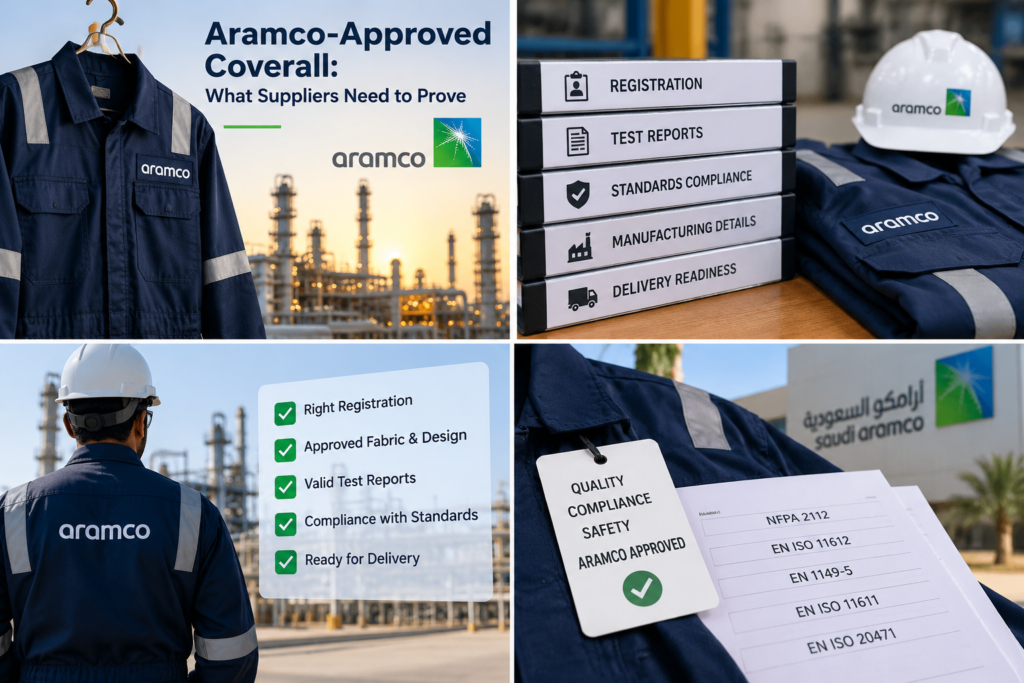
Registration gets a supplier listed, but the garment also needs the right documents for approval. An inspector checks the coverall Aramco product file carefully to confirm that it meets the requirements. Most Aramco FR coverall files include a few key standards, depending on what the tender or purchase order specifies.
| Standard | What it covers | When a buyer asks for it |
| NFPA 2112 | Flash fire protective clothing | Operators and contractors who work to US practice |
| EN ISO 11612 | Heat and flame protection, with performance codes | Heat and flame exposure on process sites |
| EN 1149-5 | Electrostatic properties of fabric | Work near flammable vapour |
| EN ISO 20471 | High visibility clothing | Roadside, yard and night work |
| EN ISO 11611 | Welding and allied processes | Crews who weld or cut |
| ISO 13688 | General requirements for protective clothing | Fit, labeling and comfort basics |
Do not send every report. Send the ones the order names, in a clean file. A tidy file marks a serious coverall Aramco supplier. A strong NFPA 2112 coverall file shows the third-party certification, the fabric report, and the garment-level result. A fabric report alone says nothing about the thread, zips, or tape.
Our post on in-house FR testing versus third-party lab certification explains what garment-level evidence looks like. If your buyer also asks about import clearance, read our guide on SASO certification for workwear imports into Saudi Arabia.
FR or IFR for a Coverall Aramco Order
Buyers ask which fabric a coverall Aramco order should use. The answer depends on the hazard, the climate and the wash plan. The purchase order may settle the question for you. If it does not, compare the three common builds.
| Build | How protection is made | Wash behaviour | Comfort in hot sites |
| FR treated cotton | Chemical treatment applied to cotton | Follow the maker’s wash rules to protect the finish | Soft and breathable |
| IFR modacrylic blend | Flame resistance sits in the fiber | Protection stays through washing | Moderate, depends on the blend |
| IFR aramid blend | Flame resistance sits in the fiber | Protection stays through washing | Light and strong |
Treated cotton suits crews who like a familiar feel. IFR blends may serve better where garments go through many industrial washes. Either can serve a coverall Aramco order if the order allows it. Ask for the report on the exact fabric, the blend ratio, and the finish. Our IFR versus FR coverall buyer’s guide goes deeper on the trade-offs.
Garment Details Inspectors Check
Inspectors read the garment as well as the paper. These are the points they check first on a coverall Aramco order:
- Thread: FR thread in every seam. Ordinary polyester melts and opens the seam.
- Closures: Zips, snaps and studs that suit the hazard named in the order.
- Reflective tape: Tape that survives industrial washing and, where required, is flame resistant.
- Labels: Size, standard marks, fabric details, lot reference and wash instructions on each label.
- Color: The color named in the order, matched to an approved swatch.
- Fit: Sleeves that reach the wrist and legs that clear the boot.
Fit causes more coverall Aramco rejections than people expect. A short sleeve leaves skin open. A loose leg catches on a valve handle. Our flame-resistant workwear size chart guide for GCC workers helps you set size runs before you order.
Proof 4: Sample, Lot and Delivery Records
A sample proves you can make the garment. For any coverall Aramco shipment, lot records prove the bulk order matches it. Buyers want both.
Here is what to do when you prepare a sample:
- Match the fabric lot on the test report to the lot used for the sample.
- Seal and sign the approved sample on both sides.
- Record the fabric lot for each bulk cut.
- Compare bulk garments to the sealed sample before dispatch.
The same guide shows why delivery records matter. It says packing and labeling must meet the purchase order and Aramco’s packing specifications. A failure can trigger a Failed Collection Notice, which counts against supplier performance. The guide also tracks claims for any deviation in quantity or quality from the order specification.
For a coverall Aramco shipment, this means your packing list, carton labels, and size split should match the order line by line. Our post on the sample approval process before a bulk FR order walks through what GCC procurement teams should request.
Coverall Aramco Submission Checklist
Use this list before you submit anything for a coverall Aramco bid.
Company file
- Registration confirmation or the route you follow, with the affiliate or distributor named
- Commercial license and, for factories, an industrial license
- ISO 9001 certificate and quality manual
- Factory map, equipment list and process flow chart
- Major user list and past supply jobs
Product file
- Test reports for the standards and order names
- Fabric composition and blend ratio
- Garment specification sheet with thread, trims and closures
- Fabric lot numbers linked to each report
- Approved sample, color swatch and size chart
- Label drawing and packing plan
Delivery file
- Lot record for each bulk cut
- Packing list that matches the order lines
- Pre-dispatch inspection record
Keep every coverall Aramco document in one folder. Name each file after the clause it answers. Reviewers find answers faster that way.
Common Mistakes in Coverall Aramco Bids
These mistakes appear in bid after bid.
- Wrong report for the fabric. The report covers a similar fabric, not the one in the garment.
- Vendor profile sold as a factory file. A trader cannot show the plant proof a manufacturer holds.
- Old specification revision. The bid follows last year’s requirement.
- Standard on the label with no report. The claim collapses at the first request.
- Treating all FR as equal. A limited flame-spread fabric does not replace a flash-fire fabric.
- Sample and bulk mismatch. The bulk lot uses a different fabric lot from the sample.
- Fit left for later. Sizes arrive wrong, and the shipment is rejected.
Who Needs Which Proof for a Coverall Aramco Order
Not every supplier carries the same load. This table shows where your focus belongs.
| If you are | Focus first on | Then add |
| Indian or overseas manufacturer | Registration route and plant file | Product file and lot records |
| Saudi distributor or vendor | Vendor profile and end-user approval | Maker’s test reports and sample records |
| EPC or maintenance contractor | Specification from the project | Supplier’s product file and delivery records |
Care and Inspection of an Aramco Coverall
Wrong washing shortens the life of a good coverall Aramco crews wear. Follow the maker’s care label. Many FR clothing makers advise against bleach and fabric softener because they can affect the finish or leave residue on the fiber.
Inspect each coverall before every shift. Look for burns, tears, open seams, and oil soaking. Retire a damaged garment. Repair small tears with FR thread and FR patches only. Keep a wash log for contractor crews. Buyers like to see that a supplier gave care guidance with the order.
How Armstrong Supports Saudi Supply
Armstrong Products is an industrial workwear manufacturer founded in 2009. Our factory is in Boisar, Maharashtra, and our corporate office is in Powai, Mumbai. Our site lists ISO 9001:2015 for quality management and ISO 13688:2013 for protective clothing general requirements.
We supply distributors and contractors across the Gulf, including teams that serve coverall Aramco projects. See our workwear manufacturer page for Saudi Arabia for the range, and browse the Work Wear category for coveralls and two-piece sets. Brands that want their own FR line can use our private label and OEM manufacturing.
Your registration route stays with you and your Saudi partner. Armstrong is a coverall Aramco manufacturing partner, not a registration agent. We build the product file that route needs. Share the clause from your order with our product team. We match the fabric, the garment build, and the test reports to it.
Conclusion
To win a coverall Aramco order, put the right documents in place. Every coverall Aramco buyer asks for the same two things. Registration shows who you are. The product file shows what you supply. Both must match the clause in the order.
Check your registration route and factory paperwork first. The product file should cover the standards mentioned in the order. Samples must match the bulk lots, and the fit should be checked before shipping. When your coverall Aramco file includes everything the buyer asks for, the risk of rejection decreases.
Planning a coverall Aramco supply order? Ask for the Armstrong catalog or send your order clause to our product team. For bulk, OEM, private label, or export orders, Contact Us.
FAQs
What is an Aramco coverall?
An Aramco coverall buyer’s order is a one-piece flame-resistant garment bought for Aramco sites or Aramco contractors. It protects the wearer from flash fire and heat, and many also carry antistatic fiber. The name points to the buyer, not to one fixed fabric. The purchase order or project specification sets the exact requirement, so read it before you quote.
Is there a public Aramco coverall specification?
We could not find one public document that covers every coverall order. Requirements come from the purchase order, the contractor, and the project. Some web pages quote Aramco clause numbers, but we could not match them to a public source. Ask your buyer for the current specification and revision in writing. Confirm any change before you cut fabric.
How does a supplier register with Aramco?
The registration process depends on where the supplier is based and the type of supplier. Saudi and GCC suppliers can register through Aramco’s e-Marketplace, managed by its Dhahran office. Suppliers outside these regions can visit the International Suppliers page or get in touch with the appropriate Aramco affiliate. Registration is only the first step and does not guarantee any business with Aramco.
Can an Indian manufacturer supply an Aramco coverall?
Indian manufacturers supply FR coveralls to Saudi buyers through distributors, contractors and, where the route allows, direct registration with an Aramco affiliate. The manufacturer provides garments, test reports, quality records, and plant details. Check Aramco’s supplier page for the route that applies to your country, because country lists and steps change over time.
What is the difference between a vendor and a manufacturer?
A vendor supplies products made by someone else. A manufacturer produces them. Aramco’s material supplier guide says vendors do not undergo the inspection process most manufacturers face. For coveralls, that means a factory should be ready to show its quality manual, equipment list, process flow, lot records, and past supply jobs. It may also receive a plant visit from inspectors, so keep the cutting room, fabric store, and stitching records ready to show at short notice.
Which standards should an Aramco FR coverall carry?
The required standards depend on what the order specifies. NFPA 2112 and EN ISO 11612 are commonly listed for flame and heat protection. Some orders also require EN 1149-5 for antistatic properties. Coveralls used for welding may need EN ISO 11611, while high-visibility work may require EN ISO 20471. Check the order requirements before submitting test reports, and make sure each report covers the exact fabric used in the coveralls.
Is FR cotton or IFR better for an Aramco coverall?
Both fabrics have their advantages. Treated FR cotton is soft and breathable, making it comfortable to wear. IFR blends have flame resistance built into the fibers, which means it won’t wash out. The choice depends on the work hazards, washing requirements, and how comfortable the fabric feels in hot weather. Before buying, ask for a test report that covers the exact fabric being supplied.
What documents prove a coverall is ready for supply?
Prepare three files. The company file holds licenses, ISO certificate, quality manual, factory details, and past supply jobs. The product file holds test reports, fabric composition, garment specification, lot numbers, sample, and size chart. The delivery file holds lot records, packing list, and inspection record. Send them in one organized folder.
Why do Aramco coverall shipments get rejected?
For a coverall Aramco buyer, the common causes are a report that covers a different fabric, a bulk lot that differs from the approved sample, wrong sizes, missing label details, and packing that does not match the order. Aramco’s supplier guide also counts claims for quality or quantity deviations against supplier performance. Matching every carton to the order line prevents most problems.
Do coverall test reports expire?
A report ties to one fabric and one build. A change in fabric, mill, finish, or construction needs a fresh report. Some buyers also want recent reports, so check the order for date limits. Keep a log that links each report to the fabric lot used in your garments, so a reviewer can trace any garment back to its paper in one step.