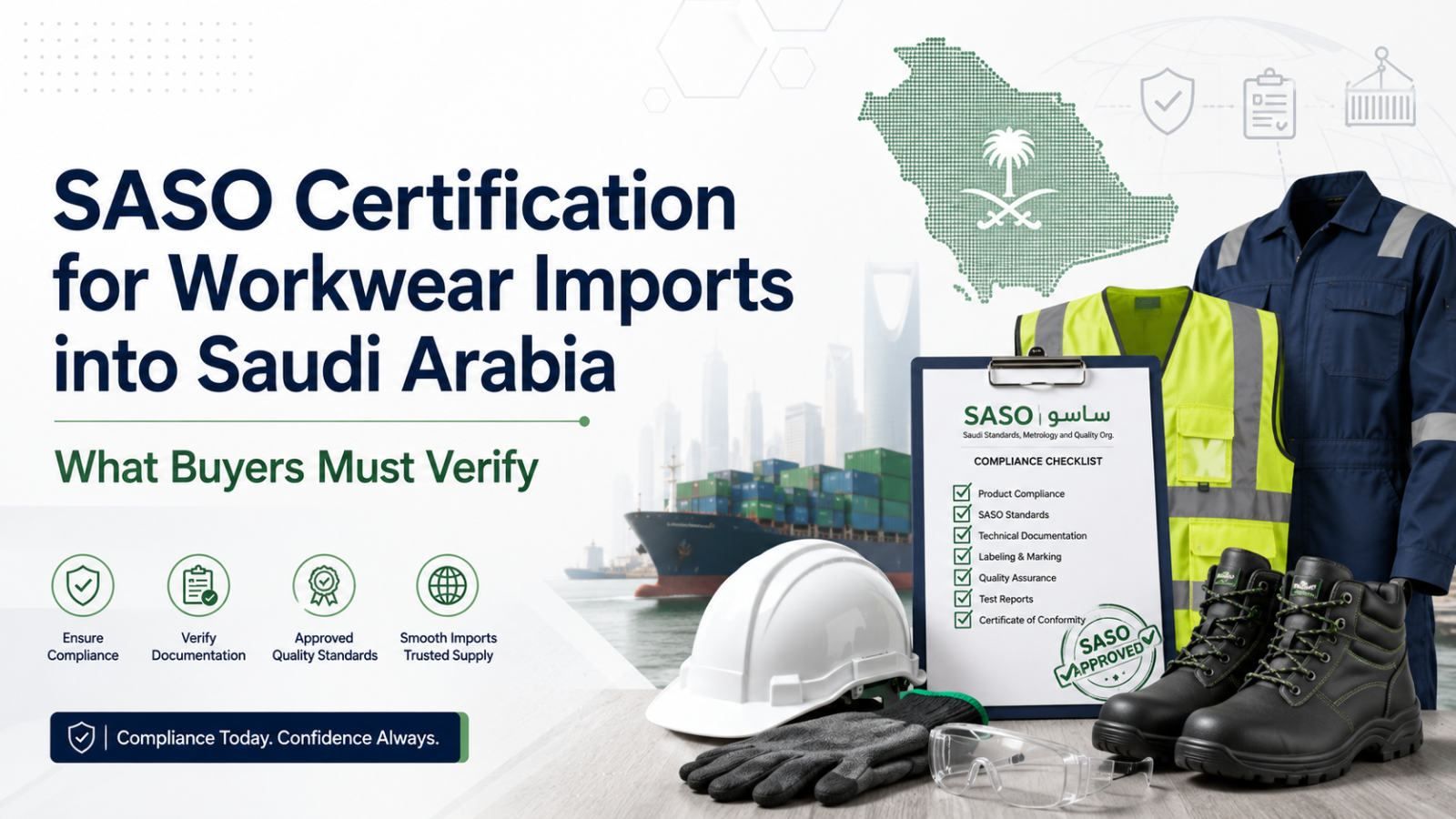
A container of FR coveralls sits at Jeddah Islamic Port. The invoice is clean. The packing list is correct. But the shipment certificate on file does not match the product batch, and customs will not release it. The buyer finds out about the gap only after the ship has already docked.
This is what SASO certification FR workwear Saudi Arabia sourcing comes down to: It is not one certificate. It is a set of documents that must match the product, the shipment, and the importer of record, all at the same time. Get one piece wrong and the goods sit at port while the project waits for uniforms.
This guide covers what SASO certification actually checks, which documents a buyer should verify before placing an order, and where FR coveralls specifically run into trouble.
What Is SASO Certification for Workwear?
SASO is the Saudi Standards, Metrology and Quality Organization, the government body that sets and enforces product standards in the Kingdom. Founded in 1972, it now regulates a wide range of product categories, including textiles, PPE, and industrial clothing, through mandatory technical regulations.
SASO, SABER, and SALEEM: How the Three Fit Together
These three names get used interchangeably, which causes confusion. SASO is the regulator. SALEEM is the Saudi product safety program under SASO’s authority. SABER is the online platform where all of this actually happens: registering a product, uploading test data, and requesting certificates. A buyer does not deal with SASO directly for day-to-day shipments. Almost everything runs through SABER.
PCoC vs SCoC: Two Certificates, Two Purposes
A Product Certificate of Conformity, or PCoC, covers one product model. It confirms that the model has passed the conformity assessment and is valid for one year. A Shipment Certificate of Conformity, or SCoC, is issued separately for each individual shipment and is what Saudi customs actually checks at the port. A supplier can hold a valid PCoC for a coverall design and still fail to get an SCoC if the shipment details, batch, or quantity do not line up with what was registered.
SASO Certification FR Workwear Saudi Arabia: What the Technical Regulation Covers
FR coveralls do not sit under one single rule. They usually fall under both the textile technical regulation and, depending on classification, a PPE-specific regulation, since flame-resistant clothing is protective equipment as well as a textile product.
The Textile and PPE Technical Regulations
SASO’s technical regulation for textile products applies to items containing a significant share of textile fiber by weight, which covers most workwear fabrics. Separately, SASO’s Technical Regulation for Personal Protective Equipment and Clothing sets requirements for design, manufacturing, labeling, storage, and transport of PPE sold or imported into the Kingdom. FR coveralls used on industrial or oil and gas sites typically need to satisfy both.
Why FR Coveralls Fall Under Stricter Scrutiny
A plain workwear shirt only needs to meet general textile requirements. An FR coverall makes a safety claim: it protects the wearer from flash fire or thermal exposure. Test data has to back that claim. This is why buyers see more document requests and more rejections on flame-resistant product lines than on ordinary uniforms.
What Is SASO Approval Workwear Really Checking?
At its simplest, SASO approval for workwear confirms three things: the product meets the applicable Saudi technical regulation, the manufacturer’s test data supports any safety claim on the label, and the specific shipment matches what was registered on SABER.
Document Checklist Before You Ship
| Document | What it confirms | Who should have it |
| Product Certificate of Conformity (PCoC) | The product model has passed conformity assessment | Manufacturer or importer of record |
| Shipment Certificate of Conformity (SCoC) | This specific shipment matches the registered product | Importer, generated per shipment |
| Fabric test report | The FR claim is backed by lab data, tied to a batch | Manufacturer, from an accredited lab |
| Commercial invoice and packing list | Quantities and descriptions match the SCoC | Exporter |
| HS code confirmation | The product was registered under the correct customs category | Importer, verified on SABER |
SASO Certified Fire Retardant Coveralls: What Buyers Should Verify
A supplier claiming SASO-certified fire-retardant coveralls should be able to produce specifics, not just a general statement that they are “SASO approved.”
Fabric Test Reports Buyers Should Ask For
Ask for the fabric test report referenced in the PCoC application, not a generic sample report from a different order. It should name the lab, the test standard, and the fabric batch. For FR performance specifically, this usually ties back to NFPA 2112, ASTM F1506, or ISO 11612, depending on which markets the fabric was originally qualified for.
Matching PCoC to the Actual Product Batch
A PCoC covers a specific product model as submitted. If the supplier changes fabric supplier, fiber blend, or construction after certification, the existing PCoC no longer accurately describes the product. This is one of the most common reasons a shipment clears the port on paper but fails a later market surveillance check.
Red flags in SASO paperwork for FR coveralls:
- PCoC references a product description that does not match the actual garment specification
- No fabric batch number tying the test report to the shipped goods
- SCoC requested after the goods have already left the factory, with no cross-check against the PCoC
- The importer of record on the SABER registration does not match the actual buyer
- Certificate dates that have expired or are close to expiry with no renewal in progress
SASO Certification Industrial Clothing Import Saudi: Common Mistakes
Most delays are not about bad products. They are about mismatched paperwork.
Wrong HS Code, Wrong Technical Regulation
If a product is registered under the wrong HS code on SABER, it can end up assessed against the wrong technical regulation entirely. FR coveralls registered as generic apparel, for instance, may skip the PPE-specific checks that matter most for a safety-critical garment.
Importer of Record Confusion
SABER registration is tied to a Saudi-based importer or representative. If the buyer changes freight forwarders or the receiving entity between the registration and the actual shipment, the SCoC request can be rejected outright.
Expired or Mismatched PCoC
A PCoC is valid for one year. Buyers placing repeat orders sometimes assume the original certificate still covers a new production run. It does not, if the certificate has lapsed or if anything about the product has changed since it was issued.
How Procurement Teams Should Evaluate a Workwear Supplier for SASO Compliance
Factory and Documentation Checklist
- Ask whether the supplier’s FR coverall design already has an active PCoC, and request the certificate number
- Confirm the fabric test report is tied to the batch being quoted, not an older or unrelated batch
- Check which importer of record the supplier normally works with for SABER registration
- Ask how the supplier handles PCoC renewal for repeat orders
- Confirm the HS code the product is typically registered under
- Ask for factory audit history and quality documentation, including ISO 9001, if available
Questions to Ask Before Placing a Bulk Order
A short set of direct questions at the RFQ stage saves far more time than untangling a rejected shipment later.
- Do you have an active PCoC for this exact coverall design, and can we see the certificate number?
- Which lab issued the fabric test report behind your FR claim?
- Who is your usual importer of record for SABER, and are they still active?
- What happens if the fabric batch changes between our order and the next one?
- Can you share references from other buyers who have cleared shipments through Saudi customs with this product?
Where Armstrong Products Fits In
Armstrong Products has manufactured industrial workwear and PPE since 2009, with production based at its facility in Boisar, Maharashtra, and its corporate office in Powai, Mumbai. Buyers preparing SASO documentation need a supplier that can produce consistent fabric test data tied to specific batches, not a one-time sample report.
Every FR coverall and PPE order leaving the Boisar facility carries traceable fabric sourcing and quality records, which is exactly the kind of documentation a SABER registration and PCoC application depend on. For procurement teams building a workwear supplier shortlist for the Saudi market, that consistency matters more than a one-line certification claim.
Conclusion
SASO certification for FR workwear in Saudi Arabia sourcing is less about finding a supplier who says the right things and more about one who can produce the paperwork that survives a customs check. A PCoC, a matching SCoC, and a fabric test report tied to the actual batch are what keep a shipment moving instead of sitting at port.
Procurement teams that verify these documents before the order ships, not after it arrives, avoid most of the delays buyers run into with Saudi imports.
Get Saudi-Ready FR Workwear From a Verified Manufacturer
Armstrong Products manufactures FR coveralls and industrial PPE with documented fabric sourcing and an audit-ready factory in Boisar, Maharashtra. If your team is preparing a SASO or SABER registration for a Saudi import, contact us with your product specification, and we will share the test documentation your certification body will ask for.
FAQ’s
What is SASO certification for workwear?
It is the conformity process required by the Saudi Standards, Metrology, and Quality Organization before workwear can be sold or imported into Saudi Arabia. It confirms the product meets the relevant technical regulation and that each shipment matches what was registered.
What is the difference between SASO, SABER, and SALEEM?
SASO is the regulator. SALEEM is the Saudi product safety program it runs. SABER is the online platform suppliers and importers actually use to register products and request certificates.
What is a PCoC?
A Product Certificate of Conformity. It confirms a specific product model has passed conformity assessment and is valid for one year.
What is an SCoC, and why does it matter separately from the PCoC?
A Shipment Certificate of Conformity is issued for each individual shipment. Saudi customs checks the SCoC, not the PCoC, at the port. A valid PCoC does not guarantee an SCoC if the shipment details do not match.
Do FR coveralls need extra certification beyond standard workwear?
Yes, in most cases. Standard textile requirements apply, but flame-resistant clothing usually also falls under SASO’s technical regulation for PPE, since it makes a specific safety claim that needs test data behind it.
Which fabric standards typically back an FR coverall’s safety claim?
NFPA 2112, ASTM F1506, and ISO 11612 are the most common, depending on which markets the fabric was originally tested for. The specific standard should be named in the supplier’s test report.
Can a supplier’s old SASO certificate cover a new production run?
Not automatically. A PCoC is valid for one year and tied to a specific product description. If the certificate has expired or the product has changed, a new PCoC is needed.
Why do shipments get held at Saudi customs even with paperwork in hand?
Most holds come down to a mismatch: wrong HS code, an SCoC that does not match the PCoC, or an importer of record that does not match the SABER registration.
Who is responsible for SABER registration, the manufacturer or the importer?
It depends on the arrangement, but SABER registration is generally tied to a Saudi-based importer or representative. Buyers should confirm this upfront rather than assume the manufacturer handles it end to end.
How can a buyer verify a supplier’s SASO claim before ordering?
Ask for the PCoC certificate number and the fabric test report it references, then check that both describe the exact product being quoted, not a similar or older version.