
Last year a welder working at a fabrication yard in Sharjah had a spark land on the sleeve of his coverall. The coverall was made of cotton, untreated, and had been purchased in bulk from a general uniform supplier since it was cheaper and appeared to be the same as the fire-retardant version that his supervisor had ordered for the rest of the team. The cotton fabric did not self-extinguish and continued to burn until a fellow worker reached him with a fire blanket. He escaped with second-degree burns on one forearm since the length of time he was exposed was short; a fire-retardant coverall would have put out the flame within a few seconds of the spark touching the material.
That is the only difference between the two clothes, and almost no one puts it simply. This guide does so.
Quick Answer
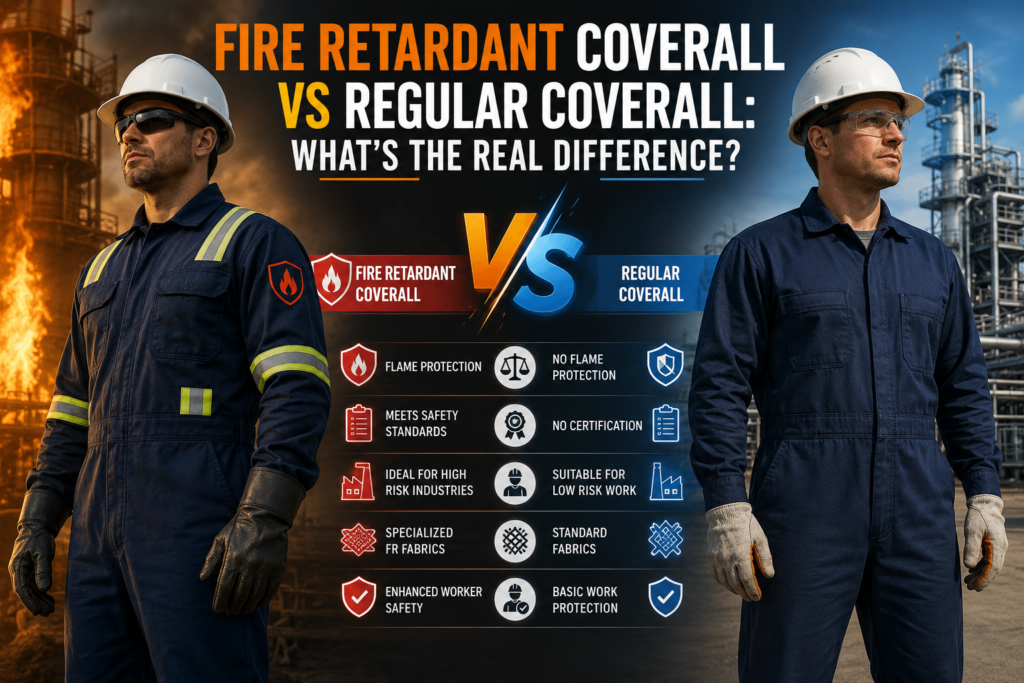
A fire retardant coverall is treated or woven using materials that resist catching fire and that self-extinguish when the flame is removed. A normal coverall, whether it is made of 100% untreated cotton or a cotton-polymer mixture, will catch fire and keep on burning, and in the case of synthetic blends it can melt onto the skin. It is the fabric that makes the difference. All the other factors, such as price and weight and comfort, are determined by this one property.
What Actually Makes a Coverall “Fire Retardant”?
A garment can obtain the FR label in two different ways. The first involves carrying out a chemical treatment on the fabric, generally cotton, which stops the combustion process at the fiber level. This is the cheaper method and the one most large-scale industrial buyers go for. The second method makes use of a naturally flame resistant fiber, for example, Nomex or a modacrylic blend, since the flame resistance is built into the polymer structure and does not wear off over time.
Both methods result in a fire retardant coverall; the difference between them becomes apparent later in terms of how long the protection lasts when the garments undergo repeated industrial washing, which we look at further down.
A regular coverall skips both processes entirely. It is made from whatever fabric is cheapest and most durable for the job: cotton drill, poly-cotton, or sometimes pure polyester. None of these fabrics are treated for flame resistance, and polyester in particular is dangerous in a fire scenario because it melts and adheres to skin rather than simply burning.
Fire Retardant Coverall vs. Regular Coverall: Side-by-Side Comparison
| Factor | Fire Retardant Coverall | Regular Coverall |
| Fabric response to flame | Self-extinguishes, chars instead of burning | Continues burning or melts (if synthetic) |
| Typical fabric | Treated cotton, Nomex, and modacrylic blend | Cotton, poly-cotton, polyester |
| Certification | NFPA 2112, ISO 11612, EN ISO 11612 depending on market | None required or available |
| Cost per unit (bulk) | Higher, roughly 40-70% more than a comparable regular coverall | Lower |
| Lifespan of protection | 12-18 months (treated), 2-3 years (inherent), depends on wash cycles | Not applicable, no protective property to degrade |
| Where it’s legally required | Oil and gas, petrochemical, electrical utility, welding | General factory floors, warehousing, non-hazard admin roles |
| Re-certification needed | Yes, treated fabric loses effectiveness with washing. | No |
When a Regular Coverall Is Actually Fine
Although most suppliers of flame-resistant (FR) materials will not admit this, it is an important consideration when making an honest decision. A regular coverall is a suitable option for warehouse workers who never enter a hot work area, for people in factory positions next to offices, or for short-term contractors who are carrying out paperwork along the site perimeter and never go into an area where there is a risk of flash fire. It would be a waste of money to buy flame-resistant clothing for every employee on a big industrial site regardless of their job, since the funds could instead be used to improve flame-resistant protection for those workers who actually need it.
The aspect to keep an eye on is exposure, not job title. If a procurement clerk happens to go round the plant floor during a shutdown, then they need to have FR on those days; if they never leave the administrative building, then they don’t.
Why the Fabric Difference Matters More Than It Sounds
Cotton will catch fire at about 400°C and will continue to burn as long as both fuel and oxygen are present. In contrast, a fire retardant coverall, when it has caught fire, will extinguish itself within a few seconds since the treated fibers char instead of keeping on burning. That difference of seconds rather than ongoing combustion is all the safety margin in the case of a flash fire. The standard set out by NFPA 2112 is the one most oil and gas operators require, and it measures precisely this self-extinguishing property together with char length and afterflame time.
There is another risk associated with polyester and poly-cotton blends apart from the fact that they catch fire. These materials melt when heated and the melted substance can stick directly to the skin, leading to burns which are more difficult to treat than ordinary flame burns. That is the reason why OSHA’s general industry guidance on personal protective equipment considers synthetic fabrics to be unsuitable in the presence of any flame or arc flash hazard, regardless of whether the garment is labelled FR.
Certification Standards Worth Checking Before You Buy
A coverall that a seller labels as “flame resistant” has not necessarily been tested in accordance with a recognized standard. Instead, request the specific certification rather than just the marketing term.
- NFPA 2112: US standard, tests self-extinguishing behaviour, char length, and heat transfer for flash fire protection.
- ISO 11612 / EN ISO 11612: the international and European standard for clothing designed to provide protection against heat and flame, being widely required in procurement contracts in the Gulf and in Europe.
- ASTM F1506 is frequently used in connection with arc flash risk assessments when working in the electrical utility industry.
A supplier who does not produce a test certificate for the particular fabric batch in question, not just the general company certification, is not in fact selling fire retardant coveralls that have been verified. This is one of the most frequent mistakes that buyers make when placing a rush order for large quantities.
Cost and Lifespan: The Real Math Buyers Skip
A regular coverall generally costs 40 to 70% less per unit than an equivalent one that has been treated to be flame resistant. The difference in cost appears greater when placing an order than it does over the course of the garment’s use, since the chemically treated fabric deteriorates as a result of washing. Most treated cotton flame-resistant coveralls retain their protective properties for between 50 and 100 industrial washes, which is about 12 to 18 months of daily use, after which the fabric must be retested or replaced even if it still looks in good condition.
Although fabrics that have inherent flame resistance, such as Nomex, have a higher initial cost, they do not lose their protective properties when washed, which is the reason why large oil and gas contractors with rigorous laundering procedures usually choose inherent FR even though this means paying more at the start. When a procurement team is deciding between the two options they should find out from their supplier how many wash cycles a treated garment is rated for, not just look at the sticker price.
Buying Checklist for Procurement Teams
- Understand the risks involved in each job role before deciding whether FR clothing is needed or regular coveralls are sufficient.
- Ask for a test certificate for the actual fabric used in the garment instead of relying only on a general compliance document from the supplier.
- Find out whether the FR protection comes from a chemical treatment or is built into the fabric itself. Also, ask the supplier to provide the expected wash-cycle life in writing.
- Make sure the coverall certification matches the requirement for your site or contract. Standards like NFPA 2112 and ISO 11612 are not accepted as replacements for each other in every location.
- Make sure the available sizes are suitable for everyone on your team. An FR coverall that does not fit properly can leave gaps around areas like the wrists or ankles, which can reduce the protection it provides.
- Keep future replacement and re-certification costs in your budget plan instead of treating them as unexpected expenses later.
- Ask for a sample batch before a bulk order; fabric weight and hand-feel vary more than spec sheets suggest
Common Mistakes Buyers Make
A common error is to order a mixed batch by giving the frontline staff who are visible the full rating (FR) and the support staff the regular rating, without first determining the actual exposure zones. A support worker who from time to time goes into a hot work area during a shutdown is not covered because the FR list has not been updated since they were originally hired.
Another company treats ‘flame resistant’ as if it were a permanent label rather than as a property of the fabric that diminishes over time. Firms which do not record the number of washes often continue to issue the same treated FR coveralls for three or four years, long beyond the point at which the chemical treatment has been washed out, even though the garments still pass a visual inspection.
Another mistake is making a purchase on the basis of price only and failing to check the certificate. Some of the coveralls available on bulk marketplaces have names that sound FR but do not actually have a test certificate behind them.
Industries Where Regular Coveralls Are Not an Option
In most jurisdictions, certified flame-resistant (FR) protection is required as a minimum standard rather than as an optional upgrade for activities such as the extraction and refining of oil and gas, petrochemical processing, the maintenance of electrical utility systems where there is a risk of arc flash, and welding operations in the manufacturing sector. Likewise, construction sites involving hot work, teams carrying out pipeline maintenance, and mining operations in areas with combustible dust also come under this category.
Maintenance Tips to Extend FR Coverall Life
The FR coveralls that have been treated should be washed using only a mild detergent. The use of bleach and fabric softener both causes the chemical treatment to be stripped away more quickly than normal use would. It is advisable to avoid high-heat tumble drying as heat speeds up the breakdown of the flame retardant coating. You should regularly check the seams and cuffs for signs of wear because if a seam is torn there will be an exposed gap, which nullifies the purpose of the garment no matter what the fabric rating is. If you are washing the garments yourself, keep a record of the number of washes each one has had and either retire or re-test them when they reach the cycle limit recommended by the manufacturer rather than waiting until visible damage occurs.
Conclusion
A fire retardant coverall and a regular coverall may look almost the same when placed side by side, but the difference is in the fabric and the protection it provides. That material can decide how a worker is protected when exposed to a spark, flame, or heat event. For teams working around flash fire, welding sparks, or arc flash hazards, the higher cost of certified FR clothing is not just an added expense it is what provides the protection the garment is designed to deliver.
Armstrong Products has manufactured industrial workwear since 2009, with production out of our Boisar, Maharashtra facility and corporate operations based in Powai, Mumbai. If your team needs help mapping the right FR coverall to your specific hazard exposure, our product specialists can walk through your site requirements and contact-us.
FAQs
What is the main difference between a fire retardant coverall and a regular coverall?
The material: a fire retardant coverall is either chemically treated or made from a fibre that is inherently flame resistant, so it will self-extinguish when it comes into contact with a flame. A normal coverall does not have this property and will keep on burning or will melt if it is a synthetic blend.
Can a regular coverall catch fire and keep burning?
Cotton and cotton-polyester mixes will catch fire and continue to burn so long as both fuel and oxygen are available; there is also the additional risk with polyester blends of them melting onto the skin when exposed to high temperatures. This does not happen in a fire-retardant coverall that is properly certified.
How long does the fire retardant treatment last on a coverall?
Chemically treated cotton generally maintains its rating for between 50 and 100 industrial washings, which is about 12 to 18 months if the cotton is used every day. Fabrics that have inherent flame resistance such as Nomex keep their protective property for the entire lifetime of the garment since this resistance is part of the fiber itself.
Is a fire retardant coverall required by law in oil and gas jobs?
The requirements will vary according to the jurisdiction and the particular hazard assessment for the position, but in almost all cases sites involved in the extraction of oil and gas, refining and petrochemical processing require personnel who enter a zone where there is a risk of flash fire to have certified flame-resistant coveralls, the standards concerned being NFPA 2112 or ISO 11612.
Does a fire retardant coverall cost significantly more than a regular one?
Bulk pricing for FR is usually 40 to 70 per cent higher than that for a similar regular coverall, but this difference decreases when liability exposure and insurance requirements at sites where FR is required are taken into account.
Are all “flame resistant” labelled coveralls actually certified?
It isn’t always the case that the term is used with precision, since some suppliers apply it loosely and do not have a test certificate specific to the fabric. Before placing a large order, buyers should ask for the real NFPA 2112, ISO 11612, or equivalent certification document relating to the particular fabric batch.
What happens if a worker wears a regular coverall in an area requiring FR?
In addition to posing a direct risk of injury in the event of a flash fire, such a situation usually amounts to a breach of compliance that can have an impact on the site’s insurance rating and the results of its safety audits, and in the case of contracted environments may violate the vendor qualification terms agreed with the operator.
Can a fire retardant coverall be washed at home?
Yes, but only with certain limitations: use a mild detergent, avoid bleach and fabric softener, and do not use high-heat drying, since all three of these speed up the degradation of the chemical FR treatment compared to normal industrial laundering.
Is Nomex better than treated cotton for a fire retardant coverall?
Nomex and other inherent FR fabrics don’t lose their protective rating through washing, making them a better long-term choice for sites with heavy laundering schedules. Treated cotton is more affordable upfront and works well for sites with moderate exposure and manageable wash-cycle tracking.
How do I know which coverall my industry actually requires?
There is no single FR coverall that fits every industry. Check your site’s hazard assessment first and identify which standard applies. NFPA 2112 is generally linked to flash fire protection in the US, while ISO 11612 is widely used for international requirements. Before you finalize a purchase, verify the requirement with your safety officer or the relevant vendor documentation.