
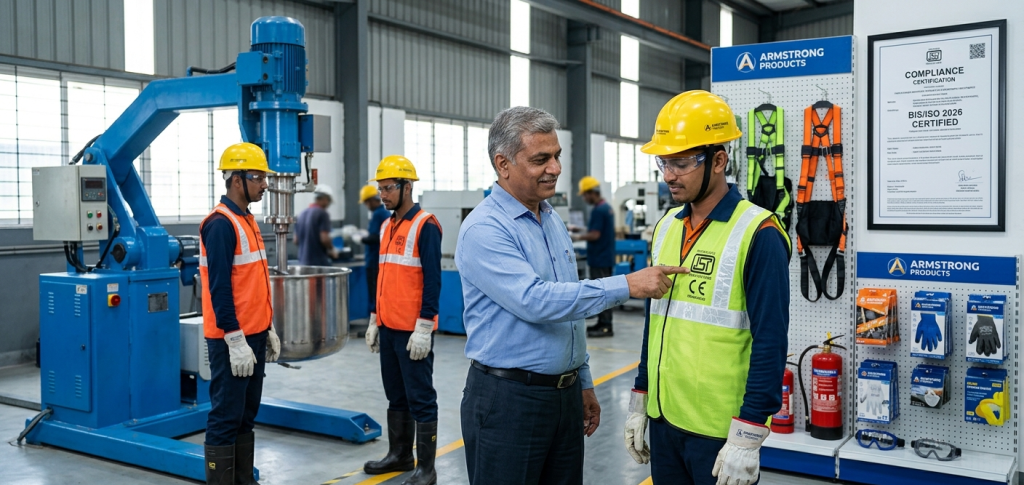
The role of a dedicated Industrial Safety Supplier has evolved from being a mere vendor to becoming a strategic partner in corporate risk management. In today’s high-stakes regulatory environment, an Industrial Safety Supplier is a specialized entity that provides certified tools, gear, and expertise to ensure a workplace meets stringent legal and operational safety standards. With India’s 2026 safety regulations including the latest BIS (Bureau of Indian Standards) updates and international ISO 45001 alignments staying compliant is no longer just about “following the rules”; it is the only way to safeguard your workforce and your bottom line.
Why does compliance matter more than ever today?
Compliance ensures that every piece of gear from a simple helmet to complex fall-protection systems actually performs under pressure. It prevents catastrophic legal liabilities, reduces insurance premiums, and, most importantly, saves lives by ensuring industrial safety equipment meets verified performance benchmarks.
How Does Compliant Industrial Safety Equipment Protect Your Business?
When you invest in industrial safety equipment, you aren’t just buying physical goods; you are buying an insurance policy for your daily operations. In 2026, the Indian manufacturing and construction sectors have seen a massive crackdown on substandard gear. Using non-certified industrial safety equipment can lead to immediate site closures and heavy financial penalties that far outweigh the initial “savings” of cheaper alternatives.
Compliance means the equipment has undergone rigorous testing for durability, chemical resistance, and impact absorption. For instance, a compliant safety equipment supplier ensures that every helmet or pair of safety shoes carries the necessary ISI or CE marking, proving it can withstand the specific hazards of your industry. This level of quality control is what separates a professional workspace from a high-risk liability zone where industrial safety equipment is treated as an afterthought.
Is compliance just a legal hurdle or a strategic advantage?
It is both. While the legal necessity is clear, the strategic advantage lies in workforce stability. Workers who feel safe in their industrial clothing supply knowing their gear is top-tier and compliant—are more focused and efficient. High-quality, compliant industrial safety equipment lasts longer, meaning a lower “Total Cost of Ownership” (TCO) for your business over time.
Why Is Choosing the Right Safety Equipment Supplier Critical for 2026?
The market is flooded with options, but not every safety equipment supplier operates with the same level of integrity. Choosing a partner like Armstrong Products means you are sourcing from a team that understands the 2026 regulatory landscape. A reliable safety equipment supplier doesn’t just sell you a product; they provide the “Conformity Assessment” documentation you need for your annual safety audits.
In the current year, supply chain transparency has become a top priority for Indian industries. When looking for an industrial safety equipment partner, you need a provider who can offer:
- Traceability: Knowing exactly where the raw materials for your industrial safety equipment came from.
- Certification: Real-time access to test reports for all workplace safety products.
- Expertise: Guidance on which specific standards apply to your specific niche.
What Are the Hidden Risks of Non-Compliant Workplace Safety Products?
Many procurement managers make the mistake of looking at the price tag rather than the certification. However, non-compliant workplace safety products carry “invisible” costs that can cripple a business.
- Legal Penalties: Under the latest industrial laws, directors can face personal liability for providing substandard industrial safety equipment that leads to accidents.
- Insurance Rejection: If an accident occurs and the investigation reveals that the workplace safety products used were non-compliant, insurance providers often reject the claim.
- Reputational Damage: A single safety failure can destroy a brand’s reputation, making it impossible to attract global investors who demand high-quality industrial safety equipment standards.
By sourcing your industrial clothing supply from a reputable manufacturer, you mitigate these risks. Compliant clothing is designed to be flame-retardant and ergonomic, ensuring that your workplace safety products actually serve their intended purpose.
How Does Industrial Clothing Supply Impact Worker Morale?
We often think of industrial safety equipment as hard hats and boots, but the industrial clothing supply is the layer that workers wear for 8–12 hours a day. In 2026, the trend has shifted toward “Performance Compliance.” This means your industrial clothing supply must not only be safe but also breathable and comfortable.
A worker struggling with a poorly fitted, non-compliant vest is a distracted worker. When you provide high-quality workplace safety products, you send a clear message to your team: “Your life is our priority.” This builds a culture where employees are more likely to use their industrial safety equipment correctly.
What Should You Look for in Industrial Safety Equipment Today?
To stay ahead of the curve, your procurement strategy for industrial safety equipment should focus on these four pillars:
1. Authentic Certification Marks
Ensure every piece of industrial safety equipment has a verifiable mark (BIS, ISO, or CE). In 2026, digital QR codes are becoming the standard for verifying workplace safety products.
2. Industry-Specific Suitability
A safety equipment supplier should offer tailored solutions. The gear required for a chemical plant is vastly different from that of a high-rise construction site. One size does not fit all in the world of industrial safety equipment.
3. Ergonomics and Fit
New regulations emphasize the “Proper Fit” rule. If your industrial clothing supply doesn’t fit the worker correctly, it isn’t compliant.
The Financial Reality: Compliant vs. Non-Compliant
| Feature | Compliant Industrial Safety Equipment | Substandard Gear |
| Initial Cost | Moderate | Low |
| Lifespan | Long (High Durability) | Short (Frequent Replacement) |
| Legal Risk | Zero / Minimal | High (Fines & Jail) |
| Worker Safety | Verified Protection | Unpredictable |
How Armstrong Products Leads as a Premier Industrial Safety Supplier
At Armstrong Products, we don’t just supply gear; we build safety ecosystems. As a leading safety equipment supplier, we have spent years perfecting our manufacturing processes to meet global benchmarks. Whether you are looking for advanced workplace safety products or a steady industrial clothing supply, our catalog is designed for the modern enterprise.
We understand that industrial safety equipment is the last line of defense. That is why our products undergo “torture testing” to ensure they perform exactly when needed.
Conclusion:
In 2026, the margin for error has vanished. By prioritizing compliance in your industrial safety equipment procurement, you are choosing to protect your people and your profits. Don’t leave your safety to chance. Partner with an experienced safety equipment supplier who understands the nuances of workplace safety products and industrial clothing supply.
FAQs
Why is BIS certification important for industrial safety equipment?
BIS certification ensures that the industrial safety equipment has been tested by the Bureau of Indian Standards and meets mandatory safety requirements.
How often should we audit our workplace safety products?
We recommend a formal audit of all workplace safety products every six months to ensure they still meet compliance standards.
Can a safety equipment supplier help with compliance training?
Yes, a professional safety equipment supplier like Armstrong Products offers training on how to use and maintain gear.
What items are included in an industrial clothing supply?
A standard industrial clothing supply includes high-visibility jackets, flame-resistant coveralls, and specialized gloves.
Does using compliant industrial safety equipment lower insurance costs?
Yes, companies using certified industrial safety equipment often receive lower premiums due to reduced workplace risk.
What is the most important factor when choosing an Industrial Safety Supplier?
The most important factor is their ability to provide certified, high-quality industrial safety equipment that meets current 2026 regulations.