A contracting company in Abu Dhabi ordered 4,000 coveralls from an Indian supplier last year. The first batch looked fine. The second batch, shipped eleven weeks later, came in a slightly different shade of orange, and the flame resistance test report attached to it covered a fabric the factory had stopped buying two months earlier. The site HSE manager rejected the lot. The project lost six weeks.
Nothing about that story is unusual. It happens because buyers check the price and the product photo and skip the two things that actually decide whether the order works out: who really makes the garment and which fabric lot went into it.
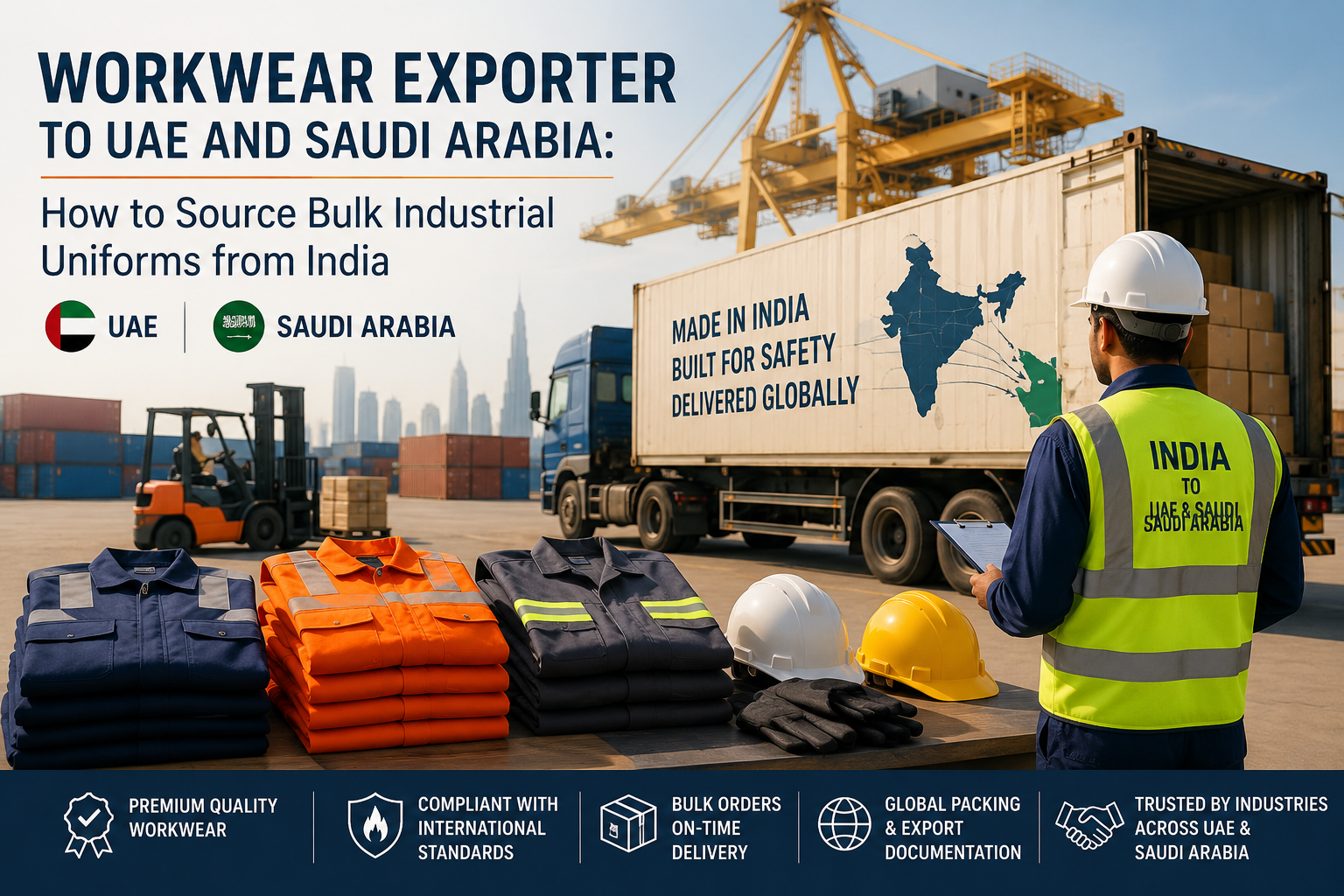
This guide is for procurement teams, safety managers, distributors, and importers who plan to buy workwear from India for sites in the UAE and Saudi Arabia. It covers the certifications Gulf sites ask for, how to tell a real factory from a trading desk, what an IFR coverall is and when you need one, and the documents your customs broker will want before the container lands.
Why Gulf buyers now buy workwear from India
Sourcing patterns in the region have shifted over the past decade. A few practical reasons sit behind it.
- Fabric access:
India has its own spinning, weaving, and finishing mills, including mills that produce inherently flame-resistant blends. A manufacturer here can control fabric sourcing instead of importing greige goods and waiting on a third country. - Shipping distance:
From West Coast Indian ports, transit to Jebel Ali runs roughly five to eight days, and to Dammam or Jubail around eight to twelve. Compare that with East Asian origins, and the difference in replenishment cycles is significant. - Documentation in English:
Test reports, technical data sheets, packing lists, and conformity paperwork come through in a language your compliance officer can read without a translator. - Custom and OEM work:
Indian factories are set up for branded, private label, and site-specific uniform programs, not just catalog stock.
None of that guarantees a good supplier. It only means the supply base exists. The rest of this guide is about filtering it.
What Gulf sites actually require from a workwear supplier
Requirements split into two layers. There is what the country requires to let the goods in and what the site requires to let the worker on the floor. Both need to be satisfied, and they are not the same list.
UAE requirements
Personal protective equipment entering the UAE falls under the conformity system administered by the Ministry of Industry and Advanced Technology, which absorbed the work of ESMA. PPE is a regulated category, so the goods normally need a certificate of conformity issued against the applicable scheme before customs clearance. Many buyers also ask for the Emirates Quality Mark on repeat supply contracts.
On top of that, individual operators run their own vendor approval processes. Oil and gas clients frequently maintain approved supplier registers and will ask for factory details, test reports, and sometimes an audit before adding a new source.
Saudi requirements: SASO and SABER
Saudi Arabia runs its conformity process through SABER, the online platform operated under SASO. Two things happen there. The product gets a Product Certificate of Conformity, and each individual shipment gets a Shipment Certificate of Conformity. Without the second one, the container sits.
Your supplier cannot complete this alone, and neither can you. The importer of record holds the SABER account, while the manufacturer supplies the technical file, test reports, and product details that the conformity body reviews. Agree early on who does what. This is one of the most common causes of delay on first shipments into the Kingdom.
Standards you will see on the spec sheet
| Standard | What it covers | Where it matters |
| EN ISO 11612 | Protection against heat and flame | General FR coveralls across oil, gas and process industries |
| EN ISO 11611 | Protection during welding and allied processes | Fabrication yards, welding bays |
| EN 1149-5 | Electrostatic dissipative properties | Flammable atmospheres, refineries, tank farms |
| EN ISO 20471 | High-visibility clothing | Roadworks, ports, plant traffic areas |
| NFPA 2112 | Flame-resistant garments for industrial personnel | Sites following US practice, common with American operators |
| ASTM F1506 | Arc-rated textiles for electrical workers | Substations, electrical maintenance |
A garment can carry more than one of these. A refinery coverall commonly needs EN ISO 11612 and EN 1149-5 together, with reflective tape added for visibility. Ask your supplier which standards the certificate actually covers, because a certificate for the fabric is not the same as a certificate for the finished garment.
Choosing the right coverall for the job
Fabric selection decides most of what happens later: comfort, lifespan, wash performance and whether the garment still protects anyone in year three.
IFR coveralls and why inherent beats treated
An IFR coverall is made from fabric where the flame resistance is built into the fibre itself. Aramid blends and modacrylic blends are the common examples. The protection is part of the material, so it does not wash out.
A treated FR coverall starts as ordinary cotton or a cotton blend and gets a chemical finish applied to make it flame-resistant. It works, and it costs less to make. The catch is that the finish degrades. Industrial laundering, hard water, incorrect detergents, and bleach all speed that up.
| IFR coverall | Treated FR coverall | |
| Source of protection | Built into the fibre | Chemical finish applied to fabric |
| Effect of washing | Protection stays through garment life | The finish degrades over repeated washes |
| Typical service life | Longer, usually measured in years of daily use | A shorter replacement cycle comes sooner |
| Comfort | Lighter blends available, generally better breathability | Heavier hand feel in most weights |
| Best suited to | Refineries, offshore, high-exposure roles, hot laundry cycles | Lower-risk areas, occasional wear, controlled laundering |
For Gulf oil and gas work, most safety managers land on inherent fabric. The garment costs more at the start and less across its life, and it does not create a situation where a coverall looks fine but no longer performs.
Fabric weight and Gulf heat
Weight is where a lot of specifications go wrong. A heavy coverall that meets every standard on paper is useless if the crew unzips it to the waist by ten in the morning.
Outdoor summer work in the region generally sits well with lighter FR fabrics in the 190 to 220 GSM range, provided the fabric still meets the required standard at that weight. Indoor and workshop use can carry more. Welding work needs heavier construction because of spatter, regardless of comfort.
Ask for the actual GSM on the technical data sheet, not a description like “lightweight.”
High visibility, antistatic and arc protection
These are add-ons layered onto the base garment.
Reflective tape needs to be FR compatible, or it becomes the weak point in an otherwise compliant coverall. Ordinary retroreflective tape will melt. Specify FR-rated tape and confirm the placement pattern matches EN ISO 20471 for the visibility class you need.
Antistatic performance under EN 1149-5 usually comes from a conductive fiber grid woven into the fabric. It is not something added later.
Arc protection is measured as an ATPV value in calories per square centimeter. If your electrical team works to a specific incident energy level, the coveralls have to match it. Ask for the arc test report with the number on it.
How to check whether an Indian manufacturer is real
This section matters more than any other in the guide.
Factory or trading desk
A large share of “manufacturers” listed on export directories are trading companies. They take your order, place it with a workshop, and pass it back. Nothing about that is illegal. It does mean nobody owns the quality problem when one appears, and it means fabric lots change without anyone telling you.
Ways to tell the difference:
- Ask for a live video walk of the production floor, not an edited video. Ask them to walk from the fabric store through cutting through the stitching lines to packing in one continuous shot.
- Ask how many stitching machines are on the floor and how many lines run at once. A real production manager answers immediately.
- Ask for the factory address and check it against the address on their test reports and certificates. Mismatches are common and revealing.
- Ask who does the cutting. Outsourced cutting usually means outsourced everything.
- Ask for photographs of the fabric store with rolls and lot tags visible.
The audit checklist
Whether you send a third-party auditor or run a remote review, work through this list.
Legal and structural
- Company registration and factory license
- Ownership of the premises or a lease in the company name
- Export license and IEC code
Production capability
- Machine list by type and count
- Monthly capacity in garments, stated by product type
- In-house cutting, stitching, embroidery, printing and packing
- Sample room and pattern-making capability
Quality systems
- ISO 9001 certificate, valid and verifiable
- Documented inline inspection process
- Final random inspection procedure and AQL level used
- Metal detection and needle control policy
- Fabric inspection at goods-in, ideally the four-point system
Compliance and certification
- Test reports for the exact fabric you are buying
- CE technical file for the garment category
- SEDEX or SMETA social audit report if your organisation requires it
- Chemical management and restricted substances policy
Traceability
- Fabric lot numbers recorded against production batches
- Mill name and mill certificate for the fabric
- Ability to trace a finished garment back to its fabric roll
Test reports and certificates
Three checks catch most problems.
First, match the fabric described in the test report against the fabric on your purchase order. Composition, weight, and construction should all agree.
Second, check the issuing laboratory. A report from a recognized testing house carries a report number you can verify with the lab directly. Ask for the number, then verify it yourself rather than accepting a PDF.
Third, check dates. Certificates expire. A five-year-old report on a fabric that has been reformulated since is not evidence of anything.
What a good pre-production process looks like
Bulk orders go wrong between sample approval and cutting. A supplier who runs this properly will propose the steps before you ask.
Sample approval comes first, on the actual fabric, not a lookalike. Then a size set, one garment in each size, is checked against your measurement chart with tolerances agreed in writing. Fabric lot approval follows, where you approve the specific roll batch for the production run. A pre-production meeting locks the specification. Inline inspection happens while the line is running, which is when problems are still fixable. Final random inspection closes the order.
Skip the size set and you will find out about the fit problem when 4,000 garments are already sewn.
Shipping, documentation and delivery to UAE and Saudi Arabia
Documents your customs broker will ask for
- Commercial invoice
- Packing list with carton-level detail
- Bill of lading or airway bill
- Certificate of origin
- Conformity certificate for the destination market
- Test reports and technical data sheets
- Insurance certificate where applicable
For Saudi shipments, add the SABER shipment certificate. For UAE shipments, add the conformity certificate issued under the applicable PPE scheme.
Ask your supplier to send draft documents for review before the container is loaded. Correcting an invoice while goods sit at the port is expensive and slow.
Ports, transit and packing
Most workwear leaves India through Nhava Sheva or Mundra. Air freight moves through Mumbai or Delhi when a site needs stock immediately.
Packing standards matter more than buyers expect. Coveralls should be individually polybagged, folded to a consistent method, and packed in cartons with size and quantity marked clearly on two faces. Mixed-size cartons without external marking mean your storekeeper opens every box. Specify carton marking in the purchase order, including your own reference numbers if your warehouse scans them.
Incoterms should be agreed in writing at the start. FOB, CFR, and CIF each place the transfer of risk at a different point and each change who arranges insurance. Whichever you choose, make sure the same term appears on the invoice, the contract, and the insurance certificate.
Common mistakes Gulf buyers make when they buy workwear from India
Approving a sample without approving the fabric lot:
This is the single most damaging mistake in the list. The sample gets made from whatever good fabric is in the sample room. Production runs on a different lot, sometimes from a different mill. Shade, weight, and occasionally the flame resistance rating vary. Fixing this costs nothing. Write fabric lot approval into your purchase order and ask for a cutting from the approved roll to be sent with the pre-production sample.
Treating a fabric certificate as a garment certificate:
A mill certificate covers cloth. It says nothing about the thread, the zip, the reflective tape, or whether the garment was constructed to the standard. Those components have to be FR compatible too. Ask for the certification that covers the finished garment.
Ordering before the size set is signed off:
Fit complaints are the most common reason a workforce stops wearing PPE properly.
Assuming the supplier handles SABER:
They supply the file. The importer holds the account.
Leaving carton marking unspecified:
Small oversight, large warehouse cost.
Buying treated FR for a site with industrial laundering:
The garments will still look serviceable long after they have stopped performing, which is the worst possible failure mode for protective clothing.
How Armstrong Products handles Gulf workwear orders
Armstrong Products has manufactured industrial safety wear since 2009. Production runs from the company’s own facility at Boisar, Maharashtra, with the corporate office in Powai, Mumbai.
Work for Gulf clients typically covers FR and IFR coveralls, high-visibility garments, ESD and antistatic clothing, and site-specific uniform programs produced under the client’s own branding. Cutting, stitching, and finishing happen in-house, which keeps fabric lot traceability intact from the goods-in stage through to packing.
For buyers running a first order into the UAE or Saudi Arabia, the technical team supplies fabric specifications, mill details, and test documentation up front, so your compliance officer and conformity body have what they need before production starts rather than after the container is booked.
Order sizes range from single-site uniform programs to multi-thousand-piece contracts with staged deliveries.
Conclusion
If you take one working rule from this guide, take this one: verify the factory and the fabric lot before you verify anything else.
Price comparisons, catalog photos, and glossy certificates all sit downstream of those two facts. A supplier who owns their production floor and can trace a finished coverall back to an approved fabric roll will solve most problems before they reach you. A supplier who cannot do either will pass the problem to your site.
Everything else on the checklist, the standards, the conformity certificates, and the packing specification are easier to manage once you know who is actually making your garments. That is the question to answer first when you buy workwear from India for UAE and Saudi Arabian projects.
FAQs
Can I buy workwear from India for UAE and Saudi projects?
Yes. Indian manufactured PPE is widely used across Gulf industrial sites. The goods need to meet the applicable standard and carry conformity documentation for the destination country.
What is an IFR coverall, and why does it cost more than a treated FR coverall?
An IFR coverall uses fabric where flame resistance is part of the fiber itself, usually an aramid or modacrylic blend. A treated coverall gets its protection from a chemical finish applied to ordinary cotton or a cotton blend. The inherent fabric costs more because the fiber itself is more expensive to produce. What you get in return is protection that survives repeated industrial washing. Treated finishes lose effectiveness over time, and the garment gives no visual warning when that happens. Over a multi-year uniform cycle, sites with heavy laundering usually find the inherent option works out better.
Which certifications should a workwear exporter to the UAE and Saudi Arabia hold?
Look for ISO 9001 for the quality system, product test reports against the relevant EN ISO or NFPA standard, and a CE technical file for the garment category. Add a social compliance audit report if your organization requires one.
What is SABER, and do I need it for PPE shipments to Saudi Arabia?
SABER is the Saudi online conformity platform. PPE shipments need a product certificate and a shipment certificate issued through it. The importer holds the account, and the manufacturer provides the technical documentation.
How do I confirm an Indian supplier owns its factory?
Ask for a live, unedited video walk from the fabric store through to packing. Check the factory address against the address printed on the test reports and certificates. Ask for the machine count and the monthly capacity by product type. Request photographs of the fabric store with lot tags visible. A trading company will hesitate on at least two of these, and the hesitation itself tells you what you need to know.
How long does a bulk coverall order take to produce?
For a first order with custom sizing and branding, plan on six to ten weeks from approved sample to shipment readiness, depending on quantity and fabric availability. Repeat orders on approved specifications move faster.
Do FR coveralls lose protection after repeated washing?
Treated FR garments do. The chemical finish breaks down with laundering, and hard water, bleach, and fabric softener all accelerate it. Inherently flame-resistant fabric behaves differently because the protection is in the fiber, so it holds through the working life of the garment. If your site uses an industrial laundry, ask the supplier for wash durability test data, ideally after fifty cycles.
Can Indian manufacturers produce private label workwear with our branding?
Yes. Private label and OEM production are standard practice, covering woven labels, embroidery, screen printing, and custom packaging.
What fabric weight works best for outdoor work in Gulf summer conditions?
Lighter FR fabrics in roughly the 190 to 220 GSM range tend to work well outdoors, as long as the fabric still meets the required standard at that weight. Welding and heavy fabrication work need heavier construction.