
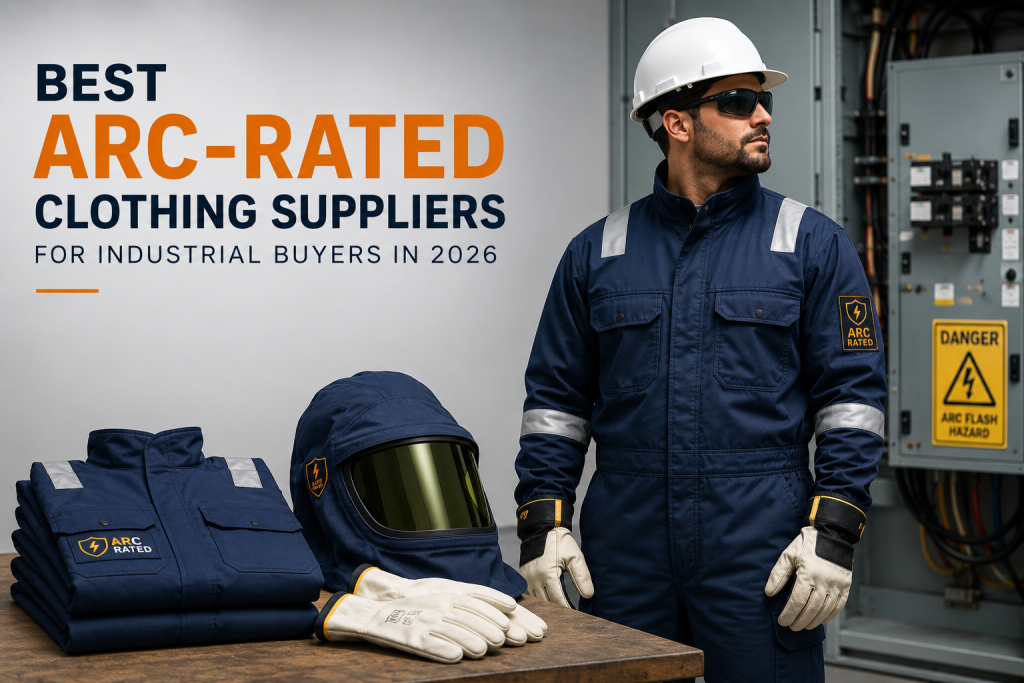
An electrician opens a breaker panel wearing a shirt labeled “flame resistant.” The label is accurate. It does not say the shirt has never been arc tested, and the task in front of him carries a real arc flash risk that calls for genuine arc flash clothing, not a general FR shirt. This gap, between clothing that resists flame and clothing that is actually rated to survive an electrical arc, is where a lot of procurement decisions go wrong, and it is exactly the gap a good supplier should close before the order ever ships.
Choosing arc rated clothing is not the same exercise as choosing general workwear. The fabric, the testing, the documentation, and the supplier’s own manufacturing discipline all affect whether a worker standing three feet from an arc flash walks away or does not. This guide breaks down what arc rated clothing means, how NFPA 70E and IEC 61482 define protection levels, and what separates the best arc-rated clothing suppliers from a catalog full of cal ratings and stock photos. For the broader fundamentals of FR clothing selection, our Flame Resistant Clothing Buyer’s Guide covers the ground this piece builds on.
What Is Arc-Rated Clothing?
Arc rated clothing is protective apparel tested and labeled with an Arc Thermal Performance Value (ATPV) or Energy Break-open Threshold (EBT), the maximum thermal energy a fabric can absorb before it causes a second-degree burn or breaks open. Every arc rated clothing item is flame resistant, since arc testing requires the fabric to pass flame resistance first. Not every flame resistant garment is arc rated, since flame resistance alone does not include the specific electrical arc exposure test. The broader category of arc flash clothing covers everything from a single arc rated shirt to a full multi-layer suit, and the right choice depends entirely on the incident energy the wearer could face.
Quick answer: Arc rated clothing is FR clothing that has been tested against an electric arc and carries a documented ATPV or EBT rating in cal/cm². If a garment’s label only says “flame resistant” with no cal/cm² figure, it has not been arc tested and should not be worn for electrical work.
Arc Rated Clothing vs. FR Clothing vs. Arc Flash Suit
These three terms get used interchangeably on product pages, and that habit causes real ordering mistakes.
| FR clothing | Resists ignition and self-extinguishes | Flash fire, welding, general hot work |
| Arc rated clothing | FR clothing tested against electric arc exposure, carries an ATPV/EBT rating | Electrical work near energized equipment |
| Arc flash suit | A full protective ensemble, jacket, bib or coverall, and hood, rated for a specific incident energy level | High-risk electrical tasks in PPE Category 3 or 4 |
Why Arc Rated Clothing and FR Clothing Are Not Interchangeable
A garment can be genuinely flame resistant and still offer no meaningful protection against an arc flash, because flame resistance testing and arc testing measure different things. FR testing checks whether a fabric ignites and keeps burning. Arc testing measures how much thermal energy a fabric transmits to the skin during a specific electrical arc exposure, a distinct hazard with its own heat profile, pressure wave, and molten metal spatter. This is why a procurement spec that simply says “FR clothing” for an electrical task is incomplete. It needs to specify the arc rating in cal/cm² as well. Fabric choice matters as well. If your team is deciding between inherent and treated FR fabric for the same order, our IFR Coveralls vs. FR Coveralls guide explains how each option holds up over repeated washing and how it affects comfort.
What Documentation Should Come With a Bulk Arc-Rated Clothing Order?
A bulk order should come with a third-party test report for the fabric lot used, a compliance declaration for the batch being shipped, care and maintenance instructions, and any export certificates required by the destination country. For example, shipments to Saudi Arabia may need SASO registration.
If you are ordering a full arc flash suit, review the documents for each item separately. The jacket, bib, and hood should all be covered by the same matching paperwork.
| Category 1 | 4 cal/cm² | Arc rated shirt and pants or coverall |
| Category 2 | 8 cal/cm² | Arc rated shirt and pants, balaclava, face shield |
| Category 3 | 25 cal/cm² | Arc flash suit jacket and pant or coverall, arc rated hood |
| Category 4 | 40 cal/cm² | Full arc flash suit, arc rated hood, higher-rated accessories |
Category 3 and 4 tasks are where a full arc flash suit becomes necessary rather than individual arc rated garments. Below that threshold, an arc rated shirt, pants, or coverall combination is usually sufficient, provided the arc rating meets or exceeds the category’s minimum.
IEC 61482: The Standard International Buyers Need
NFPA 70E is a US standard, and buyers outside the US, including most GCC and European procurement teams, should be sourcing arc rated clothing against IEC 61482 as well. This is a common gap in supplier documentation, since many manufacturers only quote NFPA 70E figures on garment tags and never mention the separate international test their product may or may not have passed.
IEC 61482 uses two separate test methods, and a garment’s rating from one method cannot be mathematically converted into the other:
- Open Arc test (IEC 61482-1-1): Measures ATPV or EBT in cal/cm², the same open-arc principle used in the US ASTM F1959 test.
- Box test (IEC 61482-1-2): This test places the fabric in either Arc Protection Class 1 or Class 2. Class 1 covers exposure to a 4 kA arc, while Class 2 covers a 7 kA arc. It is commonly used for enclosed low-voltage switchgear work across the Gulf and Europe.
Ask any arc-rated clothing supplier which method their garments were tested to, and request the actual test report rather than a summary label. A supplier that cannot produce the underlying report is not one to build a bulk order around.
How to Determine the Arc Rating You Need
Buyers sometimes choose an arc rating based on what seems suitable, much like choosing a clothing size. That is not the right approach.
The first step should be an arc flash risk assessment, usually carried out in line with IEEE 1584. This assessment calculates the incident energy a worker may face while working on a specific piece of equipment.
The required arc rating should come from the calculated incident energy, not from guesswork. For example, if a maintenance electrician is working on a 480V panel with an exposure level of 6 cal/cm², the correct choice would be PPE Category 2 clothing rated at 8 cal/cm² or above. A 40 cal/cm² arc flash suit would not be necessary simply because it appears to offer more protection.
Choosing a rating that is too high can increase cost, weight, and heat stress. Choosing one that is too low leaves the worker underprotected. If the site does not have an up-to-date arc flash study, complete that assessment before placing the clothing order.
Who Needs Arc Rated Clothing
Arc flash risk is not limited to electricians. Anyone who works within the restricted approach boundary of energized equipment rated above the threshold in a site’s arc flash study should be considered. In practice, this usually includes:
- Technicians who maintain and test electrical equipment
- Utility teams working on power distribution systems
- Workers who operate panels and switchgear at oil, gas, and petrochemical facilities
- Industrial maintenance workers who regularly need to open live control panels
- Electrical contractors working inside data centers or manufacturing plants
Facilities that outsource electrical maintenance often assume the contractor’s own PPE covers the exposure, which is not always the case. Confirming that a visiting contractor’s arc flash suit or arc rated clothing actually matches your site’s calculated incident energy is a standard part of a proper contractor safety review, not an optional extra step.
What Separates the Best Arc-Rated Clothing Suppliers
A cal rating printed on a product page tells a buyer very little on its own. The suppliers worth building a long-term relationship with distinguish themselves on a handful of specific points.
Do not rely on the rating alone. Ask whether the ATPV or EBT value was confirmed by an accredited independent laboratory or produced through the supplier’s own testing.
A report from a third-party laboratory accredited to ISO/IEC 17025 gives the result more credibility and makes it clear how the rating was established.
Fabric traceability by batch. A reliable supplier can match a delivered garment back to the fabric lot it was cut from and the test report for that lot. Without this, a buyer has no way to confirm that garment 400 in a shipment of 500 actually matches the certificate on file.
Check whether the supplier can manufacture the type of fabric your project requires. Aramid, modacrylic, and FR cotton blends respond differently during an arc event, and not every factory can produce all three in large quantities.
The supplier should be able to explain which fabric is used in its arc-rated range and why it was chosen, rather than simply giving you a cal rating.
The documents supplied with the shipment should be suitable for both customs clearance and client audits. Products sent to the UAE, Saudi Arabia, or other GCC countries may require test reports, compliance declarations, and sometimes SASO or similar registration. These documents should relate to the exact batch included in the shipment.
Generic certificates used for marketing are not enough. If the documents do not match the products in the shipment, the problem is likely to surface at the port, where delays and clearance issues become the buyer’s responsibility.
Consistency across every component of the arc flash suit. A jacket, bib, and hood sold as a matched set should share the same test documentation. Some suppliers mix components from different production runs without flagging the difference, which leaves gaps in the overall protection story.
A good supplier should be willing to discuss fit and comfort, not just the arc rating. NFPA 70E also makes it clear that arc-rated clothing should fit properly and should not get in the way of the work being done.
If a supplier talks only about the cal rating and ignores how the garment feels and performs during a full shift, the focus is on meeting the specification, not on the worker who has to wear it.
Armstrong Products manufactures under ISO 9001:2015 and is certified to ISO 13688, the general protective clothing standard, with full batch traceability across its FR production. For buyers evaluating any supplier against this list, our In-House FR Testing vs Third-Party Certification guide goes deeper into how to verify a lab’s accreditation before trusting its numbers.
Common Mistakes Buyers Make When Sourcing Arc-Rated Clothing
Ordering by cal number alone. A high cal rating does not compensate for a poor fit, missing documentation, or a fabric class unsuited to the task. Rating is one factor among several.
Assuming FR clothing already covers arc flash risk. A general FR coverall bought for flash fire protection is not automatically arc rated. Check the label for an actual cal/cm² figure before treating it as arc flash clothing.
Skipping the risk assessment. Ordering PPE before running an arc flash study means guessing at the category needed, which usually results in either overspending or under-protecting the crew.
Accepting a summary certificate instead of the full test report. A one-page compliance summary can omit the test method, the lab, and the accreditation body. Ask for the complete report.
Ignoring layering rules. Non-arc-rated synthetic base layers worn underneath an arc rated garment can melt during an arc event and cause additional injury, even when the outer garment performed exactly as rated.
Buying Checklist: Choosing an Arc-Rated Clothing Supplier
- Make sure the stated arc rating comes from a report issued by an accredited third-party laboratory, not just from the product label.
- Ask which testing standard was followed, such as IEC 61482-1-1, IEC 61482-1-2, or ASTM F1959.
- Check that the garments delivered can be traced back to the same batch covered by the test certificate.
- Verify the fabric class matches your task’s hazard profile, beyond the cal number alone
- Confirm every component of a full arc flash suit, jacket, bib, and hood carries matching documentation
- Confirm export documentation matches your import market’s specific requirements
- Run or update an arc flash risk assessment before finalizing the category and rating needed
- Check that base layers and undergarments specified are non-melting and compatible
- Ask how the garment fits, what sizes are available, and whether it has been tested for comfort, not just thermal protection.
- Check the minimum order quantity and expected lead time for bulk orders or custom sizing.
Conclusion
A higher cal rating does not always mean the garment is the better option. Buyers should also look at how the product was tested and whether the fabric, test records, and production batch can be traced back to a reliable manufacturer.
The test method, the laboratory that carried it out, the traceability of the fabric batch, and the supplier’s quality controls all matter. These are what determine whether the garment will perform as its label claims.
Before comparing cal ratings, check the laboratory accreditation, ask for the complete test report, and carry out the required risk assessment. This applies whether you are buying one arc-rated shirt or ordering full arc-flash suits for an entire high-risk crew.
Armstrong Products manufactures FR and protective clothing under ISO 9001:2015 with certified compliance to ISO 13688. Talk to our product team about your arc-rated clothing specification and documentation requirements before your next bulk order.
FAQs
What is the difference between arc rated clothing and FR clothing?
FR clothing resists ignition and self-extinguishes, which protects against flash fire and general hot work hazards. Arc rated clothing is FR clothing that has also passed testing against electric arc exposure and carries a documented ATPV or EBT rating in cal/cm². All arc rated clothing is FR clothing, but not all FR clothing is arc rated, so the label needs a cal/cm² figure before it can be trusted for electrical work.
What is an ATPV rating?
ATPV stands for Arc Thermal Performance Value, the maximum incident energy in cal/cm² a fabric can absorb before there is a 50% probability of a second-degree burn. It is one of two common ratings used to describe arc rated clothing, the other being EBT, the Energy Break-open Threshold. Neither figure is inherently better than the other, and manufacturers report whichever applies to the specific test method their arc flash suit or garment underwent.
Do I need a full arc flash suit or just an arc rated shirt and pants?
This depends on the PPE category determined by an arc flash risk assessment. Category 1 and 2 tasks are usually covered by arc rated shirts, pants, or a coverall. Category 3 and 4 tasks, with incident energy at or above 25 cal/cm², typically require a full arc flash suit with a rated hood.
Is NFPA 70E enough, or do I also need IEC 61482 certification?
NFPA 70E is a US-based standard, and buyers outside the US, particularly in the GCC and Europe, should confirm garments are also tested to IEC 61482. The two standards use different test methods and cannot be directly converted into each other, so a garment tested only to NFPA 70E may lack the documentation an international client or customs authority expects.
How do I verify a supplier’s arc rating claims are accurate?
Request the full third-party test report, not just a summary certificate, and confirm the testing lab holds ISO/IEC 17025 accreditation. Cross-check the report’s fabric lot number against the batch of the garments being shipped to your site, since a certificate for one production run does not guarantee the same performance on a later run of the same arc flash suit design.
What happens if arc rated clothing is worn with the wrong base layers?
Synthetic base layers that are not non-melting can melt onto the skin during an arc event, causing additional burn injury even when the outer arc rated garment performs correctly. NFPA 70E specifically restricts synthetic under-layers for this reason, and the same caution applies to any arc flash clothing worn as part of a layered system rather than a single garment.
How Often Does Arc-Rated Clothing Need to Be Replaced?
Arc-rated clothing should be replaced when there is visible damage, contamination from petroleum products, or fading and wear that could affect performance according to the supplier’s care instructions.
Most manufacturers do not set one fixed replacement date. Instead, they recommend regular inspections because the life of an arc flash suit depends on how often it is worn, the contaminants it is exposed to, and whether it is washed correctly according to the garment label.
Can arc rated clothing also provide flash fire protection?
Arc rated clothing must pass flame resistance testing before it can be arc tested, so a properly rated garment also protects against flash fire hazards as a byproduct of meeting the arc rating requirement. The reverse is not true. A garment built and tested only for flash fire protection, without a documented cal/cm² figure, should not be treated as an arc flash suit substitute.
What Documentation Should Come With a Bulk Arc-Rated Clothing Order?
A bulk order should come with a third-party test report for the fabric lot used, a compliance declaration for the batch being shipped, care and maintenance instructions, and any export certificates required by the destination country. For example, shipments to Saudi Arabia may need SASO registration.
When buying a complete arc flash suit, check the paperwork for every part of the set. The jacket, bib, and hood should all have matching documentation.
Why do some suppliers only list NFPA 70E and not IEC 61482 on their product pages?
Many manufacturers built their product lines around the US market first and have not always invested in the separate IEC 61482 testing required for international sale. This is a reasonable question to ask directly during supplier evaluation rather than assuming both standards are covered, particularly for any arc flash clothing headed to a GCC or European destination.