
A container with flame resistant workwear is delivered to a site in Jebel Ali. When the crew opens the boxes, they find that the sizes are wrong; some of the sleeves fall short by three inches of the wrist, and the coveralls are loose enough to catch on a valve handle. A supervisor now has forty workers gathered at a site, which will not be able to begin until each of the men has a pair of coveralls that fit properly, and the reorder will not arrive for another two to three weeks.
What happens more frequently than procurement teams anticipate is that it isn’t due to poor manufacturing but rather to incorrect sizing. All coverall size charts appear identical in print: rows of chest and waist measurements paired with a letter code. The difference between a coverall that fits and one that doesn’t usually lies in a single action: whether or not the crew was measured before the order was placed. Although a flame resistant workwear size chart seems like a minor item when compared with details such as fabric weight, arc rating, or certification documentation, an ill-fitting garment can turn a certified piece into a liability. Fabric that is too loose close to a potential fire source provides more surface area for flames to catch. A tight coverall limits the reach that a worker needs in order to move away from a hazard. Likewise, a short sleeve or an ankle gap exposes skin that the garment was purchased to protect.
The guide explains how to take a worker’s measurements, how to use a coverall size chart, the differences when the clothing is flame resistant as opposed to regular workwear, and how procurement teams in the UAE, Saudi Arabia, Kuwait, and Qatar can arrange bulk orders without experiencing a delay due to size at the gate.
What Is a Flame Resistant Workwear Size Chart?
A flame resistant workwear size chart links three body measurements – chest, waist, and height (including the inseam for two-piece garments)- to a manufacturer’s letter or numerical size since “large” has different meanings in different factories. The chart is used to turn actual measurements into a size code so that a buyer in Dubai or Dammam can order with confidence without having to try the garment on first.
With regard to FR coveralls, the chart includes the ease allowance incorporated into the pattern, that is, the extra room that the garment provides over the actual body measurement. This amount of ease is different for different types of garments since flame-resistant coveralls are generally worn over a base layer or an FR undergarment on sites where there is sustained heat exposure, and a garment cut too closely to the body would not be able to accommodate that layer.
As for a quick answer, in order to determine the right size of flame resistant workwear, you should measure the chest circumference at its largest point, the natural waist, and the total height, and then compare all three of these measurements with the manufacturer’s chart rather than using the ordinary clothing size. All coverall size charts function on the same principle, whether or not they are FR rated: you should match your body measurements to the nearest column, not to the size that the worker usually purchases off the shelf.
Why Sizing Matters More With Flame Resistant Workwear
Mistakes in the size of a cotton work shirt are a nuisance, but mistakes in the size of flame resistant workwear constitute a failure in protection.
An oversized coverall has excess fabric at the arms and legs. If there is a flash fire or arc flash incident, this extra fabric exposes a greater surface area to the flame and may also get caught in machinery, railings, or tools while the worker is carrying out normal tasks, constituting a hazard in itself. A coverall that is too small, on the other hand, tends to pull tight at the shoulders and at the waist, limiting the range of motion and the ability to bend that a worker needs in the first second after the ignition occurs. It can also have gaps at the wrist, at the ankle, or at the neck, precisely at the places where flame resistant clothing is meant to seal against the skin.
The Standard on Selection, Care, Use, and Maintenance of Flame Resistant Garments, known as NFPA 2113, makes it clear that FR garments will only function as intended when the sleeves are down, the cuffs are closed, and the front fastenings are completely engaged. Yet none of this can be achieved if the size is incorrect from the start. That is the reason why flame resistant workwear sizing should receive the same level of attention as procurement teams currently pay to fabric weight and arc rating and not be treated as a minor matter dealt with after the compliance documents have been signed.
How to Measure for a Flame Resistant Coverall
Before looking at a size chart, obtain these figures A metal tape measure is better than a cloth one, and the worker should stand in a natural position, not holding their breath or pulling the tape taut.
- Chest: For the chest, place the tape under the arms, across the shoulder blades, and around the most prominent part of the chest. Make sure that it remains even and is secure but not too tight.
- Waist: For the waist, take the measurement at the natural waistline, that is, the point at which the body bends from side to side, not necessarily at the place where a belt usually is situated.
- Height: To measure height, stand up against a wall without wearing any shoes and measure from the floor to the top of the head.
- Inseam: For two-piece garments, the inseam is measured from the crotch seam to the point where the leg should end, or else you can place a pair of well-fitting trousers flat and measure the inside of the leg.
- Sleeves: For jackets and shirts, the sleeve length is measured from the center back of the neck, across the shoulder, and down to the wrist with the arm slightly bent.
Chest, Waist, and Inseam: The Numbers That Decide Flame Resistant Workwear Fit
The chest and waist usually don’t match precisely. If there is a difference of more than one size, then go with the larger of the two measurements and allow for a slightly looser fit at the smaller area. This approach is standard in sizing and not something that applies only to FR garments, but it is more important in this case since a flame resistant coverall that is too tight at the chest will strain the zipper or closure precisely at the point where the garment should maintain its seal.
When the size required falls between two sizes on the chart, it is almost always better to go up a size when purchasing flame resistant workwear. A coverall that is a bit loose will still move and close as it should, whereas one that is a bit tight will hinder movement and may cause the closures to become undone under stress.
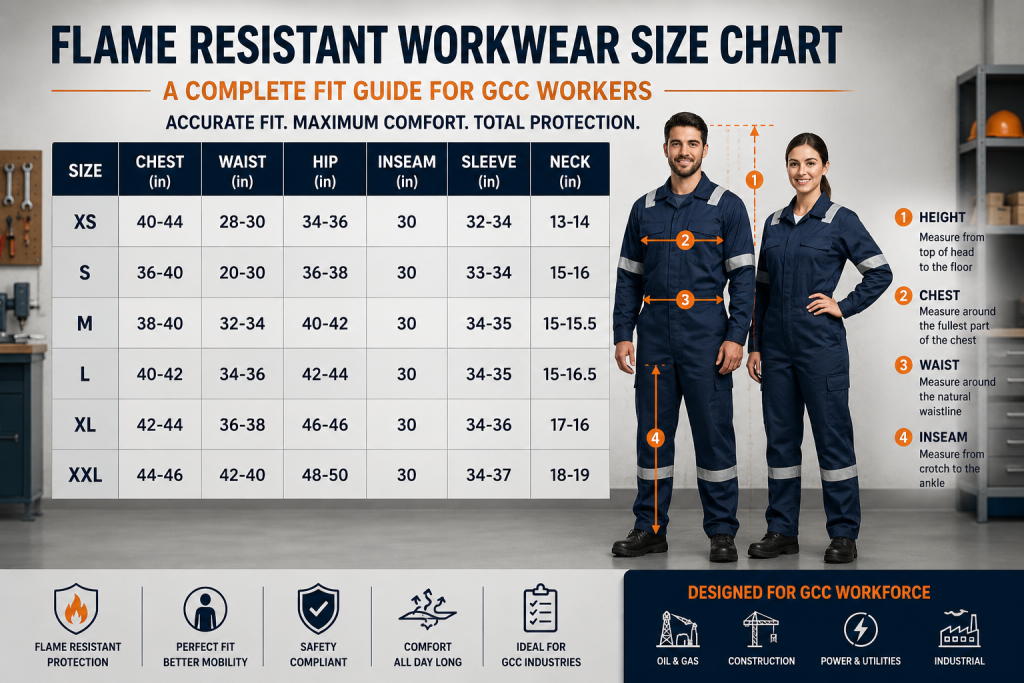
Flame Resistant Workwear Size Chart (Men’s Coveralls)
The size chart for coveralls given below is a general guide based on standard industrial measurements and is in accordance with ISO 13688, the protective clothing standard against which Armstrong is certified. It should be regarded as an initial reference; however, before placing a bulk order you should check the exact dimensions of the garment against the specification sheet for that particular product since the ease allowance varies slightly depending on the fabric weight and cut.
| S | 86-91 | 34-36 | 76-81 | 30-32 | 165-170 | 5’5″-5’7″ |
| M | 96-101 | 38-40 | 86-91 | 34-36 | 170-175 | 5’7″-5’9″ |
| L | 106-111 | 42-44 | 96-101 | 38-40 | 175-180 | 5’9″-5’11” |
| XL | 116-121 | 46-48 | 106-111 | 42-44 | 178-183 | 5’10”-6’0″ |
| 2XL | 126-131 | 50-52 | 116-121 | 46-48 | 180-185 | 5’11”-6’1″ |
| 3XL | 136-141 | 54-56 | 126-131 | 50-52 | 183-188 | 6’0″-6’2″ |
The standard range of coveralls offered by Armstrong goes from size S to 3XL, and if GCC crews require sizes larger than 3XL, bulk and export orders can be arranged as a special production run rather than as an item from stock; it is important to mention this to your supplier beforehand rather than waiting until the site headcount results have been returned.
GCC Sizing Considerations Procurement Teams Should Know
The workwear used at the sites in the UAE, Saudi Arabia, Kuwait, and Qatar has a number of regional characteristics which a general size chart will not indicate.
The numeric sizes appear in the specifications provided. In some cases, especially on projects influenced by European practices, GCC clients specify sizes using the European numeric system, for example, 46, 48, 50, etc., rather than using S, M, L. This numeric size is approximately equal to half the chest measurement in centimeters. A size 50 is about equivalent to a 100 cm chest, which matches a large to XL as shown in the chart above. However, this conversion does not always correspond to the same coverall size on the size chart that your usual supplier uses, so you should check which convention the client’s specification sheet is following before placing the order. A discrepancy between numeric and letter sizing is a frequent cause of incorrect fits in shipments.
The shape of the order curve is affected by the composition of the workforce. In most of the Gulf region industrial sites, a large proportion of the labor comes from South Asia, and the majority of the orders for flame resistant workwear on these sites are for sizes medium and XL rather than the more extreme sizes. Although extra-small and 3XL are still needed, only in smaller amounts, a reorder delay is caused when either of these sizes runs out during the course of a project.
The calculation changes when it comes to layering. For sites that go through winter in the Gulf area, or for workers who wear an FR base layer under their coverall when exposed to continuous heat, it may be necessary to go up a size from the normal-season measurement. Therefore, it is advisable to check with the site safety team to find out if layering is a standard practice before finalising the size order.
FR Coveralls vs. Regular Coveralls: Sizing Differences
FR coveralls can fit differently from regular coveralls because the fabric is usually heavier and does not stretch as easily. This can make them feel a little stiff or snug when worn.
You may need to choose a larger size, especially if you plan to wear another layer of clothing underneath. Since sizing can vary between brands, check the size chart for both FR and regular coveralls before buying. Trying them on is the best way to make sure the fit is comfortable and does not restrict movement while you work.
A flame resistant coverall is not just a fireproof version of a regular one of the same pattern because the fit tolerances differ in a few specific ways.
| Ease allowance | Standard, close to body measurement | Slightly roomier, to allow for base layers |
| Closure fit | Loose fit acceptable | Must seal fully at wrist, ankle, and neck |
| Fabric behavior | Stretch and give with movement | Cotton and modacrylic blends have less stretch |
| Sizing preference | Either direction acceptable if snug | Sizing up preferred over sizing down |
A generic coverall size chart pulled from a regular workwear catalog will not flag any of this, which is why it is worth confirming ease allowance directly with the FR garment manufacturer. If your team is also weighing IFR versus standard FR fabric for the same order, our IFR Coveralls vs FR Coveralls buyer’s guide covers how fabric choice interacts with fit and comfort across a full shift.
Planning Bulk Order Size Ratios
To order flame resistant workwear for a crew of 50, 200, or 2,000 is quite a different task from ordering a single coverall, and one of the most common reasons why a bulk shipment ends up with the wrong mix is attempting to guess the size distribution or ordering an even split among the sizes.
A more safe course of action is to use a size-ratio table that has been prepared from a real headcount survey rather than one based on an estimate taken from a standard coverall size chart; a typical distribution among an industrial workforce that is mainly South Asian is similar to this one, though each site should check its own crew data to confirm.
| S | 5-8% |
| M | 25-30% |
| L | 30-35% |
| XL | 18-22% |
| 2XL | 8-12% |
| 3XL | 3-5% |
Get the actual measurements or size preferences from the workforce roster before placing the purchase order, include a 5-10% buffer for each size when hiring new employees or replacing existing ones, and check the supplier’s minimum order quantity for each size separately rather than just the total order. For advice on sourcing in the case of large shutdown or turnaround orders, refer to our guide on bulk FR workwear sourcing for GCC oil and gas projects.
Common Sizing Mistakes to Avoid
Ordering by t-shirt size: Sort them by t-shirt size since a worker’s casual clothing size usually does not match their coverall size; coveralls are made to fit differently, often being based on a different group of people than casual clothes.
Skipping the site measurement survey: Procurement teams end up ordering another batch two weeks into a project on the basis of an estimated split, assuming that most people are medium or large without carrying out a site measurement survey.
Ignoring tall or short options: If you choose either the tall or the short length. Some suppliers provide both regular and tall inseam options. For a crew with a wide range of heights, if you order only the regular length, the trouser legs will end up being hemmed or dragging, which are both safety problems when near moving equipment.
Not accounting for layering: If the layering is not taken into account, a coverall, which is sized according to a bare-torso measurement, will fit differently when a worker puts on a thermal base layer or an FR undershirt for a winter shift or for a hot task.
Treating the coverall size chart as exact: Charts are a starting point. Fabric shrinkage after the first wash, cut variations between fabric weights, and manufacturer tolerances can shift the actual fit by half a size in either direction.
Fit Troubleshooting: What to Do Between Sizes
It is just as important to read a coverall size chart correctly as it is to take accurate measurements. When a worker’s measurement falls exactly halfway between two sizes on the chart, they should go up a size rather than down. A flame resistant coverall that is only slightly loose will still close properly at the wrists, ankles, and neck. In contrast, a coverall that is slightly tight will strain at the closures and will restrict the range of motion that a worker needs in an emergency.
When the chest measurement indicates one size but the waist indicates a different one, you should order the item in the larger size and expect it to fit more loosely at the smaller measurement. Since most coveralls have an elasticated or adjustable waist, this will take up the excess length.
When a worker finds that the sleeves or the legs are too short on a number of garments from the same batch, it is necessary to first check if the order called for regular or tall length before concluding that the size is incorrect.
Buying Checklist: Flame-Resistant Workwear Sizing
- Take the actual chest, waist, and height measurements of every worker instead of relying on estimates.
- Check whether the client uses number-based sizes or letter sizes such as S, M, and L.
- Make sure regular and tall inseam options are available for the different heights in the crew.
- Ask whether workers layer FR base layers under the coverall on this site
- Build a size-ratio table from actual headcount data, not an even split
- Add a 5-10% buffer per size for new hires and replacements
- Check whether the supplier sets a minimum quantity for each size, rather than only for the full order.
- Use the size chart made for the exact coverall you are buying, not a general chart covering several products.
- When someone’s measurements sit between two sizes, choose the larger one.
- Flag any sizes beyond the standard S-3XL range early, before production starts
Conclusion
No matter what you refer to it as, a coverall size chart is no mere formality placed somewhere alongside the fabric specifications and certification numbers. It determines whether or not the garment a worker is wearing is actually carrying out its function when it counts. If you measure the crew accurately, base the size ratios on actual data rather than making an estimate, and check the sizing conventions before the purchase order is issued, then the shipment that arrives will be the one your site can put to use on day one.
Armstrong Products manufactures flame-resistant workwear in all the standard sizes for large orders from the GCC, and custom sizing can be obtained if any group needs it. You should contact our product team about your next size order before your headcount changes once more.
FAQs
What size chart should I use for flame resistant coveralls?
Use the manufacturer’s coverall size chart for the exact product you are ordering rather than a generic clothing size chart. FR coveralls carry different ease allowances than casual clothing, and a chest or waist measurement that fits a regular Large shirt will not automatically fit a Large FR coverall the same way.
How Do I Measure Chest Size for a Coverall?
Use a soft measuring tape and place it under the arms, across the shoulder blades, and around the widest part of the chest. Keep the tape straight and close to the body, but do not pull it too tightly.
Take the measurement over light clothing rather than a heavy jacket or outer layer. The worker should stand normally and breathe as usual. Do not ask them to expand their chest, as this can give a larger measurement and lead to ordering the wrong size.
Should I size up or down for flame resistant workwear?
Size up when a measurement falls between two chart sizes. A slightly loose FR coverall still closes fully at the wrist, ankle, and neck. A tight one can strain at the closures and restrict the movement a worker needs to get clear of a hazard. This holds even for workers who normally prefer a fitted look in casual clothing, since a snug FR garment behaves differently once heat or an open flame is involved.
What Is the Difference Between FR Coverall Sizing and Regular Workwear Sizing?
FR coveralls are often cut with a little more room so workers can wear base layers underneath, especially during winter shifts or jobs involving continuous heat exposure. The fit around the wrists, ankles, and neck also needs to close properly, which is less important with standard workwear.
The fabric can also affect the fit. Cotton and modacrylic blends commonly used in FR clothing usually have less stretch than the poly-cotton fabrics found in regular work shirts. Because of this, a close-fitting FR coverall may feel tighter than regular clothing in the same size.
How Do I Plan Sizes for a Bulk Flame-Resistant Workwear Order?
Start with the actual crew list and collect each worker’s measurements or usual size. Use that information to work out how many pieces you need in each size instead of ordering the same quantity across the full range.
It is also sensible to add an extra 5 to 10% in every size for new employees and replacements during the project. Before confirming the order, ask whether the supplier’s minimum quantity applies to the complete order or to each individual size. Some manufacturers require a separate minimum for less common sizes at both ends of the range.
Does Armstrong offer flame resistant workwear beyond 3XL for GCC crews?
Armstrong’s standard stock range runs S through 3XL. Sizes beyond that can be arranged as a custom production run for bulk GCC orders when flagged to the supplier early, before the size distribution is finalized. This is common on larger turnaround and shutdown projects where the crew headcount and its size spread are not confirmed until closer to mobilization.
What happens if flame resistant workwear is sized too large?
Loose fabric around the arms and legs gives a flash fire more surface area to catch and can also snag on machinery or railings during routine work. Oversized garments also tend to bunch at the waist and shoulders, which affects mobility more than most buyers expect. A coverall several sizes too big often gets rolled at the cuffs or tucked at the waist by the worker wearing it, and neither fix restores the fit the garment was tested in.
Why Does a Coverall Size Chart Include Height Along With Chest and Waist?
Chest and waist measurements tell you how wide the coverall needs to be, but they do not tell you how long it should be. Height helps determine the right torso, sleeve, and leg length.
Two workers may have the same chest size but need different garment lengths because they are different heights. Without that information, the supplier has to guess where the crotch seam and cuffs should sit. This is why a coverall can fit well around the chest but still be too long at the ankles.
Is European numeric sizing the same as letter sizing for FR workwear?
European numeric sizing, 46, 48, 50, and similar, roughly corresponds to half the chest measurement in centimeters, so a size 50 lines up close to a Large or XL in letter sizing. The conversion is approximate rather than exact, so it is worth confirming against the actual chart rather than assuming a direct match.
How often should a company re-measure its workforce for flame resistant workwear?
Re-measuring annually, or whenever a significant portion of the crew turns over, keeps the size-ratio data accurate. Body measurements also shift over a long contract, particularly on sites with physically demanding work, so a chart built two years ago may no longer reflect the current crew. New mobilizations and major turnaround projects are a natural checkpoint to run this survey again, since the size mix rarely stays identical between one project phase and the next.
Where can I find an accurate coverall size chart for a bulk flame resistant workwear order?
The most reliable coverall size chart comes directly from the manufacturer of the specific garment being ordered, since ease allowance and cut vary between suppliers. A generic online chart is useful for a rough estimate, but confirming against the actual product’s spec sheet before production starts is what prevents a bulk shipment from arriving with the wrong fit.