
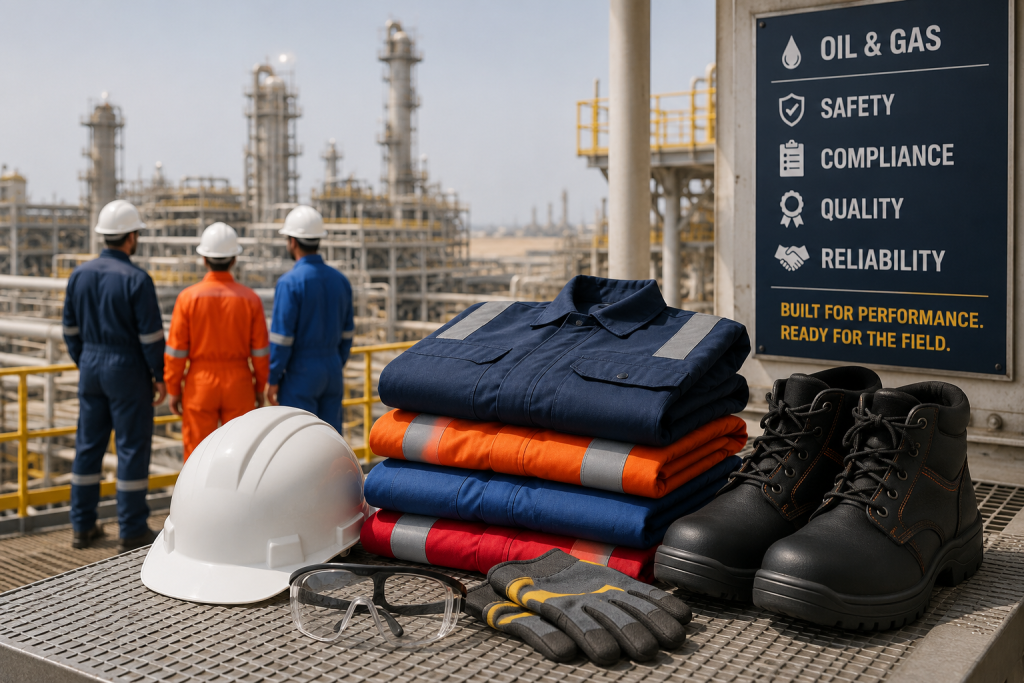
A shipment of coveralls gets held at a GCC port. The paperwork looks fine at first glance. So does the stitching. But the flame-resistant test certificate doesn’t match the fabric batch number on the shipping label, and customs holds the container for review. Two weeks gone. The workwear was never unsafe. Nobody checked the paperwork against the goods before the order left the factory.
This happens more often than most procurement teams expect. Oil and gas sites run on tight schedules and stricter HSE rules than almost any other industry, and workwear sits right in the middle of both. Price and delivery time matter, but they’re not what separates a good workwear manufacturer from a risky one. What matters is whether the supplier can put its compliance in writing and back it up when customs or a site auditor asks.
Here’s what a procurement team should check before placing a bulk order: certifications, factory conditions, and the country rules that catch first-time buyers off guard.
Why GCC oil and gas projects need a different sourcing approach
Workwear for an office or a warehouse is a simple purchase. Workwear for a refinery, a drilling site, or an offshore platform is a different kind of decision.
Oil and gas sites carry real fire, chemical, and electrical hazards. A coverall that looks identical to a certified one but skips a testing step can fail at the exact moment a worker needs it. That’s why operators like Saudi Aramco and ADNOC build specific fabric and garment requirements into their HSE specifications. Contractors bidding on these projects have to show proof.
Each GCC country also runs its own import and registration process on top of the safety requirement. A workwear manufacturer that ships confidently into the UAE may still need extra paperwork to clear customs in Saudi Arabia. Procurement teams that treat the GCC as one market often get caught out here.
What counts as a reliable workwear manufacturer for GCC projects
Before comparing prices, it helps to confirm whether a supplier can actually deliver at scale, consistently, order after order.
Manufacturing capability and scale
Ask how many units the factory can produce per month and whether that number holds during peak season. A workwear manufacturer that turns out a sample batch quickly but struggles once an order hits 5,000 or 10,000 pieces isn’t ready for a multi-site oil and gas contract. Get the current production number in writing, not the best-case figure a sales rep quotes on a call.
In-house quality control
Find out whether fabric testing, stitching checks, and final inspection happen inside the factory or get sent out to a third party. In-house quality control usually means problems get caught and fixed faster, and batches stay more consistent across a large order.
Export documentation experience
A supplier that has already shipped PPE into Gulf countries will understand SABER registration, UAE MOIAT/ECAS requirements, and the paperwork customs officers actually want to see. A first-time exporter can still be the right choice on quality. Just build extra time into the schedule for that first shipment.
Certifications and standards procurement teams should confirm
This is the section most bulk orders get wrong. A supplier saying “we meet international standards” is not the same as a supplier handing over a current, matching test report.
| Standard | What it covers | Where it’s commonly required |
| NFPA 2112 | Flash fire protection for FR coveralls and workwear | Widely written into Aramco, ADNOC, and KOC site requirements |
| EN ISO 11612 | Heat and flame protection across several hazard classes | Appears in tenders across Qatar, Kuwait, and Oman |
| EN ISO 20471 | Performance classes for high-visibility clothing | Used on Ashghal projects in Qatar and road or construction sites GCC-wide |
| ISO 9001 | Quality management system for the manufacturer itself | Standard baseline most GCC buyers expect from any supplier |
| SASO / SABER | Product registration before import into Saudi Arabia | Mandatory for all PPE entering the Saudi market since 2019 |
| MOIAT / ECAS (formerly ESMA) | Product conformity registration for the UAE market | Applies to workwear and general PPE categories imported into the UAE |
A few things worth checking directly with the supplier:
- Does the test report list the exact fabric and garment style you’re ordering, not a similar one?
- Is the certificate still valid or close to expiry?
- Does the certifying lab appear on a recognized accreditation list?
- Will the supplier re-test if you change the fabric blend or add reflective tape?
If your project supplies into an Aramco or ADNOC contract, ask your HSE department for the exact general instruction or specification reference before finalizing garment details. These operator-specific rules often go further than the national baseline.
Country-specific requirements across the GCC
GSO standards apply across the Gulf Cooperation Council, but each country layers its own national process on top. Treat this table as a starting point, then confirm current requirements with your buyer’s compliance team, since rules shift and contracts vary.
| Country | Body to check | What to confirm |
| UAE | MOIAT (formerly ESMA) | ECAS or EQM registration status for the workwear category |
| Saudi Arabia | SASO, via the SABER platform | SABER registration matches the exact batch being shipped |
| Qatar | GSO standards, Ashghal specs for public works | EN ISO 20471 compliance and any project-specific GI reference |
| Kuwait | GSO standards | Current conformity documentation required for the specific contract |
| Oman | GSO standards, national customs rules | Updated conformity paperwork attached to each shipment |
| Bahrain | GSO standards | Registration and labeling rules confirmed before the order ships |
A workwear manufacturer supplying Kuwait or Oman may need a different document set than one supplying Dubai, even for the identical garment. Build this check into the timeline early. Fixing paperwork after the goods reach port costs far more than fixing it before they ship.
How to evaluate a bulk workwear supplier before you sign
A short call and a product catalog aren’t enough for a contract this size. Run through these before committing:
Documentation
- Current test reports for the exact garments you need
- ISO 9001 certificate
- Export references for GCC shipments, if available
Production
- Confirmed capacity against your order size and deadline
- Sample approval process before bulk production starts
- Consistent sizing across different production runs
Track record
- References from buyers in oil, gas, or similar industrial sectors
- History of on-time delivery for comparable order volumes
- Willingness to share factory details or allow a visit
Communication
- A single point of contact for your account
- Clear lead times, stated upfront
If a supplier hesitates on any of these, especially test reports or references, treat it as a reason to look closer rather than a dealbreaker. Plenty of smaller manufacturers are strong on quality and weak on paperwork process. Ask direct questions and judge the answers you get.
Factory audits: what to look for
A factory audit, whether it’s done in person or through a third-party inspector, tells you more than any brochure ever will. A few things worth watching for:
- Production floor conditions. Clean, organized lines are usually a decent proxy for overall process control.
- How fabric gets stored. FR and treated fabrics need to stay away from contamination and moisture, not sit in a corner near an open door.
- Where inspection actually happens during the run, not just at the very end.
- Whether the factory takes its own workers’ safety seriously. A plant that cuts corners on basics for its own staff is unlikely to be careful about what it claims on your PPE.
- Document control. Ask them to pull a test certificate and batch record for a specific order on the spot. Minutes are a good sign. Days is not.
For large or recurring orders, a first-shipment audit earns back its cost fast. It’s a lot cheaper than a rejected container.
Common mistakes procurement teams make
- Trusting a certificate without checking the batch number against it. Certificates can be completely genuine and still cover a different fabric lot than what’s shipping.
- Leaving country-specific registration until the shipment is already booked. SABER and ECAS registration both take real time, so start them early.
- Skipping the sample approval step to save a few days. This step is usually where sizing and fit problems actually get caught.
- Assuming one certification covers the whole GCC. SASO approval doesn’t automatically satisfy the UAE’s MOIAT/ECAS requirements, and it works the other way too.
- Skipping reorder checks. A supplier that nails the first batch can still drift on fabric weight or stitching by batch three if quality control isn’t tight.
This isn’t about squeezing a better rate out of anyone. It’s about making sure the workwear that lands on site actually matches what got approved on paper.
Where Armstrong Products fits in
Armstrong Products has been manufacturing industrial workwear and PPE since 2009, with a production facility in Boisar, Maharashtra, and a corporate office in Powai, Mumbai. The company is ISO 9001 certified and supplies coveralls, high-visibility wear, and industrial uniforms to buyers across the marine, offshore, oil and gas, and construction sectors.
For procurement teams sizing up a workwear manufacturer for GCC oil and gas projects, the questions in this guide apply just as much to Armstrong as to anyone else. Ask for current test reports. Ask how production capacity holds up against your timeline and how batch consistency gets managed across a large order. A supplier confident in its own process gives straightforward answers to all of it.
Conclusion
The reliable workwear manufacturer for a GCC oil and gas project is the one that hands over current certifications matching the exact product, runs a real quality control process, and already knows the registration rules for the country you’re shipping into. Build these checks into the timeline instead of the afterthought they usually become, and the delays and rejected shipments mostly go away on their own.
If you’re evaluating suppliers for an upcoming GCC project and want to see Armstrong’s certifications, production capacity, or sample range, contact us, and our team will walk you through what’s available.
FAQ’s
Is NFPA 2112 mandatory in the GCC?
It isn’t a federal legal requirement in most GCC countries, but operators like Aramco and ADNOC write it into their site HSE specifications, so it becomes mandatory in practice for any contractor supplying those sites.
What should I ask a workwear manufacturer before placing a bulk order?
Start with test reports for the exact garment, current ISO 9001 certification, and references from buyers in similar industries. Then confirm production capacity can actually meet your deadline.
What’s the difference between NFPA 2112 and EN ISO 11612?
NFPA 2112 focuses specifically on flash fire protection. EN ISO 11612 covers a broader set of heat and flame hazards, rated across several classes. Some fabrics meet both, and tenders sometimes ask for either one depending on the region.
Do I need separate certification for each GCC country?
Usually, yes. SASO/SABER registration for Saudi Arabia doesn’t cover the UAE’s MOIAT (formerly ESMA) requirements, and each country layers its own process on top of shared GSO standards.
How long does SABER registration take for a new PPE shipment?
It’s safer to build in extra weeks for a first-time registration than to assume a fixed number, since timelines shift with product category and current backlog on the platform.
What is a factory audit, and is it necessary for every order?
A factory audit checks production conditions, quality control points, and document handling in person or through a third-party inspector. It’s most valuable for a first order or a large recurring contract, where the cost of a rejected shipment is high.
Can one supplier handle both FR coveralls and high-visibility wear for the same project?
Many manufacturers produce both, but confirm each product line has its own valid certification. A supplier being strong on FR coveralls doesn’t guarantee the same quality on hi-vis stitching or reflective tape performance.
What happens if a shipment fails a customs or site inspection?
The shipment can be held, sent back, or rejected at the site level, depending on the issue. This usually delays the project and adds cost, which is why matching certificates to batch numbers before shipping matters so much.
How often should sizing and fit be re-checked across a large order?
Check the first sample batch closely, then spot-check again at roughly the midpoint of a large production run, since fabric or cutting drift can creep in between batches.
Does Armstrong Products supply directly to GCC oil and gas projects?
Yes, Armstrong supplies coveralls, high-visibility wear, and industrial uniforms to buyers in the marine, offshore, and oil and gas sectors, including export orders into the Gulf region.