
What Is an Industrial Safety Supplier and Why Does Your Business Depend on One?
An industrial safety supplier is a specialized vendor that provides businesses with the protective gear, safety equipment, and compliance-ready products needed to keep workers safe across hazardous environments. Whether you’re managing a manufacturing unit, a construction site, or a chemical processing plant, sourcing from the right supplier isn’t just a procurement decision it’s a liability, legal, and human responsibility.
Today, workplace safety is no longer optional. With tightening OSHA regulations, ISO compliance mandates, and an increasingly safety-aware global workforce, businesses that overlook the quality of their safety equipment supplier are playing a dangerous game literally.
This guide breaks down exactly what to look for when choosing an industrial safety supplier for bulk orders, what red flags to avoid, and how to make a decision that protects both your workers and your bottom line.
Why Choosing the Right Industrial Safety Supplier Matters More Than Ever
The global PPE market is projected to surpass USD 93 billion by 2030, driven by post-pandemic safety consciousness, rising industrial accidents, and mandatory compliance frameworks across industries. Companies are no longer just buying helmets and gloves they’re building entire safety ecosystems with trusted suppliers at the core.
A poor-quality supplier doesn’t just cost you money. It costs you:
- Worker injuries and fatalities
- Government penalties and compliance failures
- Reputational damage and project shutdowns
- Insurance claims and legal disputes
Partnering with a certified, experienced industrial safety supplier is one of the highest-leverage decisions a procurement or EHS (Environment, Health & Safety) manager can make.
Key Factors to Evaluate When Selecting an Industrial Safety Supplier for Bulk Orders
Does the Supplier Offer a Comprehensive Range of Industrial PPE?
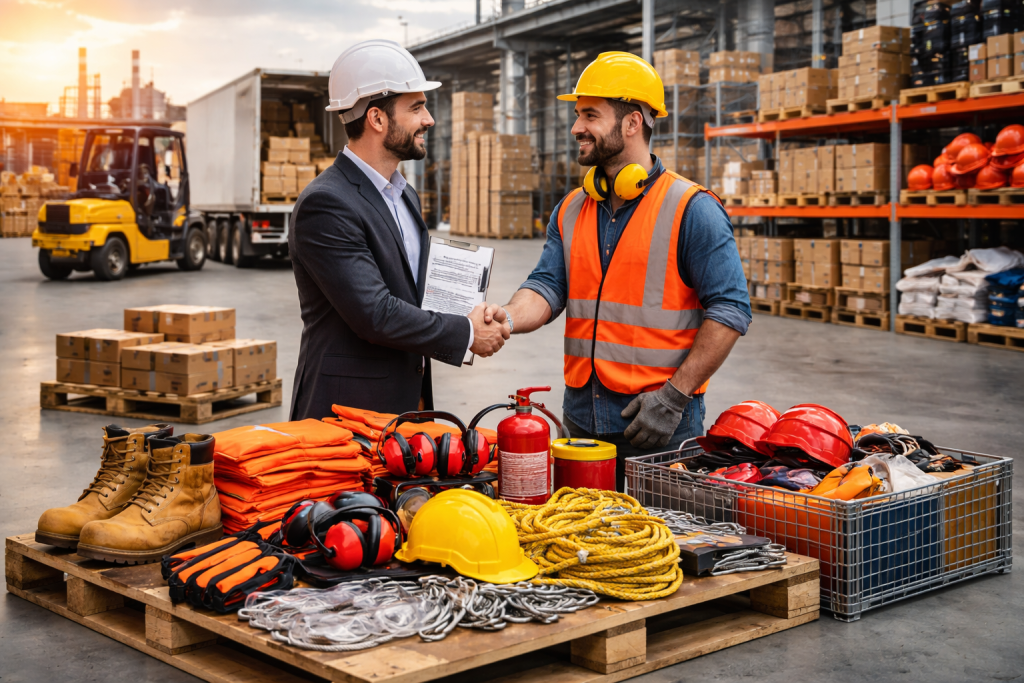
One of the first things to verify is whether the supplier covers your full spectrum of needs. A reliable protective equipment supplier should offer everything from head-to-toe protection, including:
- Head protection — safety helmets, bump caps
- Eye and face protection — safety goggles, face shields
- Respiratory protection — dust masks, respirators, SCBA units
- Hand protection — cut-resistant, chemical-resistant, and heat-resistant gloves
- Foot protection — steel-toe boots, anti-static footwear
- Body protection — high-visibility vests, flame-retardant coveralls
- Fall protection — harnesses, lanyards, anchor systems
When you source all industrial PPE from one trusted partner, you simplify procurement, reduce vendor management complexity, and unlock better bulk pricing.
Is the Supplier Certified and Compliance-Ready?
Certifications are non-negotiable. Your safety equipment supplier must be able to provide products that meet or exceed relevant safety standards. Look for:
- IS (Bureau of Indian Standards) certifications for India-based operations
- CE marking for products intended for European compliance
- ANSI/ISEA standards for US-aligned procurement
- ISO 9001 quality management certification from the supplier itself
Ask potential suppliers directly: “Can you provide test reports and certification documents for each product category?” A credible industrial safety supplier will have these ready without hesitation.
How Does the Supplier Handle Bulk Orders and Supply Chain Reliability?
This is where many buyers make costly mistakes. A supplier may look excellent on paper but fall apart during execution. When placing bulk safety products orders, evaluate:
- Minimum Order Quantities (MOQ): Does the MOQ align with your operational scale? Some suppliers are better suited for enterprise-level bulk, while others serve mid-size businesses well.
- Lead Times: Ask for guaranteed delivery timelines. Delays in safety equipment can halt entire construction or manufacturing projects.
- Stock Depth: Do they maintain ready inventory, or are they dependent on long manufacturing cycles? A strong PPE supplier should have buffer stock for high-demand SKUs.
- Logistics Capability: Can they deliver pan-India or internationally? Do they partner with reliable freight networks?
- Reorder Flexibility: Will they accommodate emergency top-up orders without premium surcharges?
What Is the Supplier’s Track Record in Your Industry?
Not all industrial environments are alike. A protective equipment supplier who primarily serves construction may not be the best fit for a chemical or pharmaceutical plant. Industry-specific experience matters enormously.
Ask for:
- Client references in your sector
- Case studies that demonstrate their ability to supply at scale
- Years of operation in industrial safety specifically
Armstrong Products, for instance, has built its reputation by serving diverse industries from heavy manufacturing to oil & gas with tailored safety solutions, making them a benchmark industrial safety supplier in the Indian market.
Does the Supplier Provide Product Training and Technical Support?
The best industrial safety supplier doesn’t just ship boxes they become a safety partner. Value-added services to look for include:
- On-site product demonstrations for respiratory or fall protection equipment
- Fit-testing services for respirators and harnesses
- Safety training workshops aligned with your industry’s hazard profile
- Dedicated account managers who understand your compliance requirements
- After-sales support for product queries and replacements
This kind of technical engagement dramatically reduces misuse of safety equipment a leading cause of workplace injuries even when PPE is available.
Red Flags to Watch Out for When Evaluating a Safety Equipment Supplier
Not every vendor claiming to be a top industrial safety supplier deserves that title. Watch out for these warning signs:
No certifications or vague compliance claims : If they can’t produce documentation, don’t proceed.
Prices that seem “too good to be true” : Substandard materials are a safety hazard and a legal liability.
No returns or quality guarantee policy : Reputable suppliers stand behind their products.
Limited product range : Forces you to juggle multiple vendors, increasing risk and operational complexity.
Poor communication or slow response times : A supplier who’s hard to reach during procurement will be impossible to reach during a crisis.
No references or client history : Inexperience in bulk industrial supply is a serious risk factor.
How to Negotiate Smarter When Buying Bulk Safety Products
Procurement teams that approach bulk safety products strategically get significantly better outcomes. Here’s how to negotiate effectively:
Build a Long-Term Supplier Relationship
Rather than treating each order as a one-off transaction, position yourself as a long-term buyer. This unlocks:
- Volume-based pricing tiers
- Priority order processing
- Customization options (branded PPE, specific color coding)
- Flexible payment terms
Request Product Samples Before Full Commitment
Always test before you commit to large volumes. Request samples of high-usage items like gloves, helmets, and safety footwear. Evaluate them against your actual workplace conditions not just the spec sheet.
Consolidate Your Vendor List
If you’re currently buying from five different suppliers for five product categories, consolidation with a full-range PPE supplier will save you time, paperwork, and freight costs while improving consistency.
Why Armstrong Products Stands Out as an Industrial Safety Supplier
Armstrong Products has positioned itself as one of India’s most dependable industrial safety suppliers, offering a comprehensive range of certified personal protective equipment across multiple industry verticals.
What sets Armstrong Products apart:
- Wide product portfolio covering all PPE categories from respiratory protection to industrial footwear
- Competitive bulk pricing designed for procurement teams managing large workforces
- Compliance-first approach with certified products aligned to IS, CE, and international standards
- Pan-India distribution network ensuring timely delivery across states
- Customer-first service model with responsive support for B2B clients
Whether you’re a procurement manager at a steel plant, an EHS officer at a pharma facility, or a contractor managing 500 field workers, Armstrong Products has the breadth and depth to serve as your primary protective equipment supplier.
The Future of Industrial PPE Trends Every Buyer Should Know
The industrial safety landscape is evolving fast. Smart procurement decisions today should factor in:
Smart PPE: Helmets with embedded sensors, GPS-enabled harnesses, and connected wearables that monitor worker vitals in real time.
Sustainability: Eco-friendly gloves, recyclable helmets, and sustainable packaging are becoming procurement differentiators.
Customization: Industries are increasingly demanding branded, color-coded, or size-specific PPE for large workforces.
Digital Procurement Portals: The best industrial safety suppliers now offer online catalogs, bulk quote tools, and real-time inventory visibility.
Regulatory Tightening: India’s BOCW Act, Factories Act, and sector-specific regulations are evolving — your supplier must keep pace.
Conclusion: Make Your Industrial Safety Supplier Work as Hard as Your Workers
Choosing the right industrial safety supplier for bulk orders is a strategic decision that touches every corner of your business from worker morale and regulatory compliance to cost efficiency and brand reputation. The right partner doesn’t just deliver equipment; they deliver confidence.
Evaluate suppliers rigorously, prioritize certifications and industry experience, demand strong after-sales support, and build relationships that go beyond transactional purchasing.
If you’re looking for a trusted, certified, and customer-focused industrial safety supplier in India, Armstrong Products is ready to be your long-term safety partner.
FAQ
Q1. What should I look for in an industrial safety supplier for bulk orders? Look for a supplier with a broad product range, valid safety certifications (IS, CE, ANSI), strong industry references, reliable logistics, and dedicated technical support. Compliance documentation and responsive customer service are essential.
Q2. How do I verify if a PPE supplier’s products are certified? Ask the supplier to provide test reports, certification documents, and compliance declarations for each product. Certified suppliers will have this documentation readily available and aligned with applicable standards like BIS, CE, or ISO.
Q3. Can I get customized safety equipment for my workforce from a bulk supplier? Yes. Many leading protective equipment suppliers offer customization options including branded helmets, color-coded PPE, and size-specific orders for large teams. Discuss your requirements upfront to confirm capabilities.
Q4. What is the difference between a safety equipment supplier and an industrial PPE supplier? The terms are often used interchangeably, but industrial PPE suppliers typically focus specifically on personal protective equipment for hazardous work environments, while a general safety equipment supplier may also cover broader safety systems like fire suppression, signage, and first aid.
Q5. How do I get the best pricing on bulk safety products? Negotiate long-term contracts, consolidate your vendor list, commit to higher volumes in exchange for pricing tiers, and build relationships with suppliers who offer transparent, volume-based pricing structures.
Q6. Why is it risky to choose the cheapest safety equipment supplier? Substandard safety products may fail under real hazard conditions, exposing workers to injury and businesses to legal liability. Cheap, uncertified PPE may also violate regulatory compliance requirements, resulting in fines and operational shutdowns.
Q7. Is Armstrong Products capable of handling large-scale bulk orders across India? Yes. Armstrong Products operates a robust supply and distribution network across India, serving clients in manufacturing, construction, pharmaceuticals, and other sectors with certified industrial PPE at scale.