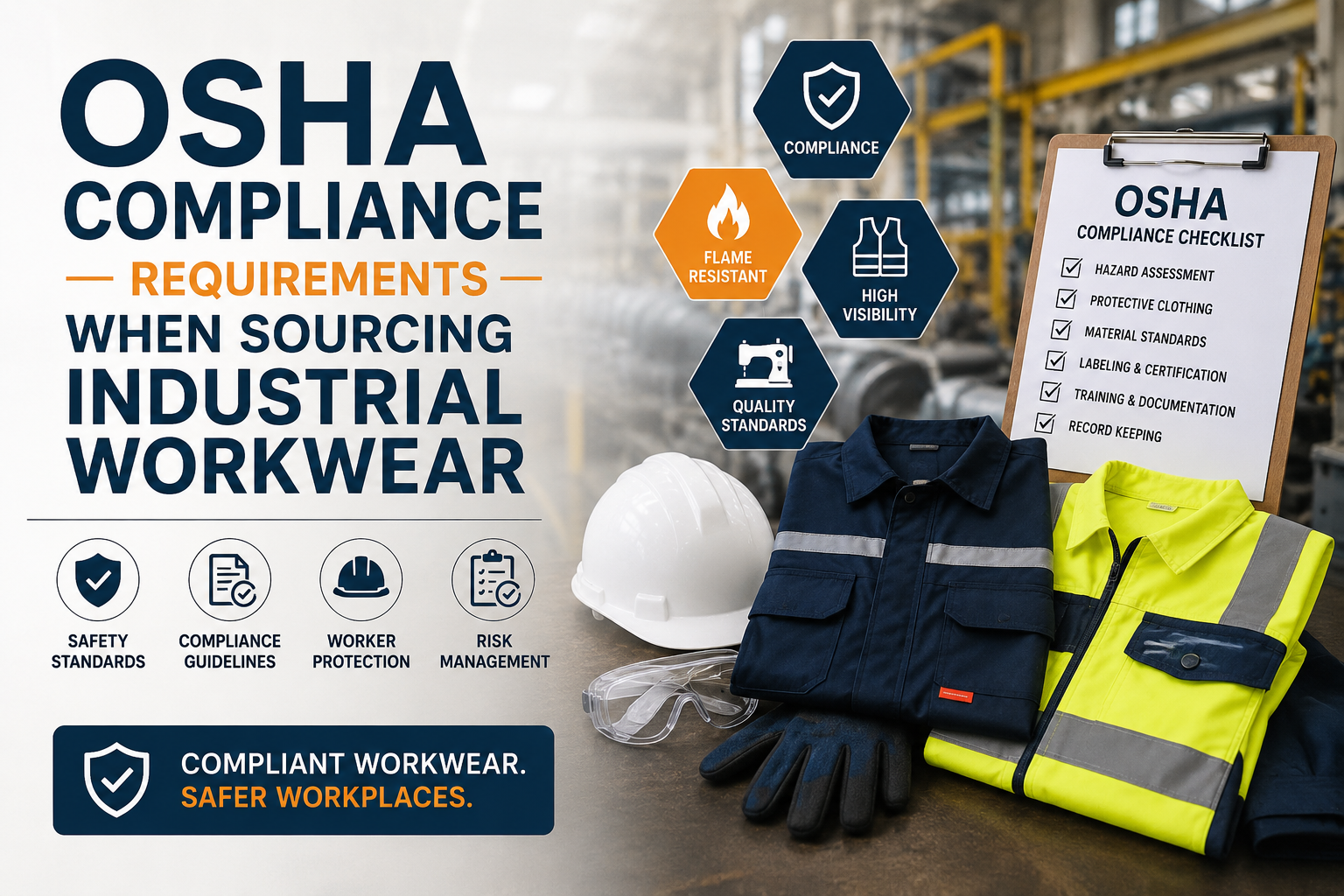
Procurement teams that source workwear for US facilities usually know what a garment should look like. Fewer know what it needs to prove on paper before anyone wears it.
The Occupational Safety and Health Act of 1970 created OSHA and gave it authority to set enforceable workplace safety standards across the US industry. Title 29 of the Code of Federal Regulations is where that authority lands; it determines which protective clothing workers wear, which independent standards those garments must meet, and who gets cited when something goes wrong. Not the garment manufacturer. The employer.
Most buyers discover this later in the sourcing process than they should.
What is OSHA compliance?
Every facility has hazards. Some require workers to wear protective clothing. What 29 CFR 1910.132 does is tell you how to document those hazards, which garments address them, and what records prove you handled them correctly.
Start with a written hazard assessment, signed by the person who conducted it, dated, and kept on file. From there, you select PPE that matches the assessment findings, provide it to workers at no cost, train each person to use it, and document the training. That paper trail is OSHA compliance in practice. There’s nothing more to it, and nothing less.
No approved supplier list exists. OSHA doesn’t certify garments or endorse any manufacturer. A garment is compliant when it meets the ANSI, NFPA, or ASTM standard that OSHA references for the specific hazard documented in your assessment. Buy a garment that meets the wrong standard and the compliance failure is already locked in before it ships, long before a worker puts it on.
The Occupational Safety and Health Act of 1970 created OSHA and gave it authority to set enforceable workplace safety standards across the US industry. Title 29 of the Code of Federal Regulations is where that authority lands; it determines which protective clothing workers wear, which independent standards those garments must meet, and who gets cited when something goes wrong. Not the garment manufacturer. The employer.
Most buyers discover this later in the sourcing process than they should.
Is OSHA compliance mandatory?
For almost every US private sector employer, yes.
The OSH Act covers private employers across all 50 states. Federal OSHA handles most workplaces directly. Twenty-six states and territories run their own OSHA-approved State Plans, which must be at least as protective as federal requirements and often go further. Small family farming operations with no non-family employees sit in a narrow exemption. Nearly everyone else falls under the Act.
The financial exposure is specific. As of January 2025, OSHA’s maximum penalty for a serious violation is $16,550. Willful or repeated violations carry a penalty of $165,514 per occurrence. Fail to correct a cited violation past the abatement deadline, and you add $16,550 per day. These figures adjust annually for inflation. None of them accounts for civil liability, which runs separately and has no ceiling.
OSHA’s framework for industrial workwear
29 CFR 1910.132: the regulation that governs PPE selection
Garment selection is not step one. Many sourcing processes treat it that way. That’s how citations happen.
Under 29 CFR 1910.132(d)(1), the employer has to assess the workplace for hazards that require PPE before selecting any protective equipment. That assessment has to be written. It needs the name of the person who conducted it, a date, and a statement identifying the document as a hazard assessment certification. An inspector who asks for this during a worksite visit isn’t looking for a verbal explanation of what you did. They’re looking for the document.
Once the written assessment exists, you select PPE that fits the identified hazards and fits each affected worker physically. Then training: workers need to know when PPE is required, which type to wear, how to put it on and take it off correctly, and how to maintain it. Under 29 CFR 1910.132(f)(4), that training gets documented with employee names, dates, and the subject covered. OSHA inspectors request these training records during worksite visits. If you can’t produce them, the absence of documentation is itself a violation.
FR clothing: NFPA 2112 and ASTM F1506
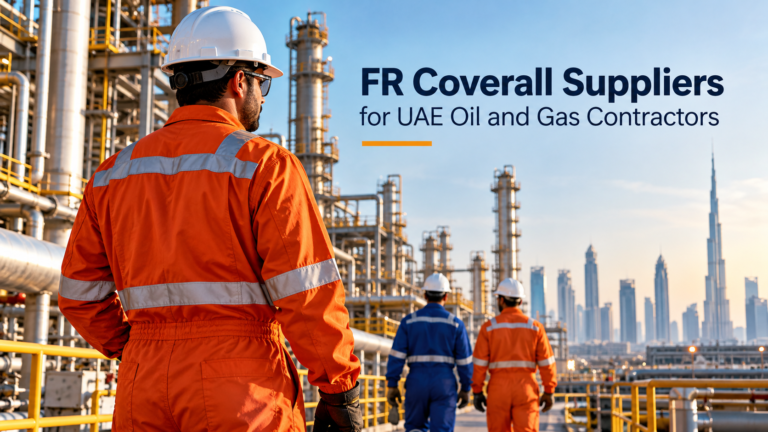
Workers with flash-fire exposure at oil and gas sites, chemical plants, or utility operations need flame-resistant outer layers. Two standards govern this, and confusing them causes problems.
NFPA 2112 covers FR garments for industrial flash-fire protection in environments where hydrocarbon fires are a real, documented risk. The test applies to the finished, assembled garment. Seams, closures, zipper tape, and trim are all part of what NFPA 2112 evaluates. A coverall made from certified FR fabric but sewn with standard polyester thread can fail the finished garment test. The fabric certification doesn’t automatically transfer to the garment. This distinction causes more sourcing problems than almost any other technical requirement in the FR space, because buyers check the fabric spec sheet and assume the garment follows. It doesn’t work that way.
ASTM F1506 governs FR clothing for arc flash electrical exposure and runs alongside NFPA 70E. OSHA 1910.269 requires FR as the outer layer for utility workers near electric arcs or flames, regardless of whether a formal arc flash study exists at the site. The obligation is there whether the study is there or not.
A standard cotton coverall satisfies neither standard.
High-visibility clothing: ANSI/ISEA 107-2020
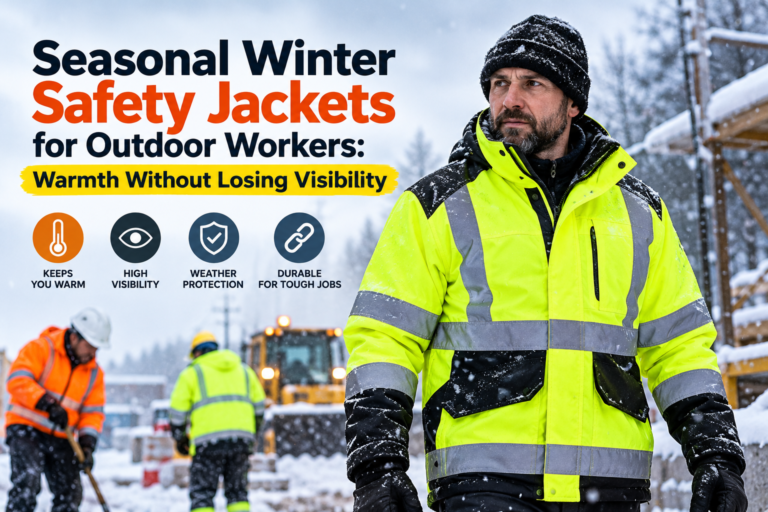
23 CFR Part 634 requires every worker within the right-of-way of a federal-aid highway project, where there’s exposure to traffic or construction equipment, to wear garments meeting ANSI/ISEA 107-2020 at a minimum Performance Class 2. Class 3 kicks in on high-speed roadways at speeds above 50 mph or when visibility drops. Warehouses and industrial sites fall under this, too; OSHA pulls them in under the General Duty Clause, with ANSI/ISEA 107 as the standard it cites.
The 2020 edition sorts garments by type and class:
| Type | Operating environment | Minimum class required |
| Type O | Off-road and industrial, no public traffic | Class 1 |
| Type R | Public roadway and highway construction zones | Class 2 (Class 3 above 50 mph) |
| Type P | Public safety and emergency response | Class 2 |
One thing buyers frequently miss: the standard includes colour retention performance requirements. A garment that fades below those thresholds is no longer compliant, regardless of its original label. You can’t re-certify a faded vest by pointing to when it was purchased.
Nearly 1 in 5 construction workplace fatalities in the US involves a struck-by injury, the hazard category that high-visibility apparel is specifically designed to address.
OSHA compliance checklist for sourcing industrial workwear
1. Write the hazard assessment before touching a product catalogue
Under 29 CFR 1910.132(d)(2), the assessment must be written, signed, and dated. Every garment decision follows from what this document says. Without it, you have no documented basis for selecting PPE, and an inspector knows it.
2. Match the garment standard to the hazard, not to the garment you already like
Flash fire calls for NFPA 2112. Arc flash requires compliance with ASTM F1506 and a documented ATPV rating. Roadway work calls for ANSI/ISEA 107-2020 Type R, Class 2 at a minimum. Choosing a Class 2 hi-vis vest for a flash-fire environment meets one standard but violates another.
3. Read the sewn-in garment label
A compliant garment carries a permanent internal label naming the specific standard, NFPA 2112:2018, ANSI/ISEA 107-2020, along with the performance class and edition year. Packaging that says “safety certified” without naming a standard and edition tells you nothing about what holds up under inspection.
4. Request third-party test reports before the first shipment
Lab test certificates from accredited bodies such as UL, Intertek, Bureau Veritas, or SGS confirm that the garment has met the standard’s test requirements. A supplier-issued conformity declaration is not the same document. For overseas orders, this request belongs at the sampling stage, before production runs.
5. Check which edition the certification references
ANSI/ISEA 107-2020 superseded the 2015 version. A garment tested only to the 2015 edition may not meet current labelling requirements. The year on the test report matters.
6. Check the care instructions
FR garments washed with bleach or fabric softener lose flame-resistant properties over time. OSHA published specific guidance on FR clothing laundering responsibilities in June 2015. The garment must include care labels that preserve its protective performance, and your procurement process should confirm workers are actually following them.
7. Document why you selected each garment
Record which garment was chosen, which standard it meets, and which hazard it addresses. Tie that record to the hazard assessment. An OSHA inspector who finds workers in FR coveralls but can’t find documentation connecting those coveralls to a certified hazard assessment has a clean basis for a citation.
8. Build replacement criteria into the supply contract
Worn FR fabric, faded hi-vis garments, and damaged protective clothing fail compliance even if they passed certification on day one. Inspection criteria and replacement triggers belong in the supply agreement. They don’t survive as verbal understandings.
What makes a garment OSHA compliant: label, test report, fit
The label is the starting point, not the endpoint.
For FR garments, the NFPA 2112 label identifies the specific edition year. For hi-vis garments, the ANSI/ISEA 107-2020 label identifies type and class. A label that doesn’t specify a specific standard and edition year provides no documented protection during an OSHA audit. This matters for importers, especially when two garments can look identical, carry similar labels, and have completely different underlying test histories.
Test reports go further than labels. Garment labels are self-certified by manufacturers. Third-party laboratory reports from accredited testing bodies confirm that the garment physically cleared the standard’s test requirements. The report shows which test protocols were run, which lab ran them, and when. For buyers placing large-volume orders from overseas suppliers, requesting this document at the pre-production sample stage is standard practice for anyone who has been through an OSHA audit. A supplier who can’t produce an accredited test report is a supplier who can’t prove their label claim.
Fit is the element most procurement teams underestimate, and OSHA is explicit about it. Under 29 CFR 1910.132, PPE must fit each affected employee properly. A coverall that meets NFPA 2112 but exposes the worker’s wrists during normal arm movement has a documented compliance gap. OSHA treats fit as a selection requirement, not a comfort consideration.
| Garment type | Applicable standard | What to check on the label |
| FR coveralls (flash fire) | NFPA 2112 | “NFPA 2112” plus edition year |
| FR clothing (arc flash) | ASTM F1506 / NFPA 70E | ATPV rating in cal/cm2 |
| Hi-vis vest or jacket (roadway) | ANSI/ISEA 107-2020 | Type (O, R, or P) plus Class (1, 2, or 3) |
| Hi-vis FR combined | ANSI/ISEA 107 plus NFPA 2112 | Both standard labels present on the garment |
| Safety footwear | ASTM F2413 | Toe and sole protection codes |
| Head protection | ANSI Z89.1 | Type and class markings |
What procurement teams get wrong
Buying on appearance. Two coveralls sitting side by side on a table look identical. One holds NFPA 2112 certification backed by accredited lab reports. The other carries a label with similar wording and no test history. Nothing visible separates them until an inspector asks for documentation or a worker is hurt.
Confusing FR fabric certification with a certified FR garment. This causes more sourcing problems than buyers expect, so it deserves more than a sentence. When a manufacturer supplies a spec sheet indicating that the shell fabric carries an FR certification, buyers often assume the finished coverall is NFPA 2112 compliant. It may not be. NFPA 2112 tests the completed, assembled garment, not the fabric in isolation. Seams sewn with standard polyester thread, non-FR zipper tape, or synthetic trim can all cause a finished garment test failure even when the shell fabric is certified. The only way to confirm the garment passes is a finished garment test report. Checking the fabric spec sheet isn’t enough, and suppliers who present fabric certification as equivalent to garment certification are providing incomplete information.
Layering non-FR high-visibility vests over FR base layers in thermal hazard zones. An ANSI Class 2 polyester mesh vest worn over FR clothing poses a melt hazard in a flash-fire environment. Both OSHA and NFPA address this directly: the outer layer in a thermal hazard zone must itself be FR. Dual-certified FR and hi-vis garments exist for exactly this situation. Check both labels before substituting.
Treating the initial purchase as a closed loop. Certified garments have a functional lifespan that no procurement contract automatically tracks. Hi-vis garments fade. FR properties degrade through repeated incorrect laundering. A procurement process that buys once and inspects never will eventually result in workers wearing garments that look compliant but aren’t.
Accepting supplier documentation without independent verification. Spec sheets and supplier-issued certificates of conformance are different documents from accredited laboratory test reports. For overseas sourcing, independent verification before accepting production is the standard that holds up when OSHA asks.
Conclusion
Most OSHA compliance issues arise from gaps in documentation, hazard assessments, supplier verification, and procurement processes rather than the workwear itself. Even high-quality protective garments can create compliance challenges if businesses fail to maintain proper records, verify certifications, conduct regular inspections, or replace damaged workwear when required. Working with a trusted manufacturer like Armstrong Products helps procurement teams source protective clothing backed by relevant testing, quality assurance processes, and supporting documentation. This not only helps organisations meet workplace safety requirements but also simplifies compliance management, reduces procurement risks, and supports safer working environments across industries such as manufacturing, construction, oil & gas, utilities, and chemical processing.
FAQs
1. What is OSHA compliance in plain terms?
Your workplace meets the safety standards required by OSHA under the OSH Act of 1970. For workwear: written hazard assessment completed and on file, garments selected to match the documented hazards, PPE provided to workers at no cost, training completed and documented. The compliance obligation is not about which brand you buy.
2. Is OSHA compliance mandatory for every US employer?
For most private sector employers, yes. The narrow exemptions cover very small family farming operations. If your workers face industrial hazards, assume the Act applies. Twenty-six states run their own approved State Plans that can and do add requirements beyond the federal standard.
3. Does OSHA approve specific workwear manufacturers or garments?
No. There’s no approved list and no OSHA certification for individual products. Compliance means your garments meet whichever ANSI, NFPA, or ASTM standard applies to the hazard documented in your assessment. The manufacturer carries the certification burden, verified through accredited third-party testing.
4. What is the difference between NFPA 2112 and ASTM F1506?
They address different thermal hazards. NFPA 2112 covers flash fire protection for industrial environments with hydrocarbon fire risk, such as oil and gas, petrochemical, and chemical plants. ASTM F1506 covers arc-flash electrical exposure for workers near energised equipment and is used alongside NFPA 70E. Some sites require compliance with both. The hazard assessment is what determines which applies.
5. Can workers use their own clothing as PPE?
Under 29 CFR 1910.132(b), an employer may allow workers to use their own PPE, provided the employer verifies that it provides adequate protection. The employer can’t require workers to buy their own PPE or deduct PPE costs from pay. Ordinary clothing worn solely for weather protection is not subject to the PPE payment requirement.
6. How often do certified garments need to be replaced?
OSHA doesn’t set fixed replacement intervals for most garment types. It requires that PPE remain in serviceable condition and continue to provide its intended protection. A hi-vis garment faded below ANSI/ISEA 107’s colour retention thresholds must come out of service regardless of its age. An FR garment that has been laundered incorrectly or shows thermal degradation gets pulled. Build garment inspection criteria into your supply contracts rather than assuming a fixed schedule covers it.
7. What records should procurement teams keep for OSHA purposes?
The written hazard assessment is signed and dated by the certifier. Documentation showing which garment was selected for which hazard and why. Third-party test certificates for each garment type in your program. Training records showing employee names, training dates, and subjects covered. Under 29 CFR 1910.132(f)(4), the training certification is a specific documentation requirement, not optional record-keeping.
8. Does the manufacturing country affect OSHA compliance?
No. Where a garment is made doesn’t change what it needs to prove. An overseas manufacturer must produce garments that meet the same US standards as a domestic one. The procurement due diligence is identical: request accredited third-party test reports, verify that the label references the correct standard and edition, and confirm fit before accepting production.
9. What are the current OSHA penalties for workwear violations?
As of January 2025: $16,550 maximum per serious violation, $165,514 per willful or repeated violation, and $16,550 per day for an uncorrected cited violation past the abatement deadline. These adjust annually. Civil liability arising from a worker injury in which inadequate PPE was a factor runs separately and is not capped by these figures.
10. What hi-vis class does a highway construction worker need?
Class 2 minimum, under 23 CFR Part 634, for any worker within the right-of-way of a federal aid highway project.Class 3 for high-speed roadways above 50 mph or reduced visibility. Class 1 doesn’t satisfy this requirement under any task or condition on a federal aid project.