
Western Australia’s WorkSafe regulator has investigated numerous incidents where a welder’s clothing caught fire. The fires started during welding, grinding, or contact with a hot plate. The burns needed medical treatment. Many of the garments looked like ordinary good workwear, and some carried a label that claimed compliance with a standard.
That gap is what this guide covers. Flame resistant clothing for welders has to turn away molten spatter and hold back the radiant heat of the arc. It also has to stop burning once the spark is gone. A plain cotton coverall never gets tested for any of that.
Below, you will see where standard workwear falls short and what the EN ISO 11611 classes mean. You will also find which fabrics work for welding and what to write into a purchase specification.
Quick answer: Flame resistant clothing for welders is protective wear made from fabric that resists ignition and stops burning when the flame source goes away. It also withstands small splashes of molten metal. Labs test welding garments to EN ISO 11611. Class 1 covers lighter spatter and Class 2 covers heavier spatter. Standard cotton, poly-cotton and hi-vis workwear does not carry that approval unless the supplier can show a test report that says it does.
What Flame Resistant Clothing for Welders Means
EN ISO 11611, the international standard for welding clothing, sets two classes. A Class 1 fabric must resist at least 15 drops of molten metal. A Class 2 fabric must resist at least 25, as Kübler’s standards guide explains. That one test puts welding clothing in a category of its own.
Flame resistant clothing for welders is made from fabric that resists ignition and stops burning once the flame source goes away. The protection sits inside the fibre or comes from a finish applied to the cloth. Welding garments add two more demands: resistance to small splashes of molten metal and slow heat transfer from the arc.
Flame Resistant vs Flame Retardant
Suppliers swap these two terms often. Fabric maker TenCate draws a line between them: resistant protection is built into the fibre, while retardant protection is added by a treatment. Ask your supplier which one a garment has, and ask for the test report that backs the answer.
Is Flame Resistant Clothing for Welders Fireproof?
No garment is fireproof. Welding clothing slows a fire and gives the wearer seconds to get clear. Hot slag trapped in a boot top can still burn a welder, and so can a sleeve soaked in cutting oil.
Where Standard Workwear Fails a Welder
WorkSafe WA states that untreated cotton drill, including hi-vis cotton drill, is not flame resistant even when the label claims compliance. The table below sets a general uniform next to a garment built for welding.
| Feature | Standard workwear | Welding garment |
| Reaction to a spark | Ignites and can keep burning | Resists ignition and self-extinguishes |
| Molten metal splash | Not tested | Tested with 15 drops (Class 1) or 25 drops (Class 2) |
| Radiant heat from the arc | Not tested | Heat transfer time measured |
| Pockets | Open patch pockets are common | Flap-covered, or no open pockets |
| Trouser hems | Cuffs are common | Plain hem with no cuff |
| Thread | Often polyester, which melts | Flame-resistant thread |
| Closures | Plastic or exposed zips are common | Covered or heat-safe closures |
| Labelling | A “complies” claim with no report | Standard and class marked on the garment |
Untreated Cotton Keeps Burning
Regular cotton drill can catch fire from a welding spark, and the flame may spread across the fabric before the welder notices. Treated FR cotton reacts differently. It chars where the spark hits instead of letting the flame spread. We’ve explained this in more detail in our guide on fire retardant vs regular coveralls, which looks at the difference in everyday industrial use.
Synthetics Melt Onto Skin
Nylon and polyester resist ignition for a while. Once alight, they melt and drip, and the molten plastic burns bare skin, according to WorkSafe WA. Poly-cotton coveralls carry the same risk because the polyester content melts.
Open Pockets, Cuffs and Folds Trap Metal
A patch pocket with no flap works like a cup. Hot slag drops in and sits against the thigh. A trouser cuff does the same job at the ankle. WorkSafe WA tells welders to avoid both. EN ISO 11611 also sets design rules, including how far pocket flaps overlap and how closures fasten.
Thread, Zips and Tape Count Too
A garment is only as flame resistant as its weakest part. Polyester thread melts and lets a seam open. Plastic zips soften against the skin underneath. Reflective tape that is not rated for flame can ignite. Ask for FR thread, covered closures and FR-rated tape.
Underlayers Can Undo the Outer Garment
An FR coverall won’t offer the same protection if the welder is wearing a synthetic shirt underneath. WorkSafe WA warns that loosely woven undergarments can catch fire easily, and once they do, the flames can spread to the outer clothing. Cotton or FR-rated base layers are a safer choice.
Hazards Welders Face That Ordinary Clothing Ignores
Four hazards drive the design of welding protective clothing:
- Molten spatter lands on sleeves, chest, and thighs, then rolls into any fold.
- Radiant heat from the arc warms the cloth and the skin beneath it without any direct contact.
- Short flame contact happens in gas welding and cutting, when a torch or a spark touches the garment.
- Ultraviolet light from the arc passes through thin fabric, so heavier weaves protect better.
Grinding and thermal cutting add a fifth problem: sparks that travel across the back and legs as well as the front. EN ISO 11611 targets spatter, short flame contact, and radiant heat, so flame resistant clothing for welders cannot cover every risk alone. Gloves, face protection and boots handle the rest.
EN ISO 11611 Class 1 vs Class 2
Class 1 asks a fabric to resist 15 drops of molten metal. Class 2 raises that to 25 drops and holds radiant heat back more than twice as long. A higher class of flame resistant clothing for welders does not suit every job. A welder doing TIG work on thin sheet at a bench overheats in Class 2 cloth for no gain. An overheated welder starts opening zips.
| Class 1 | Class 2 | |
| Hazard level | Lower: light spatter, low radiant heat | Higher: heavy spatter, high radiant heat |
| Molten metal test | At least 15 drops | At least 25 drops |
| Radiant heat test (RHTI 24) | 7 seconds or more | 16 seconds or more |
| Typical work | Gas welding, TIG, light MIG, spot welding | Stick welding, heavy MIG, confined spaces, forced positions |
Annex A of the standard pairs processes with classes, and the pairing is a guide, not a ruling. Gas welding, TIG and light MIG tend to sit in Class 1. Stick welding and work in confined spaces or awkward positions call for Class 2. Let the site hazard assessment have the last word.
EN ISO 11611 vs EN ISO 11612
Welding clothing falls under EN ISO 11611. EN ISO 11612 is for clothing that protects against heat and flames in other types of work too. A fabric may pass 11612 without meeting 11611, so seeing only 11612 on a spec sheet isn’t enough to confirm it’s suitable for welding. Some sites require both.
Buyers who ship to North American pipeline or refinery sites may also see NFPA 2112 or an arc rating in the tender. Those cover flash fire and arc flash, which are different hazards from welding spatter.
Fabric Options for Welding Protective Clothing
Treated FR cotton usually comes with a wash rating of 50 to 100 washes, depending on the finish used. Inherent FR fibers don’t have the same wash limit. This is often a deciding factor when choosing fabric for FR clothing for welding.
| Fabric | Source of protection | Strength for welding | Limit to watch | Best fit |
| Treated FR cotton | Chemical finish on cotton | Breathable, good for light and medium spatter | Finish wears down with washing | Fabrication shops, TIG, light MIG |
| Inherent FR blends (aramid, modacrylic) | Built into the fiber | Protection does not wash out | Comfort varies by blend | Heavy welding, long wash programs |
| FR cotton with nylon or similar | Treated cotton plus a strengthening fiber | Better abrasion life | Every fiber in the blend must still pass the welding tests | Rough or high-wear sites |
| Leather | Natural material | Best spatter resistance | Heavy, hot and stiff | Aprons, sleeves, overhead stick work |
Our modacrylic vs aramid comparison explains inherent fibers in detail, and IFR vs FR clothing covers the buying mistakes that follow.
Fabric Weight
Our welding suit vs welding jacket guide puts the common FR cotton range for welding garments at 240 to 280 GSM. Heavier cloth blocks more spatter and ultraviolet light. It also holds more heat. Pick the lightest cloth that passes the class your work needs, and judge it by the test report instead of the weight.
Cotton vs Blends
Pure FR cotton feels soft and wears cooler. Blends with nylon or other fibres can last longer, but the finished fabric has to pass the welding tests as a whole. Ask for the report on the finished fabric, not on the cotton alone.
Garment Types for Welders
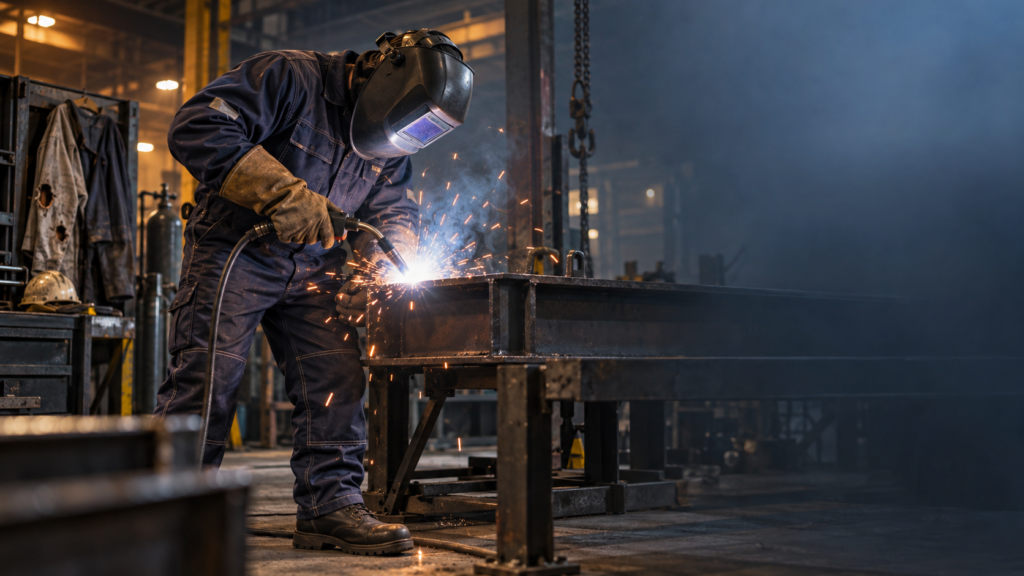
Flame resistant clothing for welders comes as coveralls, two-piece sets and add-on layers. A one-piece coverall leaves no gap at the waist, which matters most when sparks fall from above. A two-piece set lets a welder shed the jacket fast and moves more air. Jackets, aprons, and sleeves add a layer over the FR garment for heavy stick work.
That guide also sets out when a suit or a jacket fits. Buyers who compare coveralls with other one-piece styles can read boiler suit vs coverall. For buyers who want FR coveralls for welders, the workwear range is the place to start.
Design Details to Write Into a Welding Specification
- Collar: pick a high collar that fastens at the neck so sparks cannot reach the throat.
- Pockets: cover them with flaps, or leave them out.
- Legs: finish with a plain hem, no cuffs, and long enough to cover the top of the boot.
- Sleeves: Should fit close to the wrists without restricting shoulder or arm movement.
- Closures: Look for covered fastenings or ones that won’t melt under heat.
- Thread and tape: Make sure FR thread is used. If the garment needs reflective tape, it should be FR-rated too.
- Fit: loose enough for airflow and movement, close enough that cloth does not catch or form folds that hold metal.
Gear Around the Garment
WorkSafe WA says clothing should cover the tops of footwear so sparks cannot fall inside. That rule points to the boots. Safety shoes and boots need a sole and upper made for hot work, and the trouser leg should sit over them.
Leather gloves and a welding helmet complete the set, and each carries its own standard. Sites that need visibility as well as spark protection can look at high visibility wear. The fabric and the tape must both hold flame resistant ratings.
Which Garment for Which Job
A pipe welder in a refinery shutdown and a sheet-metal welder in a workshop face very different risks. The table gives a starting point for what a welder should wear by task.
| Work | Typical position | Starting class | Garment to consider |
| Bench TIG on thin sheet | Seated or standing at a table | Class 1 | FR cotton jacket and trousers, or a coverall |
| Gas welding and brazing | Flat work in open space | Class 1 | FR cotton coverall |
| Stick welding on structural steel | Standing, with vertical and overhead runs | Class 2 | FR coverall, plus leather sleeves or an apron for heavy work |
| Pipe welding in plant turnarounds | Fixed positions, often confined | Class 2 | FR coverall, inherent fiber if the program runs many wash cycles |
| Shipyard hull and tank work | Overhead and confined | Class 2 | FR coverall with leather sleeves or an apron |
| Mixed vehicle and general fabrication | Varies by job | Class 1 or 2 | Match the heaviest process in the shop |
Treat the table as a starting point. The site hazard assessment decides. Flame resistant clothing for welders in the Gulf must also cope with summer heat, so fabric weight and ventilation matter. Armstrong supplies workwear to buyers in the UAE, Saudi Arabia and Qatar.
Procurement Checklist for Flame Resistant Clothing for Welders
- Write the required class (1 or 2) into the purchase order.
- Ask which standard the garment is certified to. EN ISO 11611 should appear by name.
- Request the test report for the fabric batch and the finished garment, including the lab name and test date.
- Confirm in writing whether the flame resistance is treated or inherent, and the rated wash count for treated cloth.
- Inspect a sample for pockets, hems, closures, thread, and tape.
- Run a wear trial with real welders for several shifts before the bulk order.
- Size from actual worker measurements, with extra room across the shoulders.
- Check that logos, embroidery, and prints do not weaken the FR performance.
- Confirm export documents and lead times for your destination.
Our wider flame resistant clothing buyer’s guide covers supplier evaluation in more depth.
Common Mistakes When Buying Flame Resistant Clothing for Welders
- Ordering one class for every welder in the plant.
- Accepting “FR” on a quote without a class or a test report.
- Treating hi-vis cotton drill as flame resistant because the label says it complies.
- Letting welders wear synthetic undershirts under an FR coverall.
- Skipping the wash count for treated garments, so worn-out clothing stays in service.
- Skipping the wear trial and finding fit problems after 200 garments arrive.
Care, Inspection and Replacement
Flame resistant clothing for welders protects only while the finish and the cloth stay intact. Wash according to the label. Skip bleach and fabric softener, since bleach strips FR finishes and softener leaves a flammable residue. Garment makers also warn that dirt, sweat, and humidity can reduce protection.
Check seams, elbows, and hems before each shift. A hole is a gap in the protection. Grease or oil that will not wash out ends the garment’s service. Count the washes on treated cotton and retire it at the rated number, not when it looks tired. Issuing each welder two or three sets lets the clothing rotate and gives it time to dry between shifts.
Sourcing Flame Resistant Clothing for Welders From Armstrong Products
Armstrong Products has manufactured industrial workwear since 2009. Production runs from the Boisar, Maharashtra facility, and the corporate office sits in Powai, Mumbai. The company holds ISO 9001:2015 certification for quality management and ISO 13688:2013 for general requirements of protective clothing.
Fire retardant clothing sits within the work wear range. Bulk buyers can request OEM and private label manufacturing or logo customization. Share the welding process, the working position and the standard your site asks for. The product team will match fabric and garment to that brief.
Key Takeaways
- Flame-resistant clothing for welders must pass welding tests, not only a general flame test.
- Class 1 fits lighter spatter, and Class 2 fits heavier spatter.
- Pockets, cuffs, thread, zips, and tape can defeat a good fabric.
- Treated cotton has a wash limit, and inherent fibers do not.
- Ask for the test report, the class and the wash rating in writing.
- Trial a sample on real welders before a bulk order.
Conclusion
Flame resistant clothing for welders works only when the whole garment is built for welding: fabric, thread, pockets, hems and fit. A coverall that passes a flame test but traps slag in a cuff still burns the wearer. Pick the class from the process and ask for the test report. Then check the design details and wash rules, and trial a sample on real welders before a bulk order.
To discuss a requirement for your welding crews, request the catalog or talk to our product experts about bulk, OEM or export needs.
FAQs
Is flame resistant clothing required for welding?
Rules depend on the country, the employer and the site. Most industrial contractors, shipyards and refineries write FR clothing into their welding permits. Regulators such as WorkSafe WA recommend FR cotton drill for welders. Even where no law names the garment, a hazard assessment that finds molten spatter points to flame resistant clothing for welders. Check the site rules and the client’s PPE specification before issuing any workwear. Contractors who work for several clients should follow the strictest specification on the list.
What should a welder wear?
Start from the skin out. Cotton or FR base layers go next to the body. Over them goes an FR coverall, or an FR jacket and trousers, tested to EN ISO 11611 with the class matched to the process. Add leather gloves, a welding helmet with the right lens shade, and safety boots covered by the trouser leg. Heavy stick work or overhead work may call for leather sleeves or an apron.
Can you weld in a regular cotton shirt?
Only if the shirt is treated to be flame resistant. Untreated cotton ignites and keeps burning, and extra thickness does not change that. Poly-cotton is worse because the polyester melts onto skin. A welding shirt, or better, a coverall, with a test report for its fabric gives a defensible answer. Ask for that report before the shirt goes on the shop floor, since a label alone proves nothing.
What is the difference between flame resistant and flame retardant clothing?
Fabric makers use “resistant” for protection built into the fiber and “retardant” for protection added by a treatment. Everyday speech blurs the two, and many spec sheets treat them as synonyms. For a welder, the label matters less than the evidence. A treated garment can protect well for its rated number of washes. An inherent garment keeps its protection for the life of the cloth. Ask for the test report either way, and ask the supplier to state in writing which type the garment is.
What is EN ISO 11611?
It is the international standard for protective clothing used in welding and allied processes. Labs test fabric and garment design against molten metal splash, radiant heat, and short flame contact. The standard splits garments into Class 1 for lighter spatter and Class 2 for heavier spatter. A garment marked with the standard and its class has passed those tests. A garment with only a general flame resistant claim has not.
What is the difference between EN ISO 11611 and EN ISO 11612?
EN ISO 11611 is meant for welding and related work. EN ISO 11612 deals with heat and flame protection in jobs like foundry and refinery work. A garment that meets one standard may not meet the other. Some tenders ask for both, so check what your client requires. If the garment is certified to both, you’ll find both standards on the label. For welding work, make sure EN ISO 11611 is listed.
Does washing remove flame resistance from welding clothing?
Treated FR cotton is usually rated for 50 to 100 washes, depending on the finish. After that, its flame protection may start to wear off. Bleach and fabric softeners can reduce its life even further. Fabrics made with inherent FR fibers, such as aramid and modacrylic blends, don’t lose their flame resistance through washing, but the material can still wear thin over time. Keep a record of washes for treated garments and replace them once they reach their rated limit. For inherent FR clothing, regularly check the elbows, cuffs and seams for wear.
Do welders need flame resistant base layers?
Anything worn under the coverall should be cotton or flame resistant. WorkSafe WA warns that loose-weave undergarments burn easily and that a burning undershirt can ignite the outer garment. Many welders wear a plain cotton tee in summer heat and add an FR thermal layer in winter. Keep the base layer dry and clean too, since sweat and oil weaken protection.
Can hi-vis workwear be used for welding?
Hi-vis alone does not make a garment safe for welding. The fabric and the reflective tape both need flame resistant ratings, because standard hi-vis polyester melts and untreated hi-vis cotton can ignite. FR hi-vis garments exist for sites that need visibility and spark protection together. Ask for test reports on the cloth and the tape.
Can flame resistant welding clothing carry company branding?
Most manufacturers offer logo embroidery, colour coding and custom size runs on bulk orders. Confirm during quoting that the thread, badge material and any print do not weaken the flame resistant performance of the garment. Armstrong Products offers OEM and private label manufacturing as well as customisation and branding for bulk requirements. A welding crew’s uniform can then carry a company identity.