
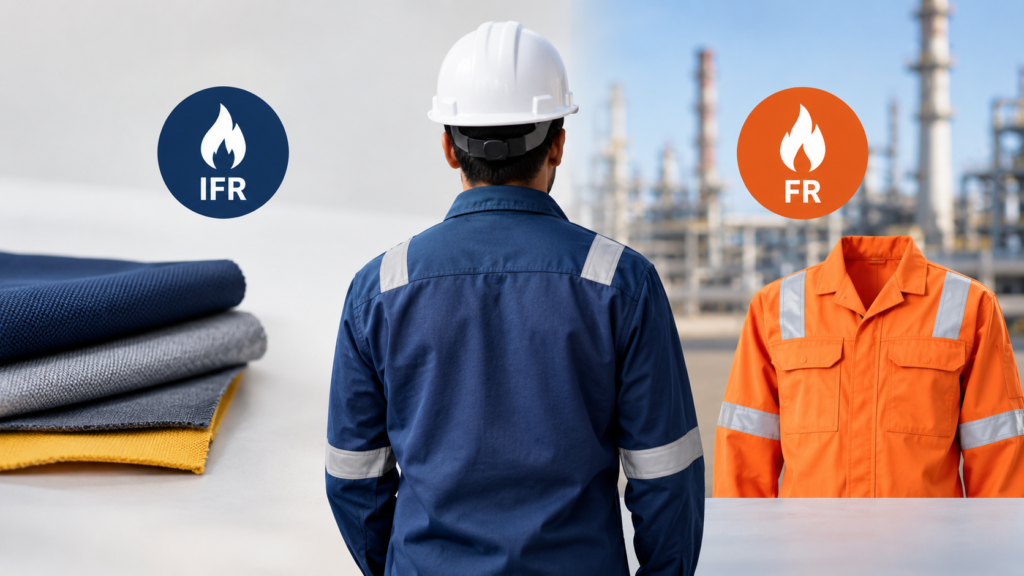
Two quotes come in on the same morning. One is for an FR coverall, while the other is for an IFR suit. Both have the same fabric weight and reflective tape. A colleague looks at them and says the IFR suit is the “better FR” option, so you approve it.
This is an easy mistake to make when selecting workwear. IFR suits and treated FR suits can both provide flame resistance, but they do it differently. That difference matters over the life of the garment, especially after repeated washing, and it also affects the tests the garment must meet.
Quick answer: An IFR suit is a coverall or boiler suit made from inherently flame-resistant fabric. IFR stands for Inherently Flame Resistant. The flame resistance sits inside the fibre, so washing cannot remove it. FR clothing is the wider group. It covers every IFR suit and every treated cotton suit that gets a chemical finish.
What Is an IFR Suit? Full Form and Meaning
IFR stands for Inherent Flame Resistant. Some suppliers write Inherently Flame Retardant. Both spellings point to one idea. The fiber resists flame because of how it is built at the molecular level. No finish sits on top of it.
The IFR suit is the finished garment. Indian suppliers also list it as an IFR coverall or an IFR boiler suit. The cut looks like any industrial coverall, with a front zip, chest pockets, an adjustable waist and reflective tape.
The fiber is where it differs. Modacrylic, aramids such as Nomex, and wool are the common inherent fibers, and makers often blend them with cotton or antistatic yarn for comfort.
Two spec examples show the range. A typical IFR coverall at 180 GSM uses 60% modacrylic, 38% cotton, and 2% antistatic fiber. Aramid versions are often sold as 93/5/2, a blend of meta-aramid, para-aramid, and antistatic fiber.
FR Clothing Explained: The Umbrella Term
FR means flame resistant. It describes what a garment does in a fire. The fabric resists ignition and stops burning once the flame source goes away. The term says nothing about how the fabric got that ability.
Two routes exist. Inherent flame-resistant clothing carries the protection in the fiber. Treated fabrics start as cotton or a cotton blend and receive a chemical finish after weaving. No third route covers the market.
So “IFR vs FR” sets one route against the umbrella. The fair comparison is an IFR suit against a treated FR suit. Armstrong makes both, and treated cotton coveralls often go by FR or FRC in tenders.
Wording adds to the confusion. The words resistant and retardant have no official split in everyday trade use, and suppliers swap them at will. Treat the labels as sales language. Fiber content and a test report carry the real information.
IFR Suit vs FR Clothing: Side-by-Side Comparison
| Factor | IFR suit | Treated FR suit |
| How flame resistance is built | Inside the fiber | Chemical finish on cotton or blends |
| Typical fabrics | Modacrylic blends, aramid blends, FR viscose blends | 100% cotton, cotton and nylon |
| Effect of washing | Protection stays with the fiber | Depends on the finish and the care |
| Laundry control needed | Low | High |
| Weight and feel | Often lighter and more breathable | Often heavier |
| Wear life | Follows the physical condition of the fabric | Limited to the tested number of washes |
| Best fit | Long contracts, frequent wear | Short contracts, occasional wear |
How an IFR Suit Handles Washing and Wear
An IFR suit keeps its protection through laundering because nothing washes out of the fiber. Performance holds even when the laundry ignores the care label.
Treated fabric follows other rules. It keeps protection for an indicated number of wash cycles, and the laundry must follow the maker’s instructions to get there.
Modern treated cotton has outgrown its old reputation. To carry NFPA 2112, the flash fire standard, a fabric must keep its flame resistance through repeated industrial washing. The IFR advantage is tolerance for rough laundering and a lighter feel. Treated cotton can still meet the standard.
8 Mistakes Procurement Teams Make With IFR Suits
1. Treating IFR and FR as rival grades
Tenders often state that “IFR is preferred over FR,” which can make IFR sound like the better level of protection. But the fiber itself does not determine how well the garment protects. A treated cotton suit that meets the required standard can pass the specification, while an IFR suit with weaker performance may not.
Write the hazard and the standard into the tender. Then compare the two routes on wash life and laundry control.
2. Trusting the product name
Search “ifr suit,” and some results lead to IFR Workwear, a Canadian brand. The letters are part of the company name. A product title carrying IFR tells you about the seller. It tells you nothing about the fiber.
Ask for the composition with percentages. Ask the supplier to state in writing whether the FR method is inherent or treated.
3. Assuming an IFR suit is fireproof
No FR garment is fireproof. FR clothing resists ignition and goes out fast, but it does not prevent injury. The suit buys seconds. Heat can still reach the wearer.
Put this in the safety briefing. A worker who believes the suit is fireproof takes risks that the suit cannot cover.
4. Checking the fabric and forgetting the trims
A flame-resistant fabric sewn with ordinary polyester thread has a weak point. The thread melts, and the seam opens. The same goes for non-FR zips, snaps, labels, and reflective tape.
An IFR suit needs FR thread, FR tape, and FR hardware. Ask for a bill of materials and check the seams on a sample.
5. Skipping the hazard check
Flash fire, arc flash, welding sparks, and molten metal each call for a different standard. NFPA 2112 addresses flash fire, and EN ISO 11612 addresses heat and flame. Electric arc falls under IEC 61482-2. Welding falls under ISO 11611.
An IFR suit does not carry an arc rating by default. Sites with arc risk need the rating printed on the label.
6. Forgetting what goes underneath
Polyester and nylon base layers melt and stick to skin. A good IFR suit over a synthetic vest loses much of its value. Put the base layer in the PPE matrix, and name cotton or FR underwear as the standard.
7. Accepting a fabric certificate for the finished suit
A report for the fabric roll is not enough to assess a finished garment. It covers the fabric, but not the performance of seams, zips, or tape. So ask for both reports before deciding. Our guide explains the difference between in-house testing and third-party lab certification and what each report shows.
8. Ignoring how the suits are actually washed
It is easy to focus on the spec sheet and overlook what happens after the suit reaches the site. Camp laundries often wash mixed loads at high temperatures, and that repeated treatment can be hard on treated FR suits. With an IFR suit, the protection is part of the fiber, so it is better suited to this kind of washing.
Find out who washes the suits before you pick the route.
IFR Suit or FR Suit: Which Should You Buy?
Contract length and wear pattern drive most of this choice. Long contracts with frequent wear favor an IFR suit. Short shutdown jobs can work with treated FR. The table below sets out the split.
| Your situation | Better fit | Reason |
| Long contract, suits worn often | IFR suit | Protection stays through repeated washing |
| Short shutdown job, suits worn for weeks | Treated FR suit | Wear life of the fabric matches the contract |
| Hot climate, long shifts | IFR suit, if the blend is light | Lower fabric weight helps comfort |
| Laundry not supervised | IFR suit | Fiber protection survives poor washing |
| Arc flash risk present | Either route | Choose by arc rating, not by fiber |
| Hydrocarbon flash fire risk | Either route | Choose by NFPA 2112 or EN ISO 11612 results |
Fabric Choices Inside an IFR Suit
Not every IFR suit uses the same fiber. The blend changes feel, wear life, and fit for the site.
| Fabric | Typical blend | Where it fits | Ask the supplier |
| Modacrylic and cotton | For example, 60/38/2 with antistatic fiber, near 180 GSM | General plant and refinery work | Fiber ratio and GSM |
| Aramid blend | Often 93/5/2 | Long wear life and higher heat exposure | Fiber ratio and weight |
| FR viscose blend | FR viscose mixed with other fibers | Cotton-like comfort | Full blend ratio |
Our deeper comparisons cover the two most common choices. See modacrylic versus aramid IFR coveralls for refinery buyers, and when a Nomex coverall beats FR cotton.
IFR Suit Spec Checklist for Tenders
Paste these into your RFQ. Each line closes a gap that vendors use.
- The hazard and the standard the IFR suit must meet.
- Fabric composition with percentages, plus GSM.
- A written statement of the FR method, inherent or treated.
- Fabric and garment test reports from an accredited lab.
- FR thread, zips, snaps, tape, and labels, listed by name.
- An antistatic requirement where flammable vapors exist.
- The wash-cycle claim and the exact care label wording.
- Size range, plus sample approval before bulk production.
- Color and hi-vis requirement, with the tape class.
- Branding method, such as embroidery, and its effect on FR performance.
- Export packing and carton labeling.
Where IFR Suits Are Used
Refineries and petrochemical plants carry hydrocarbon flash-fire risk. An IFR suit suits operators and shutdown crews in these units, because frequent wear and heavy washing are normal there.
Power utilities and electrical maintenance teams face arc flash. Here, the arc rating decides the purchase. Chemical plants add splash risk, which an IFR suit does not cover on its own. Buyers should check the chemical splash standard, such as EN 13034, as a separate line in the spec.
Welding-adjacent hot work areas need a welding standard on the label. An IFR suit made for general flame protection may not carry it.
Care and Maintenance of an IFR Suit
An IFR suit tolerates rough laundering, but it still wears out. A few habits extend its life.
- Wash by the label. Check the maker’s advice on bleach and softener.
- Keep fuel- or oil-soaked suits out of service until you clean them as the label directs.
- Inspect seams, knees, cuffs, and tape after each wash cycle.
- Repair with FR thread and FR patches only.
- Retire suits with tears, thin patches, burn marks, or failed tape.
How Armstrong Products Approaches the IFR Suit
Armstrong Products has manufactured industrial workwear since 2009. Production runs at the Boisar, Maharashtra facility, and the corporate office sits in Powai, Mumbai. The range includes FR coveralls, IFR coveralls, and FRC coveralls, with OEM and private-label options and export-ready packing.
Ask any supplier for fiber ratio, GSM, and trim details before you compare quotes. Armstrong included.
Key Takeaways
- FR describes the result. Inherent and treated describe the route.
- An IFR suit keeps protection through washing and tolerates poor laundry practice.
- A product name tells you nothing about fiber. Composition does.
- Hazard, standard, and trims belong in the tender, not just the fabric.
- Contract length and laundry control should drive the IFR or FR choice.
Conclusion
An IFR suit and a treated FR suit can both provide protection, but in different ways. The right choice depends on the site hazards, the required standard, and the suit’s trims. Instead of choosing based on the product name alone, include these details in the specification. Also consider how long the contract will run and how the suits will be laundered.
Ready to compare options for your site? Request the Armstrong catalog, talk to our product experts about bulk requirements, or discuss OEM, private label, and export orders. Contact us with your hazard and site details, and we will point you to the right IFR suit or FRC option.
FAQs
What is the full form of IFR in an IFR suit?
IFR stands for Inherently Flame Resistant. Some suppliers write Inherently Flame Retardant, and both mean the same thing. The flame resistance comes from the fiber, not from a finish applied to cotton. An IFR suit is the coverall or boiler suit made from that fabric, and Indian listings often use the boiler suit name.
What is the difference between IFR and FR clothing?
FR clothing is the wider group. IFR clothing is one type of FR clothing, where the fibre carries the protection. Treated FR clothing is the other type, where cotton receives a chemical finish after weaving. The difference shows up in wash behavior and in fabric weight. Both can meet a test standard when made well, so ask for the report, not just the label.
Is an IFR suit better than an FR suit?
Not always. It really depends on the job. IFR suits can be a better choice for long-term contracts, regular use, or sites where the employer does not manage the laundry. For a short shutdown project, a treated FR suit may be a practical option, especially when the job is short-term.
Don’t decide the level of protection based on fiber type alone. Start with the hazards involved and the required test standard. When comparing suppliers, ask for the fabric composition and relevant test reports, and make sure you are comparing products on the same basis.
Does an IFR suit lose flame resistance after washing?
Flame resistance in an IFR suit sits in the fiber, so washing does not strip it out. The fabric can still wear thin, tear, or pick up fuel and oil, and each of those problems cuts safety. Inspect the suit after every wash cycle, follow the care label, and pull damaged or contaminated suits from service.
Which fabrics are used in an IFR suit?
Modacrylic and cotton blends, aramid blends, and FR viscose blends are the common choices. A common blend is 60% modacrylic, 38% cotton, and 2% antistatic fiber at 180 GSM. Aramid versions often use a 93/5/2 split. Each blend changes comfort, weight, and wear life, so request the exact ratio and GSM before you approve a sample. A swatch in hand tells you more than a brochure line.
Is an IFR suit fireproof?
Fireproof is the wrong word for any FR garment. An IFR suit resists ignition and stops burning once the flame source is removed, giving the wearer time to move clear. Heat can still cause injury, so brief your crews on that limit before they start work. A suit soaked in fuel or oil also loses its margin and should come out of service.
Can an IFR suit protect against arc flash?
Yes, but only if the IFR suit has an arc rating tested to a relevant standard, such as IEC 61482-2. Simply using inherently flame-resistant fibers does not mean the suit provides arc-flash protection.
Electrical sites should specify the required arc rating in the tender and verify it against the label of the suits supplied. The clothing worn underneath also matters. A synthetic base layer can melt when exposed to arc heat and may worsen burns. For this reason, the approved base layer should also be listed in the PPE matrix.
It is also good practice to check sample labels before sending suits for bulk dispatch.
How long does an IFR suit last?
Life depends on fabric weight, task, laundering, and care. The flame resistance stays in the fiber, so the limit is physical wear. Seams open and knees thin. Reflective tape cracks. Inspect suits after each wash and set a retirement rule based on condition rather than a calendar date. Burn marks or failed tape mean the suit leaves service at once.
Who should choose an IFR suit over a treated FR suit?
An IFR suit makes more sense for crews who wear their workwear regularly throughout a long contract. It can also be a better choice where garments go through mixed laundry loads or where a lighter fabric is more comfortable in hot weather. Refinery operators and long-term plant contractors are good examples.
For a short shutdown job, treated FR may be the better choice. The suits may not go through enough washes for wash life to become a major concern. Just check the required standard and the arc or flash-fire rating before ordering. Keep some time aside for sample approval too.
What should a tender list for an IFR suit order?
Start by mentioning the hazard and the applicable standard. Then include the fiber composition and percentages, GSM, FR treatment, and the fabric and garment test reports. Details of the FR thread, zips, tape, and labels should also be covered. Add the wash-cycle claim, available size range, sample approval, and export packing details. If the garments are being used where flammable vapors are present, clearly mention any antistatic requirements.