
A procurement manager from Jubail told us that her team had lost six weeks and a container of coveralls because no one had checked the fabric lot number on the pre-production sample against that on the bulk shipment; the garments appeared to be the same,, but the lab report was inconsistent. That one step being overlooked turned what should have been a normal FR workwear order into a compliance investigation.
This is exactly what the FR workwear sample approval process is meant to achieve; it acts as the point at which a supplier’s promise becomes a factory’s output, and in the case of flame resistant clothing being sent to a GCC oil, gas, or petrochemical site, making a mistake involves a greater level of risk than having a poorly fitted jacket. The following guide outlines what should be requested, what should be verified, and how long the process actually takes before a large-scale FR order should proceed.
What is the process for obtaining approval of FR workwear samples?
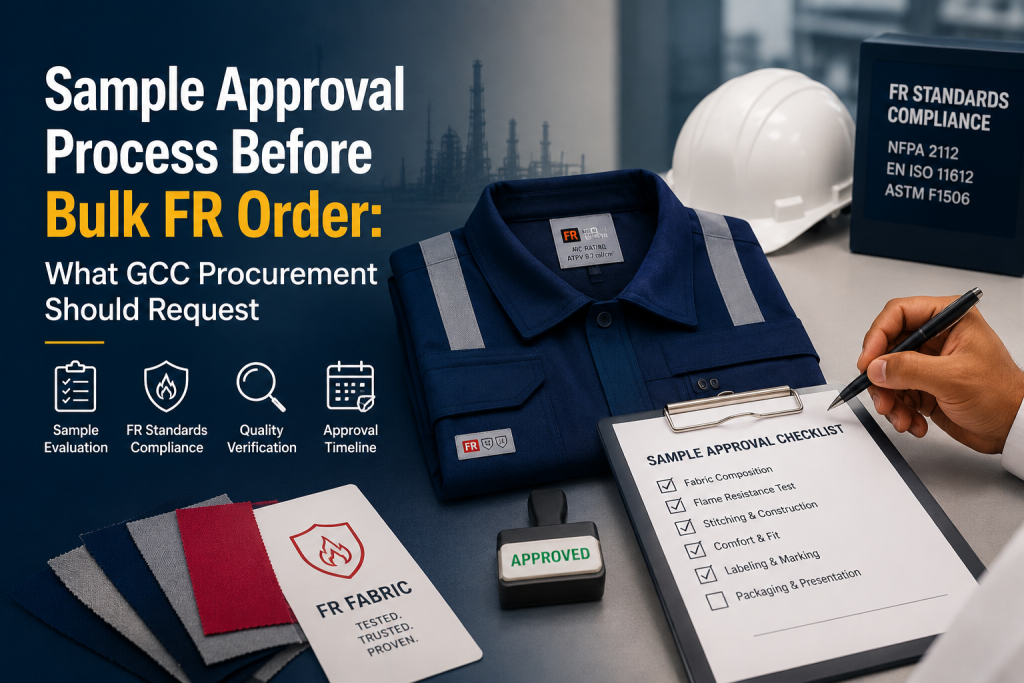
The review stage of the FR workwear sample approval process is the point at which a buyer examines the physical samples of the garment and then approves them before the manufacturer begins mass production. In the case of flame resistant clothing, this review includes two aspects that are not usually covered by standard workwear sampling: the garment’s construction (including fit, stitching, and sizing) and its flame resistant performance (which involves fabric certification, lab test reports, and, where applicable, an arc rating).
A sample may appear correct but still fail when tested on the second layer, and a coverall can have seams that are perfect and a fabric that has never been tested to NFPA 2112 or EN ISO 11612. That is why FR sample approval should have its own checklist, rather than using the general apparel process most buyers are already familiar with.
Why This Step Matters for Bulk FR Orders in the GCC
Failing to approve samples, or hurrying through the approval of samples, when it comes to flame resistant workwear results in two types of risk simultaneously: a financial one and a safety one.
The financial risk is clear in this case: if an order for 3,000 coveralls is placed on a sample that has not been verified, the item might arrive with the wrong GSM, the wrong stitch density, or reflective tape that fails after just a few washes. The cost of having to rework or discard a large shipment is much higher than the two or three weeks it takes to properly review a sample.
The danger in this regard is more difficult to remedy. Even FR fabric that has not been tested in the laboratory, or that was tested on a batch of fabric different from the one actually used for production, can pass a visual inspection and yet fail to protect a worker during a flash fire. For contractors who are supplying services to Aramco, QatarEnergy, or KOC sites, there is also a problem relating to documentation; auditors are now requiring the sample approval record to be provided together with the finished garment, not merely the certificate on file.
Types of Samples in the FR Workwear Approval Process
Most buyers in the GCC only have one sample shown and therefore suppose that this is all there is. A properly conducted FR order generally goes through three separate stages, each of which provides different evidence.
| Fit sample | Sizing, cut, mobility, pocket and closure placement | Safety manager or end-user representative |
| Pre-production sample (PPS) | Fabric lot, stitching method, trims, labeling, and FR performance match the final spec | Procurement lead, with lab report review |
| Top-of-production sample (TOP) | The production line is actually reproducing the approved PPS at scale | QC or third-party inspector |
The garment can be said to be wearable if a fit sample is available. It is at the stage of the pre-production sample that the actual FR workwear sample approval process takes place, since it is here that the fabric, trims, and construction are finalized. A TOP sample, which is taken after production has begun, picks up any deviations before the entire order is dispatched. Asking for just a fit sample and omitting the PPS is the most common kind of shortcut, which results in mismatched bulk shipments.
What to Verify in FR Workwear Samples
The section that many buyers give short shrift to is flame resistant clothing since a simple visual inspection is not sufficient. Before they approve a sample, procurement teams should check each of the following points against the supplier’s documentation, not merely the garment itself.
The GSM should match that on the specification sheet, allowing for the stated tolerance (usually plus or minus 5 percent), and a lower fabric weight can quietly decrease thermal protection.
We need to confirm whether the fabric is inherently flame resistant or treated FR cotton, as there are different expectations regarding wash life in the two cases and the garment should therefore be labeled accordingly.
The test report together with the batch number should be provided. The sample must be accompanied by a test report from an accredited laboratory and the batch number on that report must correspond to the batch of the fabric roll from which the sample was cut. A report relating to a different batch says nothing about the garment in question.
When it comes to the accuracy of the certification mark and label, make sure that the label states the correct standard (NFPA 2112, EN ISO 11612, or both in the case of dual compliance), includes the arc rating in cal/cm² if the garment is arc rated, and gives the name of the manufacturer’s certification body.
The type of stitching and the kind of thread. Flame-retardant (FR) garments must use flame-retardant (FR)-rated thread because standard polyester thread can melt instantly in a flash fire even if the outer fabric does not.
Regarding trimmings and hardware, zippers, buttons, and snaps should be made of a material that does not melt, and where the application requires it, they should be either metal-free or heat-resistant to prevent them from posing a secondary burn hazard.
When it comes to reflective tape used on high-visibility, flame-resistant coveralls, it is necessary to make sure that the tape is rated for surviving flame exposure and not just for standard industrial washing.
With respect to FR clothing, stress-relief pleats and seam construction are more important than with ordinary workwear, since if a seam tears out during heat exposure,, the protection is lost precisely where it is needed most.
Documents and Test Reports Procurement Teams Should Request
A sample without the necessary documentation is merely a piece of clothing; therefore, ask for the documents at the same time as the physical sample, before it is sent for approval.
| Lab test report | Standard tested (NFPA 2112, ASTM F1930, ASTM D6413), batch number, test date, accredited lab name |
| Fabric mill certificate | Fiber content, GSM, FR classification, and whether it matches the sample fabric lot |
| Care and wash-cycle guidance | Number of industrial washes the fabric retains FR performance for |
| Size specification sheet | Measurements per size, tolerance range, grading rules |
| AQL inspection standard agreed for bulk | The acceptable quality level for the final shipment should be agreed in advance, usually using the sampling tables in ISO 2859-1 . |
Buyers who ask for a certificate without also having a report attached to the specific batch of fabric are most likely to receive a bulk shipment that does not match what they approved.
Sample Approval Timeline for Bulk FR Orders
The procurement teams of GCC usually think that getting a sample approved will add a week to the project, but in reality a well-managed process for flame resistant workwear takes about three to five weeks to go from the first request to the point at which the bulk purchase order is released, depending on the number of revision rounds that are required.
| Sample request and fabric sourcing | 5–8 working days |
| First sample production and shipping | 7–12 working days |
| Buyer review, lab report cross-check, and feedback | 3–5 working days |
| Revision round (if required) | 7–10 working days |
| Final sample sign-off | 2–3 working days |
| Bulk PO release and production start | Immediate after sign-off |
It is realistic rather than pessimistic to plan for a single round of revisions. Generally, the majority of FR orders require at least one modification, most frequently relating to fit or trim, before the pre-production sample is ready for final approval. The most frequent reason large-scale FR shipments differ from the approved sample is to speed up this process to meet a delivery date.
FR vs IFR: What Changes in Sample Approval
The way in which the sample approval process is carried out varies according to whether the garment is made from a fiber that is inherently flame resistant or from treated FR cotton.
With IFR garments, it is the fiber that possesses the flame resistant property, and in this case verification depends on checking the fiber content and ensuring that the fabric mill is certified as IFR. In the case of FR cotton that has been treated, an extra step is required: one must verify the treatment process and ask for the wash-cycle test data, as treated fabric can lose its flame resistant performance after a certain number of industrial launderings. Just because a sample has been approved on day one does not mean that the same level of protection will be provided after wash cycle fifty unless the mill has carried out tests to confirm this.
Common Mistakes GCC Buyers Make During Sample Approval
Approval is based solely on fit. A sample that fits properly but has never been cross-checked with its lab report is approved on the basis of appearance, not on its performance.
The batch numbers don’t match: approving a sample from one fabric batch and then permitting the bulk production to proceed with a different batch without having a new test report.
We’re going to skip the TOP sample; instead of confirming the production line, we’ll treat the pre-production sample as the final check.
Taking up a general certificate; a certification mark accompanied by no batch-specific test report gives the buyer very little information regarding the garment they have.
To compress the timeline under pressure from the delivery side, we shortened the revision round in order to meet the shipping date and then dealt with the cost of the mismatched bulk order later.
Sample Approval Checklist for Procurement Teams
- Check that the fabric weight and composition match the specification sheet.
- Make sure the lab test report is linked to the same fabric batch used for the sample.
- Verify that the certification standard and arc rating are printed correctly on the garment label.
- FR-rated thread used throughout, not just on visible seams
- Trims and hardware are non-melting and application-appropriate
- If reflective tape is used, check that it is also FR-rated.
- Get the approved size specifications and tolerances confirmed in writing.
- Agree on the AQL standard for bulk inspection before production begins.
- Review both the pre-production sample and the TOP sample, rather than approving the fit sample alone.
- Revision round built into the timeline before committing to a delivery date
How Armstrong Products Approaches Sample Approval for Bulk FR Orders
Armstrong Products has been making industrial workwear since 2009 at its plant in Boisar, Maharashtra, and its corporate headquarters are located in Powai, Mumbai. When GCC buyers place large orders for flame retardant fabric, there is a documented pre-production sample stage, during which the fabric batch records are linked to the laboratory test reports before mass production starts. Buyers who are involved in private label and OEM programs can ask for sample approval to be included in the production schedule from the very first quotation, rather than having it dealt with as a separate stage afterward.
Conclusion
The FR workwear sample approval process is not just another paperwork step. It is the point where a supplier’s claims are checked against what will actually be produced and shipped months later.
For GCC procurement teams, asking for lab reports that match the batch, reviewing pre-production and TOP samples separately, and allowing enough time for each approval stage can prevent serious problems later. The biggest risk is approving a bulk order that looks correct but fails to perform when it is needed most.
If you are planning a bulk FR coverall order, ask the supplier to provide the sample review timeline in writing before production begins.
FAQ’s
What is the procedure for obtaining approval of fabric samples for use in workwear?
At the review stage, a buyer examines garment samples together with the fabric and lab test documentation before giving approval for a supplier to start bulk production; in the case of flame resistant clothing, the construction and the FR performance are checked separately since it is possible for a garment to pass one of these tests and still fail the other.
How long does it take to approve a FR workwear sample before placing a bulk order?
It usually takes from three to five weeks to go from the first request for a sample to the final approval, including one round of revisions. The main reason for bulk shipments differing from the approved sample is this period.
When asking for an FR workwear sample, which documents should I request?
Get a lab test report linked to the sample’s fabric batch number, together with a certificate from the fabric mill, the wash-cycle performance data, and a size specification sheet that states the tolerances.
What is the difference between a TOP sample and a pre-production sample?
A pre-production sample is used to fix the fabric, construction, and trims before mass production, while a TOP sample, which is taken after production has started, checks that the production line is actually reproducing the approved standard on a large scale.
Is the procedure for approving the sample different for IFR cotton as compared to treated FR cotton?
The sample review of IFR material concentrates on fiber content and mill certification since it is the fiber that possesses the flame resistant property. With treated FR cotton, it is necessary to carry out an additional check on the wash-cycle test data because the treatment can lose its effectiveness after a number of industrial washings.
When carrying out sample approval, what should I check on the FR label?
You should verify the standard that was tested (NFPA 2112, EN ISO 11612, or both), the arc rating in cal/cm² if the garment has an arc rating, and the name of the certifying laboratory. The label should be questioned before being approved if it is missing any of these details.
May I give my approval for a sample simply on the basis of the supplier’s certification?
A certification mark shows that the fabric type complies with a standard; it does not indicate that the specific batch used in your garment has been tested. You should always ask for the batch-matched lab report together with the certificate.
What happens if the bulk shipment does not match the approved sample?
Buyers should request a corrective action report, batch-level retesting, and, depending on the scale of the mismatch, a rework or replacement order. This is why agreeing on an AQL inspection standard before production starts matters, since it gives both sides a documented basis for the claim.
How many rounds of sample revision should I expect?
Budget for at least one revision round, usually on fit or trim. Treated FR fabric orders sometimes need a second round if initial wash-cycle data comes back short of the required standard.
Should procurement or the safety manager approve the final FR sample?
Both. Procurement should confirm the commercial and documentation side (batch numbers, lab reports, and timeline), while the safety manager or an independent inspector should verify the garment against the technical spec before the bulk PO is released.