

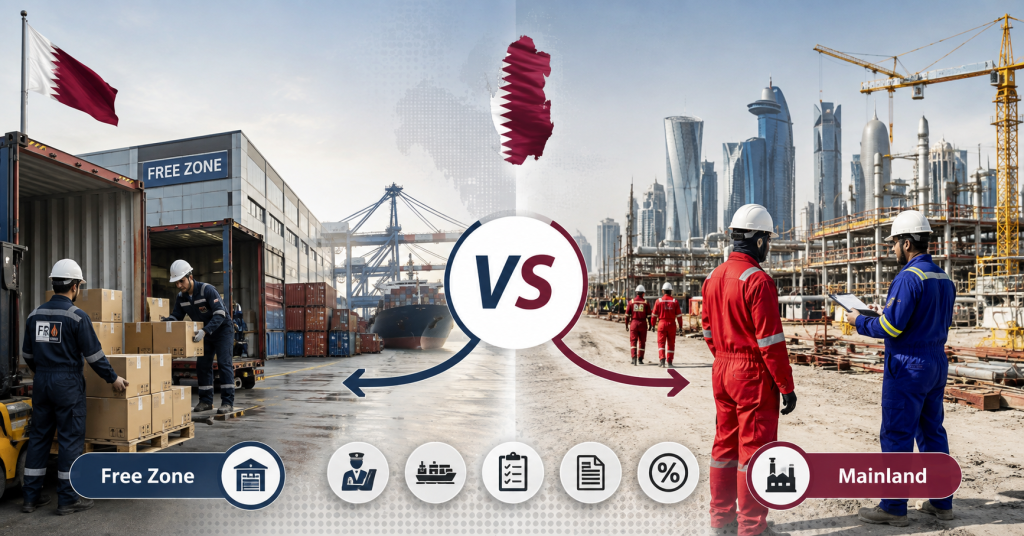
Qatar’s LNG terminals, refineries, and construction sites go through flame-retardant coveralls by the thousand every year. Before a single container leaves the factory, the buyer has to answer a question that has nothing to do with fabric or fit: Should this shipment enter through a Qatar free zone or clear customs on the mainland?
Get that decision wrong, and the cost shows up later. Duty gets paid twice. Coveralls sit in a bonded warehouse when they should be on site. A container gets held at the port because the HS code on the invoice does not match what is inside the box. For procurement teams handling bulk FR clothing imports into Qatar, the free zone versus mainland choice is a supply chain decision, not paperwork.
This guide walks through both routes, what each one means for Hamad Port logistics, and the product details that matter once the coveralls actually reach a Qatari worksite.
Why the import route decision comes before the purchase order
Most buyers plan FR clothing procurement around size ratios, delivery dates, and fabric specifications. The Qatar entry route rarely gets the same attention, even though it decides how much duty gets paid, how the goods are stored, and how fast they move to the final site.
Qatar offers two main paths for imported goods. One runs through a free zone, where the Qatar Free Zones Authority (QFZA) manages Ras Bufontas, next to Hamad International Airport, and Umm Alhoul, next to Hamad Port. The other is a direct mainland import through Doha, where standard GCC customs rules apply from the moment the container touches the dock.
Neither route is universally better. The right one depends on who is buying, how the coveralls will be used, and whether part of the order needs to move on to another GCC country later.
Qatar free zone sourcing: Ras Bufontas and Umm Alhoul
How the free zone duty exemption works
Under Qatar’s Free Zones Law, free zones sit outside the state’s customs territory. Goods brought in for approved processing, storage, or re-export do not attract import duty while they remain inside the zone, since raw materials and finished goods held for these purposes are treated as never having entered Qatar’s customs territory in the first place.
Umm Alhoul is the zone that matters most for bulk FR clothing shipments moving by sea. It sits directly adjacent to Hamad Port, which gives container shipments a short, controlled path from vessel to bonded warehouse. Ras Bufontas, next to Hamad International Airport, suits smaller or time-critical air freight orders rather than full container loads of coveralls.
When free zone entry makes sense for FR clothing buyers
Free zone sourcing works well for:
- Distributors who plan to resell FR coveralls to buyers in more than one GCC country from a single Qatar base
- Importers who need to hold months of stock without paying duty on inventory that has not sold yet
- Companies that expect order volumes to shift and want the option to release stock to the mainland in phases
It suits regional stockists more than a single contractor buying coveralls for one project site.
Mainland import through Doha: the direct route to site
A mainland import clears Qatar customs immediately, with no re-export step and no bonded storage stage. Coveralls move from Hamad Port straight to the buyer’s warehouse or project site.
As a member of the GCC Customs Union, Qatar applies a 5 percent tariff on general cargo, including textiles and clothing. That duty is paid once, at entry, and the goods are then free to move anywhere in Qatar.
Getting the HS classification right
Protective and industrial clothing is not always classified the same way as ordinary garments. Agreeing the correct HS code with the customs broker before the shipment leaves origin prevents delays at Hamad Port, where a mismatch between the invoice description and the tariff code is one of the more common reasons a container gets pulled for inspection. This matters more for FR clothing than standard workwear since flame-retardant fabric and finishes can change how customs officers read the classification.
Mainland import suits contractors and end users bringing coveralls directly onto their own sites, with no plan to resell or move stock across borders.
Free zone vs mainland: side by side
| Factor | Free Zone (Ras Bufontas / Umm Alhoul) | Mainland (Doha, via Hamad Port) |
| Customs duty on entry | Deferred while goods stay in the zone for storage or re-export | 5 percent GCC tariff paid at clearance |
| Ownership requirement | 100 percent foreign ownership permitted under QFZA | Standard mainland registration rules apply |
| Best suited to | Distributors, regional stockists, multi-country resellers | Contractors and end users delivering to one Qatar site |
| Onward movement to site | Requires a second customs step once goods leave the zone | Goods move directly to site after clearance |
| Storage before use | Bonded warehousing available inside the zone | The buyer arranges its own warehousing after clearance |
| Order pattern that fits | Large stock held for phased release | One-time or project-linked bulk orders |
Hamad Port and the physical journey of a bulk shipment
Hamad Port is Qatar’s main seaport and the entry point for both routes. It is capable of handling up to 7.8 million tonnes of cargo a year, with the depth and berths to receive some of the largest container vessels calling at Gulf ports.
A typical bulk FR clothing shipment travels as a full container load from the manufacturing origin, arrives at Hamad Port, and then splits into one of two paths. Free zone bound cargo moves a short distance into Umm Alhoul for bonded storage. Mainland-bound cargo clears customs at the port and continues directly to the buyer.
Free zone companies are not fully cut off from the mainland market either. A Qatar free zone company can sell FR clothing to a mainland contractor, but that sale still goes through standard customs procedure once the physical goods cross into mainland territory. In practice, the duty is deferred, not avoided, if the coveralls eventually reach a mainland end user.
FR clothing product specifications Gulf buyers should check
Fabric construction: FR-treated cotton vs inherently FR blends
Bulk orders for Qatar’s oil, gas, and construction sectors usually come down to two fabric choices. FR-treated cotton starts as ordinary cotton fabric with a flame-retardant finish applied during processing. It is breathable, familiar to most workers, and a practical choice for roles with moderate heat exposure. Inherently FR fabric, usually an aramid blend, has the flame resistance built into the fiber rather than added as a coating, so the protection does not wash out over the life of the garment. It costs more to produce, but it holds up better for higher-hazard roles and repeated industrial laundering.
Most bulk coverall orders for Qatar fall in a fabric weight range of roughly 220 to 280 GSM. Lighter fabric helps with heat stress in Qatar’s climate. Heavier fabric resists abrasion and repeated laundering better, so the right weight depends on the job, not just the fabric type.
Coverall design details that affect comfort and durability
Small details separate a coverall that lasts one project from one that lasts three.
- Stitching thread rated for flame resistance, not standard polyester thread that can melt under heat
- Back yoke vents and underarm gussets for airflow in high-temperature site conditions
- Metal-free or covered closures where spark risk matters, with stud or snap options depending on the site’s hazard profile
- Reinforced knees and elbows for crawling or bending work
- Elasticated waistbands and cuffs sized for a range of body types across a mixed international workforce
These are the details a site safety officer checks on day one, well before anyone looks at a compliance certificate.
Planning size ratios and packaging for bulk container orders
A container that arrives with the wrong size spread creates a second procurement problem before the first one is solved. Buyers with existing workforce data should share it with the supplier so the size ratio matches the actual site population, instead of defaulting to a generic small-to-extra-large split.
For sea freight, individual poly-bagging protects against humidity inside the container during the multi-week transit from India to Hamad Port. Carton weight should stay within a range site storekeepers can handle manually, and each carton should carry a label matching the purchase order number, so receiving staff can check the shipment against site requirements without opening every box.
Bulk FR clothing import Qatar strategy: free zone, mainland, or both
Most FR clothing buyers do not have to pick one route forever. A hybrid approach is common: hold a base stock in a free zone warehouse and release it to the mainland in batches that match project mobilization dates. This keeps working capital lower than clearing the full order at once, while still giving the site team coveralls when they need them, not whenever a shipment happens to arrive.
Procurement decision checklist
- Confirm the final destination of the coveralls: a single mainland site, or possible re-export to another GCC country
- Confirm whether the buying entity already holds a QFZA license or would need to register with a free zone company
- Check in-country storage capacity against order volume, since free zone bonded storage only helps if there is a plan for phased release
- Confirm the customs broker has handled protective and FR clothing classification before, not just general apparel
- Ask the supplier whether a single order can be split across both routes if part of it needs to move on to another country
Armstrong Products has been manufacturing industrial and FR workwear since 2009, from its production facility in Boisar, Maharashtra. The company ships bulk orders to Gulf buyers on a regular basis and prepares export documentation that works for either a free zone or a mainland Qatar entry, including invoices with HS classification agreed in advance with the buyer’s customs broker.
Conclusion
The free zone versus mainland decision shapes how a bulk FR clothing import into Qatar performs from the day the container leaves the origin to the day the last coverall reaches the site. Free zone entry through Umm Alhoul or Ras Bufontas suits distributors and stockists managing demand across more than one GCC country. A direct mainland import through Doha suits contractors and end users who need coveralls on one site with no resale involved. Larger, recurring programs often end up using both, holding stock in a free zone and releasing it to the mainland as project schedules require. Whichever route fits, the decision needs to happen before the purchase order is placed, not after the container is already sitting at Hamad Port.
Planning a bulk FR clothing shipment into Qatar? Contact Armstrong Products’ export team to match your coverall specification, size ratios, and shipping documents to the free zone or mainland route that fits your project.
FAQs
What customs duty applies to FR clothing imported into mainland Qatar?
Textiles and clothing, including FR workwear, fall under the GCC common external tariff of 5 percent on the CIF value, paid once at the point of clearance.
Is FR clothing duty-free if it enters through a Qatar free zone?
Duty is deferred, not eliminated, as long as the goods stay inside the free zone for storage, approved processing, or re-export. Moving the stock to the mainland later triggers the standard duty at that point.
Which free zone works better for bulk FR clothing shipments, Ras Bufontas or Umm Alhoul?
Umm Alhoul suits large sea freight shipments because it sits next to Hamad Port. Ras Bufontas, next to Hamad International Airport, fits smaller or urgent air freight orders better than full container loads.
Can a Qatar free zone company sell FR coveralls directly to a mainland contractor?
That sale is possible, but the shipment still goes through standard customs procedure once it physically crosses from the free zone into mainland territory.
Do FR coveralls need special HS code classification for Qatar customs?
Protective and FR-finished clothing is not always coded the same way as ordinary garments. Agreeing the classification with the customs broker before shipping helps avoid a hold at Hamad Port.
What is the difference between FR-treated cotton and inherently FR coveralls?
FR-treated cotton is regular cotton fabric with a flame-retardant finish applied afterward. Inherently FR fabric, usually an aramid blend, has the flame resistance built into the fiber, so it does not wash out over repeated laundering cycles.
How should bulk orders be sized for a mixed Gulf workforce?
Sharing actual workforce size data with the supplier gives a more accurate size ratio than a standard small-to-extra-large split, which reduces the chance of shortages in specific sizes.
Does Hamad Port handle both free zone and mainland shipments?
Hamad Port is the entry point either way. The Umm Alhoul free zone sits directly beside it, while mainland-bound cargo clears customs at the same port before moving on.
Is customs clearance faster through a free zone or through mainland Doha?
Free zone bonded storage removes the pressure to clear goods immediately, since duty is only triggered on release. Mainland clearance timing depends mainly on how complete the shipping documents and HS classification are when the container arrives.
Can bulk FR clothing be stored in a free zone warehouse before distribution across Qatar?
Yes, that is one of the main reasons distributors choose the free zone route, since it allows stock to sit without a duty charge until it is actually released for sale.