
Search “ADNOC approved workwear” and you will get dozens of suppliers using the phrase. Ask those same suppliers for their Unified Supplier ID, and the list gets very short, very quickly.
That gap is the whole problem. Approval has become a marketing line in a market where it is actually a registered status with a paper trail behind it. Meanwhile, the safety clothing itself gets evaluated on a certificate PDF that nobody verifies.
Two separate checks, and most buyers run neither properly.
This guide covers both. How to confirm a supplier’s approval status in a few minutes, and what to check on the garments before a bulk order goes out. It is written for procurement teams, HSE coordinators, distributors, and agents working on Abu Dhabi oil and gas projects.
What “ADNOC approved” actually means
ADNOC approval is a registration outcome, not a description.
Suppliers apply through ADNOC’s SAP Ariba Supplier Hub and go through a prequalification stage where technical, financial, and compliance information is reviewed. Companies that clear it receive a Unified Supplier ID, which is what allows them to take part in tenders and sourcing events. Registration also requires an Abu Dhabi mainland DED license, with Supreme Petroleum Council approval on the trade license, and the activities on that license have to match what the company intends to supply.
There is one more rule that catches buyers out. Manufacturers based outside the UAE appoint a local agent under a notarized agreement. So an international manufacturer can absolutely supply ADNOC projects. It just does so through a registered structure rather than directly.
None of that says anything about the garment. Which brings us to the distinction most suppliers are happy to leave blurry.
Approval and certification are two different checks
Vendor approval is commercial standing with the operator. It tells you the company can be contracted.
Certification to NFPA 2112 or EN ISO 11612 is product performance. It tells you the garment will behave correctly in a flash fire.
A company can hold one without the other. An approved vendor can still quote uncertified fabric. A manufacturer with excellent certification can be unable to invoice ADNOC directly. You need both confirmed, and they are confirmed in different places.
How to verify a supplier’s claim in one email
Three questions. Ask for the Unified Supplier ID. Ask which product groups they are prequalified under, because approval is granted per work and product group rather than across the board. Ask whether they supply directly or through a registered local agent.
A genuine supplier answers all three in one reply. Vagueness on any of them is your answer.
Working on an ADNOC tender right now?
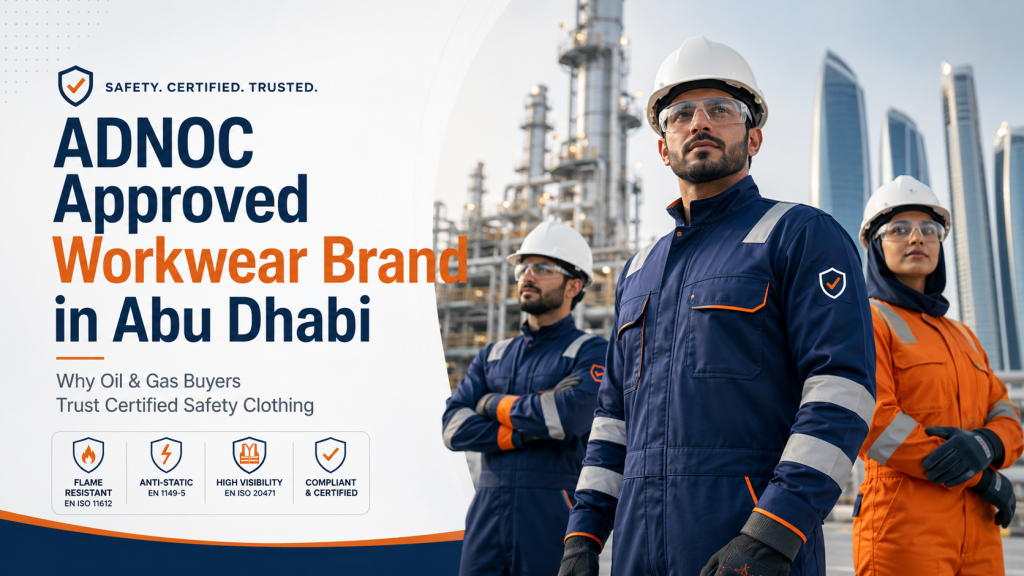
Armstrong Products is an ADNOC-approved workwear brand manufacturing certified safety clothing for oil and gas sites across Abu Dhabi and the wider Gulf. Send across the HSE specification you are working to, and our technical team will confirm fabric, standards, and trims against it before you build the bid.
The safety clothing standards named in Gulf HSE specifications
Approval gets you onto the vendor list. The specification decides what the garment has to be.
Most Abu Dhabi tenders name more than one standard, and they are not interchangeable. Knowing what each one actually tests stops you accepting a certificate that does not cover your hazard.
| Standard | Protects against | What to check on the certificate |
| NFPA 2112 | Hydrocarbon flash fire | Third-party certification, predicted body burn under the 3-second manikin test, heat transfer performance values, no melting, dripping or separation |
| EN ISO 11612 | Heat and flame across hazard codes A to F | Which codes are certified and at which performance level, not just the standard number |
| EN 1149-5 | Static discharge in flammable atmospheres | Whether the site specification calls for it, and whether the tested garment matches the supplied one |
| IEC 61482 or NFPA 70E | Arc flash | The arc rating value, and whether one garment carries both flash fire and arc protection |
| EN ISO 20471 | Visibility | Class level, tape placement, and that the tape itself is flame resistant |
The regulatory logic behind all of this is not new. In a published interpretation letter, OSHA concluded that where flash fire hazards exist in refining and chemical operations, employees working in those areas must wear flame-resistant garments. Gulf operators reach the same conclusion through their own HSE specifications and enforce it at the gate.
Flash fire and arc flash are not the same requirement
This causes more procurement errors than any other point on the list.
NFPA 2112 is built around the hydrocarbon flash fire scenario found on rigs, refineries, and tank farms and tested using the ASTM F1930 manikin method and the ASTM D6413 vertical flame method. Arc flash is a different exposure with different physics, covered by IEC 61482 or NFPA 70E, and reported as an arc rating value.
Some fabrics carry both. Many do not. If electrical work is part of the scope, put the arc rating in the tender rather than assuming the flame-resistant garment handles it.
Colour, tape layout and labelling
Operators specify garment color, reflective tape layout, and labeling in their own documents, and those documents get revised.
Work from the current written specification your client has issued, not from a version someone saved last year. A coverall can be fully certified to NFPA 2112 and still be rejected at site access because the tape layout no longer matches. That is a compliant garment and a failed delivery at the same time.
Treated FR or IFR coverall: what changes over the wash life
This decision affects everything downstream, and it comes down to where the protection sits.
Treated FR fabric gets its flame resistance from a chemical finish applied to the material. In an IFR coverall, protection is built into the fiber itself, so it cannot wash out.
| Factor | Treated FR | IFR (inherently flame resistant) |
| Source of protection | Chemical finish on the fabric | Built into the fibre |
| Effect of washing | Can reduce across the wash life, and the wrong detergent speeds that up | Part of the fiber holds through the wash life |
| Test benchmark | Performance verified before and after laundering cycles | NFPA 2112 requires flame resistance to hold after 100 industrial launderings |
| Best fit | Shorter deployments, contractor and visitor stock | Core crew, offshore work, high wash frequency |
Neither is the wrong answer. A three-month contractor rotation and a permanent offshore crew have different exposure levels and very different wash volumes. Specify accordingly.
Buyers sourcing IFR coveralls UAE crews will wear year-round usually land on inherent fabric for that reason alone. The same logic applies to teams buying IFR coveralls Saudi Arabian sites require, where summer conditions push wash frequency higher still.
What causes real trouble is running both on one site without tracking which is which. Treated FR garments need wash cycle records. IFR garments do not. Once both sit in the same store room and go through the same laundry, nobody knows how much service life is left in anything.
Laundering rules that quietly void protection
Bleach, starch, fabric softener, and detergents containing hydrogen peroxide can all damage flame resistant performance. Softener is the common one, and it works by leaving a residue the fabric was never tested with.
Petroleum soiling is a separate issue. Residual oils can mask the flame resistance of the fabric and act as fuel for an ignition source, which is why heavily contaminated garments should come out of service for cleaning or replacement rather than going back on the rack. NFPA 2113 is the governing standard here, covering selection, care, use, and maintenance.
Agree the laundering method before the order ships. Get written care instructions from the supplier and hand them to whoever runs the site laundry. It takes one conversation and prevents a failure mode the manufacturer has no control over.
How to evaluate a safety clothing supplier Abu Dhabi buyers can audit
Run every shortlisted vendor through the same set of questions. The differences show up fast.
Manufacturer or trader
Plenty of companies selling safety clothing in the region buy finished stock and re-label it. That is not automatically a problem, but it changes what they can control when something goes wrong.
Four questions sort it out on one call:
- Who owns the factory, and where is it?
- What is your monthly stitching capacity for coveralls?
- Can you show me the production floor on a live video call this week?
- Do you hold fabric inventory, or do you buy fabric only after receiving an order?
A manufacturer answers all four immediately. A trader hesitates on the first, gives a soft number on the second, offers photographs instead of live video on the third, and steers away from the fourth.
Fabric sourcing and traceability
Ask for the mill name and the fabric reference. Then ask whether the garment label will carry a batch number that traces back to that specific fabric lot.
Traceability sounds like paperwork until month seven, when a performance question comes up and you need to isolate one production lot instead of pulling every coverall on site.
Thread, tape and hardware
Here is where certified garments quietly fail and where almost no supplier website says a word.
A coverall made from certified flame-resistant fabric and stitched with ordinary polyester thread is not certified safety clothing. This is written into the standard, not a matter of opinion. NFPA 2112 carries separate thread and hardware requirements. Thread heat resistance is tested to ASTM D7138 Method B; the thread must not melt at 260°C, and the test applies to every thread type used in the garment. Hardware has its own rule: it must not melt, and metal must not sit against the wearer’s skin.
Reflective tape is covered too. Under NFPA 2112, reflective strips used on flame-resistant garments have to pass flame-resistance testing, with an afterflame of no more than 2 seconds and no melting or dripping.
Get all of it confirmed in writing. A manufacturer who builds these garments regularly will do so without pausing, because those trims are bought on purpose.
Quality control stages, by name
“Strict quality control” tells you nothing. Ask which stages exist and what records come out of each:
- Inward fabric inspection against the specification, before cutting
- Sampling-based inspection during production
- Inline checks on stitching, seam strength and measurements
- Final inspection before packing
- Retained records available on request
If a supplier cannot name the stages in the order they happen, they are describing a process they do not run.
Factory audit readiness
Genuine manufacturers expect audits and plan for them. Ask whether they can host a physical audit and how much notice they need. A virtual walkthrough works well as a first pass and reveals more than most buyers expect.
Look at the cutting table, the stitching lines, the trim store, and the finished goods area. Then ask to see fabric inward inspection records for a recent lot. The reaction to that request tells you more than the records do.
Capacity and shutdown scheduling
Shutdown dates do not move.
Plan delivery backwards from the date crews need garments in hand, not from the date the container leaves. Ask what capacity is already committed for your window and how the supplier handles a specification change mid-production. Ask what happens if the size trial returns a different size curve than expected. These questions test planning discipline rather than sales confidence.
Documentation for delivery into Abu Dhabi
Documentation errors cause customs delays, and customs delays land directly on the shutdown schedule.
Review the full set before dispatch: packing list, shipping marks, invoice detail, HS classification, and any conformity documents needed for entry. Confirm who prepares each document and who checks it. An experienced exporter treats this as routine. A first-time exporter finds out at the port.
Pre-order checklist for certified safety clothing
- Supplier’s Unified Supplier ID and prequalified product groups confirmed
- Current written HSE specification from the end client, verified as the latest version
- Standards and versions agreed, including EN ISO 11612 hazard codes where relevant
- Test certificates matching the exact fabric reference being supplied
- Certificate report numbers verified directly with the issuing laboratory
- FR thread, FR reflective tape and compatible hardware confirmed in writing
- Fabric weight and construction suited to Abu Dhabi summer conditions
- Colour and reflective tape layout matched to the client specification
- Size trial completed with actual site crew before the production run
- Batch traceability label specified on every garment
- Laundering instructions agreed and passed to the site laundry
- Delivery schedule confirmed against the shutdown date
- Export and conformity documentation reviewed before dispatch
Screenshot that and use it as the scorecard for every vendor on the list.
What goes wrong on bulk safety clothing orders
A buyer approves a sample, and the production run arrives from a different fabric lot at a different weight. Nobody matched the reference number on the sample against the reference on the certificate.
A team skips the size trial to save two weeks. The crew is multinational with a wide size range, the standard curve does not fit, and several hundred garments sit in the store unused.
One certificate gets accepted across three colors and two fabric weights. It covered one of them.
Garments go to a site laundry running softener because nobody sent the care instructions.
An order goes out against a specification the client revised last quarter. The tape layout no longer matches. Certified garments, rejected at the gate.
Every one of these is preventable at the checklist stage, and none of them is fixable after delivery.
How Armstrong Products manufactures certified safety clothing
Armstrong Products has manufactured PPE and industrial workwear since 2009. The manufacturing facility is in Boisar, Maharashtra, with the corporate office in Powai, Mumbai. We are an ADNOC-approved workwear brand supplying oil and gas projects across Abu Dhabi and the wider Gulf.
Cutting and stitching happen in house rather than through subcontractors, which is what makes fabric traceability and inline checks possible at all. Fabric is sourced against the client’s written specification with batch records maintained through production. FR thread and FR reflective tape are standard on flame-resistant garments because the alternative is a certified fabric with a failure point at every seam.
Quality control runs through inward fabric inspection, sampling-based checks during production, inline stitching and measurement verification, and final inspection before packing. Records are retained and available for audit.
We produce under private label and on an OEM basis for distributors and agents across the region, and we prepare export documentation as part of the order rather than as an afterthought. Audits are welcome, virtual or physical, with reasonable notice.
Conclusion
Every supplier quoting your tender will describe their safety clothing as approved and certified. Most of them believe it. The difference between belief and evidence only shows up during a client audit, or worse, at a site gate three weeks before a shutdown.
Run the two checks separately. Confirm the approval status through the supplier ID and product groups. Confirm the garment through the certificate, the fabric reference, and the trims. A supplier who clears both without stalling is one worth putting a bulk order behind.
Send us your HSE specification and delivery window, and we will confirm fabric, standards, trims, and production schedule against it before you commit to anything. You can reach the team through our Contact Us page.
FAQs
1. What does it mean when a workwear brand is ADNOC approved?
It means the company has completed ADNOC’s vendor registration and prequalification process and holds a Unified Supplier ID, which allows it to take part in tenders and supply ADNOC projects. It is a commercial registration status, separate from any product certification the garments carry.
2. How do I verify that a safety clothing supplier is actually registered with ADNOC?
Ask for the Unified Supplier ID and the specific product groups the supplier is prequalified under, since approval is granted per work and product group rather than across the whole catalog. Also ask whether they supply directly or through a registered local agent. A registered supplier can answer all three without needing to check.
3. Is ADNOC approval the same as NFPA 2112 certification?
No. Approval is about the company. Certification is about the garment. You need both, and you verify them in different places.
4. Can a manufacturer outside the UAE supply safety clothing to Abu Dhabi projects?
Yes. Manufacturers based outside the UAE appoint a local agent under a notarized agreement and supply through that registered structure. It is a normal arrangement rather than a workaround, and it does not affect the certification status of the garments themselves.
5. What is the difference between an FR coverall and an IFR coverall?
Treated FR fabric carries a chemical finish that provides the flame resistance, so performance can decrease across the wash life. In an IFR coverall, the protection is part of the fiber and stays there. IFR is usually specified for core crews on sites with high wash frequency.
6. Does washing reduce the protection in safety clothing?
It can. Bleach, starch, fabric softener, and detergents containing hydrogen peroxide all risk damaging flame-resistant performance. Petroleum soiling is a separate problem, because residual oils can mask the fabric’s flame resistance and become fuel for ignition.
7. Do certified coveralls also protect against arc flash?
Only if the garment carries a separate arc rating. Flash fire and arc flash are tested under different standards. Check the label for an arc rating value, and specify it in the tender if electrical work is in scope.
8. How do we tell a manufacturer from a reselling supplier?
Ask to see the production floor on a live video call rather than in photographs. Ask for monthly stitching capacity as a number. Ask whether they hold fabric inventory or buy per order. Ask for inward fabric inspection records from a recent lot. Then ask whether they can host a physical audit and how much notice they need. A manufacturer answers all five in a single conversation. A reseller redirects to product images and reassurance.