Most coverall manufacturers look credible during the RFQ stage. The catalog is professional. The certifications are listed. The sales team responds quickly and gives confident answers to every question.
What you cannot see from that stage is whether the QC process that produced a clean pilot order holds up twelve months into a contract when the relationship is no longer new. Whether the fabric specification they quoted is what actually arrives in batch three. Whether the certification on the product page is backed by a current test certificate or just a label applied to a datasheet years ago.
The manufacturer selection decision is where most bulk coverall program problems either get prevented or get built in. This guide covers what to actually check before the order is placed.
What to look for when comparing coverall manufacturers
Before evaluating fabric specs, certifications, or lead times, there is one structural question worth answering first: does the manufacturer actually make the coveralls themselves?
In-house manufacturing vs third-party production
A manufacturer running their own facility controls what happens on the production floor. When a fabric lot comes in below spec, their incoming inspection catches it. When stitching quality drops mid-run, their in-process supervisor sees it. When a batch has a problem, they know exactly where in their own production process it came from and they can fix it before the next run.
A distributor or trading company placing your order with an external factory does not have that visibility. The production is happening somewhere else, managed by someone else, under quality controls the distributor cannot directly enforce. Quality problems that a manufacturer would catch internally become problems the buyer discovers when the shipment arrives.
For one-off orders this is manageable. For large-scale recurring contracts where the fifth production runs twelve months and needs to match the first, it is a fundamental capability gap. Ask the question directly and early.
Types of industrial coveralls and their applications
Standard cotton and poly-cotton coveralls
Workers prefer cotton. It is comfortable, it breathes across a long shift, and in warm factory or outdoor environments that preference is real and worth accounting for. The problem with pure cotton does not show up on delivery day. It shows up across the first few months of a laundry program.
High-temperature commercial washing shrinks cotton. It fades faster than blended fabrics and loses dimensional stability across repeated cycles. At the knees and seat where physical wear concentrates, cotton wears through before the replacement interval the program was budgeted around.
A 65/35 poly-cotton blend trades some of that comfort for significantly better durability. Dimensions stay more stable through industrial laundering. Color holds more consistently across production batches. At high-friction areas, the polyester content resists surface wear in a way pure cotton does not. For most general industrial applications running frequent laundry cycles, the blend outlasts cotton in practice regardless of how the initial samples compare.
GSM weight is the other variable. A 200 GSM fabric suits lighter-duty environments. Construction sites, fabrication workshops, and heavy industrial floors generally need 240 GSM or above to hold up across a full contract period.
FR coverall options for hazardous environments
Environments with welding, hot work, or flash fire exposure require coveralls that have been genuinely tested against a specific hazard standard, not just described as flame resistant on a product page. In European and international markets, EN 11612 is the standard for heat and flame protection. In the US, NFPA 2112 covers flash fire. Both require finished garment testing, not just fabric testing, and the certificate needs to be current and product-specific.
The construction method is where the real decision sits. Inherent FR fabric has the flame-resistant property in the fiber itself. It cannot wash out because it was never applied as a surface treatment. The protection is there on wash one and still there on wash one hundred.
Treated FR fabrics work differently.The protective coating on treated FR fabric sits on the surface of the fiber. Repeated laundering wears it down. At high wash temperatures or with detergents the care label prohibits, it wears down faster. A program running industrial laundry twice a week on treated FR coveralls can reach the point where garments are no longer meeting the standard they were certified to well inside the planned replacement interval, without anyone on site noticing because the garments still look serviceable. Writing the FR construction method into the contract specification is what prevents that situation from developing quietly over the first year of a program.
High-visibility and multi-hazard coveralls
Which standard applies to high-visibility coveralls depends on where the garments are going. EN ISO 20471 governs European and international markets. ANSI/ISEA 107 covers North American operations. Both standards set minimum performance thresholds for retroreflective material, background color, and the minimum coverage areas the garment must provide.
Neither standard addresses what happens to that performance after two years of commercial laundering.
Retroreflective tape loses reflectivity over time. Commercial washing is the main driver, though UV exposure on outdoor sites contributes as well. The rate of degradation varies depending on the quality of the tape material itself and whether the laundry process has been following the care label requirements. A coverall that meets EN ISO 20471 when it leaves the manufacturer and gets washed twice a week in a commercial laundry running above the care label temperature may be well below the standard’s reflectivity threshold by the time the first re-order lands. If the retroreflective material was never tested for wash durability, there is no data to show where the garment actually sits on the compliance scale at any point after manufacture.
Before approving a supplier for a long-term high-visibility program, ask for wash cycle durability data that shows reflectivity readings taken at intervals across a realistic laundry cycle count.
What you want to see is reflectivity readings taken at intervals across a realistic laundry cycle count, not just the result from when the garment was new. Suppliers who have genuinely qualified a product for sustained industrial use have run that testing and can produce the numbers. Those who have not will point you back to the initial certification.
Suppliers who have qualified products for long-term programs have done this testing and can produce the data.
Multi-hazard coveralls combining FR performance with high-visibility tape carry two separate compliance requirements. Each needs its own test certificate. A garment label listing multiple certifications is not the same as having test certificates for each. Ask for both.
Coverall fabric and construction quality
Fabric GSM and composition
There are two documents worth requesting from any coverall supplier: the fabric specification sheet and the fabric test reports. They tell you different things.
The specification sheet tells you what the fabric is made of. The test reports tell you how it behaves under conditions similar to your site. Shrinkage data shows what happens to dimensions after commercial laundering at a specific temperature. Colorfastness results show how color holds under washing, UV exposure, and friction. Tensile strength data shows how the fabric holds up under physical stress at the seam points.
A coverall that loses 4% across the chest after the first wash cycle at your laundry’s operating temperature is already the wrong size. It is going to be the wrong size across every unit in the order. Catching that before the specification is locked in costs nothing. Discovering it after the program is running is an exchange and replacement exercise that was not in anyone’s budget.
Stitching and seam strength
Seams fail before fabric panels do. That is where the physical stress of movement concentrates, and it is where the difference between a well-constructed coverall and a cheaply constructed one becomes visible six months into a contract.
At the shoulder seams, crotch seam, and pocket joins, double stitching and higher stitch count per inch add holding strength at exactly the points that carry the most load. Polyester thread outlasts cotton thread in commercial laundry conditions, which matters more than it sounds when garments are going through an industrial wash program multiple times per week.
On any sample garment, pull firmly at the shoulder seam and crotch seam. Uneven stitching and loose thread ends visible with no magnification are consistent indicators of production inconsistency. A formal seam strength pull test produces tensile data if you need documented results, but a physical inspection with your hands eliminates the obvious failures before any formal testing begins.
Colorfastness and shrinkage resistance
Colorfastness problems do not show up on a single garment. They show up when two production batches from the same supplier, ordered six months apart, are in use on the same site at the same time and the difference in shade is visible from across the room.
ISO 105 is the standard covering colorfastness testing. It covers wash fastness, light fastness, and rubbing fastness separately. In most industrial uniform programs, all three are relevant. Wash fastness matters for any program running industrial laundry. Light fastness matters for outdoor roles. Rubbing fastness matters anywhere workers are in physical contact with other surfaces for extended periods. Ask for results across the specific tests relevant to your environment before approving a supplier.
Shrinkage behaves differently from colorfastness and tends to surface faster. A garment that loses meaningful chest width after the first commercial laundry cycle at the temperature your laundry actually runs at creates a sizing problem across every unit in the order. If the care label maximum is 40 degrees and your laundry runs at 60, that information needs to be on the table before the specification is finalized.
Coverall quality standards and compliance
ISO 13688:2013
Before any product-specific standard applies to a protective clothing garment, ISO 13688:2013 needs to be satisfied first. It covers the general requirements that every protective clothing item must meet regardless of the hazard it protects against: ergonomics, sizing, how the garment is expected to age under use, labeling requirements, and what technical documentation the manufacturer must supply with the product.
What it does not do is certify protection against a specific hazard. A coverall that satisfies ISO 13688 has cleared the baseline for being classified as protective clothing. Whether it protects against heat, flame, high-visibility requirements, or chemical exposure is determined by separate product-level standards that sit alongside it.
That distinction matters when evaluating supplier documentation. A product page that lists ISO 13688 compliance tells you the supplier believes the product satisfies that standard. A test certificate tells you what was actually tested, under which edition of the standard, using which test method, and what result was measured. For vendor qualification processes where documented evidence of compliance is required, only one of those documents counts.
EN 11612 and NFPA 2112 for FR coveralls
FR coverall certifications to EN 11612 or NFPA 2112 apply to the finished garment, not to the fabric alone. A fabric-level FR test certificate, even a recent one for a fabric you recognise, does not satisfy the certification requirement for the specific coverall being ordered. The garment itself needs to have been tested.
Certificate dates matter more than they tend to get checked. Both EN 11612 and NFPA 2112 go through revision cycles. A certificate from several years ago may reference an edition of the standard that has since been superseded. Clients in oil and gas and petrochemical sectors often specify particular standard editions in their vendor qualification documents, which means a certificate showing compliance with a 2012 edition of EN 11612 may not satisfy a vendor qualification requirement that cites the current edition. Checking the edition on the certificate, not just the standard name, is the step that gets skipped most often and causes the most friction during formal qualification reviews.
For clients in oil and gas or petrochemical who specify particular standard editions in their vendor qualification documents, the edition on the certificate matters as much as the standard name. Ask for the certificate and check the edition before the specification is approved.
CE marking
CE marking confirms that a garment has been assessed against applicable EU safety directives. It does not tell you which product-level standard that assessment covered.
A coverall can carry CE marking while only meeting the baseline ISO 13688 protective clothing requirements, without meeting EN 11612 or EN ISO 20471. The CE mark on the label and the product-level test certificate are separate documents serving different functions. One confirms the directive assessment happened. The other confirms what performance was actually tested. For programs where EN 11612 or EN ISO 20471 compliance is required, both documents need to be present and current.
How to evaluate a coverall manufacturer before a bulk order
Manufacturing capacity and lead time
When a new client relationship is being established and both parties know the order is being evaluated, production gets more supervisory attention than it will get later. The pilot order benefits from that attention. The seventh production run on a 24-month contract does not. The quality controls a manufacturer has in place for routine production, not their management of an order they know is being scrutinized, are what determine whether the program holds up long-term.
Ask for monthly production capacity specific to the garment types you need. Confirm directly whether the entire order will be produced in-house or whether any element goes to a subcontractor. Confirm a production start date and a delivery date as two separate commitments, and establish the escalation process for production delays before they happen rather than while they are happening.
Certifications to verify
Requesting certificates and confirming they exist are different things. Ask to see the actual documents: ISO 9001:2015 for the quality management system, ISO 13688:2013 for the protective clothing baseline, and product-specific certificates for each hazard standard claimed. Check the date on each certificate and confirm the edition against what your own client contracts or site access requirements specify.
For export orders, the documentation package also needs to include compliance paperwork formatted for the destination market’s customs and regulatory requirements. This is not automatically part of every manufacturer’s standard offering. Confirm it before the order is placed.
OEM and customization capability
Logo embroidery, department color coding, modified pocket placement, and reflective tape configuration are standard requirements across most industrial coverall programs. Whether those modifications are handled in-house or go to a third-party embroidery or printing facility affects how consistently they are applied across a full production run.
On 500 branded coveralls, logo position, thread color, and embroidery tension need to be the same on unit 500 as on unit one. When customization is in-house, the manufacturer controls that directly. When it goes to an external facility, a handoff occurs where errors can develop without the main manufacturer knowing until the finished goods come back. Confirming which model applies, and requesting customized samples before approving the full run, is the check that prevents branding inconsistency from becoming a post-delivery correction exercise.
Factory audit and transparency
How a supplier responds when audit access is requested tells you something before any audit takes place. A manufacturer who runs a production floor they are confident in welcomes the visit. The audit lets you see how incoming fabric is inspected, how in-process quality is monitored across a full run, how defects are documented and handled, and whether the same standards apply across all shifts rather than only when quality is being formally reviewed.
When visiting is not practical, current third-party audit reports from Bureau Veritas, SGS, or Intertek are a reasonable alternative. Ask whether current reports exist and whether they are available to share. If neither option is available, the production quality is not being independently verified and the quality claims rest entirely on what the supplier says about themselves.
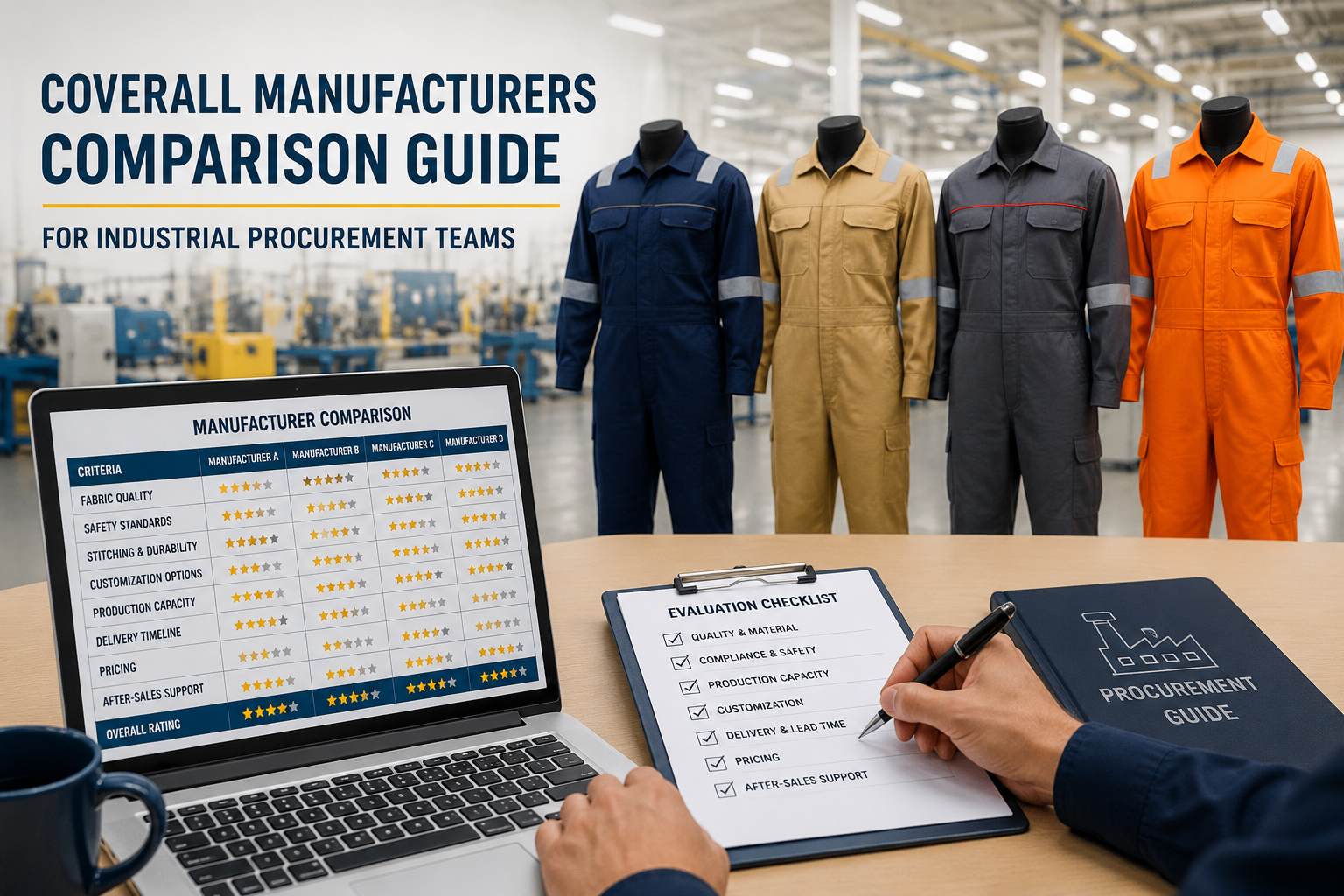
Coverall manufacturer comparison checklist
| Area | What to check |
| Manufacturing | In-house or outsourced? Monthly capacity for your garment types? |
| Fabric | GSM, composition, test reports for shrinkage, colorfastness, tensile strength? |
| FR coveralls | Inherent or treated? Wash cycle rating? EN 11612 or NFPA 2112 certificate current? |
| Hi-vis coveralls | EN ISO 20471 or ANSI/ISEA 107 certified? Retroreflective wash durability data? |
| Certifications | ISO 9001:2015, ISO 13688:2013, CE marking, product-specific — actual certificates? |
| Samples | Full size-run samples tested under site laundry conditions before bulk order? |
| Customization | In-house or subcontracted? Consistent application confirmed across full run? |
| Batch consistency | In-process QC checkpoints documented? QC report issued per shipment? |
| OEM capability | Own-brand production available? Export compliance documentation available? |
| Lead time | Production start date and delivery date confirmed separately? |
| Multi-site delivery | Split shipments to named locations? Single account contact? |
Common mistakes in coverall procurement
Carrying the pilot order quality expectation into the full contract.
The pilot order gets managed differently from subsequent batches. Both parties are paying attention, the relationship is new, and the stakes feel higher. That level of attention does not persist. Before approving a supplier for volume, ask specifically how quality is controlled on a production run that is not being evaluated, what the defect threshold is before a batch gets rejected, and who signs off on quality before a shipment leaves. A manufacturer with a real quality system gives you specific answers. One without tends to redirect toward general assurances.
Approving fabric specifications based on certificates without testing samples in your conditions.
A certificate tells you how a garment performed under standardized lab conditions. Your site’s laundry runs at a specific temperature, with specific detergents, on a specific cycle frequency. Request samples in your most common sizes and run them through your actual laundry process before the specification is finalized. A 4% shrinkage result under your conditions is more useful information than any certificate produced elsewhere.
Not specifying FR construction method in the contract.
Inherent FR and treated FR coveralls can carry the same EN 11612 certification. The label does not distinguish between them. Inherent FR protection stays in the fiber regardless of how many times the garment is washed. Treated FR protection degrades with washing, faster when the laundry process uses high temperatures or prohibited detergents. Writing “FR certified to EN 11612” in the contract without specifying the construction method leaves the supplier free to supply whichever option suits their production, not your compliance requirements.
Assuming domestic supply capability transfers to export orders.
A manufacturer who produces compliant coveralls for a local market may not have the documentation infrastructure for international shipments. Country-specific compliance declarations, test certificates in the format the destination market’s regulators require, and customs documentation are not automatically part of every manufacturer’s offering. Finding out at the port that the documentation package is incomplete is significantly more expensive than confirming it during the qualification process.
Why manufacturing quality matters
Armstrong Products has manufactured industrial coveralls and protective workwear since 2009. The manufacturing facility is in Boisar, Maharashtra, with the corporate office in Powai, Mumbai.
The facility holds ISO 9001:2015 certification for its quality management system and ISO 13688:2013 certification for protective clothing, with CE marking across the garment range.
Clients include ONGC, L&T, JSW Steel, Adani, Halliburton, Hitachi, Godrej, and Weatherford. These organizations run formal vendor qualification programs with on-site audit requirements and compliance documentation standards that go beyond reviewing a product catalog. Keeping those supply relationships across multiple contract cycles means the production quality, batch consistency, and documentation have been tested against independent scrutiny on a recurring basis.
OEM and private-label manufacturing is available for buyers who need coveralls produced under their own brand or compliance documentation formatted for specific export markets. Customization is handled in-house.
Conclusion
The qualification process for a coverall manufacturer is where the real procurement decision gets made. By the time the contract is signed and production is running, the opportunity to ask the hard questions has passed. What you find out at batch three is what you locked in at RFQ stage, whether you knew it or not.
The manufacturers who cause the most contract problems rarely give warning signs during the initial conversations. The certifications look real. The pilot order is managed carefully. The questions get confident answers. What becomes apparent later is that the quality management on that pilot order was not the system. It was the exception.
Asking specifically about what happens on a routine production run, not one that is being evaluated, is the single question that separates a manufacturer with a real quality process from one who manages impressions.
FAQs
What should I look for when comparing coverall manufacturers?
Start by confirming whether the manufacturer produces in-house or routes orders to third-party factories. In-house production means direct control over quality at every stage. Then request actual test certificates rather than product page listings, ask for fabric test reports covering shrinkage and colorfastness under your site’s specific laundry conditions, confirm batch QC controls, and verify audit access before placing volume orders.
How do I verify a coverall manufacturer can handle bulk orders?
Ask for monthly production capacity data specific to your garment types and request references from clients who have placed comparable order volumes on recurring contracts. A manufacturer running their own facility gives you actual production numbers. Current third-party audit reports from recognized bodies give you independent confirmation that those capacity claims hold up under scrutiny.
What fabric weight is right for industrial coveralls?
It depends on the environment. Lighter-duty environments and warmer climates work with 180 to 220 GSM. General industrial use typically sits between 220 and 260 GSM. Heavy fabrication, construction, and high-abrasion sites generally need 260 GSM and above. Fiber composition matters alongside weight. A 240 GSM poly-cotton blend will outlast a 240 GSM pure cotton garment in most industrial laundry programs because polyester holds its shape and resists surface abrasion better.
What certifications should a coverall manufacturer hold?
ISO 9001:2015 for the quality management system. ISO 13688:2013 for general protective clothing requirements. CE marking for European and UK markets. For FR coveralls, EN 11612 or NFPA 2112 depending on hazard type and market. For high-visibility, EN ISO 20471 or ANSI/ISEA 107. Ask for the actual test certificates with standard editions and test dates on each one.
Can coveralls be customized with company branding?
Yes. Logo embroidery, department color coding, reflective tape placement, and modified pocket configurations are standard from established manufacturers. Confirm customization is handled in-house rather than subcontracted, and request customized samples before approving a full production run.
What is the difference between standard and FR coveralls?
Standard coveralls need to hold up physically, fit correctly across a full size range, and maintain colorfastness through industrial laundering. FR coveralls carry an additional tested requirement that the fabric resists ignition and self-extinguishes when the heat source is removed, certified to EN 11612 or NFPA 2112. They also carry specific laundering restrictions around bleach and fabric softener that standard workwear does not. In environments with flame, flash fire, or arc flash exposure, FR certification is a regulatory requirement.
How is coverall quality tested across a large production run?
Pre-shipment inspection at the manufacturer’s facility is the standard for well-managed programs. Testing covers shrinkage, colorfastness, and seam tensile strength on garments from the actual production batch before they ship. For FR coveralls, wash durability of the protective treatment needs to be confirmed as a separate test alongside the general fabric spec. Pre-shipment inspection is the point in the process where defects can be corrected before they affect your sites.
What documentation should a coverall manufacturer provide?
Test certificates for each product type, ISO certification documents, compliance declarations for your market, fabric specification sheets, and material safety data. For export orders, confirm the supplier can provide the commercial invoice, packing list, and country-specific compliance paperwork required by your destination market’s customs process. Request the full documentation package before placing the order.