

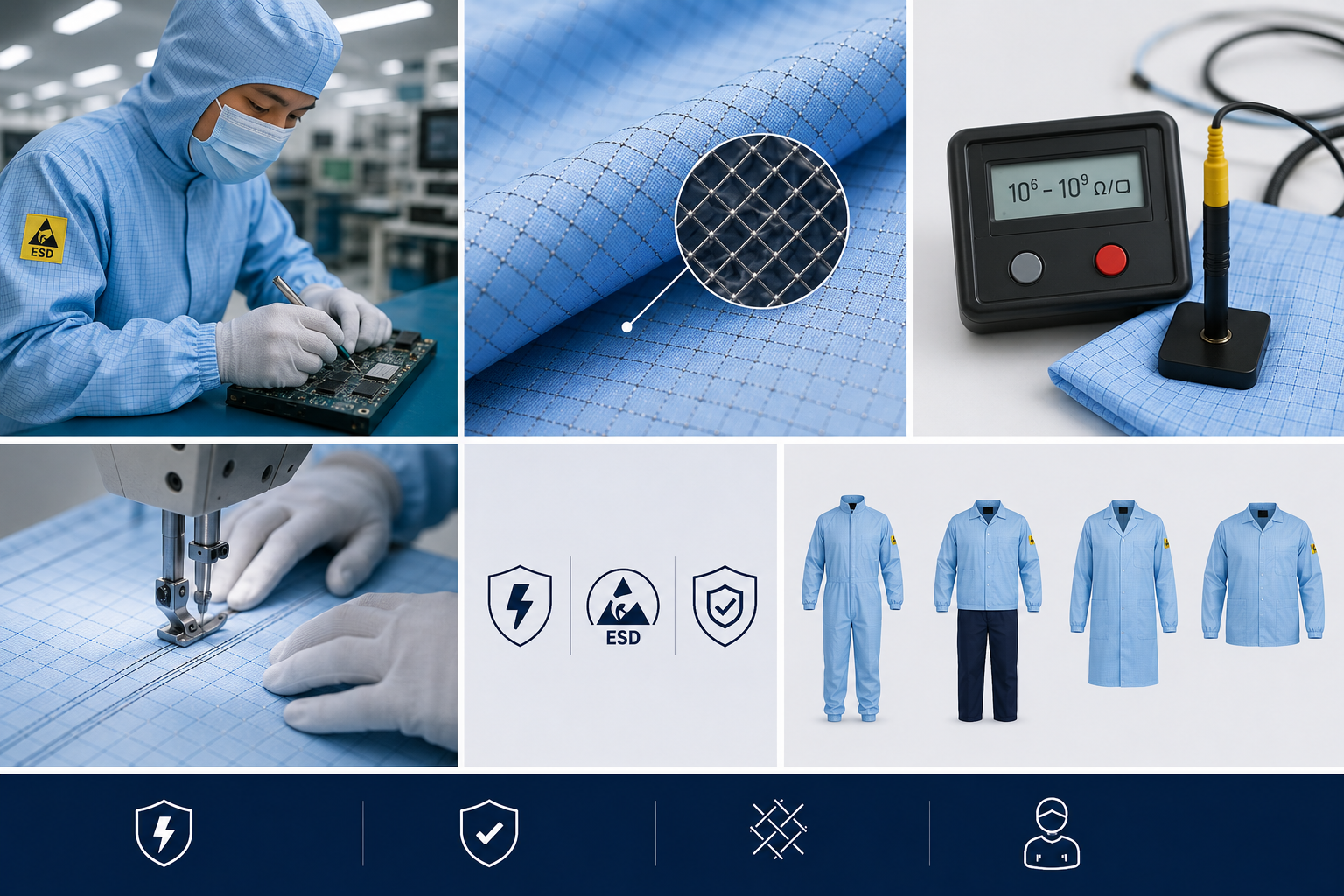
Static electricity is invisible, and so is most of the damage it causes. A discharge too small for the worker to notice can alter a semiconductor device at the component level, and the part will look completely fine when it ships. In a PCB assembly line or semiconductor fab running at volume, that kind of undetected damage does not stay undetected for long. It shows up as field returns, failed incoming inspection at the customer, or a batch quarantine that traces back to an ESD control gap somewhere on the production floor.
ESD garments are one of the main controls between that outcome and normal production. Getting the supplier selection right matters because ESD compliance gaps are rarely obvious. They surface during quality audits, customer complaints, or failure investigations, by which point the cost is already higher than it would have been to fix the problem up front.
This guide covers what procurement managers and cleanroom facility heads need to consider when evaluating ESD clothing suppliers, as well as what the relevant standards actually require.
What is ESD protection clothing?
Regular workwear, especially polyester and other synthetic fabrics, generates static charge through friction. A worker moving around a production floor builds up charge with every step, every reach, every adjustment of their clothing. That accumulated charge has to go somewhere. In an uncontrolled environment, it discharges through whatever conductive path is available, which can mean straight through a component the worker is handling.
ESD-protective clothing addresses this by incorporating conductive or static-dissipative fibers into the fabric. Those fibers provide a controlled path for the charge to move through the garment at a rate slow enough to prevent sudden discharge spikes that damage sensitive electronics. The fabric does not eliminate static. It manages how and how fast the charge moves.
How ESD garments dissipate static charge
Carbon grid fabrics weave conductive carbon fiber through a base fabric in a regular grid pattern. Conductive fiber blends distribute the dissipative element throughout the yarn. Both approaches work, but they perform differently across humidity ranges and laundry cycles, and the construction type affects how consistently resistivity is maintained across the garment surface over time.
These are not details to verify after an order is placed. Fabric construction determines whether a garment remains within the resistivity limits of IEC 61340-5-1 or ANSI ESD S20.20 after 50 wash cycles under your facility’s laundry conditions, not just when it is new.
Why ESD clothing matters in electronics and cleanroom settings
Risks of static discharge in semiconductor and PCB environments
ESD damage in electronics manufacturing is not always visible. There is a category of damage, latent damage, in which the discharge event alters device characteristics to a level that passes visual inspection and even functional testing at the point of manufacture. The device ships. It reaches the customer. It fails in the field. By the time the failure is traced back to an ESD event during assembly, the batch has already shipped, and the warranty claim is already in progress.
In semiconductor fabrication, components operate at the nanometer scale, where even a minor ESD event can permanently shift device parameters without any physical marking on the component surface. In PCB assembly, the failure points are capacitors, MOSFETs, and microcontrollers that can be degraded by discharges well below the level a worker would feel through their fingertips.
Add a cleanroom requirement to the same environment, and the complexity increases further. An ISO 14644-classified cleanroom demands that the garment system simultaneously manage static dissipation and particulate contamination. These two requirements can conflict in fabric selection because fabrics that perform well on ESD metrics do not always perform well on particle shedding, and vice versa.
The cost argument for getting ESD clothing right is simple. Compliant garments across a full workforce cost a fraction of what a single rework campaign, field return program, or failed customer audit costs.
Types of ESD protection clothing
ESD coveralls
Semiconductor fabs and high-sensitivity component-handling areas are where ESD coveralls are standard. Full-body coverage from the neck to the wrists and ankles means the entire surface area the worker presents to the production environment is controlled. The fabric is typically a carbon grid or a conductive fiber blend, and conductive thread at the seams maintains ESD continuity across the garment rather than creating gaps at every stitch.
In ISO Class 5 and cleaner environments, the coverall carries a second set of requirements in addition to the ESD spec. Sealed seams, minimal lint generation, and fabrics that pass particulate shed testing for the relevant cleanroom class are all necessary, and those requirements narrow the fabric options considerably compared to a standard ESD environment.
ESD smocks and lab coats
PCB assembly lines and electronics test areas often use smocks and lab coats rather than full coveralls. The work involves upper-body component handling where the torso and arms are the primary exposure concern, and smocks are faster to put on and take off for workers moving between ESD-controlled and general areas throughout a shift.
The coverage limitation is real, though. Where a site risk assessment determines that full-body ESD control is necessary, a smock does not satisfy that requirement. The smock selection needs to follow from the risk assessment, not precede it.
ESD cleanroom suits
Cleanroom suits are designed for environments where ISO 14644 Class 5 or cleaner classification and ESD control are both active requirements. Every design decision, the fabric selection, seam construction, closure type, material at cuffs and collar, affects both the ESD performance and the cleanroom classification compliance. These are not garments where a standard ESD coverall with a different fabric substitutes. They require qualification against both sets of requirements simultaneously.
ESD clothing vs antistatic clothing
| Feature | ESD clothing | Antistatic clothing |
| Surface resistivity | 10^5 to 10^11 ohms | Typically 10^9 to 10^12 ohms |
| IEC 61340-5-1 compliant | Yes, when tested | Not always |
| ANSI ESD S20.20 compliant | Yes, when tested | Not always |
| Designed for electronics handling | Yes | Not necessarily |
| Suitable for sensitive component areas | Yes | Depends on resistivity |
| Grounding strap compatibility | Yes | Not always |
These two categories get used interchangeably in product descriptions and supplier conversations, but they are not the same thing in compliance terms. ESD clothing is designed and tested to meet the resistivity and charge-generation requirements defined in IEC 61340-5-1 and ANSI ESD S20.20. Antistatic clothing reduces static buildup but may not fall within the specific resistivity ranges defined by those standards, and it may never have been tested against them.
For environments where ESD compliance is written into a customer contract or a facility certification requirement, what matters is a test certificate against the specific standard that governs the environment, not a product description that mentions static control. These are different documents and not interchangeable.
Key standards and compliance
IEC 61340-5-1
IEC 61340-5-1 sets the international requirements for protecting electronic devices from electrostatic phenomena, including garment performance requirements covering surface resistivity and charge generation. For most international electronics manufacturing environments, this is the standard a garment supplier should be demonstrating compliance against. If a supplier cannot provide a current test certificate to IEC 61340-5-1 for the specific garment you are evaluating, the gap must be explained before the qualification process proceeds.
ANSI ESD S20.20
US electronics manufacturers and many international facilities that have adopted US standards run their ESD control programs in accordance with ANSI ESD S20.20. It sets limits on surface resistivity and charge generation for garments in controlled areas. If your facility operates in accordance with ANSI ESD S20.20, or your customers require it as part of their supplier qualification program, a general ESD product label from a supplier does not satisfy that requirement. A tested compliance certificate does.
ISO 14644
ISO 14644 classifies cleanrooms and defines the particulate cleanliness limits for each class. It does not set requirements for garment resistivity. What it does set is what every item inside the cleanroom, including clothing, must achieve in terms of particulate shedding. A coverall that passes all ESD testing but generates particles above the limit for the cleanroom class in which it is used is not compliant for that environment, regardless of its ESD certification.
Suppliers providing garments for cleanroom use need to produce particulate testing data alongside ESD performance data. Not every ESD clothing supplier has both. Asking for both before qualifying a supplier is the check that reveals whether they actually manufacture for cleanroom environments or just sell into them.
How to evaluate an ESD protection clothing supplier
Fabric quality and testing
Carbon grid fabrics typically deliver more consistent surface resistivity across the garment because the conductive element runs in a regular, predictable pattern. Conductive fiber blends vary more in resistivity distribution depending on how the fibers are distributed within the yarn, and they tend to be more sensitive to changes in laundry temperature and detergent chemistry over time.
Ask for the fabric specification sheet, the resistivity range across the garment surface, and wash durability data showing how resistivity holds up after a defined number of laundry cycles under the care label conditions. That last piece of data is the one that separates suppliers who genuinely understand ESD garment performance from those who are selling fabric with conductive properties without having tested how those properties behave throughout the garment’s actual use life.
Certifications to check
Test certificates against IEC 61340-5-1 and ANSI ESD S20.20 should specify the measured resistivity values, the test method used, and the date the test was performed. A certificate more than two or three years old on a garment that has since gone through production changes is worth questioning. For cleanroom garments, also request ISO 14644 particulate test data for the cleanroom class for which the garment is intended.
ISO 9001:2015 on the manufacturer’s quality management system confirms that documented production processes exist. ISO 13688:2013 covers general protective clothing requirements. Both apply alongside the ESD-specific certifications, not instead of them.
Customization and OEM capability
Electronics manufacturers and semiconductor fabs often need more than an off-the-shelf ESD garment. Access zone color coding, integration with grounding wrist strap systems, specific closure designs that minimize particle generation, and custom pocket layouts for tool access: these are facility-specific requirements that a standard product catalog rarely fully covers. Whether a supplier handles these modifications in-house significantly affects quality control and lead times for large orders more than buyers tend to expect until a customization goes wrong mid-contract.
For organizations that need garments produced under their own brand or with compliance documentation formatted for specific export markets, OEM capability needs to be confirmed as a separate question from general customization availability.
Factory audit and transparency
A supplier running a credible ESD garment operation will not hesitate to grant audit access when requested. What the audit lets you see: whether ESD fabric testing happens at the batch level before shipment or only on initial samples, whether conductive seam stitching is inspected for continuity as a production checkpoint, whether the resistivity values on certificates reflect ongoing production output, and whether the processes that produced the initial qualification samples are the same processes being used on the 500th order.
Third-party audit reports from recognized bodies are a workable alternative when a site visit is not feasible. Ask whether current reports exist. A supplier who cannot provide either option is a supplier whose production quality is not being independently verified.
ESD supplier evaluation checklist
| Area | What to check |
| Fabric specification | Construction type, resistivity range, and wash durability data |
| Compliance certificates | IEC 61340-5-1, ANSI ESD S20.20, ISO 13688 – actual certificates, not product labels |
| Cleanroom compatibility | ISO 14644 particulate data if applicable to your environment |
| QC process | Batch-level resistivity testing before shipment? |
| Customization | In-house or subcontracted? Grounding integration available? |
| OEM capability | Own-brand production, export compliance docs available? |
| Audit access | Third-party audit reports available to share? |
| Wash cycle rating | Rated cycle count required before resistivity testing? |
| Lead time | Confirmed production and delivery timeline for your volume? |
| Account management | Single point of contact managing the program? |
Common mistakes when choosing ESD clothing
Treating an antistatic label as proof of ESD compliance.
A garment described as antistatic may reduce static buildup without ever having been tested against IEC 61340-5-1 or ANSI ESD S20.20. The product does something. Whether it does the specific thing those standards require is a separate question that only a test certificate answers. In environments where compliance with those standards is written into customer contracts or facility certifications, the label is not the document. The certificate is.
Not asking about wash cycle durability before approving a supplier.
Carbon grid fabrics can degrade at the seams and grid intersections with repeated industrial laundering. A garment that reads within specification when new and tested in a lab may drift out of the acceptable range after 25 wash cycles in your facility’s actual laundry conditions. The supplier’s wash durability data indicate where the drift occurs and whether it falls within your program’s replacement cycle. Garments without that data have not had their long-term ESD performance verified.
Approving a supplier based on lab test results without testing samples in your own facility.
Lab certifications are produced under controlled conditions, often at specific temperature and humidity settings that may not reflect your cleanroom or assembly environment. Resistivity varies with humidity. Your grounding system may interact with the garment differently than the grounding setup used in the test lab. Request samples and take your own resistivity readings in your actual environment before committing to volume. The results are more useful than any third-party certificate for predicting how the garment will actually perform in daily use.
Checking fabric resistivity without checking seam construction.
ESD continuity across a garment depends on more than the fabric. Seams stitched with standard polyester thread create breaks in the ESD system at every stitch line, even if the fabric panels themselves are fully compliant. Check that conductive thread is used at the seams, and that zippers, cuffs, and closure hardware are incorporated into the ESD system rather than being exceptions to it.
Care and maintenance of ESD garments
How a garment is laundered affects its ESD performance long before the fabric shows any visible wear. Industrial detergents with high ionic content, fabric softeners, and wash temperatures above the care label maximum all degrade the conductive properties of ESD fabrics, with carbon grid fabrics being particularly sensitive to temperature and chemical exposure.
Most manufacturers specify a rated wash cycle count, after which resistivity testing should confirm that the garment remains within specification. Facilities operating in high-sensitivity environments often combine the cycle count limit with periodic resistivity checks on garments in active use, because the rated cycle count assumes proper laundering. If the laundry process has been run at the wrong temperature or with an unapproved detergent, the garment may fall out of spec before the rated cycle count is reached.
The care label on an ESD garment defines the conditions under which the garment’s resistivity certification remains valid. Facilities that use commercial laundry services need to confirm that operators have the care specifications and are following them. This is the part of an ESD program that gets the least attention in supplier qualification conversations and causes the most compliance problems over the life of a garment program.
Store ESD garments in sealed packaging away from particulate contamination between uses. Contamination on the garment surface affects resistivity measurements and creates a separate compliance issue in cleanroom environments.
Why manufacturing quality matters
Armstrong Products has manufactured industrial protective clothing and workwear since 2009. The manufacturing facility is in Boisar, Maharashtra, with the corporate office in Powai, Mumbai.
The facility holds ISO 9001:2015 certification for its quality management system and ISO 13688:2013 certification for protective clothing, with CE marking across the garment range.
The client list includes ONGC, L&T, JSW Steel, Adani, Halliburton, Hitachi, Godrej, and Weatherford. These are organizations that run structured vendor qualification programs with documented audit requirements. Keeping those supply relationships across multiple contract cycles requires production quality that holds up under independent scrutiny, not just when the first order is placed.
For electronics manufacturing and cleanroom procurement teams, Armstrong supports OEM and private-label manufacturing for buyers who need garments built to facility-specific ESD specifications or compliance documentation formatted for specific export markets. Customization, including grounding system integration, cleanroom class compatibility, and access zone color coding, is handled in-house.
Conclusion
ESD programs that pass an internal review can still have real gaps. The garment supplier provided certificates. The products arrived on spec. The laundry program has been running for two years. What nobody checked is whether the laundry facility is using the approved detergent, or whether the carbon grid fabric in batch 12 performed the same as batch 1, or whether the conductive thread at the collar seams is the same spec as the thread at the shoulder seams.
None of those gaps show up in a visual inspection. They show up when a customer audit asks a question the program cannot answer cleanly, or when a failure investigation traces an ESD event back to a garment that technically should have been compliant.
The supplier qualification process is where all of that gets caught or gets missed. How thoroughly it is done before the first order is placed determines how many of those questions have answers when someone eventually asks them.
FAQs
What is ESD protection clothing used for?
ESD clothing prevents workers from generating or accumulating static electricity that could discharge into sensitive electronic components during handling, assembly, or testing. It is used in semiconductor fabrication, PCB assembly, electronics testing, and any controlled environment where electrostatic discharge poses a product quality or compliance risk. The garment does not eliminate static. It controls how and how fast charge dissipates.
How is ESD clothing different from regular workwear?
Synthetic workwear fabrics generate and hold static charge through friction during normal movement. ESD clothing incorporates conductive or static-dissipative fibers that provide a controlled path for charge to dissipate through the fabric. The practical difference shows up in resistivity measurements. Standard workwear reads in the teraohm range. ESD clothing should read between 10^5 and 10^11 ohms, depending on the standard being met.
What standards should ESD clothing meet?
IEC 61340-5-1 is the primary international standard. ANSI ESD S20.20 applies to US operations or facilities that follow US standards, regardless of location. For cleanroom environments, ISO 14644 governs particulate requirements the garment must also satisfy. Ask for test certificates against the specific standard that governs your facility.
How often should ESD garments be replaced?
Replacement is driven by the rated wash cycle count and periodic resistivity testing rather than a fixed time interval. Any garment that reads outside the specified resistivity range is taken out of service, regardless of how many cycles it has been through or how long it has been in use. Physical damage, contamination, or seam failure is also an immediate retirement trigger. For treated or carbon grid fabrics, tracking cycle counts against the rated maximum is part of basic program management.
Can ESD clothing be customized for our facility?
Yes. Zone color coding, grounding system integration, closure type, pocket configuration, and cleanroom class compatibility are all standard customization options from established manufacturers. Confirm whether customization is handled in-house before approving a supplier. In-house customization means faster corrections on large runs and clearer responsibility when something is wrong.
How is ESD clothing tested for compliance?
Surface resistivity is measured across the garment surface using the test methods defined in IEC 61340-5-1 and ANSI ESD S20.20. Charge generation testing measures static charge generated during simulated movement. Wash durability testing confirms resistivity stays within specification after a defined number of laundry cycles. A serious ESD clothing manufacturer runs batch-level testing before shipment, not just on initial qualification samples.
What is the right ESD garment for semiconductor fabs versus PCB assembly?
Semiconductor fabs in ISO Class 5 environments typically require full ESD coveralls that are qualified against both ESD performance requirements and cleanroom particulate limits. PCB assembly lines generally use ESD smocks or coveralls depending on component sensitivity and the risk assessment for that specific area, without the cleanroom particulate requirement layered on top. The garment selection should follow the risk assessment and the cleanroom classification for the specific facility, not a general industry assumption.