An importer based in Germany found a clothing manufacturer through a B2B directory a couple of years back. Good photos, fast replies, and a reasonable price on a sample order. He paid a deposit, waited six weeks, and the shipment that showed up didn’t match the sample at all. Different stitching, a different fabric weight, and a factory address that turned out to belong to someone else entirely. The actual production had happened somewhere he’d never heard of.
That story comes up more than you’d think. Reliable clothing manufacturers exist in plenty of countries, India included, but reliability isn’t something you can read off a website. It has to be checked, and the checking has to happen before the deposit clears, not after a shipment arrives looking wrong.
This guide walks through how to properly verify a manufacturer: what separates a real factory from a trading company using a factory’s name, which documents actually mean something, and where the real red flags tend to show up.
Why verifying a clothing manufacturer matters more for importers than domestic buyers
A domestic buyer can usually drive to a factory and see it for themselves within a day. That option mostly doesn’t exist for an importer working across a border and a time zone. Everything has to come through photos, a handful of documents, and whatever a sales contact chooses to tell you over email.
That gap is exactly where problems start. A factory that looks legitimate on a video call can still turn out to be a middleman passing your order along to whoever can produce it most cheaply that month. None of that shows up until something’s already gone wrong, usually a missed deadline, a quality mismatch, or a certificate that doesn’t hold up under scrutiny.
Clothing manufacturer vs. trading company: knowing who you’re actually buying from
Many listings on B2B directories label the company as “manufacturer” when it is actually a trading house or export agent. They take your order, source it from one of several factories they work with, and manage the relationship without necessarily telling you any of that.
This isn’t automatically a bad thing. Some trading companies do solid work and have real quality control built into their factory management. But it changes who’s actually responsible when something goes wrong, and it changes how much control you have over fabric sourcing, certification, and lead times.
The way to find out isn’t to accuse anyone of lying. Just ask directly: Is this your own facility, or do you work with partner factories? A company with nothing to hide answers that question without hesitating. One that dodges it or gives you a vague answer about “our production network” is telling you something, too, just not in words.
What “certified clothing manufacturer” should actually mean
Buyers hear “certified” and assume it covers everything. It usually doesn’t.
ISO 9001:2015 certifies how a company runs its own operation: documented processes, consistent output, and a system for catching and fixing mistakes. It says nothing about whether a specific garment meets a specific safety or performance standard.
Product-level certification is a separate thing entirely. ISO 13688:2013 covers protective clothing specifically. In India, products may also need to meet BIS standards depending on the category, and these often mirror international ISO norms, but aren’t automatically the same certificate.
A manufacturer can hold ISO 9001:2015 and have nothing covering the actual product you’re importing. Ask which certification applies to which product line, and ask to see the certificate itself rather than taking “we’re certified” as the full answer.
Why workwear manufacturers in India are a major sourcing destination for importers
India has built up a genuinely deep textile and garment manufacturing base over several decades, with hubs concentrated in places like Tirupur, Ahmedabad, and the Delhi-NCR region. Skilled labour is available at scale, and the raw material supply chain for cotton and blended fabrics is well established.
What matters just as much for an importer is the accreditation infrastructure sitting behind that manufacturing base. NABL (National Accreditation Board for Testing and Calibration Laboratories), India’s accreditation body for testing and calibration labs, oversees thousands of accredited labs whose results are recognised internationally. BIS standards are often built to align with ISO norms rather than sit apart from them.
That accreditation structure gives importers something useful: a way to independently verify a manufacturer’s claims. A test report from a NABL-accredited lab can be verified by contacting the lab directly. A claim with no lab name attached to it can’t be checked at all, which is the real distinction worth paying attention to.
What to check before assuming “India-based” means “verified”
Being located in India says nothing about whether a specific manufacturer is reliable. Plenty of unreliable suppliers operate out of every manufacturing hub in the country, as they do elsewhere. Country of origin and verification status are two separate questions, and treating them as the same one is how buyers end up skipping the actual check.
The verification checklist before working with any export clothing manufacturer
Run through this before any deposit goes out:
- Business registration documents confirmed against the company’s official name
- GST registration checked and matched to the entity you’re paying
- IEC, or Import Export Code, is confirmed for any Indian exporter specifically
- ISO certification scope checked against the actual product being imported
- Product-specific certification (BIS or otherwise) verified, not assumed from a general ISO claim
- Test reports requested from NABL-accredited labs for any technical or safety claim
- Factory address cross-checked against the address listed on official documents
- References from at least one past export client, contacted directly if possible
- Sample order history reviewed before committing to a bulk run
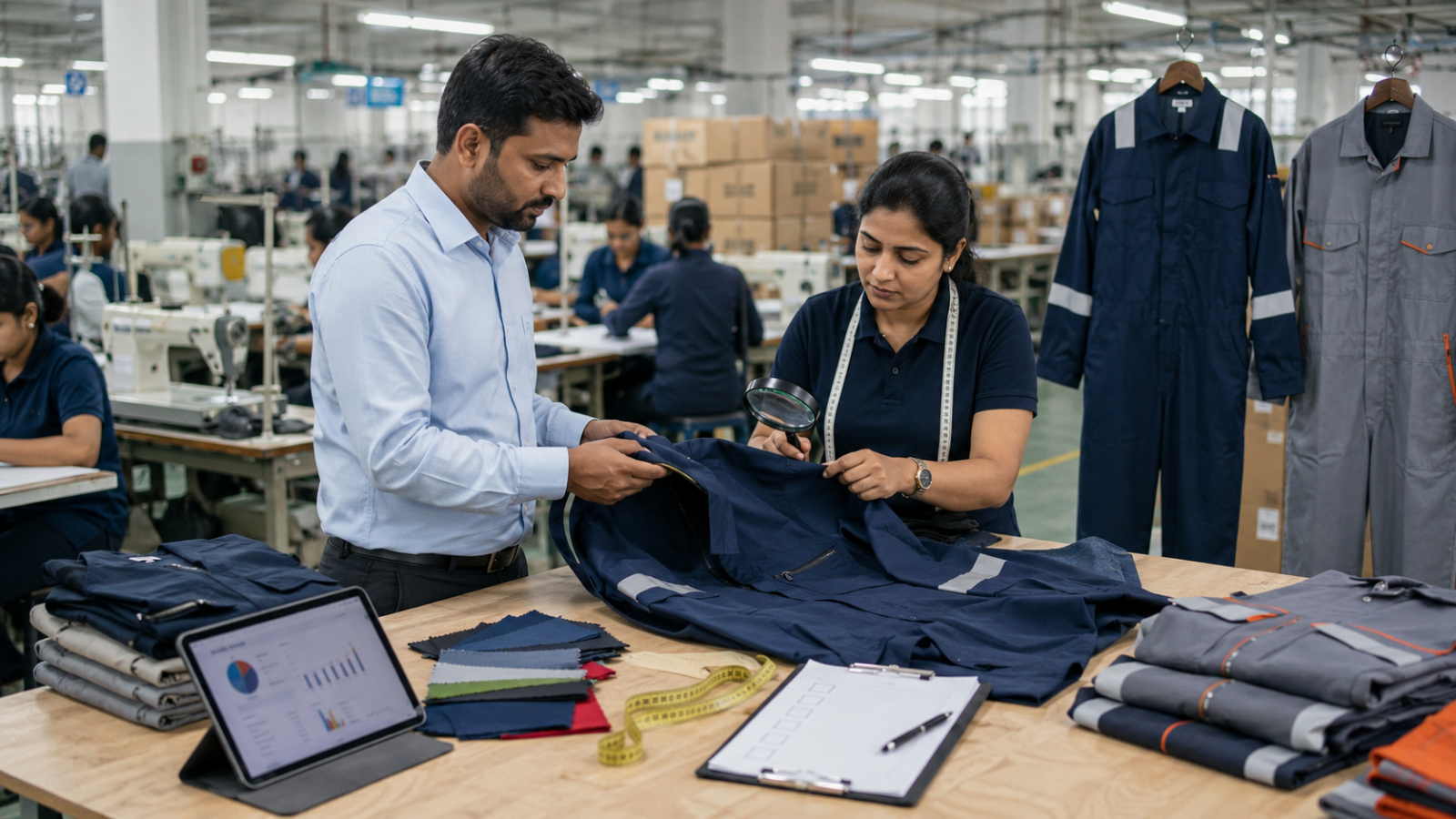
- Production site verified through a video call or, where the order size justifies it, an on-site visit
Documents that a genuine export clothing manufacturer should produce without hesitation
A real manufacturer with real export experience has this paperwork ready before you even ask twice. A commercial invoice that’s properly coded. A packing list detailed enough to match cartons against specific size runs and batch codes. A certificate of origin issued through the correct channel. None of this should take more than a day or two to produce if the manufacturer has actually shipped internationally before.
Destination-specific requirements matter here, too. The EU has its own labelling rules. The US has batch coding expectations that differ from other markets. A manufacturer who’s exported to your destination market before should already have these built into their process, not be figuring it out for the first time on your order.
Hesitation is the signal worth watching for, more than any single missing document. A manufacturer who needs a week to produce a certificate of origin, or who can’t explain why a packing list doesn’t match the actual shipment, is telling you something about how this order is likely to go before it’s even shipped.
Verifying a clothing manufacturer remotely vs. on-site
| Method | What it confirms | What it can’t confirm | Best suited for |
| Document and certificate review | Registration status, certification scope, and export history on paper | Whether the factory floor actually matches the documents | First-pass shortlisting before any real commitment |
| Video call or virtual factory tour | Floor layout, equipment, and general production conditions | Fine detail on fabric handling and finish quality | Long-distance buyers early in a new relationship |
| Third-party inspection or on-site audit | Hands-on sample checks, real production conditions, and worker conditions | Time and cost of arranging it properly | Large first orders, or anything carrying certification claims |
Clothing manufacturer verification red flags importers should not ignore
A factory that can’t obtain its IEC or GST registration without delay is the first to take it seriously. These aren’t optional for a genuine Indian exporter, and a real company has them on hand without needing to “check with the team.”
Generic-looking factory photos are a smaller signal on their own, but worth noticing. Stock images repurposed from elsewhere, or photos that never quite show the company’s actual name or branding anywhere in the frame, show up often enough to warrant a second look.
No verifiable past export client is a bigger gap than it sounds. A manufacturer with real export history usually has at least one client willing to confirm they exist and ship as described. A flat refusal to provide any reference, or a reference that turns out to be unreachable, is worth pausing on.
The costliest one by far is a certificate with no lab name or accreditation number attached. This is the same mistake that shows up in factory-floor audits generally, and it’s just as serious here. A real test report names the lab, gives a report number, and states the exact standard tested against. A document missing all three of those is a claim printed on letterhead, not proof of anything, and it’s the single gap most likely to surface later during a customs inspection or a client compliance review, long after the order’s already shipped and paid for.
A sales contact who can’t answer basic production questions, capacity, lead time, fabric sourcing, without checking with someone else first usually means you’re talking to someone managing the relationship rather than someone who actually understands the production behind it. That’s not always disqualifying, but it’s worth knowing early.
Where Armstrong Products fits for importers evaluating workwear manufacturers in India
Armstrong Products, based in Mumbai, manufactures workwear and industrial PPE in-house and holds ISO 9001:2015 certification for its quality management system. The company has a long-standing background in fabric and textile sourcing, which carries directly into how its garments are specified and produced.
Production runs through Armstrong’s own facility rather than being split across an undisclosed network of subcontracted factories, which keeps the documentation chain intact from fabric to finished garment. The company works directly with international buyers on export requirements, rather than through a separate trading layer.
None of this replaces an importer’s own verification process. It’s the kind of documentation and structure that the process should be checking for in the first place.
Conclusion
Verification is the importer’s job, not something a manufacturer’s claim can do for you. Reliable clothing manufacturers exist, but the only way to know you’ve found one is to check the documents, ask direct questions, and confirm what can actually be confirmed before any money moves. Do that before the deposit, not after a shipment shows up looking nothing like the sample.
Get in touch with Armstrong Products to discuss your export and sourcing requirements: Contact Us
FAQs
1. What makes a clothing manufacturer “reliable” rather than just cheap?
Consistency you can actually verify, not a low price on a single sample order. A reliable manufacturer can produce documentation, references, and a production history that backs up what they’re claiming.
2. What’s the difference between a clothing manufacturer and a trading company?
A manufacturer runs its own production. A trading company sources from one or more factories and manages the order on your behalf, sometimes without disclosing that arrangement upfront. Neither is automatically better, but they carry different risks and different levels of control over quality and certification.
3. What does “certified clothing manufacturer” actually guarantee?
On its own, not much specific to your product. ISO 9001:2015 covers how the company generally manages its operations. Whether a specific garment meets a safety or performance standard depends on separate, product-level certification that must be assessed on its own terms.
4. Are workwear manufacturers in India required to hold BIS certification?
It depends entirely on the product category. Some garment types fall under mandatory BIS standards; others don’t. Ask which standard applies to the specific product you’re importing rather than assuming either way.
5. How do I confirm a manufacturer’s export documents are genuine?
Contact the issuing authority or the accredited lab directly rather than relying on the document alone. A NABL(National Accreditation Board for Testing and Calibration Laboratories ) L-accredited lab can confirm whether a test report it issued is genuine. Government bodies issuing GST or IEC registration can usually confirm the same.
6. Can I verify a manufacturer without visiting the factory in person?
To a real extent, yes. A video call or virtual factory tour covers a lot of ground, floor layout, equipment, and general conditions. It won’t catch everything an in-person, hands-on inspection would, particularly fine details around fabric handling, but it’s a legitimate option for buyers who can’t travel for every order.
7. What is an IEC code, and why does it matter for an export clothing manufacturer?
An Import Export Code is required for any business in India that wants to legally import or export. A manufacturer without one isn’t legally authorised to ship internationally, no matter what else they tell you about their production capabilities.
8. How long should manufacturer verification take before placing a first order?
There’s no fixed number, but rushing this stage is usually where problems start. Most of the checks here, documents, references, and a video tour, can be done within a couple of weeks if the manufacturer is responsive and has nothing to hide.
9. What happens if a manufacturer can’t produce a certificate of origin?
Customs delays, most likely, and possibly a shipment held at the border until the paperwork is sorted out. A certificate of origin isn’t optional for most international shipments, and a manufacturer without one ready is either a manufacturer who hasn’t done this before or isn’t being straightforward about whether they have.
10 Does Armstrong Products work directly with international importers?
Yes. Buyers can reach out through the Contact Us page to discuss export requirements and documentation directly.