
Data from OSHA and the U.S. Bureau of Labour Statistics tells a sobering story about protective clothing PPE and how workers actually use it. Only 16% of workers who suffered head injuries were wearing hard hats, even though nearly half of them were required to wear one. Only 23% of workers with foot injuries had protective footwear on. About 40% of workers who sustained eye injuries were not wearing any eye protection at all.
These numbers do not just point to non-compliance. They point to a system failure, one that starts long before the incident. Worn-out gear, improper maintenance, missed inspection cycles, and PPE that has exceeded its service life all contribute to this gap. Across manufacturing units in India and globally, managing protective clothing PPE as a lifecycle, not just a one-time purchase, remains one of the most overlooked aspects of workplace safety.
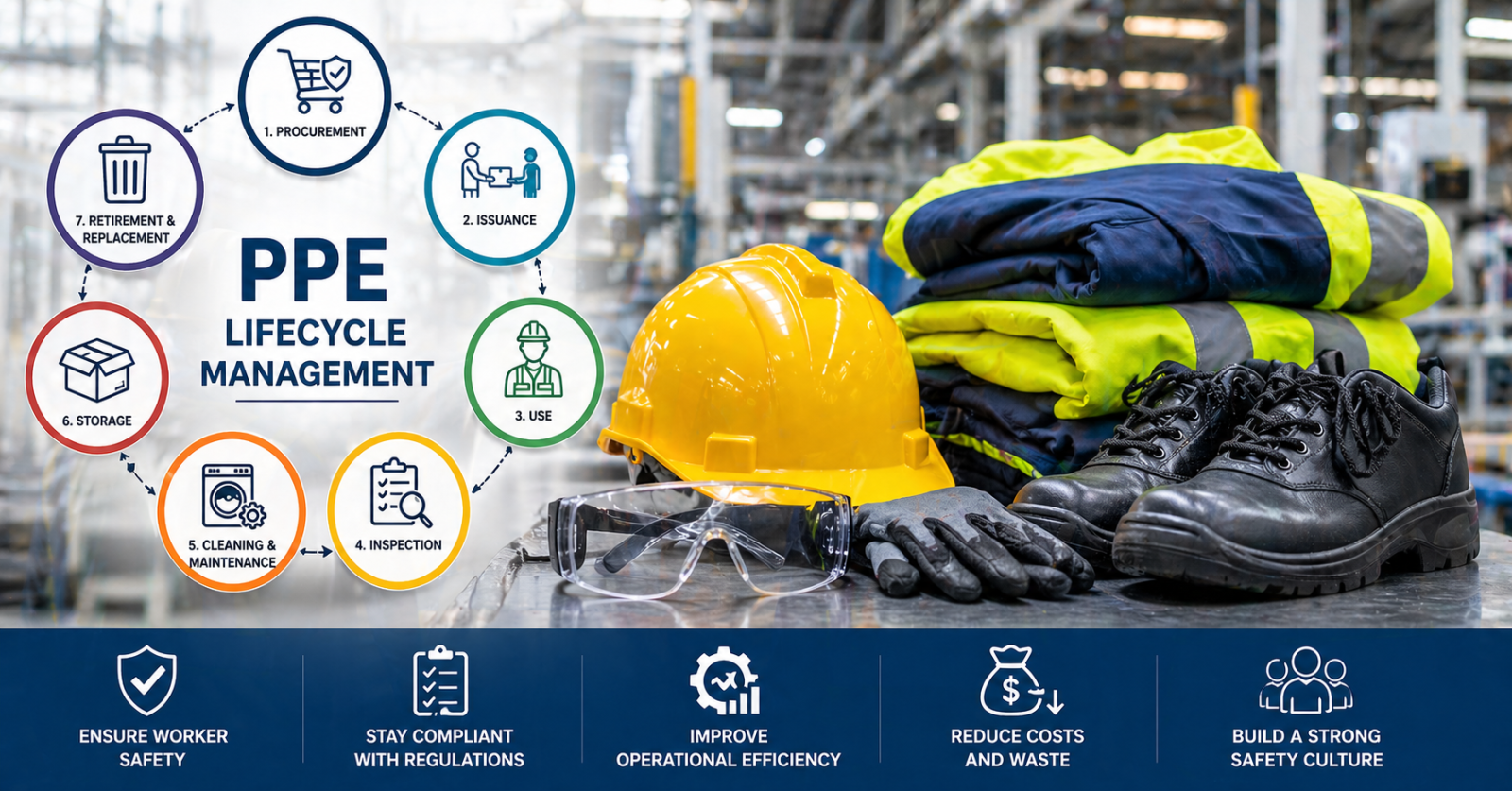
This guide covers the full lifecycle of protective clothing PPE: from procurement to retirement. It outlines best practices that safety managers, plant supervisors, and HR teams can apply to protect workers, stay compliant, and reduce long-term costs.
Why Lifecycle Management of Protective Clothing PPE Matters
Buying protective clothing PPE is the easy part. Managing it over time is where most organisations fall short.
Protective clothing PPE degrades. Flame-resistant coatings wear off after repeated washing. Reflective tape loses brightness. Chemical-resistant fabrics develop micro-perforations that are invisible to the eye. When gear is used past its effective life, it gives workers a false sense of security, which is more dangerous than wearing no PPE at all.
Proper lifecycle management of protective clothing PPE achieves three things. First, it ensures that every worker on the floor has gear that actually functions. Second, it keeps the organisation compliant with legal and regulatory requirements. Third, it reduces the total cost of ownership because planned replacement is far cheaper than incident costs, legal penalties, or emergency procurement.
The Stages of a Protective Clothing PPE Lifecycle
Understanding lifecycle management starts with knowing its stages.
Stage 1: Hazard Assessment and Procurement
Every effective protective clothing PPE lifecycle begins with a hazard assessment. Before ordering anything, safety teams must identify the specific hazards present on the manufacturing floor: heat, chemical splashes, falling objects, electrical arcs, dust, or a combination of several.
The type of hazard determines the type of protective clothing PPE required. A worker in a chemical processing area needs different gear than one in a welding bay or a cold storage unit.
Procurement should follow these principles:
- Buy protective clothing PPE that meets relevant standards ISO 13688 for protective clothing performance, EN ISO 11612 for heat and flame, and IS standards applicable in India.
- Choose certified products from reputable suppliers. Uncertified protective clothing PPE may pass a visual check but fail when exposed to real hazards.
- Consider the total cost of ownership, not just the unit price. Durable protective clothing PPE that lasts longer is almost always more cost-effective than cheaper gear that needs frequent replacement.
Armstrong Products manufactures a wide range of certified workwear and industrial coveralls designed for the demands of manufacturing environments. All products are made to meet standard quality benchmarks, ensuring your protective clothing PPE investment is sound from the start.
Stage 2: Issuance and Assignment
Once procured, protective clothing PPE must be issued correctly. This stage is often treated as administrative, but it directly affects compliance and accountability.
Best practices for issuance:
- Assign PPE individually. Each worker should receive their own set of protective clothing PPE. Shared gear creates hygiene issues and reduces compliance.
- Record every issuance. Maintain a log that captures the item type, size, quantity, date of issuance, and the worker’s name. This becomes critical during inspections and audits.
- Conduct a fit check at issuance. Protective clothing PPE that does not fit correctly does not protect correctly. Ensure the right size is issued for each worker, accounting for body type and any additional layers worn underneath.
- Brief workers at issuance. Explain how to wear the protective clothing PPE, how to store it, and what signs of damage to watch for.
Stage 3: Daily Use and Worker Responsibility
The effectiveness of protective clothing PPE during active use depends heavily on worker behaviour. Training and culture are as important as the gear itself.
Workers must understand:
- Put on and remove PPE correctly. Improper doffing, especially with chemically contaminated protective clothing PPE), can transfer hazardous material to the skin.
- Never modify protective clothing PPE. Cutting, altering, or making adjustments to protective clothing PPE voids its protection rating.
- Report damage immediately. Workers should know that reporting worn or damaged gear is an expected part of their role, not an inconvenience.
Regular short-format training refreshers (monthly or quarterly) help keep these habits active on the floor.
Stage 4: Inspection
Inspection is the backbone of protective clothing PPE lifecycle management. Without regular inspection, degradation goes unnoticed until an incident occurs.
Establish a three-tier inspection schedule:
Daily checks (by the worker): Before putting on any protective clothing, PPE, workers should visually inspect for tears, stains, missing buttons or closures, faded reflective tape, and unusual odours that might indicate chemical contamination.
Weekly checks (by the supervisor): Supervisors should conduct a systematic walk-through, checking the condition of protective clothing PPE across the team. This includes checking stitching integrity, coating condition, and any signs of wear at high-stress points like elbows, knees, and cuffs.
Monthly comprehensive audits (by the safety team): Safety officers should review the full PPE inventory by department. This audit should cross-reference issuance records with physical stock, flag items due for replacement, and identify patterns for example, if certain types of protective clothing PPE are wearing out faster than expected for a particular workstation.
Stage 5: Cleaning and Maintenance
Proper cleaning extends the life of protective clothing PPE and preserves its protective properties. However, incorrect washing can destroy those properties faster than normal wear.
Key guidelines:
- Follow the manufacturer’s washing instructions strictly. Flame-resistant (FR) protective clothing PPE, for example, must never be washed with bleach or fabric softeners. Both strip the FR treatment from the fabric.
- Wash protective clothing PPE separately from household or non-industrial clothing. Cross-contamination from personal laundry can affect performance.
- Inspect after every wash. Protective clothing PPE should be checked before it is returned to the worker, not just before it goes into the wash.
- Track wash cycles. Many types of protective clothing PPE have a rated number of wash cycles after which protective properties decline. High-visibility vests, for example, typically maintain their rating for 25–50 wash cycles depending on the standard.
For large manufacturing units, a centralised laundering system managed on-site or through a contracted industrial laundry service ensures consistency and traceability.
Stage 6: Storage
Improper storage degrades protective clothing PPE even when it is not in use. Storage conditions must be controlled.
- Keep protective clothing PPE away from direct sunlight. UV exposure weakens fabric fibres and degrades reflective coatings.
- Store away from chemicals, heat sources, and sharp objects.
- Use individual labelled hooks or lockers. This maintains accountability and prevents protective clothing PPE from being mixed up between workers.
- Inspect items before returning them to storage after use. Do not store contaminated or damaged protective clothing PPE.
Stage 7: Retirement and Replacement
Knowing when to retire protective clothing PPE is as important as any other stage. Holding on to gear past its useful life introduces risk.
Replace protective clothing PPE immediately if:
- There are visible tears, holes, or fraying
- Reflective tape is peeling, faded, or no longer meets visibility standards
- FR or chemical-resistant coatings show signs of degradation
- The item has been involved in a chemical spill, fire incident, or physical impact
- The manufacturer’s recommended service life or wash-cycle limit has been reached
- The worker reports discomfort or reduced functionality
Do not wait for the annual procurement cycle to replace damaged protective clothing PPE. Replacement must be demand-driven, not calendar-driven.
Building a Protective Clothing PPE Management System
Individual best practices only work if they are part of a structured system. Here is how to build one for a manufacturing unit.
Create a PPE Inventory Register
Maintain a central register, digital or physical, that tracks every item of protective clothing PPE in the facility. The register should include item type, standard/certification, date of purchase, date of issuance, worker assignment, inspection records, wash cycles (where applicable), and retirement date.
This register is essential during regulatory inspections and internal safety audits.
Establish Replacement Criteria
Write down clear, objective criteria for when each category of protective clothing PPE must be replaced. Remove subjectivity. If reflective tape drops below a certain brightness, it gets replaced no exceptions. If a coverall has reached its rated wash cycles, it gets retired regardless of appearance.
Clear criteria protect workers and protect supervisors from the pressure to “make do” with borderline gear.
Set Reorder Triggers
Avoid stock-outs of protective clothing PPE by setting minimum reorder levels. When inventory drops to the reorder point, procurement is triggered automatically. Stock-outs lead to workers operating without proper gear a serious safety and compliance failure.
Integrate PPE Checks into Existing Safety Processes
Protective clothing PPE inspection should not be a standalone exercise. Integrate it into existing toolbox talks, shift handovers, and monthly safety reviews. When PPE management is part of the normal safety rhythm, it gets done consistently.
Regulatory Compliance and Protective Clothing PPE in India
Manufacturing units in India operating under the Factories Act, 1948, are required to provide workers with adequate safety equipment. The Occupational Safety, Health and Working Conditions Code, 2020, further strengthens these obligations.
Regulatory inspectors can ask for issuance records, inspection logs, and evidence that protective clothing PPE meets relevant standards. Organisations that manage PPE as a lifecycle with proper documentation are far better positioned during inspections than those that treat PPE as a simple purchase item.
Beyond legal compliance, investing in high-quality protective clothing PPE and managing it well reduces workers’ compensation claims, incident investigation costs, and downtime from workplace injuries.
Choosing the Right Protective Clothing PPE for Manufacturing
Different manufacturing environments require different types of protective clothing PPE. Here is a quick reference:
- General manufacturing and assembly: Poly-cotton or 100% cotton coveralls and work wear. Explore Armstrong’s industrial work wear range.
- Outdoor manufacturing and logistics: High-visibility coveralls and vests with reflective tape. See our high-visibility wear collection.
- Wet environments and monsoon conditions: Waterproof protective clothing PPE for outdoor workers. Check our rain wear range.
- Cold storage and refrigeration units: Insulated thermal wear for extreme cold. View our winter wear options.
- Heavy manufacturing and plant work: Steel-toed safety boots for foot protection. Browse our safety shoes and boots.
Conclusion
Protective clothing PPE is an asset, not a consumable. When managed through a structured lifecycle from the right procurement decision through to timely retirement, it delivers consistent protection, keeps organisations compliant, and reduces costs over time.
Manufacturing units that treat protective clothing PPE management seriously see fewer incidents, fewer regulatory issues, and stronger safety cultures. The practices outlined in this guide are not complex. They require discipline, documentation, and the commitment to see safety as a system rather than a checklist.
Armstrong Products has been supplying certified protective clothing, PPE and industrial safety wear to India’s leading manufacturers since 2009. Our clients include ONGC, L&T, JSW, Adani, and many more organisations that trust quality gear and consistent supply.
Get in touch to discuss bulk requirements, customisation options, or to request samples for your facility.
FAQs
Q1. What is protective clothing PPE lifecycle management?
It is the systematic process of procuring, issuing, using, inspecting, maintaining, storing, and retiring protective clothing PPE in a planned, documented way. The goal is to ensure that every item of protective clothing PPE in use is fully functional and fit for purpose at all times.
Q2. How often should protective clothing PPE be inspected in a manufacturing unit?
Workers should do a visual check before each use. Supervisors should conduct detailed checks weekly. Safety teams should run a full inventory audit monthly. Items involved in incidents should be inspected immediately.
Q3. How do I know when to replace protective clothing PPE?
Replace it when there is visible damage, when it has reached the manufacturer’s rated wash-cycle limit, when a protective coating has degraded, when it has been exposed to a chemical spill or fire, or when a worker reports that it no longer fits or functions correctly.
Q4. Can protective clothing PPE be shared between workers?
It is not recommended. Sharing creates hygiene concerns and makes issuance records unreliable. Each worker should have individually assigned protective clothing PPE. Shared gear also makes lifecycle tracking much harder.
Q5. Does washing frequency affect protective clothing PPE performance?
Yes, significantly. Most protective clothing, PPE, especially FR and high-visibility items, has a rated number of wash cycles. Exceeding those cycles, or using incorrect detergents, reduces the garment’s protective properties even if it looks intact.
Q6. What records should a manufacturing unit maintain for protective clothing PPE?
At minimum: issuance logs, inspection records, wash cycle tracking, replacement history, and incident reports linked to specific PPE items. These records support compliance under the Factories Act and the OSH Code, 2020.
Q7. Is it cost-effective to invest in higher-quality protective clothing PPE?
Yes. Higher-quality protective clothing PPE typically has a longer service life, maintains its protective properties through more wash cycles, and reduces the frequency of replacement. Evaluating the total cost of ownership, not just unit cost, almost always favours durable, certified gear.
Q8. What standards apply to protective clothing PPE in India?
Relevant standards include ISO 13688 (general protective clothing), EN ISO 11612 (heat and flame protection), IS 15742 (high-visibility garments), and IS 15298 (protective footwear). BIS certification is required for certain categories under Indian regulations.