Every procurement manager has experienced it at least once. An order of industrial workwear and supplies arrives. The garments look fine in the catalogue photos. But after six weeks on the factory floor, seams are splitting, colours are fading, and workers are complaining about fit. Half the order is already due for replacement.
Procuring industrial workwear and supplies is not just a purchasing task. It is a safety and operational decision. The right gear keeps workers protected, keeps the factory compliant, and reduces the total cost of ownership over time. The wrong order wastes budget and creates risk.
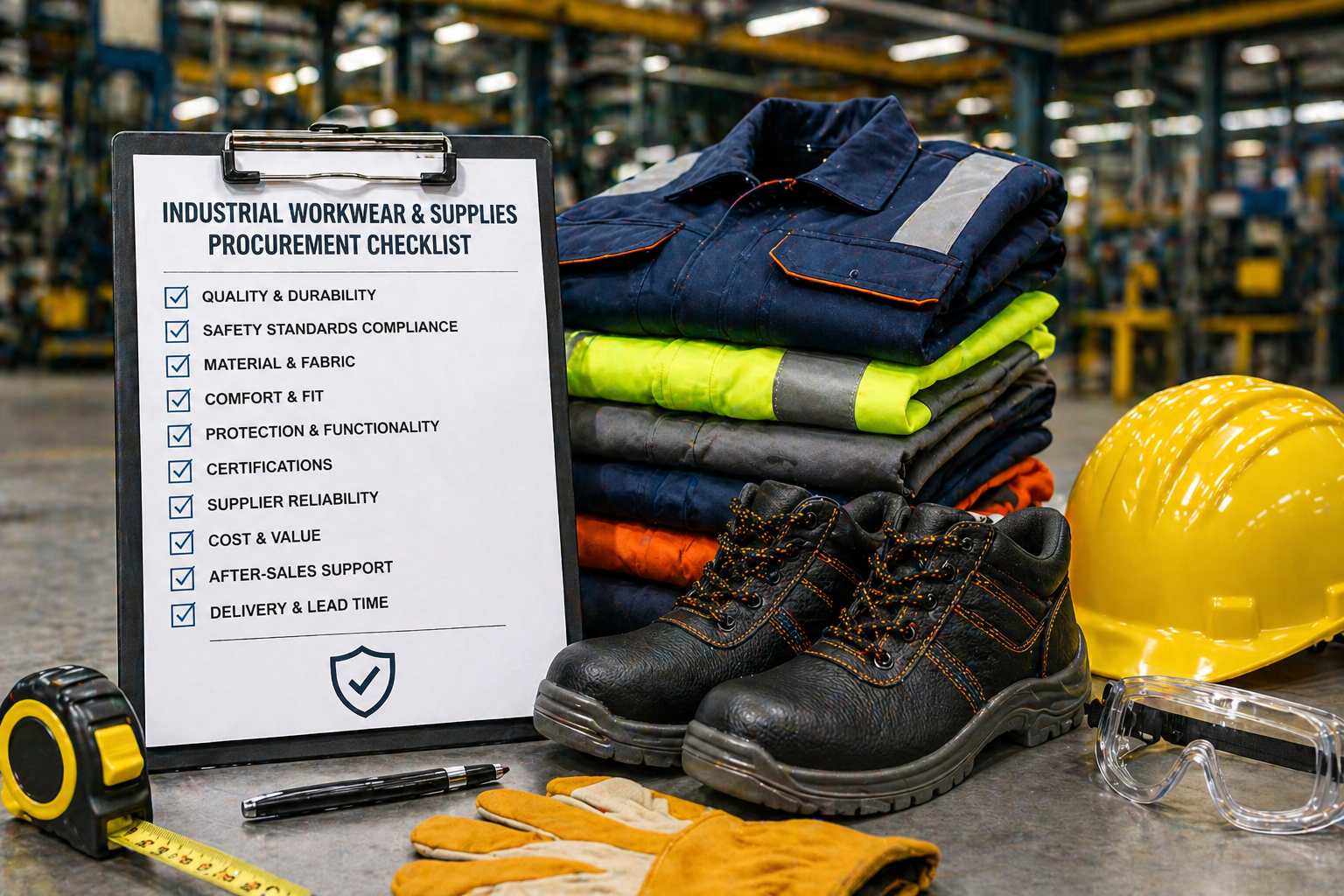
This checklist covers every stage of the procurement process from needs assessment to post-delivery review so that factory managers, purchase teams, and safety officers can make confident, informed buying decisions every time.
Why Getting the Procurement of Industrial Workwear and Supplies Right Matters
Poor procurement decisions compound over time. A factory with 200 workers that replaces industrial workwear and supplies every six months instead of every twelve is spending twice what it should on garments alone. Add in the cost of reactive procurement, worker downtime during replacements, and the risk of using non-compliant gear, and the cost gap becomes significant.
Conversely, factories that follow a structured procurement process consistently report longer garment lifecycles, fewer compliance issues, and higher worker satisfaction with their gear.
The checklist below is built around seven decision areas. Work through each one before placing any order for industrial workwear and supplies.
Checklist Area 1: Needs Assessment
Before evaluating any industrial workwear and supplies, define exactly what is required.
Identify the hazards present in each work area. Different zones in a factory carry different risks: heat, chemicals, moving machinery, low visibility, or extreme cold. Industrial workwear and supplies must be matched to the actual hazard, not selected generically.
Map workwear requirements by department and role. A welder, a floor supervisor, and a logistics worker have different protection needs. Create a role-based requirements matrix before sourcing industrial workwear and supplies.
Count the workforce by department and size range. Sizing errors are one of the most common and expensive procurement mistakes. Industrial workwear and supplies that do not fit correctly offer reduced protection and lower compliance rates.
Establish replacement frequency targets. Based on the work environment, estimate how long each category of industrial workwear and supplies should last. This feeds directly into budget planning.
Review feedback from the previous supply cycle. Before placing a new order, collect feedback from workers and supervisors on the previous set of industrial workwear and supplies. Common complaints, such as tight collars, pockets that tear, and reflective tape that peels, should inform the next specification.
Checklist Area 2: Fabric and Construction Quality
The durability of industrial workwear and supplies starts with the fabric. Garment construction determines how long it holds up under daily industrial stress.
Check fabric weight (GSM) for the application. Lightweight fabrics (160–200 GSM) suit hot environments and light-duty tasks. Heavier fabrics (240–300 GSM) are better suited to heavy industry, construction, and outdoor environments. Always confirm GSM when ordering industrial workwear and supplies.
Verify fabric type matches the hazard.
- Poly-cotton blends (65/35 or 80/20): Good for general factory use — durable and cost-effective.
- 100% cotton: Breathable and suitable for hot environments.
- Flame-resistant (FR) fabrics: Required for welding, oil and gas, and electrical work.
- Chemical-resistant coated fabrics: Required for chemical processing and lab environments.
- Ripstop weave: High tear resistance for construction and heavy industry.
Assess seam construction. Triple-stitched seams at high-stress points (shoulders, crotch, cuffs) indicate quality construction. Single-needle stitching at these points is a durability warning sign in industrial workwear and supplies.
Check reinforcement at wear points. Elbow and knee reinforcements significantly extend the usable life of coveralls and trousers. Look for bar-tacking at pocket corners and attachment points.
Evaluate hardware quality. Zippers, buttons, and fasteners on industrial workwear and supplies must be strong enough for repeated industrial use. Plastic hardware in high-heat zones and non-corrosion-resistant metal hardware in wet environments are common failure points.
Review colourfastness ratings. Fading garments reduce worker visibility and create a poor professional image. Confirm that the industrial workwear and supplies you are sourcing meet colourfastness standards for industrial laundering.
Checklist Area 3: Certification and Compliance
Certified industrial workwear and supplies protect both the worker and the organisation. In India, specific regulations and IS standards govern what is required.
Confirm relevant IS (Indian Standards) certifications. Look for BIS-certified industrial workwear and supplies where standards apply, particularly for high-visibility garments (IS 15742) and protective footwear (IS 15298).
Check EN ISO compliance for specialized applications.
- EN ISO 20471: High-visibility clothing
- EN ISO 11612: Heat and flame protection
- EN 343: Protection against rain and wind
- EN 13034: Chemical splash protection
Verify CE marking for exported or internationally used gear. If your factory supplies or works with international clients or projects, CE-marked industrial workwear and supplies may be a contractual requirement.
Request test reports and batch traceability documents. Reputable suppliers of industrial workwear and supplies can provide lab test reports for fabric performance. Ask for these before bulk ordering.
Ensure FR-rated garments have not been altered. Flame-resistant properties are applied at the fabric level. Any post-production modifications, additional logos, pockets, or alterations must not interfere with the FR treatment or certification validity.
Checklist Area 4: Supplier Evaluation
Not all suppliers of industrial workwear and supplies operate at the same standard. Evaluate before committing to volume orders.
Confirm the supplier manufactures directly. A direct manufacturer offers better quality control, traceability, and pricing than a reseller. Ask to see manufacturing certifications, such as ISO 9001:2015, when sourcing industrial workwear and supplies.
Request samples before bulk ordering. Never place a large order of industrial workwear and supplies without evaluating physical samples. Wash the samples through an industrial cycle, check seams, test reflective tape brightness, and ask workers to assess fit and comfort.
Check the supplier’s track record in your industry. Industrial workwear and supplies for a pharmaceutical plant differ from those for a steel mill. Look for suppliers with verified experience in your specific sector. Client references and case studies are meaningful evidence.
Evaluate minimum order quantities and lead times. Lead times for industrial workwear and supplies can vary from two weeks to three months, depending on customization requirements and manufacturing capacity. Factor this into your procurement calendar.
Confirm customisation capability. If your industrial workwear and supplies require company logos, department colour-coding, or name embroidery, confirm the supplier can execute this without compromising garment certifications.
Assess after-sales support. What is the supplier’s policy on defective industrial workwear and supplies? Can they handle partial reorders quickly? Is there a dedicated account manager for bulk buyers?
Armstrong Products has been manufacturing and supplying certified industrial workwear and supplies across India since 2009. Trusted by clients including ONGC, L&T, JSW, and Adani, we offer direct manufacturing, full customisation, and same-day dispatch on standard orders.
Checklist Area 5: Product Range Matching
Match the right product category to each factory role. Use this section to cross-check your order list.
General factory workers — coveralls and work wear: Poly-cotton or 100% cotton coveralls for daily industrial use. Browse Armstrong’s range of certified industrial work wear and coveralls.
Outdoor and logistics workers — high-visibility clothing: Vests, jackets, and coveralls with EN ISO 20471-compliant reflective tape. Essential for workers in loading bays, on construction sites, and around moving vehicles. Explore our high-visibility wear range.
Outdoor workers in wet conditions — rain wear: Waterproof jackets, trousers, and coveralls for workers exposed to rain, particularly during India’s monsoon season. See our rain wear collection.
Cold storage and refrigeration workers — thermal wear: Insulated industrial workwear and supplies for environments below 10°C. Movement comfort and layering compatibility are key selection factors. View our winter wear options.
All factory workers — safety footwear: Steel-toed safety shoes and boots protect against crush injuries, punctures, and slips. Never treat footwear as optional in a factory environment. Browse our safety shoes and boots.
Checklist Area 6: Total Cost of Ownership
Unit price alone is a misleading metric for industrial workwear and supplies. Evaluate total cost of ownership.
Calculate cost per wear, not cost per piece. A garment that costs ₹1,200 and lasts 18 months costs less than one priced at ₹750 that needs replacement every seven months.
Factor in laundering costs. Some industrial workwear and supplies require specialised cleaning that increases per-cycle cost. Confirm washing compatibility with your laundry facilities before ordering at scale.
Account for replacement and attrition rates. Plan for a 10–15% buffer in your order quantity to cover damaged items, new joiners, and size exchanges.
Assess the cost of non-compliance. Industrial workwear and supplies that fail to meet IS or EN standards can result in regulatory penalties, failed audits, and worker compensation claims. These costs far exceed the savings from buying cheaper, uncertified gear.
Checklist Area 7: Delivery, Storage, and Inventory Management
Procurement does not end when the order is placed.
Confirm delivery timelines align with your requirements. Urgent orders may need expedited processing. Confirm whether your supplier of industrial workwear and supplies can meet your timeline before finalising the purchase order.
Inspect the delivery on arrival. Check that delivered industrial workwear and supplies match the order specification quantities, sizes, colours, certifications, and customisation. Report discrepancies within 48 hours.
Store correctly before issuance. Industrial workwear and supplies in storage must be protected from sunlight, moisture, and chemical exposure. Improper storage degrades garments before they are even used.
Maintain an inventory register. Track every item of industrial workwear and supplies issued to workers, including item type, size, date issued, and worker name. This record supports compliance audits and replacement planning.
Set reorder points. Avoid stock-outs by setting minimum inventory levels for each category of industrial workwear and supplies. When stock drops to the reorder point, a purchase request is triggered automatically.
Conclusion
Procuring durable industrial workwear and supplies is a process, not a single transaction. Factories that treat it as a strategic activity running through needs assessments, fabric evaluations, compliance checks, and supplier reviews get more value from every rupee spent. Their workers are better protected, their audits are cleaner, and their garment replacement costs are lower.
This checklist is designed to be used before every major procurement cycle. Save it, share it with your purchase team, and revisit it whenever your factory’s needs change.
Armstrong Products manufactures and supplies a full range of certified industrial workwear and supplies for factories across India. With 15+ years of experience, ISO-certified manufacturing, and direct supply to India’s largest industrial organisations, we deliver quality that performs on the floor, not just in the catalogue.
Reach out to our team to discuss your factory’s requirements, request samples, or get a bulk quote.
FAQs
Q1. What is the difference between industrial workwear and supplies and standard uniforms?
Standard uniforms are primarily for identification and professional appearance. Industrial workwear and supplies are engineered for protection from heat, chemicals, impact, and other workplace hazards. They must meet specific safety standards that standard uniforms do not.
Q2. How do I choose the right GSM for factory coveralls?
For light industrial work in warm environments, 160–200 GSM poly-cotton is suitable. For heavy industry, outdoor environments, or cooler temperatures, 240–300 GSM provides better durability and protection. Always match GSM to the actual working conditions when ordering industrial workwear and supplies.
Q3. Is BIS certification mandatory for industrial workwear and supplies in India?
BIS certification is mandatory for certain categories under Indian law, including safety footwear (IS 15298) and high-visibility garments (IS 15742). For other categories of industrial workwear and supplies, BIS or equivalent international certifications are strongly recommended for compliance with the Factories Act and the OSH Code, 2020.
Q4. How many sets of industrial workwear and supplies should each worker receive?
A minimum of two to three sets per worker is standard practice. This allows for washing rotation without leaving workers without gear. For high-exposure environments, chemical processing, and FR-rated work areas, additional sets may be required.
Q5. Can logos and branding be added without affecting certification?
Yes, if done correctly. Embroidery and prints placed outside certified zones, such as away from reflective tape or FR fabric panels, do not affect certification. Always confirm with your supplier of industrial workwear and supplies before adding customisation to certified garments.
Q6. How often should factory procurement teams re-evaluate their industrial workwear and supplies specifications?
At a minimum, once a year or whenever the work environment changes significantly, such as with new machinery, new chemicals, new regulations, or workforce growth. Specifications for industrial workwear and supplies that worked two years ago may not reflect current risks.
Q7. What should I do if the delivered industrial workwear and supplies do not match the sample?
Document the discrepancy with photographs and written records. Report it to the supplier immediately. Reputable suppliers will replace non-conforming stock. This is why sample approval before bulk production is a critical step in procurement.
Q8. Is it better to buy industrial workwear and supplies from a local manufacturer or an importer?
Local manufacturers offer faster turnaround, easier communication, better after-sales support, and lower logistics costs. For India-based factories, sourcing industrial workwear and supplies from domestic manufacturers also simplifies compliance with Indian standards.