
Think of a Jebel Ali worksite in August with 200 workers wearing navy coveralls. The stitching looks good, and the supervisor has already approved the sample in an air-conditioned office. But by 10 AM, half the workers have rolled up their sleeves and unzipped their coveralls to deal with the heat. Six weeks later, the knees have started looking shiny, and the color has faded. The stitching isn’t the problem. It’s the workwear fabric.
Cotton and polyester-cotton are widely used for industrial uniforms, but they don’t perform the same way in every working condition. Choosing the wrong workwear fabric can mean replacing uniforms sooner, dealing with worker complaints, or facing delays during gate inspections.
Armstrong Products has been manufacturing industrial garments at its Boisar, Maharashtra facility since 2009. Its coverall range includes 100% cotton, poly-cotton, and spun polyester. These fabric options provide a useful starting point for understanding the differences.
Quick Answer
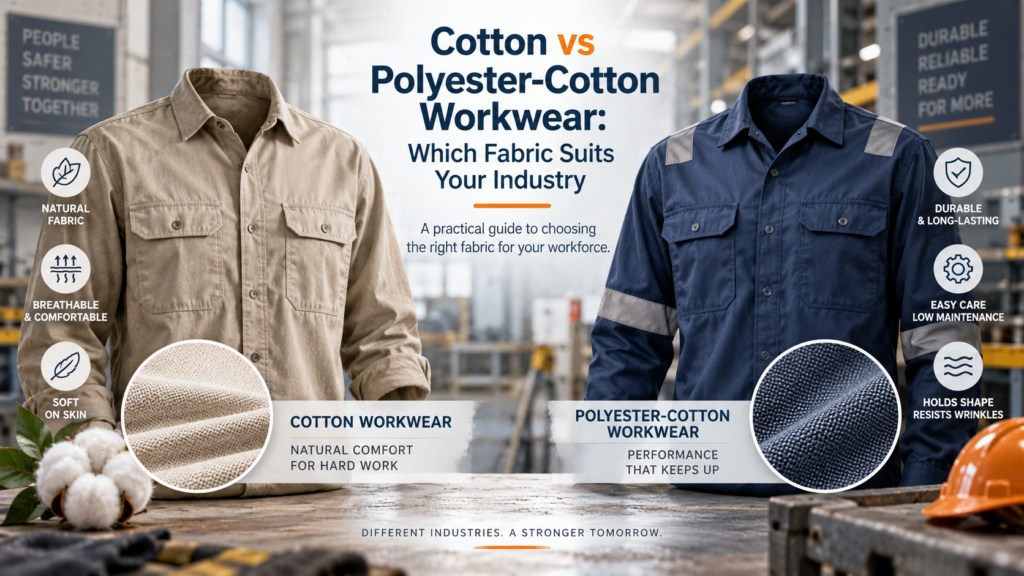
Cotton works well in hot, dry conditions where breathable workwear and comfort are important. Polyester-cotton is better suited to frequent washing, rough use, color retention and quicker drying. The 65/35 polyester-cotton blend is a common choice for industrial uniforms.
The right workwear fabric depends on the climate, the work being done and the hazards
Most industrial uniforms use one of three workwear fabric routes. Some are 100% cotton. Others are a polyester-cotton blend. A smaller group uses spun polyester. Armstrong’s work wear range covers all three, which makes the comparison practical rather than theoretical.
Weave counts too. Twill and drill constructions tend to resist abrasion better than plain weave, which is why many coveralls use them. Fiber gets the attention, but a loose weave in a good fiber still gives you workwear fabric that wears out early.
Cotton Workwear Fabric: Strengths and Limits
Cotton workwear fabric takes in sweat because of the way its fibers are made. Cotton has a moisture regain of about 8.5%, while polyester is closer to 0.4%. On warm mornings, a cotton coverall can feel more comfortable since air passes through the cloth and the fibers absorb sweat from the skin.
Cotton also feels soft, which matters when workers spend ten hours in the same clothes. Rough collars and stiff seams can become uncomfortable after a few hours. With cotton, there’s less of that irritation. Pre-shrunk 100% cotton workwear fabric also keeps its fit after the first wash.
The downside is how long cotton takes to dry. In humid coastal areas, a shirt soaked with sweat can remain damp and stick to the skin. Cotton also wrinkles, fades with repeated harsh washing, and tends to lose its shape sooner than blended fabrics. Untreated cotton doesn’t provide flame protection either, as discussed in the industry section below.
Where Cotton Works Well
Cotton works well in indoor plants and for outdoor jobs in dry, hot weather. Employers may also prefer it when keeping workers comfortable helps with staff retention. Workshops, stores, maintenance crews and facilities that handle food often consider a cotton coverall for these jobs.
Polyester-Cotton Workwear Fabric: How the Blend Performs
Polyester-cotton workwear fabric combines both fibers in the yarn. A common mix is 65% polyester and 35% cotton, although you’ll also find 50/50 blends in industrial fabric catalogs. Increasing the polyester content improves strength and helps the fabric dry faster, while a higher cotton content makes it more breathable.
Polyester also helps this workwear fabric stand up to rubbing and repeated washing without losing color as quickly. It dries faster, too. Carrington Textiles, a fabric mill in the UK, says its 65/35 polycotton has around 50% better abrasion resistance than pure cotton, based on its own tests. That figure applies to the mill’s testing rather than every polycotton fabric, although buyers often notice similar differences in everyday use.
The blend has limits as well. As polyester content rises, polyester-cotton workwear breathes less and can hold static and odor. Polyester also melts when it meets flame or a hot spark, so a blend is the wrong tool where flash fire or molten splash is on the hazard assessment.
Cotton vs Polyester-Cotton Workwear Fabric: Side-by-Side Table
| Workwear fabric factor | 100% cotton | Polyester-cotton (65/35 typical) |
| Breathability | Higher | Moderate, drops as polyester rises |
| Moisture handling | Absorbs sweat, slow to dry | Dries faster, absorbs less |
| Abrasion resistance | Moderate | Higher |
| Shrinkage | Higher unless pre-shrunk | Lower |
| Color after industrial washing | Fades sooner | Holds color longer |
| Static build-up | Low | Higher |
| Flame behavior (untreated) | Burns | Melts and burns |
| Best fit | Hot, dry, comfort-led roles | Heavy washing, abrasion, outdoor sites |
Read the last row as a starting point. Climate, GSM and the hazard assessment can reverse it.
Workwear Fabric GSM: Pick the Weight Before the Blend
GSM means grams per square meter. It tells you how much workwear fabric sits in one square meter, and it shapes comfort, durability and heat. Suppliers often list coverall workwear fabric anywhere from 150 to 340 GSM, so the number you specify matters as much as the fiber.
| GSM range | Feel | Typical use |
| 150 to 200 | Light | Hot climates, indoor roles, shirts and short-sleeve garments |
| 200 to 260 | Mid-weight | General industrial coveralls, mixed indoor and outdoor work |
| 260 to 340 | Heavy | Abrasive work, cooler sites, garments that must hold structure |
Weight alone does not make a workwear fabric good. A well-finished 180 GSM garment can outlast a loose-weave 250 GSM one. Ask for the weave, the shrinkage result, and a wash test along with the number.
Armstrong’s product pages do not publish GSM figures for each garment. State your target weight, blend, and color when you request samples so the team can match it.
Which Workwear Fabric Suits Your Industry?
| Industry | Main conditions | Workwear fabric lean | Note |
| Oil and gas, refinery, petrochemical | Flash fire, hydrocarbons | FR or IFR fabric for process areas | Cotton or poly-cotton fits stores, admin and support roles |
| Construction and infrastructure | Sun, abrasion, frequent washing | Polyester-cotton, mid-weight | Add reflective trim for site visibility |
| Manufacturing and engineering | Long indoor shifts, moderate wear | Cotton or cotton-rich blend | Pre-shrunk fabric keeps sizing steady |
| Logistics, ports and warehousing | Movement, hi-vis layering | Polyester-cotton | Pairs well withhigh visibility wear |
| Utilities and mining | Dust, abrasion, outdoor exposure | Heavier polyester-cotton | Confirm site rules before ordering |
| Facilities and hospitality | Heavy laundering, branding | Polyester-cotton | Holds embroidery and print well |
The first row deserves a closer look. A welder at a fabrication yard needs more than a good cotton or blend garment. Untreated cotton and blends are not flame resistant, and the difference between standard and fire-retardant clothing is covered in Armstrong’s guide to fire retardant coverall vs regular coverall. Read it before you specify anything for hot work. Choose workwear fabric by hazard first, then by climate.
When choosing workwear for hot climates, heat and humidity are two things buyers need to consider. Summers along the Gulf coast are extremely hot, with plenty of humidity. Singapore stays humid throughout the year and gets frequent, sudden rain. In both regions, fabrics that draw moisture away from the skin are a practical choice.
A 2024 study published in the Saudi Journal of Art and Design examined the comfort and mechanical properties of Middle Eastern outerwear. The researchers found that quick-dry polyester shirts performed better at handling moisture than the other shirts tested. Denim trousers also received good comfort scores. For buyers, this shows why fabric weight and moisture management deserve just as much attention as fiber type.
UAE, Oman, Kuwait and Qatar
Workers in these countries spend long hours in strong sunlight, and their uniforms often go through bulk washing. A lightweight cotton coverall, towards the lower end of the GSM range, can feel cooler during a shift. Polyester-cotton coveralls, on the other hand, dry quicker and hold their color better after repeated washing. That’s useful for companies that need uniforms to look the same across large teams.
Some buyers choose different fabrics depending on the job. Cotton is often preferred for indoor workers or those working in shaded areas, while blended fabrics are used for teams working outdoors.
Armstrong has separate pages for buyers in the UAE, Oman, Kuwait, and Qatar, with distributor access available in each country.
Singapore
In Singapore, humidity is an everyday concern, and outdoor work can be interrupted by sudden rain. Uniforms that dry quickly after getting wet are more comfortable to wear and don’t stay damp for as long.
Light to medium GSM polyester-cotton fabrics are suitable for shipyard, marine, and construction workers. Cotton remains a good option for technical staff working indoors.
Buyers can check Armstrong’s Singapore page for the workwear range available in the market.
UK, US and other tier one buyers
Procurement teams in the UK, North America, Australia and Western Europe tend to review paperwork in detail. Ask for fibre content, GSM, shrinkage after washing and color fastness results for each lot. Armstrong holds ISO 9001:2015 for quality management and ISO 13688:2013 for general requirements of protective clothing, and it supplies customers across North America and the UK. Match the workwear fabric to the hazard assessment first, then match the paperwork to the workwear fabric.
Armstrong Cotton and Poly-Cotton Coveralls Compared
Armstrong’s workwear range lets you test the workwear fabric decision against real garments.
| Product | Workwear fabric | Key features | Colours |
| Deluxe 100% Cotton Coverall | 100% cotton, pre-shrunk | Raglan sleeve, two chest pockets with flap and Velcro, two-way concealed zipper, full elasticated waist back, 2 inch reflective strips on arms, knees and back | Khaki, Navy Blue, Orange, Red, Royal Blue |
| Elite Blended Poly Cotton Coverall | Polyester-cotton blend | Single-piece full sleeve, one open and one zipped chest pocket, tool pockets on leg, arm and back, action pleats on both legs, 1 inch reflective strips on arms, shoulders and knees | Khaki, Navy Blue, Orange, Red |
| Classic Workers Uniform Coverall | Spun polyester | Heavy-duty threads, double stitching at stress points, two chest pockets with button-down flap, half elasticated waist back, reflective strips on shoulders and knees | Navy Blue, Orange |
All three come in sizes S to 3XL.
The Deluxe suits crews that want a cotton coverall with room to move. The raglan sleeve gives the arms freedom, and the pre-shrunk workwear fabric keeps sizing predictable. The Elite is the blend option for outdoor and high-wash roles, with action pleats that help when workers kneel or climb. The Classic relies on reinforced stitching and spun polyester for daily industrial use.
Shirt and trouser sets follow the same split. The Elite Blended Poly Cotton Work Shirt & Trouser and the Deluxe 100% Cotton Work Jacket & Cargo Pants let a site dress different roles in the same workwear fabric family.
Branding also depends on the workwear fabric you choose. Armstrong provides customization and branding options, including embroidery, screen printing, DTG, and vinyl transfers. Brands looking to develop their own product range can also use its private label and OEM manufacturing services. Mid-weight blends generally work well with embroidery, but it’s worth testing the method on a sample before placing a bulk order.
Workwear Fabric Buying Checklist
- Look at the job risks first. If workers face flash fires or molten metal exposure, consider FR or IFR workwear fabric rather than regular cotton or blends.
- Check the fiber content and blend ratio, such as 100% cotton or 65/35 polyester-cotton.
- Pick a GSM that suits the working conditions and local climate.
- Consider the weave. Twill and drill are good options for work involving frequent abrasion.
- If you’re buying cotton, check whether it’s pre-shrunk and ask for wash shrinkage test results.
- Ask for color fastness test results for both washing and sunlight.
- Wash a sample using your regular laundry process before placing a bulk order.
- Make sure your preferred branding method works with the
Common Mistakes, Care and Key Takeaways
Mistakes that cost buyers
- Judging workwear fabric by touch in a showroom instead of testing it on site.
- Assuming a heavier garment is a better one.
- Sending 100% cotton through harsh industrial laundering and expecting the color to hold.
- Using non-FR garments in areas where the hazard assessment calls for flame resistance.
- Approving a workwear fabric sample without a wash test.
Care in brief
Always check the care label before washing. Avoid chlorine bleach on coloured clothes. Cotton is best left to air dry when possible, while blended fabrics can go in the dryer on a low setting. Even pre-shrunk cotton should be washed once before you check the fit.
Key takeaways
- Cotton wins on breathability and comfort in hot, dry, indoor or shaded work.
- Polyester-cotton wins on abrasion, color retention, and drying time.
- Workwear fabric GSM and weave change the result as much as the blend ratio.
- Neither workwear fabric is flame resistant in its standard form.
Conclusion
Choosing the right workwear fabric comes down to the job, the weather and the risks involved. Cotton is a good choice for hot, dry conditions where comfort matters. Polyester-cotton blends work better when clothes need frequent washing, take more wear and tear, or need to dry quickly. The GSM, weave, and fabric ratio also make a difference. Before making a final choice, test a sample using your usual laundry process. For jobs with fire-related hazards, make sure the fabric has the required flame resistance.
Armstrong Products can supply cotton, poly-cotton and spun polyester coveralls for bulk, OEM, private label and export orders. Request the catalog or talk to the product team through the contact page with your workwear fabric, GSM, and quantity.
FAQs
Which workwear fabric is best for hot climates?
Cotton works well in dry heat, especially when it’s lightweight and has a lower GSM. It lets air through and absorbs sweat. When the weather gets humid, polyester-cotton can be more comfortable because it dries faster. Some buyers in the Gulf and Singapore choose cotton coveralls for staff working indoors or in the shade. For outdoor workers, they often prefer blends. There’s also the safety side to think about. Regular cotton and polyester-cotton aren’t designed to protect against flames.
Is polyester-cotton better than 100% cotton for coveralls?
Polyester-cotton fabric generally handles frequent washing and rough use better. It also holds its color longer. Pure cotton is softer and allows better airflow, which can make a difference during long shifts. Blends are often a better fit for outdoor jobs, heavy washing, and work that causes fabric wear. Cotton is worth considering where comfort matters more, especially in dry or shaded areas. You can compare Armstrong’s Elite poly-cotton coverall with its Deluxe 100% cotton coverall to see which suits the job.
What GSM should industrial workwear fabric be?
For hot weather or indoor work, 150–200 GSM is usually suitable. General industrial coveralls commonly use 200–260 GSM fabric, while 260–340 GSM works better for rougher jobs and cooler locations. GSM alone doesn’t tell you how the garment will perform. The weave and fabric finish also make a difference. Ask for wash-test results before placing a bulk order.
Does the 65/35 ratio matter?
Yes. In a 65/35 polyester-cotton blend, polyester provides most of the strength and helps the fabric dry faster. Cotton adds some breathability. A 50/50 mix feels more like cotton, while blends with more polyester tend to feel more synthetic. Always check the exact fabric composition. Two garments labeled “poly-cotton” may have different ratios and perform quite differently.
Can cotton or polyester-cotton coveralls be worn where fire is a risk?
Standard cotton and polyester-cotton workwear fabric is not flame resistant. Untreated cotton burns, and polyester melts, which can worsen a burn. Where a flash fire, welding, or hot work hazard exists, the site needs FR or IFR clothing that matches its hazard assessment. Use cotton and blend coveralls for general roles, stores, workshops and support staff.
Can Armstrong make coveralls in a fabric and blend I specify?
Armstrong offers OEM and private label manufacturing, plus branding by embroidery, screen print, DTG and vinyl transfer. Share your target workwear fabric, GSM, color, and branding method when you request a sample, and the team will confirm what is available for your order. Samples can be requested before a bulk order is placed.