Most factory uniform programs start with a straightforward question: who makes good uniforms at volume? The answer gets complicated quickly. A manufacturer who handles 300 units cleanly may not have the infrastructure to maintain the same standard across 3,000 units on a recurring contract. What tends to happen is this: the pilot order goes well, both sides pay attention, and the quality meets specifications. Then the contract scales. By the third production run, the supervisory focus that went into the pilot is nowhere near the same level, and there is no documented QC process holding things together in its absence. That is when the problems start arriving, and by then they are contract problems rather than specification problems.
Getting the manufacturer right before the first order is placed is what keeps it from getting to that point.
What defines a factory worker uniform?
Factory floors are not all the same environment, and the uniforms worn on them are not all the same garment. A pharmaceutical production worker needs different things from their workwear than a steel fabrication operator or an automotive assembly line technician. What they share is that the uniform has to function under real working conditions: physical movement across a full shift, repeated commercial laundering, and in many cases, specific hazard requirements tied to what is actually happening on that floor.
Beyond function, most factory uniform programs also carry a visual layer. Color coding by department, role, or clearance zone. Logo placement that identifies the company or contractor. Consistency across the workforce so that the uniform program looks like one rather than a collection of approximations of the same specification.
Those requirements together are what separate a factory worker uniform from general workwear. The garment has to hold up physically, meet any applicable compliance standard, and look consistent across every unit in a large production run.
Core requirements for factory floor workwear
A factory uniform that works well on day one needs to still be working at month 10. That means the fabric holds its dimensions through commercial laundry cycles, the stitching at stress points does not fail under regular physical movement, and the color remains consistent enough across production batches that the uniform program still looks like a program rather than a collection of different shades of the same specification.
For roles with specific hazard exposure, the garment also needs to carry a tested certification relevant to that hazard. A factory floor with welding operations, chemical handling, or proximity to electrical equipment needs garments that meet the standards applicable to those hazards, not just a general workwear specification.
Why manufacturer choice matters for large-scale operations
Risks of inconsistent quality across bulk orders
A size discrepancy across 50 units is an administrative problem. Across 2,000 units covering multiple sites, it becomes a returns program that nobody budgeted for and a workforce complaint that lands on the procurement head’s desk. A fabric colorfastness failure that produces two visibly different shades of navy across two production batches creates a uniform program that looks inconsistent every day on every floor.
The harder failures are the ones that do not announce themselves. A production batch in which the stitching thread at the shoulder seams was substituted during a supply chain disruption may look fine upon delivery. The failures appear gradually across the first three months of wear, once the program is already running. By then, the correction involves managing an active contract dispute rather than a specification review.
Large-scale uniform procurement also surfaces a manufacturer capability gap that smaller orders hide. A supplier who devotes significant supervisory attention to a pilot order may run the 10th production batch of a long-term contract with significantly less oversight. The systems a manufacturer has in place for maintaining quality across production runs, not just on the first order, are what actually determine whether a bulk uniform program holds up.
Types of factory worker uniforms
Standard cotton and poly-cotton coveralls
The choice of fabric in a factory uniform program has more practical consequences than most procurement conversations give it credit for. Pure cotton is comfortable, particularly in warm environments, and workers generally prefer it. The problem is what happens after 30 commercial laundry cycles: cotton shrinks, loses its shape, and wears through faster at the knees, elbows, and seat than blended fabrics do.
A 65/35 poly-cotton blend performs differently. The polyester content keeps the garment’s dimensions more stable through repeated laundering, holds color more consistently across production batches, and resists surface abrasion better in high-friction areas. For most general factory environments, the blend is the more durable long-term choice. The GSM weight needs to match the intensity of use on the specific floor. A light fabric that works in a warehouse does not hold up as well in a heavy-fabrication environment.
FR and hazard-specific uniforms
Not every factory role needs standard workwear. Welding, chemical handling, work near electrical equipment, and operations in environments where ignition is a real risk all require garments that are tested and certified to the relevant standard, not just garments that feel like PPE.
FR coveralls for heat and flame environments need to be certified to EN 11612 or NFPA 2112. The certificate needs to be product-level, up to date, and specific to the garment being ordered. A fabric-level certificate on a different garment in the supplier’s catalog does not satisfy this requirement.
The construction method matters as much as the certification label. Inherent FR fabrics have the flame-resistant property in the fiber itself, and it stays there for the life of the garment regardless of how many times the garment is washed. Treated FR fabrics have a surface coating that provides the protection, and that coating degrades with laundering. For factory laundry programs running multiple cycles per week, a treated FR garment can lose meaningful protection well before the end of its expected contract life. The contract specification needs to state which construction method is required, not just which certification the garment carries.
Department-wise color-coded uniforms
Most manufacturing, automotive, pharmaceutical, and food-processing operations use color to visually organize their workforce. Maintenance is one color. Production operators are another. Quality control wears something different. The system lets a supervisor read a production floor in seconds without checking badges or asking questions, and it supports safety protocols by making it immediately obvious when someone from one area is in a zone they should not be.
The procurement issue that color-coded programs run into most often is dye lot variation between production batches. Two batches of navy blue coveralls from the same supplier, ordered six months apart, can arrive as noticeably different shades if dye lot controls were not specified in the contract. The maintenance team ends up in two different shades of the same specification, and the visual system that the program is built on stops working cleanly. Before approving a supplier for a color-coded uniform program, confirm how they control dye consistency across production runs and what their tolerance is for shade variation between batches.
Standard cotton and poly-cotton coveralls
The fabric choice in a factory uniform program has more practical consequences than most procurement conversations give it credit for. Pure cotton is comfortable, particularly in warm environments, and workers generally prefer it. The problem is what happens after 30 commercial laundry cycles: cotton shrinks, loses its shape, and wears through faster at the knees, elbows, and seat than blended fabrics do.
A 65/35 poly-cotton blend performs differently. The polyester content keeps the garment’s dimensions more stable through repeated laundering, holds color more consistently across production batches, and resists surface abrasion better in high-friction areas. For most general factory environments, the blend is the more durable long-term choice. The GSM weight needs to match the intensity of use on the specific floor. A light fabric that works in a warehouse does not hold up the same way in a heavy fabrication environment.
FR and hazard-specific uniforms
Not every factory role needs standard workwear. Welding, chemical handling, work near electrical equipment, and operations in environments where ignition is a live risk all require garments tested and certified to the relevant standard, not just garments that feel like PPE.
FR coveralls for heat and flame environments need to be certified to EN 11612 or NFPA 2112. The certificate needs to be product-level, current, and specific to the garment being ordered. A fabric-level certificate on a different garment in the supplier’s catalog does not satisfy this requirement.
The construction method matters as much as the certification label. Inherent FR fabrics have the flame-resistant property in the fiber itself, and it stays there for the life of the garment regardless of how many times the garment is washed. Treated FR fabrics have a surface coating that provides the protection, and that coating degrades with laundering. For factory laundry programs running multiple cycles per week, a treated FR garment can lose meaningful protection well before the end of its expected contract life. The contract specification needs to state which construction method is required, not just which certification the garment carries.
Department-wise color-coded uniforms
Most manufacturing, automotive, pharmaceutical, and food-processing operations use color to visually organize their workforce. Maintenance is one color. Production operators are another. Quality control wears something different. The system lets a supervisor read a production floor in seconds without checking badges or asking questions, and it supports safety protocols by making it immediately obvious when someone from one area is in a zone they should not be.
The procurement issue that color-coded programs run into most often is dye lot variation between production batches. Two batches of navy blue coveralls from the same supplier, ordered six months apart, can arrive as noticeably different shades if dye lot controls were not specified in the contract. The maintenance team ends up with two different shades of the same specification, and the visual system that the program is built on stops working cleanly. Before approving a supplier for a color-coded uniform program, confirm how they ensure dye consistency across production runs and what their tolerance for shade variation between batches is.
Standard cotton and poly-cotton coveralls
The choice of fabric in a factory uniform program has more practical consequences than most procurement conversations give it credit for. Workers prefer cotton. It breathes; it is comfortable during a long shift; and in warm factory environments, that matters. The issue shows up later, usually after the laundry program has been running for a few months. Cotton shrinks after repeated high-temperature washing. It fades faster than blended fabrics. At the knees and seat, where physical wear is heaviest, it wears through before the replacement cycle the procurement team planned.
A 65/35 poly-cotton blend does not have the same comfort reputation, but it holds up differently in practice. Dimensions stay more stable across repeated commercial laundry cycles. Color variation between production batches is less pronounced. In high-friction areas, the polyester content resists surface wear better than pure cotton does. In factory environments that run daily laundry programs, the durability gap between the two fabrics becomes apparent within the first six months of a contract.
The GSM weight needs to match the intensity of use on the specific floor. A light fabric that works in a warehouse does not hold up as well in a heavy-fabrication environment.
FR and hazard-specific uniforms
Not every factory role needs standard workwear. Welding, chemical handling, work near electrical equipment, and operations in environments where ignition is a real risk all require garments that are tested and certified to the relevant standard, not just garments that feel like PPE.
FR coveralls for heat and flame environments need to be certified to EN 11612 or NFPA 2112. The certificate needs to be product-level, up to date, and specific to the garment being ordered. A fabric-level certificate on a different garment in the supplier’s catalog does not satisfy this requirement.
The construction method matters as much as the certification label. Inherent FR fabrics have the flame-resistant property in the fiber itself, and it stays there for the life of the garment regardless of how many times the garment is washed. Treated FR fabrics have a surface coating that provides the protection, and that coating degrades with laundering. For factory laundry programs running multiple cycles per week, a treated FR garment can lose meaningful protection well before the end of its expected contract life. The contract specification needs to state which construction method is required, not just which certification the garment carries.
Department-wise color-coded uniforms
Most manufacturing, automotive, pharmaceutical, and food-processing operations use color to visually organize their workforce. Maintenance is one color. Production operators are another. Quality control wears something different. The system lets a supervisor read a production floor in seconds without checking badges or asking questions, and it supports safety protocols by making it immediately obvious when someone from one area is in a zone they should not be.
The procurement issue that color-coded programs run into most often is dye lot variation between production batches. Two batches of navy blue coveralls from the same supplier, ordered six months apart, can arrive as noticeably different shades if dye lot controls were not specified in the contract. The maintenance team ends up with two different shades of the same specification, and the visual system that the program is built on stops working cleanly. Before approving a supplier for a color-coded uniform program, confirm how they ensure dye consistency across production runs and what their tolerance for shade variation between batches is.
Standard cotton and poly-cotton coveralls
The choice of fabric in a factory uniform program has more practical consequences than most procurement conversations give it credit for. Pure cotton is comfortable, particularly in warm environments, and workers generally prefer it. The problem is what happens after 30 commercial laundry cycles: cotton shrinks, loses its shape, and wears through faster at the knees, elbows, and seat than blended fabrics do.
A 65/35 poly-cotton blend performs differently. The polyester content keeps the garment’s dimensions more stable through repeated laundering, holds color more consistently across production batches, and resists surface abrasion better in high-friction areas. For most general factory environments, the blend is the more durable long-term choice. The GSM weight needs to match the intensity of use on the specific floor. A light fabric that works in a warehouse does not hold up as well in a heavy-fabrication environment.
FR and hazard-specific uniforms
Not every factory role needs standard workwear. Welding, chemical handling, work near electrical equipment, and operations in environments where ignition is a live risk all require garments tested and certified to the relevant standard, not just garments that feel like PPE.
FR coveralls for heat and flame environments need to be certified to EN 11612 or NFPA 2112. The certificate needs to be product-level, current, and specific to the garment being ordered. A fabric-level certificate on a different garment in the supplier’s catalog does not satisfy this requirement.
The construction method matters as much as the certification label. Inherent FR fabrics have the flame-resistant property in the fiber itself, and it stays there for the life of the garment regardless of how many times the garment is washed. Treated FR fabrics have a surface coating that provides the protection, and that coating degrades with laundering. For factory laundry programs running multiple cycles per week, a treated FR garment can lose meaningful protection well before the end of its expected contract life. The contract specification needs to state which construction method is required, not just which certification the garment carries.
Department-wise color-coded uniforms
Most manufacturing, automotive, pharmaceutical, and food processing operations use color to organize their workforce visually. Maintenance is one color. Production operators are another. Quality control wears something different. The system lets a supervisor read a production floor in seconds without checking badges or asking questions, and it supports safety protocols by making it immediately obvious when someone from one area is in a zone they should not be.
The procurement issue that color-coded programs run into most often is dye lot variation between production batches. Dye lot variation is one of those problems that only becomes visible after the second or third production batch arrives on site. The first order looks fine. Six months later, when the reorder comes in, the navy blue is half a shade different from what is already in circulation. Put the two batches side by side on a busy production floor, and the difference is obvious. The zone identification system the program was designed around starts to break down not because the garments are defective, but because no one confirmed dye lot tolerance in the specification.
Ask the manufacturer directly: how do you control shade consistency across repeat production runs, and what is your acceptable variance between dye lots? A supplier who has managed color-coded programs before has a specific answer. One who has not tends to treat the question as a detail rather than a production control issue.
Key factors when choosing a factory worker uniform manufacturer
Manufacturing capacity and scalability
The first question worth asking any uniform manufacturer is whether they produce in-house or route orders to third-party factories. A manufacturer running their own production facility controls quality at every stage. A distributor or agent placing orders with external factories loses direct oversight of the production process, so quality problems at the third-party facility become problems the buyer discovers upon delivery rather than ones the supplier catches during production.
Confirm monthly production capacity for the specific garment types in your program. A manufacturer who can tell you precisely how many units per month their facility produces for your garment category has real capacity data. One who answers in general terms about “significant capacity” does not.
For recurring contracts, also confirm how the manufacturer handles concurrent orders. A facility that can produce your 2,000 units while running several other clients’ orders simultaneously without compromising quality on any of them is a different operation from one that can only maintain quality standards when your order is the only one on the floor.
Fabric quality and testing
The fabric specification sheet tells you what a garment is made of. Test reports tell you how it performs. Both documents are necessary, and they are not interchangeable.
Request GSM weight, fiber composition, and weave type for each garment in the program. Then ask for test reports covering shrinkage, colorfastness, and tensile strength at seam points. A fabric spec that looks good on paper but produces 4% chest shrinkage after the first commercial laundry cycle is a sizing problem across every unit in the order.
On FR garments, request the treatment method and wash cycle rating separately from the general fabric specification. A treated FR coverall rated to 25 wash cycles going into a factory laundry program running twice weekly has a compliance lifespan of under three months. That calculation needs to happen during specification review, not after the first compliance question arrives.
Certifications to verify
A test certificate and a product page listing certification names are two different documents. The certificate specifies which standard was tested, which edition, which test method was used, and the measured result. The product page tells you what the supplier believes is true about the product.
Ask for actual test certificates for each garment type in the program. Check the date on each certificate. Standards get revised, and a certificate issued against an older standard edition may not reflect current requirements. For ISO 13688:2013 compliance, confirm the certificate edition matches the current standard. For FR garments, confirm the product-level certificate matches the hazard standard applicable to your specific factory environment.
ISO 9001:2015 certification of the manufacturer’s quality management system confirms the existence of documented production processes. It does not tell you how those processes apply to your specific production run. Batch-level QC details require a separate conversation.
OEM and customization capability
Logo embroidery, company name printing, department color coding, modified pocket configurations, and reflective tape placement are standard requirements in established factory uniform programs. Whether the manufacturer handles these in-house or routes them to an external embroidery or printing facility affects both the quality of execution and how issues are addressed when something needs correcting in a large run.
In-house customization gives the manufacturer direct control over placement accuracy, thread color matching, and consistency across a full production run. External customization adds a handoff where errors can develop without the manufacturer’s quality system catching them before the garments ship.
For companies needing garments produced under their own brand or with compliance documentation formatted for specific markets, OEM capability needs to be confirmed separately from general customization availability.
Factory audit and transparency
A manufacturer confident in their own production process welcomes audit access. What the audit lets you verify includes the incoming fabric inspection process, in-process quality checkpoints throughout the production run, how defects are documented and resolved, whether subcontracted processes are disclosed, and whether production standards are consistent across shifts rather than only when quality is formally reviewed.
Third-party audit reports from Bureau Veritas, SGS, or Intertek are a workable alternative when a site visit is not feasible. Ask whether current reports exist and whether they can be shared. A manufacturer who cannot provide either option is one whose production quality is not being independently verified.
Uniform manufacturer evaluation checklist
| Area | What to check |
| Manufacturing | In-house or outsourced? Monthly production capacity for your garment types? |
| Fabric | GSM, composition, test reports for shrinkage, colorfastness, tensile strength? |
| FR garments | Inherent or treated? Wash cycle rating? Product-level standard certification? |
| Certifications | ISO 9001:2015, ISO 13688:2013, CE marking – actual test certificates, not product listings? |
| Samples | Full-size run samples tested under your laundry conditions before bulk order? |
| Customization | In-house or subcontracted? Consistent logo application confirmed across the run? |
| Batch consistency | In-process QC checkpoints? QC report issued with each shipment? |
| Multi-site delivery | Split shipments to named site locations? Single account contact? |
| Lead time | Production start date and delivery date confirmed separately? |
| Compliance docs | Test certificates, material safety data, export compliance paperwork? |
Common mistakes when selecting a bulk uniform manufacturer
Assuming pilot order quality reflects long-term production quality.
Pilot orders attract more attention than they deserve because the relationship is new, and both parties know the buyer is evaluating. The third production batch on a 24-month contract rarely receives the same level of supervisory attention. Before approving a manufacturer for volume, ask specifically how in-process QC is structured on a full production run, what triggers a batch rejection, and whether those controls are documented. A manufacturer with a real quality system answers with specifics. One without answers with reassurances about their commitment to quality.
Locking in specs without testing samples under site conditions.
Laboratory test results are produced under controlled conditions. Your factory laundry may run at a different temperature, with different detergents, and at a different cycle frequency than the conditions under which the garment was tested. Request physical samples in your most common sizes and run them through your site’s actual laundry process before finalizing the specification. Shrinkage and colorfastness results from your environment tell you more than a certificate produced under standardized lab settings.
Treating FR as a single uniform category.
Inherent FR and treated FR garments look identical on a product page and can carry the same compliance label. Their protective mechanisms work differently, their care requirements differ, and their effective compliance lifespan under industrial laundering differs significantly. Specifying FR without specifying the construction method creates a gap a supplier can fill with whichever option suits their production process rather than your compliance requirements.
Not confirming multi-site logistics capability before signing the contract.
A manufacturer that handles a single-location 1,500-unit order cleanly may not have the logistics infrastructure to split the same volume across eight plant locations, with site-specific size distributions, separate packing lists, and different delivery contacts. Find out whether multi-site delivery is something they have executed on existing customer contracts, not something they are confident they can figure out.
Managing multi-site uniform supply
Manufacturing groups, EPC contractors, and companies running operations across multiple plant locations often manage uniform programs centrally while distributing stock to individual sites. The complexity of doing that well is something a manufacturer either has experience with or does not.
Central procurement with site-level delivery requires the manufacturer to maintain accurate stock across SKUs throughout the contract period, handle split shipments with site-specific documentation, manage re-order requests from individual sites without disrupting the main delivery schedule, and provide a single account contact who owns the entire program rather than treating each site as a separate customer.
Before assuming these capabilities exist, confirm them directly. Ask for references from current multi-site customers. Ask how an emergency re-order from one site is handled when it falls between scheduled deliveries. The answers reveal whether you are dealing with a manufacturer that has built infrastructure for enterprise procurement or one that handles large orders by scaling up what they do for smaller ones.
Why manufacturing quality matters
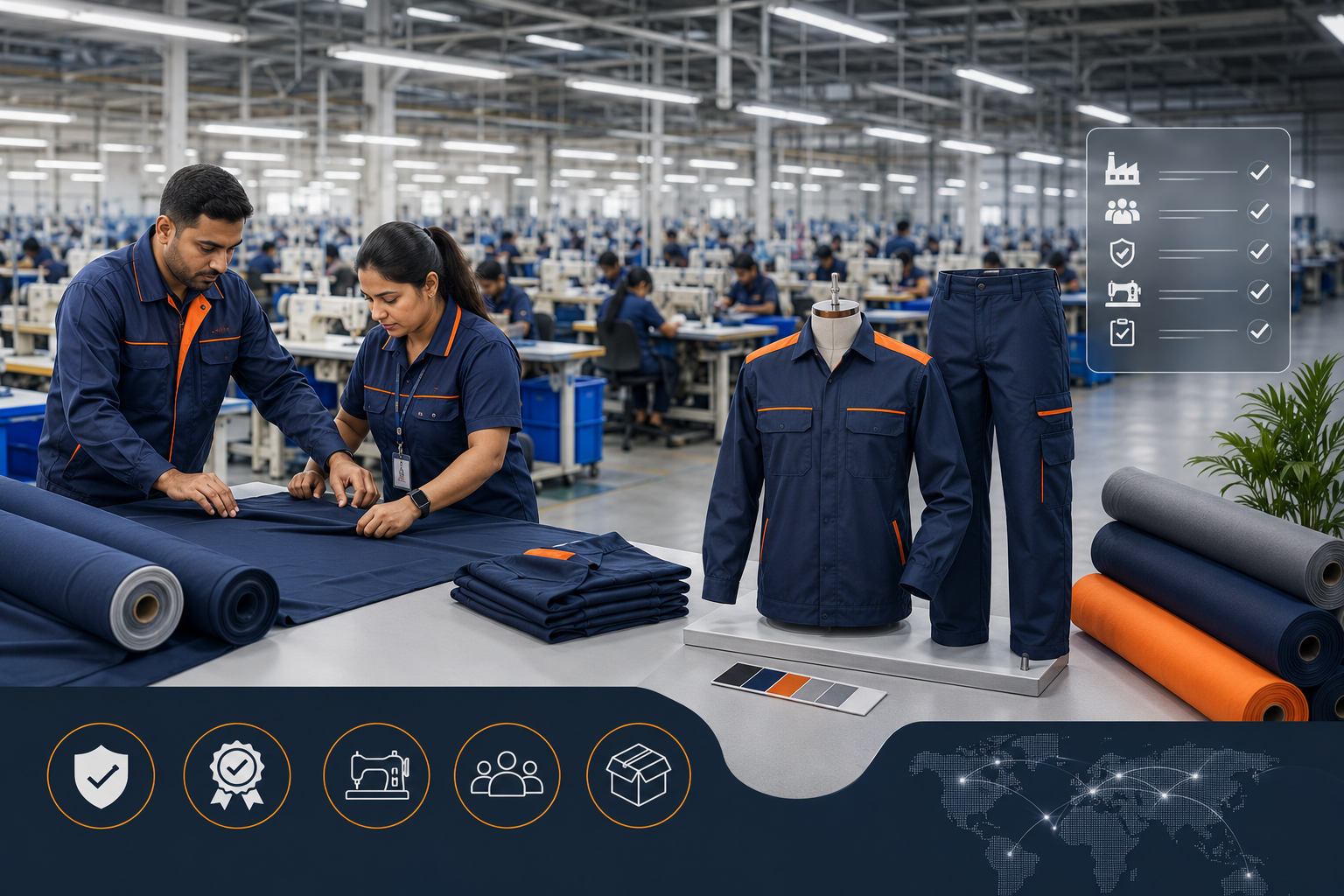
Armstrong Products has manufactured factory workwear and industrial uniforms since 2009. The manufacturing facility is in Boisar, Maharashtra, with the corporate office in Powai, Mumbai.
The facility holds ISO 9001:2015 certification for its quality management system and ISO 13688:2013 certification for protective clothing, with CE marking across the garment range.
The client list includes ONGC, L&T, JSW Steel, Adani, Halliburton, Hitachi, Godrej, and Weatherford. These are organizations with formal vendor qualification programs and audit requirements that go beyond reviewing a product catalog. Supplying them across multiple contract cycles means the production quality, batch consistency, and compliance documentation have been tested against independent scrutiny on a recurring basis.
Armstrong also supports OEM and private-label manufacturing for buyers who need branded factory uniforms, multi-site delivery programs, or compliance documentation formatted for specific export markets. Customization, including logo embroidery, department color coding, and modified garment specifications, is handled in-house.
Conclusion
Factory uniform procurement decisions that go smoothly long-term are almost never the result of a good product alone. They come from asking the right questions before the first order is placed: how is quality controlled across production runs rather than just on the pilot, what happens when three sites need re-orders at the same time, what does the fabric spec actually look like after 40 wash cycles in the factory’s laundry conditions.
The suppliers who cause the most problems mid-contract rarely advertise that upfront. They responded to the RFQ, delivered a decent pilot order, and gave confident answers to general quality questions. The gaps surface when volume increases and the supervision that went into the pilot batch does not scale with it.
The evaluation work that prevents those gaps is not complicated. It just happens before the contract is signed rather than after the problems start arriving.
FAQs
What should I look for in a factory worker uniform manufacturer?
Start with manufacturing capability. Confirm whether production happens in-house or through third parties, what monthly capacity exists for your garment types, and how quality is controlled across production runs, not just on the first order. Then verify certifications with actual test certificates rather than product page listings. Request samples for testing under your site conditions, and confirm audit access or third-party audit documentation before placing volume orders.
How do I know a manufacturer can handle large-scale orders?
Ask for monthly production capacity data and references from clients with comparable order volumes. A manufacturer running their own facility gives you specific numbers backed by production records. One routing order through third parties usually cannot. Willingness to provide audit access, combined with third-party audit reports, gives you the clearest picture of whether the production capability behind the sales conversation is real.
Can factory uniforms be customized with our company branding?
Yes. Logo embroidery, department color coding, modified pocket configurations, and reflective tape placement are all standard from established manufacturers. Confirm that customization is handled in-house before approving a supplier. In-house customization means direct quality control at every stage and faster resolution when something needs correcting on a large run.
What is the typical lead time for bulk factory uniform orders?
Straightforward bulk orders from manufacturers with available in-house production capacity typically run four to eight weeks. Programs involving customization, multiple garment types, or multi-site delivery logistics take longer. Get a confirmed production start date and a confirmed delivery date as two separate commitments, and ask what the escalation process is if production falls behind.
What certifications should I verify before placing a bulk order?
ISO 9001:2015 confirms a documented quality management system. ISO 13688:2013 covers general protective clothing requirements. CE marking applies to European and UK markets. For hazard-specific garments, product-level certifications apply: EN 11612 or NFPA 2112 for FR, EN ISO 20471 or ANSI/ISEA 107 for high-visibility. Request the actual test certificates with standard editions and test dates, not product pages listing certification names.
How is fabric quality tested for large production runs?
Properly managed programs include pre-shipment inspection at the manufacturer’s facility before goods leave. Testing covers shrinkage, colorfastness, and tensile strength at seams. For FR garments, wash durability of the protective treatment is a separate test from the fabric spec and needs to be confirmed alongside it. Pre-shipment inspection is when defects can be corrected without disrupting your site delivery schedule.
What is the difference between standard and FR factory uniforms?
Standard factory uniforms need to hold up under physical use and industrial laundering, fit correctly across a full size range, and maintain colorfastness across production batches. FR uniforms carry an additional tested requirement that the fabric resists ignition and self-extinguishes when the heat source is removed, certified to EN 11612, NFPA 2112, or both depending on the hazard and market. FR garments also carry specific care restrictions around chlorine bleach and fabric softeners that standard workwear does not. For roles with flame, flash fire, or electrical arc exposure, FR-rated garments are a regulatory requirement.
How often should factory worker uniforms be replaced?
Replacement intervals depend on the garment type, the intensity of use, and how well the laundry program has been managed. For standard factory workwear, annual replacement cycles are typical in most industrial environments, though high-wear roles or environments with chemical exposure often need more frequent turnover. For FR garments, replacement is also driven by wash cycle count against the manufacturer’s rated maximum, physical damage, and whether the protective treatment shows signs of degradation.