Six months into a workwear contract, a site HSE officer noticed something wrong with the FR coveralls. The shoulder seams were stitched with standard polyester thread. Not conductive. Nobody had asked about seam construction during the procurement process, and the supplier had not volunteered it.
The pilot order had been fine. First delivery on time, quality looked acceptable, sizes ran true. By the second batch, the high-visibility orange had shifted shade, and three sizes were running small. The seam issue only came up because someone physically pulled at a coverall to check.
What makes bulk HSE uniform procurement different from smaller purchases is that oversights do not stay contained. The same oversight that goes unnoticed on 50 units is a program-wide compliance issue on 2,000. This guide covers the questions worth asking before the contract is signed, not after the problems start arriving with the shipments.
What are HSE uniforms?
In industrial environments, what workers wear is not a branding decision. An oil refinery worker near hot work needs FR coveralls. A construction operative working around moving plant needs high-visibility clothing. These are garments chosen because the environment demands specific protection, and each one needs to perform to a tested standard rather than simply fit and hold together.
HSE uniforms are the category name for this type of workwear – garments selected to meet health, safety, and environmental requirements specific to the hazard profile of the work environment.
Core components of an HSE uniform program
Buying uniforms and running a uniform program are not the same thing, and the distinction is where most procurement problems start.
A purchase delivers garments. A program defines which garment each role requires, the performance standard it must meet, when it is replaced and on what basis, how it is laundered without compromising compliance, and how supply is replenished over the contract period. Most uniform programs that run into trouble six months in have a program design problem, not a product problem. The garment was fine. The specification did not require the FR type to be inherent rather than treated. The laundry instructions never reached the site team. The replacement schedule was based on how long a garment had been in service rather than how many times it had been washed. Getting those details into the contract before the first order is placed is what determines whether the program runs cleanly or generates a steady stream of complaints, replacements, and compliance queries from month six onward.
Why HSE uniform quality matters at scale
Risks of poor quality in bulk orders
A size L coverall that runs small is not a problem. It is that problem multiplied by every worker in that size across every site the order covers. An FR fabric rated for 30 wash cycles, when run through a laundry program twice a week, reaches its compliance limit in under four months. A stitching failure at the shoulder seam on a handful of units is an isolated defect. The same failure pattern appearing across a batch is a production issue that runs through everything shipped under that production run.
The harder problems are the ones that do not show up in a physical inspection. A treated FR garment laundered with fabric softener by a laundry team that was never given the care restrictions still looks fine. The color is holding. The fabric structure is intact. What has changed is the protective finish, which has degraded beyond the point where the original certification remains accurate. That compliance failure stays invisible until an auditor asks a specific question or someone actually tests the garment. Across 400 units in active use, that is not an inconvenient finding. It is a workforce safety gap that has been running undetected for months.
Types of HSE uniforms
FR coveralls
Oil and gas sites, petrochemical facilities, utilities, and any environment where workers are exposed to electrical arcing, flash fires, or sustained flames require FR coveralls as the standard daily garment for operational and maintenance roles. The certification that matters is the one tied to the actual hazard on the site. EN 11612 covers heat and flame protection. NFPA 2112 is the standard for flash fire environments. A garment carrying a general FR label without a specific tested standard behind it does not tell you what protection level you are actually buying.
Inherent FR fabrics have the flame-resistant property in the fiber itself. Washing does not change that because there is no applied coating to remove. Treated FR fabrics work differently. The protective finish on treated FR fabric sits on the fiber surface. Repeated laundering wears it down, and the process accelerates when the wash cycle uses chlorine bleach or fabric softeners. On sites where several contractors share one laundry facility, a care restriction mentioned during onboarding will not reliably survive three staff rotations and a shift in laundry management. A written document, posted at the machine and referenced during any new operator handover, is what actually holds across the length of a contract.
High visibility uniforms
Retroreflective tape begins to degrade after the first wash. UV exposure on outdoor sites contributes to that. The rate at which a specific garment loses reflectivity depends on the quality of the retroreflective material itself and how consistently the laundry process has followed the care label, and that rate varies enough between garment types that a certification issued at the point of manufacture tells you nothing useful about where the garment will sit on the performance scale 14 months into its use life.
When evaluating high-visibility garments for a long-term program, ask for wash-cycle durability data that track reflectivity readings across a realistic number of laundry cycles, not just the initial certification result. A supplier who has done that testing produces the data without hesitation. One who has not will redirect toward the garment certification, which only confirms what the garment could do when it was new.
Standard industrial workwear
Workwear for general industrial roles still has to perform across a full contract period under real working and laundry conditions. The variables that determine whether it does are fabric weight, fiber composition, stitching quality at load-bearing points, and how well the garment retains its dimensions and color through repeated commercial washing. These are not specialist concerns. They are the basics that determine whether a garment lasts 12 months or starts incurring replacement costs at 6 months.
Standard workwear receives the least scrutiny in most procurement processes because it lacks a specialist certification. That logic gets the situation backward. A general industrial garment that fades to a visibly different shade between the first and second production batches is a problem every person on every site sees every day. The scrutiny standard workwear needs is different in nature from that required by FR or high-visibility procurement. It is no less important.
Key standards and compliance to check
Two baseline standards apply across most HSE garment categories before any product-specific certifications come into the picture.
ISO 13688:2013 covers the general requirements protective clothing must meet: ergonomics, how the garment is sized and labeled, aging characteristics under use, and the technical documentation a manufacturer is required to supply. It is not a standard that certifies protection against a specific hazard. It confirms that the garment meets the minimum criteria to be classified as protective clothing in the first place, and product-level certifications such as EN 11612 or EN ISO 20471 build on that foundation rather than replace it.
ISO 9001:2015 certifies the quality management system at the manufacturing facility, not the product itself. A third-party auditor has verified that documented production processes and defect tracking are in place. That is a meaningful credential for a manufacturing operation, but it does not tell you how those processes apply to your specific garment specification on your specific production run. Batch-level QC details require a separate conversation, which ISO 9001 certification does not address.
CE marking on garments for the UK or European markets confirms that applicable safety directives have been assessed. What the CE mark does not tell you is which product-level standard applies, and that distinction matters. EN 11612 is the standard for heat and flame protection. EN ISO 20471 governs high-visibility. EN 1149 covers anti-static properties for use in explosive atmosphere environments. The CE mark on the label confirms that the directive assessment has been completed. The product standard certificate confirms what was actually tested.
Operations in North America reference a different set of standards entirely. ANSI/ISEA 107 governs high-visibility garments. NFPA 2112 covers flash fire environments. NFPA 70E applies to electrical arc protection. A garment certified to EN ISO 20471 has not been tested to ANSI/ISEA 107 and does not satisfy that requirement, and the same applies in the other direction. For programs covering sites in multiple markets, identify which standard applies to each geography before the garment specification is finalized, and confirm the supplier can produce the relevant compliance documentation for each. Finding out mid-program that a garment certified for one market does not qualify for another is an avoidable problem.
What to look for before bulk procurement
Fabric quality and testing
The fabric specification sheet and the test reports are two different documents. The spec sheet tells you what the fabric is made of. The test reports show how it actually performs under conditions similar to those at your site. Both matter, and in many procurement processes, only the spec sheet gets requested.
Ask for GSM weight, fiber composition, and weave type for each garment in the program. Then ask for shrinkage data, colorfastness results, and tensile strength at seam points. A garment that loses 4% across the chest after the first commercial laundry cycle at the temperature your laundry actually runs at is a sizing problem across every unit in the order. Fabric that fades to noticeably different shades across production batches creates a workforce presentation problem that worsens with each repeat order.
For FR garments, request the treatment method and the rated wash cycle count separately. A treated FR coverall rated for 25 wash cycles, going through a site laundry that runs twice weekly, has a compliance lifespan of roughly three months. That calculation needs to happen during specification review while there is still time to change the specification, not after the garments are already in circulation and the question has become urgent.
Certifications to verify
A test certificate and a product page that lists certifications are not the same thing. The certificate specifies the standard tested, the edition of that standard, the test method, and the actual measured result. The product page tells you the supplier believes the product complies. Request the certificates.
Check the date on each one. Standards get revised, and a certificate issued against an older edition may not reflect current requirements. For high-visibility garments especially, where retroreflective performance requirements have been updated in recent standard revisions, certificate currency matters more than most buyers realize.
Manufacturing capacity and lead time
Pilot orders tend to receive more production attention than subsequent bulk orders. The sales relationship is new, the buyer is evaluating, and the batch gets closer supervision. By the third production run under a long-term contract, that dynamic has shifted. The question worth asking before committing to volume is how QC is structured on a 3,000-unit run, not what happened on the 300-unit pilot.
Confirm monthly production capacity for your specific garment types. Ask directly whether any part of the order would go to a subcontracted facility and, if so, which part. On lead times, get a confirmed production start date and a confirmed delivery date as two separate commitments. There can be significant time between them depending on the shipping route and customs requirements for your destination market. Ask what the escalation process looks like if production falls behind, before the situation arises, rather than while it is happening.
Customization and branding options
Large uniform programs almost always involve customization: logos, department color-coding, modified pocket layouts, and reflective tape placement. Whether those modifications are handled in-house or sent to an external facility affects how consistently they are applied across a full production run.
On a run of 400 branded jackets, the logo needs to be in the same position on unit 400 as on unit 1, with the same thread color and embroidery tension. When in-house customization is the model, the manufacturer directly controls that consistency. When the garments are sent to an external facility for branding, a handoff occurs during which errors can develop without the manufacturer knowing until the finished goods come back. Corrections at that point take longer and involve more parties than they would if the work had never left the production floor.
Factory audit and transparency
Ask a supplier about audit access early in the qualification process. How they respond tells you something useful before any audit takes place. A manufacturer with confidence in their own processes welcomes the visit. What the audit lets you verify includes incoming fabric inspection records, in-process QC checkpoints, defect documentation and how defects are resolved, and whether production standards remain consistent across shifts rather than only during planned quality reviews.
When a site visit is not feasible, third-party audit reports from Bureau Veritas, SGS, or Intertek are a workable alternative. Ask whether current reports exist and whether they can be shared. If neither option is available, the production quality is not being independently verified, and you have no external basis for the supplier’s quality claims.
HSE uniform supplier evaluation checklist
| Area | What to check |
| Manufacturing | In-house or outsourced? Capacity for your volume? |
| Fabric | GSM, composition, test reports for shrinkage, colorfastness, tensile strength? |
| FR garments | Inherent or treated? Wash cycle rating? Relevant standard certification? |
| Hi-vis garments | EN ISO 20471 or ANSI/ISEA 107 certified? Retroreflective durability data? |
| Certifications | ISO 9001, ISO 13688, CE marking, product-specific – actual certificates, not product listings? |
| Samples | Full-size run samples tested under your laundry conditions before bulk order? |
| Customization | In-house or subcontracted? Consistent application confirmed across production run? |
| Batch consistency | In-process QC checkpoints documented? QC report issued with each shipment? |
| Multi-site delivery | Split shipments to named locations? Single account contact across all sites? |
| Lead time | Production start date and delivery date confirmed separately? |
| Compliance docs | Are test certificates, material data, and country-specific paperwork available? |
Common mistakes in bulk uniform procurement
Using the pilot order as the primary quality reference for the full contract.
When a new supplier relationship is being established, the pilot batch gets more attention than it will receive later. The sales team is involved; both sides know the buyer is evaluating, and the production floor treats it accordingly. That level of attention does not persist into the third bulk shipment, which is 14 months into the contract. Before approving a supplier for volume, ask specifically how in-process quality checkpoints are structured on a large production run and what the process is when a batch fails an internal QC check. A supplier with a real quality system answers those questions with specifics. One without a real system gives you general reassurances about their commitment to quality.
Locking in specifications based on lab test results without testing samples on your own site.
Garment certifications are produced under standardized lab conditions. Your site laundry runs at a specific temperature, with specific detergents, on a specific cycle frequency, which may differ from the test conditions assumed. High-visibility garments at outdoor sites experience UV exposure levels that vary by geography. Request physical samples in your most common sizes and run them through your actual site conditions before the specification is finalized. Results from your environment are more relevant to predicting long-term compliance than results from a controlled test setting.
Treating FR as one category without distinguishing the construction method.
An inherent FR garment and a treated FR garment can carry the same label in everyday use. Their protection mechanisms, care requirements, and compliance lifespans under industrial laundering differ significantly. A program that mixes both types and launders them under the same process will have compliance gaps in the treated garments that are not visible during routine inspection. The FR specification in the contract needs to include the construction method, not just the certification name.
Not having a specific conversation about multi-site logistics before signing the contract.
A supplier who handles a single-location 1,500-unit order cleanly may not have the infrastructure for splitting that same volume across eight sites with different size distributions, site-specific packing requirements, and separate delivery contacts. Find out whether they have managed multi-site delivery on existing customer contracts, and ask for references from buyers who can confirm this. General confidence that they can handle it is not the same as having done it.
Care and maintenance for long-term use
Most garment certification testing happens under controlled conditions that do not fully match industrial laundry environments. A care label maximum of 40 degrees Fahrenheit, going through a commercial laundry facility running at 60 degrees, will produce shrinkage, color shift, and dimensional instability faster than the replacement schedule assumes. The care label is not a starting point for negotiation with the laundry team. It defines the conditions under which the garment remains compliant.
FR garments need more than basic care label adherence. Chlorine bleach breaks down flame-resistant coatings, and fabric softener coats the fibers, interfering with the thermal protection of treated FR fabrics. Site laundry facilities handling FR garments need a written document specifying prohibited wash additives, separate from the standard care label and specific enough that a laundry operator who has never handled FR clothing before understands exactly what not to use. That document needs to be provided at program startup, confirmed as received, and checked periodically, not distributed once and forgotten.
At the site level, build regular garment inspection into the program. Supervisors or workers who can identify faded retroreflective tape, open seams at high-stress points, and worn-through fabric at knees or elbows will flag replacement needs while the garments are still within the compliant window. Catching those issues through routine inspection costs far less than discovering them during an audit when the program’s compliance history becomes part of the conversation.
Why manufacturing quality matters
Armstrong Products has manufactured industrial workwear and HSE uniforms since 2009. The manufacturing facility is in Boisar, Maharashtra, with the corporate office in Powai, Mumbai.
The facility holds ISO 9001:2015 certification for its quality management system and ISO 13688:2013 certification for protective clothing, with CE marking across the garment range.
Clients include ONGC, L&T, JSW Steel, Adani, Halliburton, Hitachi, Godrej, and Weatherford. These are organizations that run structured vendor qualification programs with formal audit requirements. Maintaining those supply relationships across multiple contract cycles means the production quality, batch consistency, and compliance documentation have been tested against independent scrutiny on a recurring basis, not just at the point of initial qualification.
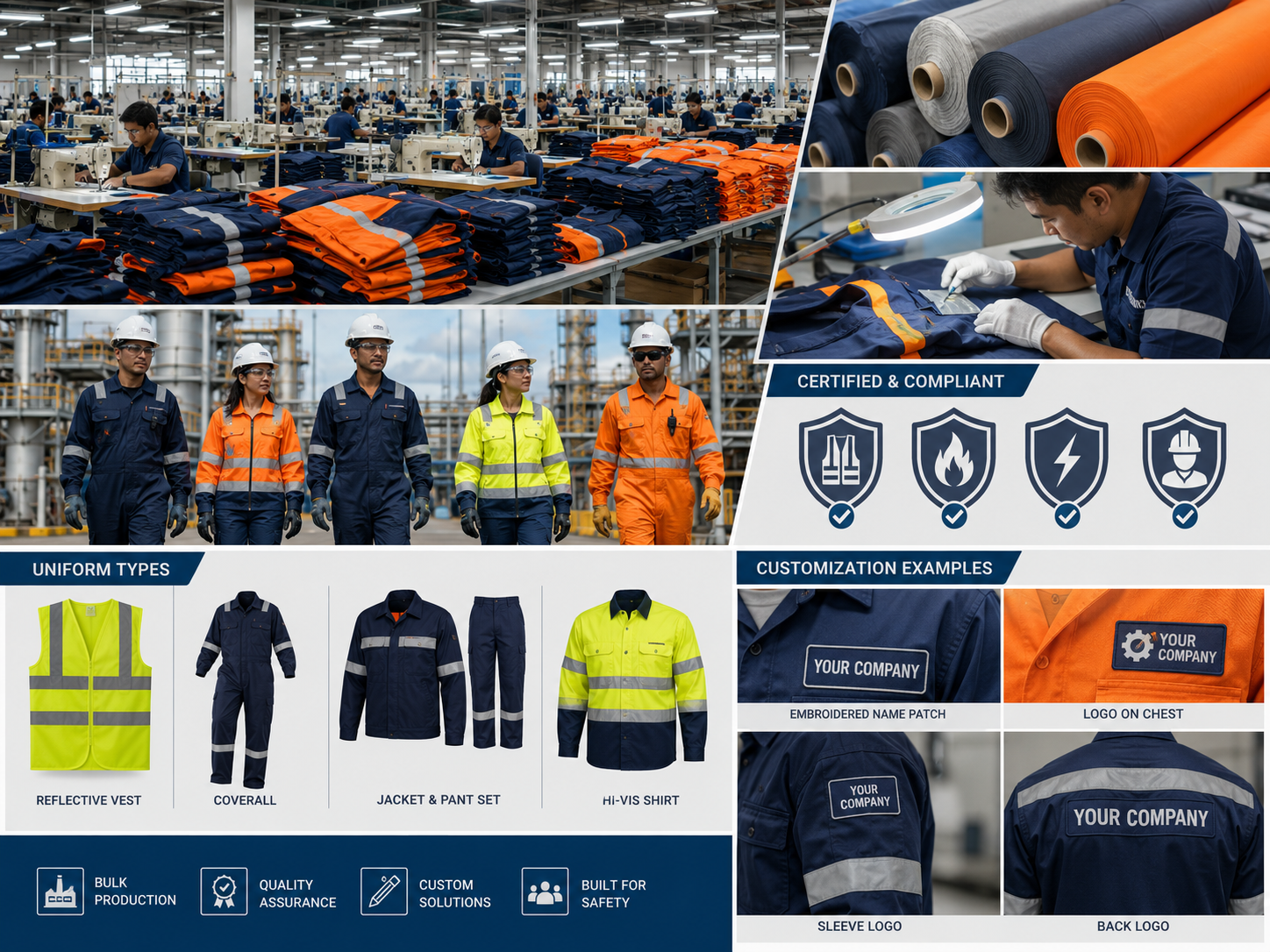
OEM and private-label manufacturing is available for buyers who need branded HSE uniforms, multi-site delivery programs, or compliance documentation formatted for specific export markets. Customization, including logo embroidery, department color coding, and modified garment specifications is handled in-house.
Conclusion
The contracts that run into trouble six months in almost never have a product problem at their center. The garment existed. The certification was real. What failed was something about the product: a specification that did not go deep enough into the FR construction method, laundry instructions that were communicated at kickoff and never confirmed again, and a batch consistency question that received a confident verbal answer without any written process behind it.
Procurement timelines push toward moving quickly through supplier evaluation. The questions that get dropped under that pressure are rarely the obvious ones. They are the specific, slightly awkward ones about what happens on the fourth production run, what the laundry operator was told about prohibited additives, and whether the retroreflective durability data covers more than the garment’s first day out of the box.
Those questions are easier to ask before the contract is signed than they are to answer after the program is already running.
FAQs
What should be included in an HSE uniform program?
A program needs garment specifications for each role category in the workforce; the compliance standard each garment type must meet; replacement criteria based on wear and laundry frequency rather than calendar time alone; laundering requirements specific to each garment type, documented in writing; and logistics covering initial supply and ongoing replenishment. The supplier relationship should be structured around program management throughout the contract period, rather than a sequence of separate purchase orders that each start from scratch.
How do I choose a reliable bulk uniform supplier?
Start by confirming in-house manufacturing capability. A supplier routing your order to a third-party factory loses direct control over the production quality covered by their own certifications. Then verify that certifications are current, product-level, and backed by actual test certificates rather than product page listings. Request samples and test them under your site conditions. Ask specifically about batch QC controls, not general quality commitments, and confirm audit access before placing volume orders.
Can HSE uniforms be customized with our branding?
Yes. Logo embroidery, printed branding, department color coding, modified pocket layouts, and reflective tape configurations are standard from established manufacturers. Confirm that customization is handled in-house rather than subcontracted, and request samples with the customization applied before approving the specification for a full production run.
What certifications should I check before bulk ordering?
ISO 9001:2015 for the quality management system. ISO 13688:2013 for general protective clothing requirements. CE marking for European and UK markets. Product-specific certifications depend on the garment type: EN 11612 or NFPA 2112 for FR garments; EN ISO 20471 or ANSI/ISEA 107 for high-visibility garments. Request actual test certificates with test dates, standard editions, and measured results rather than certification name lists.
What is the typical lead time for bulk uniform orders?
Straightforward bulk orders from manufacturers with in-house production and available capacity typically run four to eight weeks. Programs involving customization, multiple garment types, and multi-site delivery logistics take longer. Get a production start date and a delivery date confirmed separately as two distinct commitments, and confirm the escalation process if production falls behind schedule.
How is fabric quality tested before a large order ships?
Pre-shipment inspection at the manufacturer’s facility before goods leave is the standard for well-managed programs. Testing covers shrinkage, colorfastness, and tensile strength at seams. For FR garments, the wash durability of the protective treatment is a separate test from the general fabric spec and should be confirmed alongside it. Pre-shipment inspection is when defects can be addressed before they affect your site delivery schedule.
What is the difference between FR uniforms and standard HSE uniforms?
Standard HSE uniforms need durability, correct sizing, colorfastness under industrial laundering, and a fit appropriate for the physical demands of the role. FR uniforms carry an additional requirement that the fabric resists ignition and self-extinguishes when the heat source is removed, tested and certified to EN 11612, NFPA 2112, or both, depending on the hazard and the market. FR garments also carry laundering restrictions around bleach and fabric softener that standard workwear does not. In environments with flash fire, arc flash, or sustained flame exposure, FR-rated garments are a regulatory requirement, not an upgrade.
Are HSE uniforms washable in industrial laundries?
Industrial workwear is designed for industrial laundering, but the care label temperature rating needs to match what your laundry facility actually runs at. For FR garments, the laundry team needs a specific written document listing prohibited additives, including chlorine bleach and fabric softeners, not just a copy of the standard care label. Confirm the laundry team has received and understood those requirements before the program goes live.