There’s a reason most procurement guides skip straight to the checklist. Evaluating a PPE supplier for a 50-unit order is genuinely simple. You pick a product, check the cert, and place the order. Done.
Do that same process for 2,000 units across three sites on a project timeline, and the checklist misses half of what actually matters. The supplier who looks fine on paper-certified, responsive, good catalog- can still fall apart when the volume goes up, the schedule tightens, and batch three of five looks nothing like batch one. That is where most bulk procurement decisions quietly go wrong, and where the cost of a bad supplier choice stops being a headache and starts affecting worker safety.
This guide is for safety managers and procurement teams who are past the basics. It covers what to look at before committing to a large-scale PPE order and why some of the most common evaluation shortcuts are the most expensive.
What bulk PPE purchasing actually involves
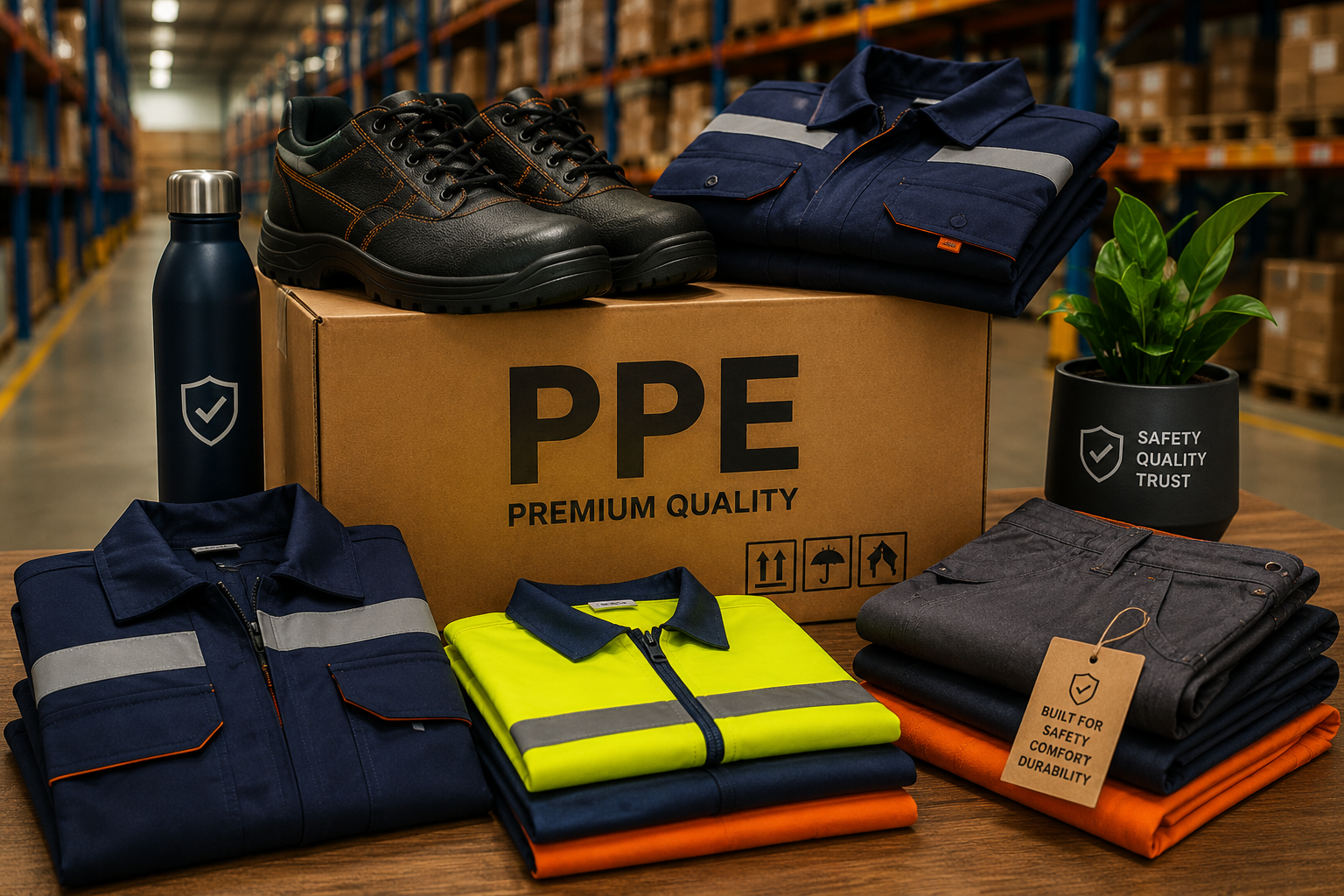
Walk into any large industrial procurement conversation, and two categories come up before anything else: protective clothing and footwear. FR coveralls, high-visibility garments, anti-static workwear, safety boots, these are what organizations buy in the thousands, not the dozens. Gloves and hard hats show up in bulk orders too, but clothing and footwear are where the volume, the compliance complexity, and the supplier risk tend to concentrate, so that’s what this guide focuses on.
“Bulk” also means something different depending on who’s asking. A mid-size construction firm might call 250 units per SKU a large order. A multinational energy company running PPE programs across 20 sites in three countries has a completely different frame of reference. Both are dealing with bulk procurement challenges. The evaluation criteria just aren’t the same.
Some teams call 200 units per SKU a bulk order. Others are managing annual contracts covering tens of thousands of garments shipped to a dozen sites across multiple countries. Both are bulk. But the way you evaluate a supplier for 300 coveralls and the way you evaluate one for 8,000 are genuinely different, and treating them the same is one of the more consistent and costly mistakes safety teams make.
Why your supplier choice matters more than most buyers expect
The International Labor Organization puts the number at over 2.3 million workers killed from work-related accidents and diseases every year, with inadequate or non-compliant PPE cited as a contributing factor in a significant share of preventable incidents.
Bad PPE kills people. That sounds blunt, but it’s the honest version of the compliance conversation.
When an FR garment loses its fire-resistant treatment after 8 washes and you have 20 of them in circulation, you have a problem. When you have 2,000 of them distributed across a site where workers are near live equipment or flash-fire hazards, the scale of that problem changes completely. The quality failure is the same either way. What changes is the number of people exposed to it.
There’s also a timeline reality that comes with large orders. A quality problem on a 50-unit purchase slows you down. The same problem on a 2,000-unit order tied to a construction mobilization date can push an entire project back, trigger compliance audits you weren’t expecting, and create situations where workers show up on day one without the gear they legally need. The upfront evaluation feels like extra work until you’ve been through one of those situations. After that, it never feels optional again.
Key factors to check before placing a bulk PPE order
Manufacturing capacity and lead time
The first question worth asking any PPE supplier, before anything else, is whether they actually make the product themselves.
More distributors route orders through third-party factories than openly admit to it. You usually find out when something goes wrong, and the distributor has no real visibility into why, because they don’t control the production floor. By then, you’re negotiating a fix through a middleman who can’t make the decisions that matter, while your project clock is running. Knowing whether the facility that makes your garments has the physical capacity to produce your order volume, on your timeline, without pulling resources from someone else’s contract, is not a detail. It’s the thing the rest of the relationship is built on.
Push for specifics. Monthly production output, current lead times for comparable order sizes, and what happens if production runs behind schedule. Manufacturers running their own facilities give you those answers with actual numbers. Distributors tend to give you ranges and reassurances.
Fabric and material quality
Two coveralls from two different manufacturers can look identical on a product sheet and perform completely differently after six months in the field. GSM weight, fiber composition, weave type, and how the fabric handles industrial laundering all determine whether a garment is still doing its job at the end of a contract period or is just technically present on the worker’s body.
Before placing a bulk order, ask for the fabric specification sheet, test reports covering shrinkage, colorfastness, and tensile strength, and, for FR clothing specifically, both the treatment method and the rated wash-cycle count.
That last point is worth understanding in greater depth than most procurement documents explain. Inherent FR fabrics are constructed so that the fire-resistant property lives inside the fiber itself. It does not wash out because it was never applied to the surface. Treated FR fabrics, by contrast, have fire resistance added as a coating or chemical finish after the fabric is made. That finish degrades with washing. Past the rated cycle count, the garment may still look like PPE, feel like PPE, and pass a visual inspection. What it no longer provides is meaningful protection against flame exposure. For any program running in high-heat or flash-fire environments, the difference between inherent and treated FR is not a technical footnote. It’s a liability question with a very specific answer.
Certifications to verify
Certifications matter, and they’re also routinely misunderstood, so it’s worth separating what each one actually covers.
ISO 9001 certifies that a quality management system is in place. There are documented processes for identifying defects before products ship. What it does not do is certify that any specific product meets any specific performance standard.
ISO 13688:2013 covers the general requirements. Ergonomics, sizing, aging characteristics, labeling, and the technical information manufacturers are required to supply with the product.
CE marking confirms the product has been assessed against applicable EU safety directives. Relevant for UK and European market compliance.
Product-specific standards sit on top of these. FR clothing in oil and gas typically needs EN 11612 or NFPA 2112. High-visibility garments need EN ISO 20471 or ANSI/ISEA 107 for North American markets. Ask for the actual test certificates for whichever standards apply to your environment. A product datasheet that lists certification logos and a set of verified test certificates is not an interchangeable document.
OEM and customization capability
Most large industrial buyers need more than an off-the-shelf garment. Company logos, department color-coding, modified pocket placement, specific reflective tape configurations, and custom closures aren’t optional extras in a lot of procurement programs. They’re how you identify workers by role, meet internal branding requirements, and satisfy site-specific safety rules.
Whether that customization happens inside the manufacturer’s facility or is handed off to an outside embroidery or printing shop matters because of what happens when something goes wrong. If the logo placement is off on 400 jackets and the fix needs to go through a subcontractor the manufacturer doesn’t directly control, you’re waiting. If it’s handled in-house, a competent manufacturer corrects it and moves on.
For organizations sourcing across different countries, it’s also worth asking whether the manufacturer offers OEM production. Some can manufacture entirely under your brand, with your label, your certifications in your name, and documentation formatted to meet the import requirements of each market you’re supplying. That capability removes a significant logistics burden from multi-country procurement programs.
Factory audit and transparency
Ask any reputable manufacturer if they offer factory audit access, and the answer should be yes without hesitation.
What an audit actually gives you is the ability to verify capacity claims in person, walk the production floor, see how quality-control checkpoints are structured, understand what gets subcontracted and what stays in-house, and verify that working conditions and environmental practices align with your organization’s vendor standards. If a site visit isn’t feasible, current third-party audit reports from Bureau Veritas, SGS, or Intertek give you a documented alternative. Ask whether those reports exist and whether the supplier will share them.
Reluctance to provide access or vague answers about what an audit would involve are useful indicators of the supplier, regardless of what their catalog says.
PPE procurement checklist for safety managers
Use this before finalizing any bulk PPE supplier:
| Area | What to check |
| Manufacturing | In-house or outsourced? Production capacity for your volume? |
| Fabric | GSM, composition, test reports (shrinkage, tensile, colorfastness)? |
| FR clothing | Treatment type? Wash-cycle rating? Standard compliance (EN 11612 / NFPA 2112)? |
| Certifications | ISO 9001? ISO 13688? CE marking? Product-specific standards? |
| Samples | Full-size run samples before bulk order? Pre-shipment inspection? |
| Customization | In-house logo application? Department color-coding? |
| Compliance docs | Test certificates? Material safety data? Country-specific documentation? |
| Multi-site delivery | Can they ship to multiple locations? Who manages logistics? |
| Lead time | Confirmed production start and delivery date? Re-order buffer? |
| Communication | Dedicated account contact? Clear escalation process? |
Common mistakes in bulk PPE procurement
Skipping physical samples.
A spec sheet and a product photo tell you what a garment looks like on day one in a controlled environment. They tell you nothing about seam integrity after 30 industrial wash cycles, how the fabric handles exposure to the chemicals or conditions on your specific site, or whether the sizing runs true across the full range you need. Request samples in your most common sizes before committing to a volume order. Put them through your facility’s actual laundry process. Look at what the collar and cuffs look like after ten cycles. This is not extra due diligence. It’s the minimum a serious procurement process requires. A supplier who makes getting samples complicated is showing you, very early, what the post-order relationship will look like when something needs fixing.
Treating ISO 9001 as a product certification.
This mistake shows up constantly, and it’s understandable because ISO 9001 sounds like it covers everything. It does not. ISO 9001 certification verifies the facility’s quality management system. The factory has documented processes. That’s it. A manufacturer can hold ISO 9001 and still ship garments that fail to meet EN 11612 or ANSI/ISEA 107 because those are product-level certifications that apply to the garment itself. You need both the facility certification and the product-level test certificates, and you need to see the actual documents, not a salesperson confirming they exist.
Ignoring what happens between batches.
A quality problem in batch one of a five-batch order is visible early enough to address. A quality problem that only appears in batch three, when your site already has 600 units from the first two batches in use, is a supplier systems failure that creates a much more complicated situation. Ask specifically how quality is controlled across production runs, not just how the first order is managed.
Skipping documentation review under time pressure. Missing test certificates or incorrect compliance declarations can stop a customs clearance or sink a site audit at the worst possible moment. This is not where you save time.
Pre-shipment inspection is the one that gets cut most often when schedules tighten, and it’s the most expensive cut to make.
Managing multi-site PPE supply
Energy companies, large construction groups, and manufacturers operating across multiple regions often manage PPE programs that span dozens of sites under a single procurement function. Central purchasing with site-level delivery is how it typically works. It is also where supplier capability gaps become very apparent, very quickly.
A supplier that handles a single-location 2,000-unit order well may have no infrastructure to split shipments to 14 different site addresses, maintain consistent stock across SKUs mid-contract, or manage emergency reorders from individual sites without disrupting the delivery schedule for everyone else. Before assuming a manufacturer can handle the complexity, confirm it directly. Who is the single point of contact for the account? What is the process when one site needs something urgently between scheduled deliveries? How is stock availability managed across the full contract period, not just at the point of initial order?
A supplier that has done multi-site supply before knows exactly what you’re asking and answers without hesitation. One that hasn’t tends to treat each question as a new problem.
Why manufacturing quality matters
Armstrong Products has manufactured industrial workwear and PPE since 2009. The manufacturing facility is in Boisar, Maharashtra. The corporate office is in Powai, Mumbai.
The facility holds ISO 9001:2015 certification for its quality management system and ISO 13688:2013 certification for protective clothing, with CE marking across the garment range.
Clients include ONGC, L&T, JSW Steel, Adani, Halliburton, and Weatherford, organizations that run formal vendor audits with detailed requirements and don’t maintain supplier relationships that hold up to scrutiny. Supplying them across multiple contract cycles requires documented QC processes that pass audit review, production capacity to handle large orders on industrial timelines, and batch-to-batch consistency that doesn’t require the buyer to inspect every shipment to feel confident in what they’re receiving.
Armstrong also supports OEM and private-label manufacturing for buyers who need branded garments or country-specific compliance documentation built into the supply chain from the start.
Conclusion
Most bad bulk PPE decisions aren’t made during the order. They’re made in the two weeks before it, when the schedule is tight, and the supplier sounds confident, and the sample looks fine, so the deeper questions don’t get asked.
The suppliers who cause the most problems mid-contract rarely advertise that upfront. They have certifications. They have a catalog. They respond quickly to emails. What they don’t have is the production capacity, the documented QC systems, or the multi-site logistics experience to hold up once the volume gets real. You find that out when you’re six weeks into a project and batch three looks wrong.
Asking the harder questions before the order doesn’t slow things down as much as people think. It just moves the friction to a point in the process where you can actually do something about it.
FAQs
1. What certifications should a bulk PPE supplier have?
ISO 9001:2015 and ISO 13688:2013 are the starting point. On top of those, you need product-specific certifications tied to the actual hazard. FR clothing for oil and gas should meet EN 11612 or NFPA 2112. High-visibility garments should comply with EN ISO 20471 or ANSI/ISEA 107, depending on your market. Ask for the test certificates, not just confirmation that they exist.
2. How do I know a supplier can handle a large order?
Ask for their monthly production capacity and references from clients who placed comparable order volumes. A manufacturer running their own facility gives you real output numbers. One routing order through third parties usually doesn’t have that clarity. Willingness to offer audit access without hesitation is the clearest signal that a supplier is confident in what you’d find if you showed up.
3. What documentation should I request before placing a bulk order?
Test certificates for each product type, ISO certification documents, compliance declarations for your specific market, fabric specification sheets, and material safety data. For import orders, make sure they can provide the commercial invoice, packing list, and any country-specific compliance paperwork required by your customs process. Get this before the order is placed, not after the shipment is in transit.
4. Can PPE be customized with company branding?
Yes. Logo embroidery, printed branding, department color-coding, and design modifications are standard offerings from most established manufacturers. The question worth pushing on is whether customization happens in-house or gets subcontracted. In-house means fewer handoffs, tighter quality control, and faster correction if something is wrong on a large run.
5. How is quality controlled across a large production run?
Ask whether the manufacturer runs in-process quality checks during production or only inspects finished goods before shipment. Ask what their defect tolerance threshold is before a batch gets rejected, and whether they issue a quality report with each delivery. A manufacturer holding ISO 9001 has documented answers to all of these. Push for specifics rather than general reassurances about their commitment to quality.
6. How often should industrial PPE be replaced?
FR garments need inspection after every wash and replacement when the protective treatment shows signs of degradation or the garment has structural damage. High-visibility clothing loses retroreflective performance over time and should be replaced once it drops below the rated standard, which fading makes harder to assess visually. For most industrial workwear, annual replacement cycles are typical, though roles involving high physical wear or frequent chemical exposure often need more frequent turnover. The manufacturer’s guidance and the relevant product standard should both inform the schedule.
7. What is the practical difference between a PPE manufacturer and a distributor for bulk orders?
A manufacturer controls the production process, the quality checkpoints, and the sources of materials. A distributor buys from manufacturers and resells. For large-volume orders, buying directly from the manufacturer gives you real visibility into how things are made, actual flexibility in customization, and a direct line to whoever can fix things when something goes wrong. Distributors are practical for smaller or more varied orders where pulling everything from a single factory doesn’t make sense logistically.