
In industrial environments, safety isn’t just about helmets and gloves it extends to full-body protection, where the choice between coveralls and two-piece workwear can directly impact worker safety, compliance, and operational risk.
Whether you’re managing a construction site, manufacturing unit, or chemical facility, selecting the right protective clothing is not a routine procurement decision it’s a critical safety investment.
A poor choice in workwear can lead to:
- Increased exposure to hazardous materials
- Workplace injuries and long-term health risks
- Non-compliance with industrial safety standards
- Higher liability and insurance costs
As a leading industrial workwear supplier, Armstrong Products helps businesses choose between coveralls and two-piece uniforms based on real-world risk conditions not assumptions.
This guide breaks down the complete safety comparison, industry use cases, and expert insights to help you make the right decision.
Why Choosing the Right Industrial Workwear Matters More Than Ever
The demand for industrial safety clothing and PPE in India is rising rapidly due to stricter compliance norms and increased workplace safety awareness.
Today, businesses are expected to align with:
- Factory safety regulations
- Industry-specific compliance standards
- Worker welfare expectations
Choosing the wrong workwear doesn’t just affect comfort—it can result in:
- Chemical exposure incidents
- Fire-related injuries
- Productivity loss due to discomfort or fatigue
- Legal penalties for non-compliance
This is why working with trusted safety workwear manufacturers in India is essential for long-term operational safety.
What Are Coveralls?
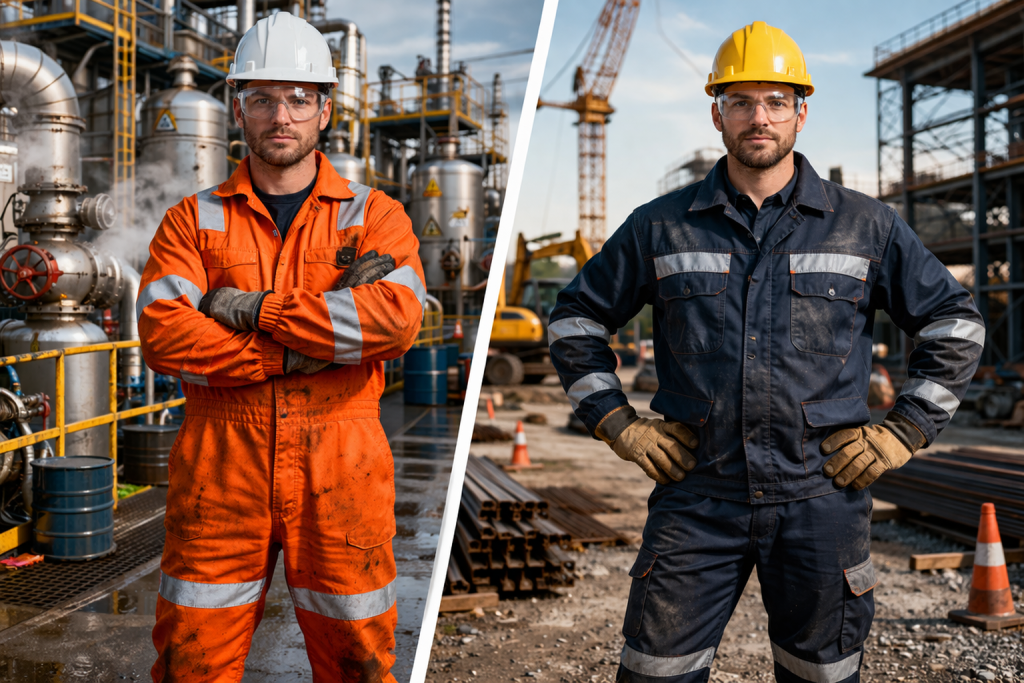
Coveralls, also known as boiler suits, are one-piece protective garments designed to provide complete body coverage in hazardous environments.
Key Features of Coveralls:
- Full-body protection (no gaps between upper and lower body)
- High resistance to chemicals, sparks, dust, and contaminants
- Secure closures (zippers, buttons, elastic cuffs)
- Available in flame-resistant and chemical-resistant materials
Where Coveralls Are Commonly Used:
- Oil & Gas industries
- Chemical processing plants
- Heavy manufacturing units
- Welding and fabrication environments
As trusted coverall manufacturers in India, Armstrong Products designs coveralls that prioritize maximum protection and durability under extreme conditions.
What Is Two-Piece Workwear?
Two-piece workwear consists of separate garments, typically a shirt or jacket paired with trousers.
Key Features of Two-Piece Workwear:
- Better airflow and ventilation
- Greater flexibility and ease of movement
- Convenient to wear, remove, and replace
- Suitable for long working hours
Common Applications:
- Construction sites
- Warehousing operations
- Maintenance and repair work
- Light industrial environments
Two-piece uniforms are widely used where comfort and mobility are critical factors.
Key Safety Comparison: Coveralls vs Two-Piece Workwear
| Feature | Coveralls | Two-Piece Workwear |
| Body Coverage | Full | Partial |
| Exposure Risk | Minimal | Higher (gaps possible) |
| Chemical Protection | High | Moderate |
| Fire Resistance | Better (sealed design) | Lower |
| Comfort | Moderate | High |
| Convenience | Less | More |
Which Is Safer? A Practical, Risk-Based Answer
There is no universal answer—the safer option depends entirely on the hazard level of your work environment.
When Coveralls Are the Safer Choice
Coveralls are the preferred option in high-risk industrial environments, such as:
- Chemical handling and processing
- Welding and high-temperature operations
- Dust-heavy or contaminated zones
- Oil & gas facilities
Why?
Because coveralls provide continuous, sealed protection, eliminating exposure gaps between garments and significantly reducing the risk of injury.
When Two-Piece Workwear Is the Safer Choice
Two-piece workwear is more suitable for low to medium-risk environments, especially when:
- Workers are exposed to high temperatures (heat stress risk)
- Tasks require frequent movement and flexibility
- Long working hours demand better ventilation and comfort
In such cases, improved comfort can reduce fatigue, which is a major cause of workplace accidents.
Industry-Wise Workwear Recommendations
Construction Industry
- Recommended: Two-piece workwear
- Reason: Mobility and flexibility are essential
Oil & Gas Industry
- Recommended: Coveralls
- Reason: Fire resistance and full-body protection are critical
Manufacturing Industry
- Recommended: Depends on risk level
- Low risk → Two-piece
- High risk → Coveralls
Chemical Industry
- Recommended: Coveralls (Mandatory)
- Reason: Protection from hazardous chemicals
Compliance and Safety Standards You Cannot Ignore
Industrial workwear must meet strict safety and compliance requirements.
Key Standards to Look For:
- Flame-resistant (FR) materials
- Chemical-resistant fabrics
- High-visibility clothing for hazardous zones
- Durable stitching and tear resistance
Working with reliable workwear manufacturers in India ensures:
- Compliance with safety regulations
- Reduced workplace injuries
- Long-term durability and cost efficiency
Quality PPE clothing in India is not an expense—it’s a risk management strategy.
Why Armstrong Products Is a Trusted Industrial Workwear Supplier
Armstrong Products has established itself as a leading industrial workwear supplier and safety workwear manufacturer in India, delivering high-quality, compliant, and durable protective clothing for various industries.
What Sets Armstrong Products Apart:
- Wide product range:
- Coveralls
- Two-piece uniforms
- Complete PPE solutions
- Customization options for large workforces
- High-performance, safety-compliant materials
- Competitive bulk pricing for B2B buyers
- Reliable supply for large-scale industrial operations
Whether you need bulk coveralls or customized work uniforms, Armstrong Products ensures consistent quality and timely delivery.
The Future of Industrial Workwear
The industrial safety landscape is evolving rapidly, and workwear is no exception.
Key Trends to Watch:
- Smart PPE with sensors and tracking
- Sustainable and eco-friendly fabrics
- Customized and branded workwear
- Improved ergonomic designs for worker comfort
Forward-thinking businesses are already upgrading their protective workwear strategies to align with these trends.
Conclusion: Safety Depends on the Right Choice
Choosing between coveralls and two-piece workwear is not about preference—it’s about risk assessment.
- Coveralls offer maximum protection and are ideal for high-risk environments
- Two-piece workwear provides flexibility and comfort for lower-risk tasks
Final Takeaway:
If your workplace involves high-risk exposure, coveralls are the safer and more reliable choice.
Partnering with an experienced industrial workwear supplier ensures you get the right solution tailored to your operational needs.
FAQs
Q1. Which is safer: coveralls or two-piece workwear?
Coveralls are safer in high-risk environments due to full-body protection, while two-piece workwear is suitable for low-risk conditions where comfort is important.
Q2. Are coveralls mandatory in industrial jobs?
Yes, in industries like oil & gas and chemical processing, coveralls are often mandatory due to safety regulations.
Q3. What fabric is best for safety workwear?
Flame-resistant, chemical-resistant, and durable fabrics are ideal for industrial safety clothing.
Q4. How to choose the right workwear supplier in India?
Choose suppliers with strong certifications, product range, customization options, and proven experience in industrial safety.